Loading page, please wait…
Vaidra Logo
Vaidra

Top 4 items + smart groups

UPSC GPT
New
Current Affairs
Daily Solutions
Daily Puzzle
Mains Evaluator

Version 2.0.0 • Built with ❤️ for UPSC aspirants

Loading...
Loading...
Loading...
Loading...
Loading...
Loading...
Loading...
Loading...
Loading...
Loading...
Loading...
Loading...
Loading...
Back
All Subjects

Topics

0 topics • 0 completed

Loading topics...
Loading...
Loading...
Loading...
Loading...
Loading...
Overall Progress0%

Ordinary Private Members in the P.V Narasimha Rao and Related Cases - UPSC Polity And Governance

What is Ordinary Private Members in the P.V Narasimha Rao and Related Cases in UPSC Polity And Governance?

Ordinary Private Members in the P.V Narasimha Rao and Related Cases is a key topic under Polity And Governance for UPSC Civil Services Examination. Key points include: The Supreme Court's 2024 ruling overturned the 1998 P.V. Narasimha Rao verdict.. Bribery by MPs/MLAs is no longer protected by parliamentary privileges (Articles 105 & 194).. Accepting a bribe is a criminal act under Section 7 of the Prevention of Corruption Act.. Understanding this topic is essential for both UPSC Prelims and Mains preparation.

Why is Ordinary Private Members in the P.V Narasimha Rao and Related Cases important for UPSC exam?

Ordinary Private Members in the P.V Narasimha Rao and Related Cases is a Medium-level topic in UPSC Polity And Governance. It is tested in both Prelims (factual MCQs) and Mains (analytical answer writing). Previous year UPSC questions have frequently covered aspects of Ordinary Private Members in the P.V Narasimha Rao and Related Cases, making it essential for comprehensive IAS preparation.

How to prepare Ordinary Private Members in the P.V Narasimha Rao and Related Cases for UPSC?

To prepare Ordinary Private Members in the P.V Narasimha Rao and Related Cases for UPSC: (1) Study the comprehensive notes covering all key concepts on Vaidra. (2) Practice previous year questions on this topic. (3) Connect it with current affairs using daily updates. (4) Revise using key takeaways and mind maps available for Polity And Governance. (5) Write practice answers linking Ordinary Private Members in the P.V Narasimha Rao and Related Cases to related GS Paper topics.

Key takeaways of Ordinary Private Members in the P.V Narasimha Rao and Related Cases for UPSC

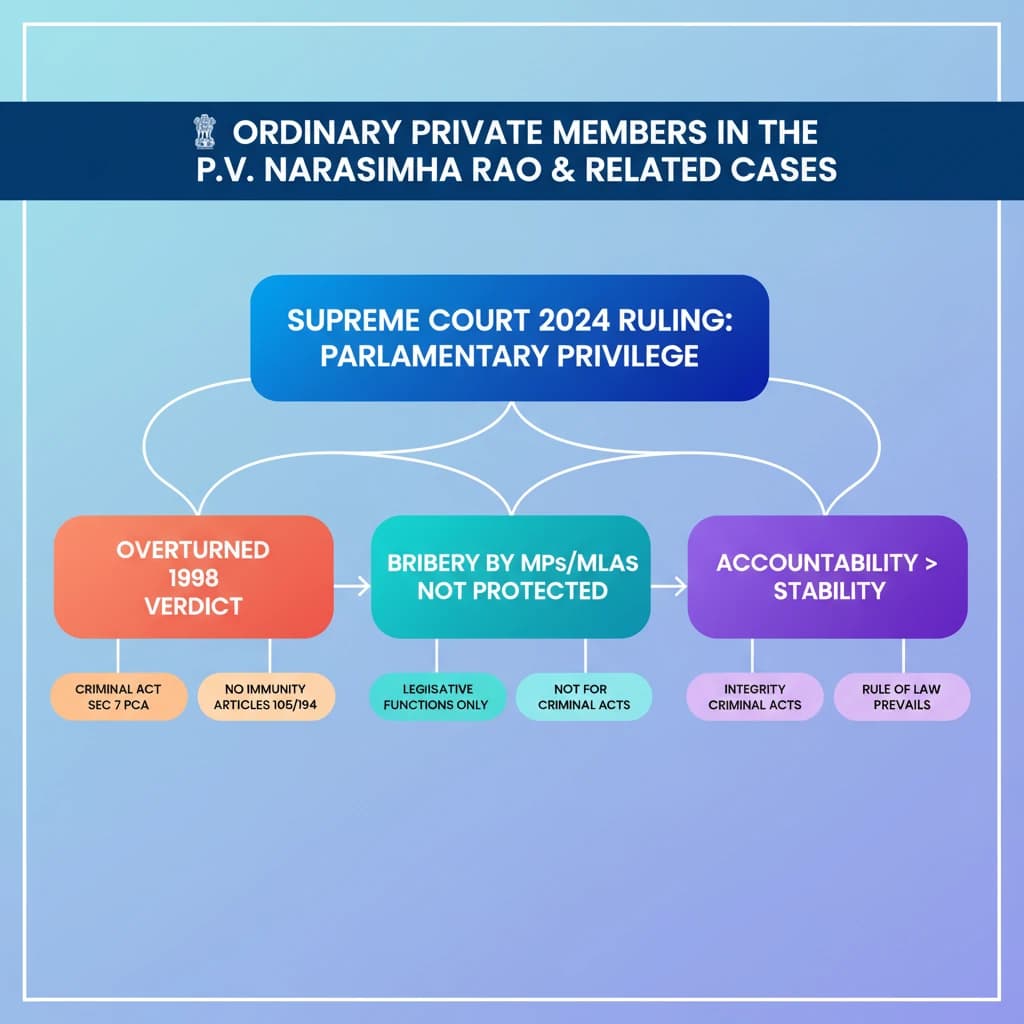
  • The Supreme Court's 2024 ruling overturned the 1998 P.V. Narasimha Rao verdict.
  • Bribery by MPs/MLAs is no longer protected by parliamentary privileges (Articles 105 & 194).
  • Accepting a bribe is a criminal act under Section 7 of the Prevention of Corruption Act.
  • The 2024 decision prioritizes accountability and integrity over legislative stability alone.
  • Parliamentary privileges protect legislative functions, not criminal acts like bribery.
Ordinary Private Members in the P.V Narasimha Rao and Related Cases

Ordinary Private Members in the P.V Narasimha Rao and Related Cases

Medium⏱️ 10 min read✓ 98% Verified
polity and governance

📖 Introduction

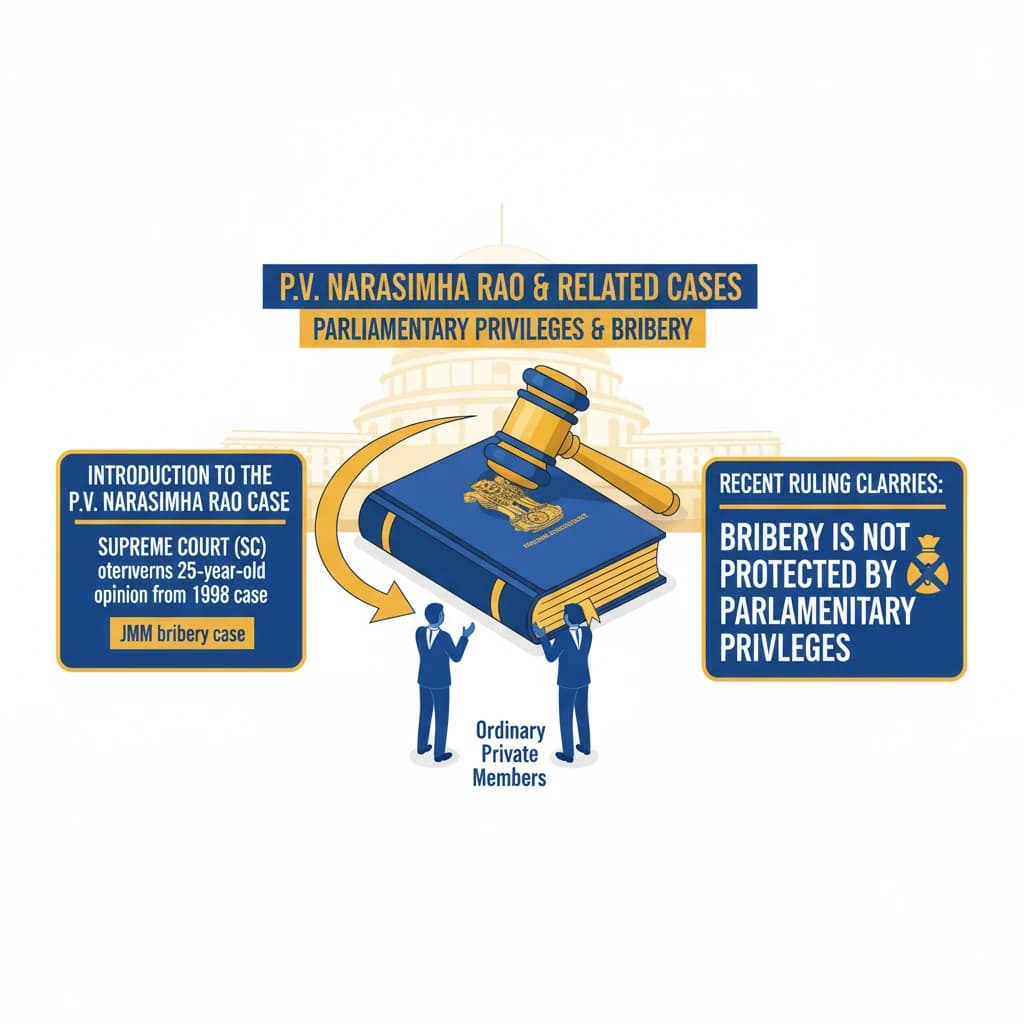
<h4>Introduction to the P.V. Narasimha Rao Case</h4><p>The <strong>Supreme Court (SC)</strong> recently delivered a landmark judgment, overturning a <strong>25-year-old majority opinion</strong> from the <strong>P.V. Narasimha Rao v. State (CBI/Spe) Case, 1998</strong>. This case, also known as the <strong>JMM bribery case</strong>, dealt with parliamentary privileges concerning bribery.</p><p>The recent ruling clarifies that <strong>bribery is not protected by parliamentary privileges</strong>. This decision marks a significant shift in the interpretation of legislative immunity in India.</p><h4>The 1998 P.V. Narasimha Rao Case: Background and Ruling</h4><p>The <strong>1993 P.V. Narasimha Rao case</strong> involved serious allegations of corruption. Several <strong>Members of Parliament (MPs)</strong> from the <strong>Jharkhand Mukti Morcha (JMM)</strong> were accused of accepting bribes.</p><p>These bribes were allegedly taken in exchange for voting against a <strong>no-confidence motion</strong> in the Lok Sabha. The case raised profound concerns about the integrity of India's legislative processes and the accountability of elected representatives.</p><div class='info-box'><p><strong>Case Specifics (1998)</strong></p><ul><li><strong>Accused:</strong> Certain JMM MPs.</li><li><strong>Allegation:</strong> Accepting bribes to vote against a <strong>no-confidence motion</strong>.</li><li><strong>Key Issue:</strong> Whether parliamentary privilege protected lawmakers from prosecution for bribery.</li></ul></div><p>The <strong>Supreme Court's 1998 ruling</strong> established a controversial precedent. It granted immunity to <strong>MPs</strong> and <strong>Members of Legislative Assembly (MLAs)</strong> from criminal prosecution in bribery cases.</p><p>This immunity applied specifically if the lawmakers fulfilled their part of the agreement, i.e., casting their vote or speaking in the House as promised after taking the bribe.</p><div class='key-point-box'><p><strong>1998 Ruling's Core Point:</strong> The bribe-takers who cast their vote against the <strong>no-confidence motion</strong> were deemed immune from criminal prosecution under <strong>Parliamentary Privilege (Article 105(2))</strong>.</p></div><p>The 1998 decision prioritized the <strong>stability of governance</strong> and the smooth functioning of parliamentary democracy. It suggested that prosecuting lawmakers for bribery could potentially disrupt governmental stability.</p><h4>The 2024 Supreme Court Ruling: A Paradigm Shift</h4><p>A <strong>7-Judge Constitution Bench</strong> of the Supreme Court recently overturned the earlier <strong>5-Judge Bench verdict</strong> of the <strong>P.V. Narasimha Rao v. State Case, 1998</strong>.</p><p>This new ruling directly contradicts the previous stance that <strong>MPs</strong> and <strong>MLAs</strong> enjoyed immunity if they cast a vote in the House after taking bribes.</p><div class='info-box'><p><strong>Key Aspects of the 2024 Ruling</strong></p><ul><li><strong>Bench:</strong> 7-Judge Constitution Bench.</li><li><strong>Outcome:</strong> Overturned the 1998 verdict.</li><li><strong>Central Tenet:</strong> Bribery is a criminal act and not covered by parliamentary privilege.</li></ul></div><p>The <strong>Supreme Court</strong> strongly emphasized the <strong>detrimental impact of bribery</strong> on democratic principles and the overall governance structure of the nation.</p><p>The court clarified that <strong>accepting a bribe is a separate criminal act</strong>. It is distinct and unrelated to the core duties of lawmakers within the Parliament or legislative assembly.</p><div class='key-point-box'><p><strong>Legal Basis for Bribery Prosecution:</strong> <strong>Section 7 of the Prevention of Corruption Act</strong> specifically deals with 'offence relating to public servants being bribed'.</p></div><p>Therefore, the immunity provided under <strong>Articles 105</strong> (for MPs) and <strong>194</strong> (for MLAs) of the Constitution <strong>does not extend to cases of bribery</strong>. This is a crucial distinction made by the court.</p><div class='exam-tip-box'><p>This decision signifies a major shift towards prioritizing <strong>accountability</strong> and <strong>integrity in governance</strong> over stability alone. It aims to uphold the ideals of a <strong>responsible, responsive, and representative democracy</strong> in India, a key topic for <strong>GS Paper II (Polity & Governance)</strong>.</p></div><h4>Understanding Parliamentary Privileges</h4><p><strong>Parliamentary privileges</strong> are special rights, immunities, and exemptions. They are enjoyed by the members of the Parliament and their committees to ensure their effective functioning.</p><p>These privileges are explicitly defined in <strong>Article 105 of the Indian Constitution</strong> for Members of Parliament. <strong>Article 194</strong> guarantees the same privileges to the <strong>Members of Legislative Assemblies</strong> of states.</p><div class='info-box'><p><strong>Scope of Privileges</strong></p><ul><li>Members are exempted from <strong>civil liability</strong> for any statement made or act done in the course of their duties.</li><li>Crucially, these privileges <strong>do not extend to criminal liability</strong>, a point reinforced by the 2024 SC ruling.</li></ul></div><p>The Indian Parliament has not enacted a comprehensive law to exhaustively codify all these privileges. Instead, they are derived from multiple sources, ensuring flexibility and evolution.</p><ul><li><strong>Constitutional provisions:</strong> Primarily <strong>Articles 105 and 194</strong>.</li><li><strong>Various laws made by Parliament:</strong> Specific statutes related to parliamentary functioning.</li><li><strong>Rules of both the Houses:</strong> Procedural rules established by Lok Sabha and Rajya Sabha.</li><li><strong>Conventions:</strong> Unwritten practices and precedents.</li><li><strong>Judicial interpretations:</strong> Rulings by courts, such as the recent 2024 verdict.</li></ul>
Concept Diagram

💡 Key Takeaways

  • •The Supreme Court's 2024 ruling overturned the 1998 P.V. Narasimha Rao verdict.
  • •Bribery by MPs/MLAs is no longer protected by parliamentary privileges (Articles 105 & 194).
  • •Accepting a bribe is a criminal act under Section 7 of the Prevention of Corruption Act.
  • •The 2024 decision prioritizes accountability and integrity over legislative stability alone.
  • •Parliamentary privileges protect legislative functions, not criminal acts like bribery.

🧠 Memory Techniques

Memory Aid
98% Verified Content

📚 Reference Sources

•Supreme Court of India judgment: P.V. Narasimha Rao v. State (CBI/Spe), 1998
•Supreme Court of India judgment: Sita Soren v. Union of India, 2024
•The Constitution of India (Articles 105, 194)
•The Prevention of Corruption Act, 1988 (Section 7)

Related Topics

Loading related topics...
Explore:Polity And Governance Topics·All Subjects·Daily Current Affairs·Editorial Analysis·Previous Year Questions·UPSC GPT
Ordinary Private Members in the P.V Narasimha Rao and Related Cases - UPSC Polity And Governance