Loading page, please wait…
Vaidra Logo
Vaidra

Top 4 items + smart groups

UPSC GPT
New
Current Affairs
Daily Solutions
Daily Puzzle
Mains Evaluator

Version 2.0.0 • Built with ❤️ for UPSC aspirants

Loading...
Loading...
Loading...
Loading...
Loading...
Loading...
Loading...
Loading...
Loading...
Loading...
Loading...
Loading...
Loading...
Curative Petition - UPSC Polity And Governance
Back
All Subjects

Topics

0 topics • 0 completed

Loading topics...
Loading...
Loading...
Loading...
Loading...
Loading...
Overall Progress0%

Curative Petition - UPSC Polity And Governance

What is Curative Petition in UPSC Polity And Governance?

Curative Petition is a key topic under Polity And Governance for UPSC Civil Services Examination. Key points include: Curative Petition is the last judicial remedy in India, after a Review Petition is dismissed.. It was evolved by the Supreme Court in the 2002 Rupa Ashok Hurra case.. Based on inherent powers under Article 137 and Article 142 of the Constitution.. Understanding this topic is essential for both UPSC Prelims and Mains preparation.

Why is Curative Petition important for UPSC exam?

Curative Petition is a Medium-level topic in UPSC Polity And Governance. It is tested in both Prelims (factual MCQs) and Mains (analytical answer writing). Previous year UPSC questions have frequently covered aspects of Curative Petition, making it essential for comprehensive IAS preparation.

How to prepare Curative Petition for UPSC?

To prepare Curative Petition for UPSC: (1) Study the comprehensive notes covering all key concepts on Vaidra. (2) Practice previous year questions on this topic. (3) Connect it with current affairs using daily updates. (4) Revise using key takeaways and mind maps available for Polity And Governance. (5) Write practice answers linking Curative Petition to related GS Paper topics.

Key takeaways of Curative Petition for UPSC

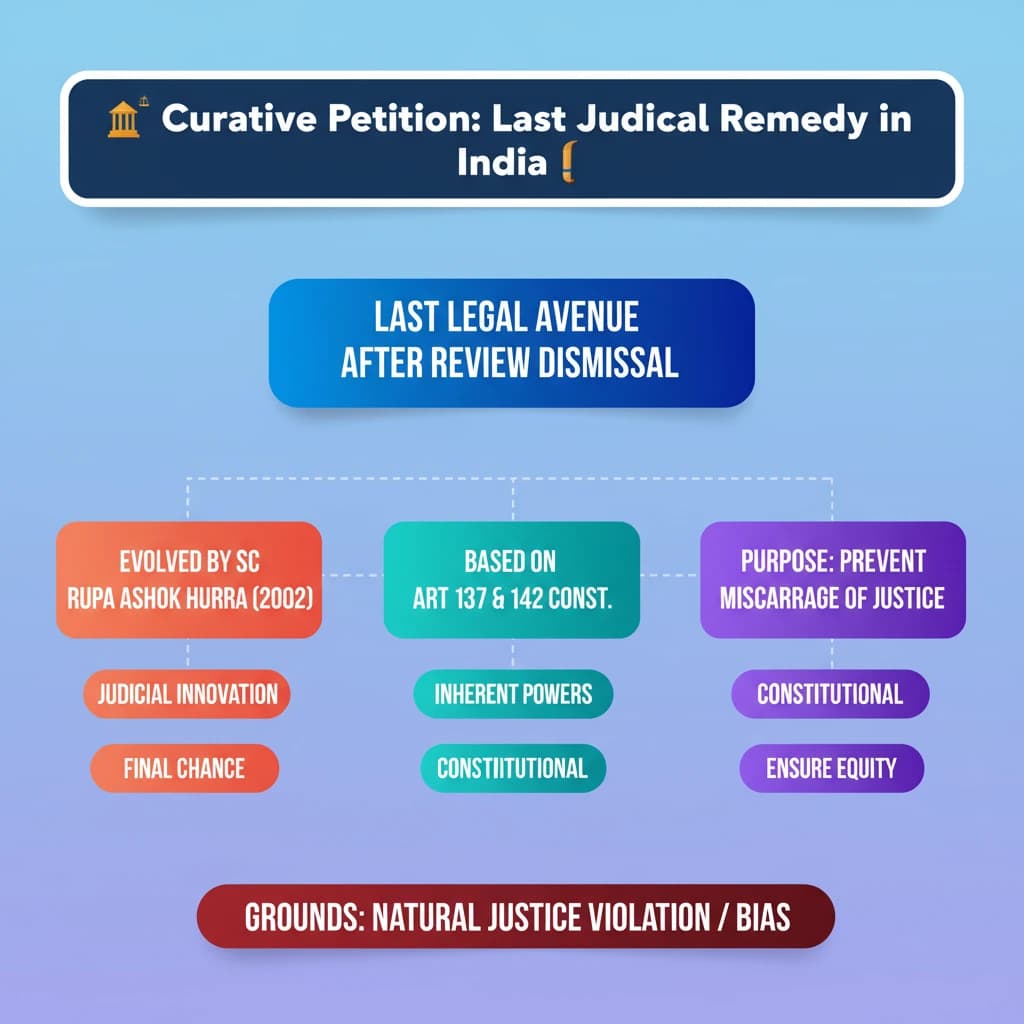
  • Curative Petition is the last judicial remedy in India, after a Review Petition is dismissed.
  • It was evolved by the Supreme Court in the 2002 Rupa Ashok Hurra case.
  • Based on inherent powers under Article 137 and Article 142 of the Constitution.
  • Purpose is to prevent miscarriage of justice and abuse of court process.
  • Grounds are extremely narrow: violation of natural justice or apprehension of bias.
  • Recent SC action (overturning 2021 judgment) highlights its extraordinary nature.
Curative Petition

Curative Petition

Medium⏱️ 7 min read✓ 98% Verified
polity and governance

📖 Introduction

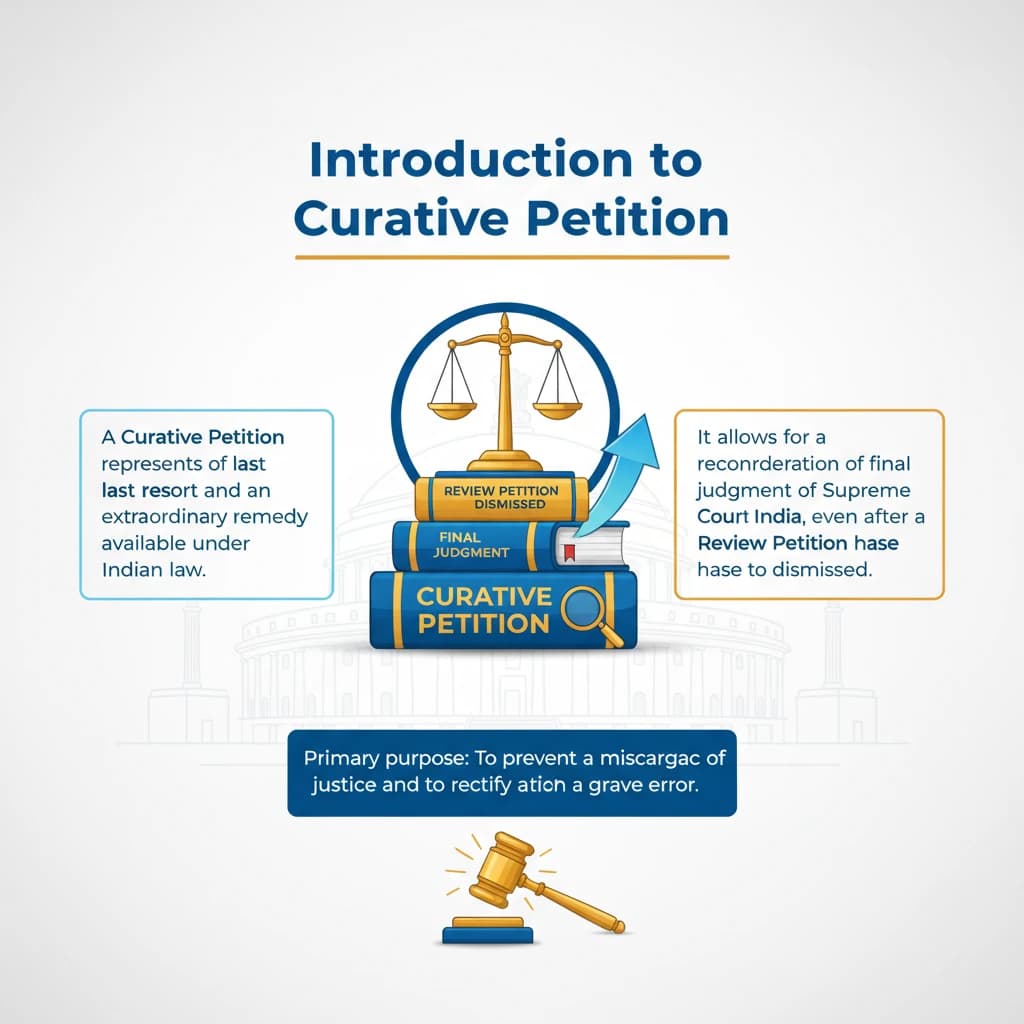
<h4>Introduction to Curative Petition</h4><p>A <strong>Curative Petition</strong> represents the <strong>last resort</strong> and an extraordinary legal remedy available under Indian law. It allows for a reconsideration of a final judgment of the <strong>Supreme Court of India</strong>, even after a <strong>Review Petition</strong> has been dismissed.</p><p>Its primary purpose is to prevent a <strong>miscarriage of justice</strong> and to rectify a grave error that might have occurred in the earlier judgments. This power underscores the Supreme Court's commitment to ensuring justice.</p><h4>Why in News?</h4><p>The <strong>Supreme Court of India</strong> recently exercised its <strong>extraordinary powers</strong> by admitting and acting upon a <strong>curative petition</strong>. This significant move led to the overturning of its own previous judgment from <strong>2021</strong>.</p><div class='exam-tip-box'><p><strong>UPSC Insight:</strong> The recent event highlights the practical application and the immense power vested in the Supreme Court through the <strong>Curative Petition</strong>. Understanding its scope and limitations is crucial for both Prelims and Mains, especially in <strong>GS Paper II (Polity)</strong>.</p></div><h4>Nature and Scope</h4><p>The <strong>Curative Petition</strong> is not a regular appeal. It is an exceptional remedy, invoked only in rare circumstances where a fundamental error or injustice is apparent, and all other remedies have been exhausted.</p><p>It emphasizes the principle that no person should suffer due to an error of the court, even if that error was made by the highest court in the land.</p><div class='key-point-box'><p><strong>Key Point:</strong> The concept of <strong>Curative Petition</strong> evolved to ensure the absolute finality of justice, not just the finality of litigation. It acts as a safeguard against judicial errors that might lead to a gross injustice.</p></div>
Concept Diagram

💡 Key Takeaways

  • •Curative Petition is the last judicial remedy in India, after a Review Petition is dismissed.
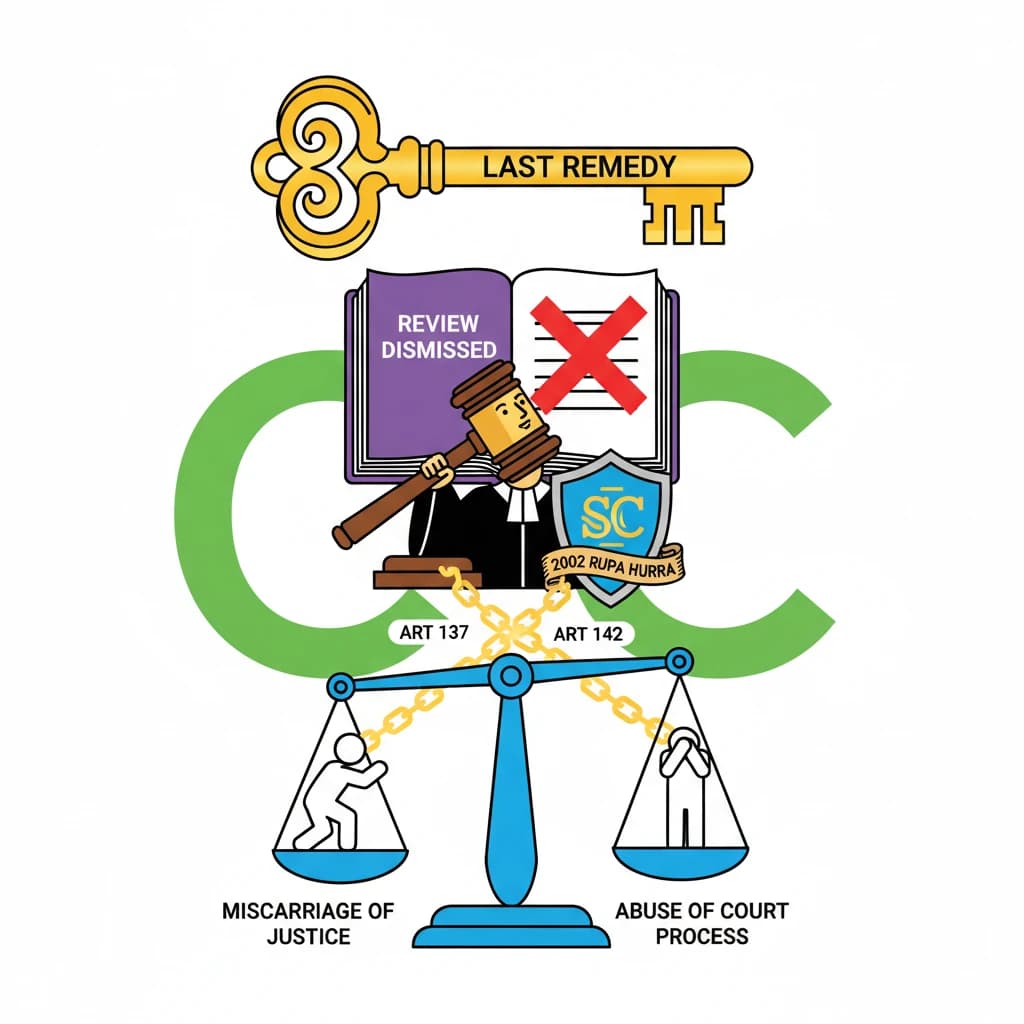
  • •It was evolved by the Supreme Court in the 2002 Rupa Ashok Hurra case.
  • •Based on inherent powers under Article 137 and Article 142 of the Constitution.
  • •Purpose is to prevent miscarriage of justice and abuse of court process.
  • •Grounds are extremely narrow: violation of natural justice or apprehension of bias.
  • •Recent SC action (overturning 2021 judgment) highlights its extraordinary nature.

🧠 Memory Techniques
Memory Aid
98% Verified Content

📚 Reference Sources

•The Constitution of India (Articles 137, 142)
•Supreme Court of India judgment: Rupa Ashok Hurra v. Ashok Hurra and Anr. (2002)
•Standard Indian Polity textbooks (e.g., M. Laxmikanth)

Related Topics

Loading related topics...
Explore:Polity And Governance Topics·All Subjects·Daily Current Affairs·Editorial Analysis·Previous Year Questions·UPSC GPT