Loading page, please wait…
Vaidra Logo
Vaidra

Top 4 items + smart groups

UPSC GPT
New
Current Affairs
Daily Solutions
Daily Puzzle
Mains Evaluator

Version 2.0.0 • Built with ❤️ for UPSC aspirants

Loading...
Loading...
Loading...
Loading...
Loading...
Loading...
Loading...
Loading...
Loading...
Loading...
Loading...
Loading...
Loading...
Back
All Subjects

Topics

0 topics • 0 completed

Loading topics...
Loading...
Loading...
Loading...
Loading...
Loading...
Overall Progress0%

SC Prioritising SLPs Disposal - UPSC Polity And Governance

What is SC Prioritising SLPs Disposal in UPSC Polity And Governance?

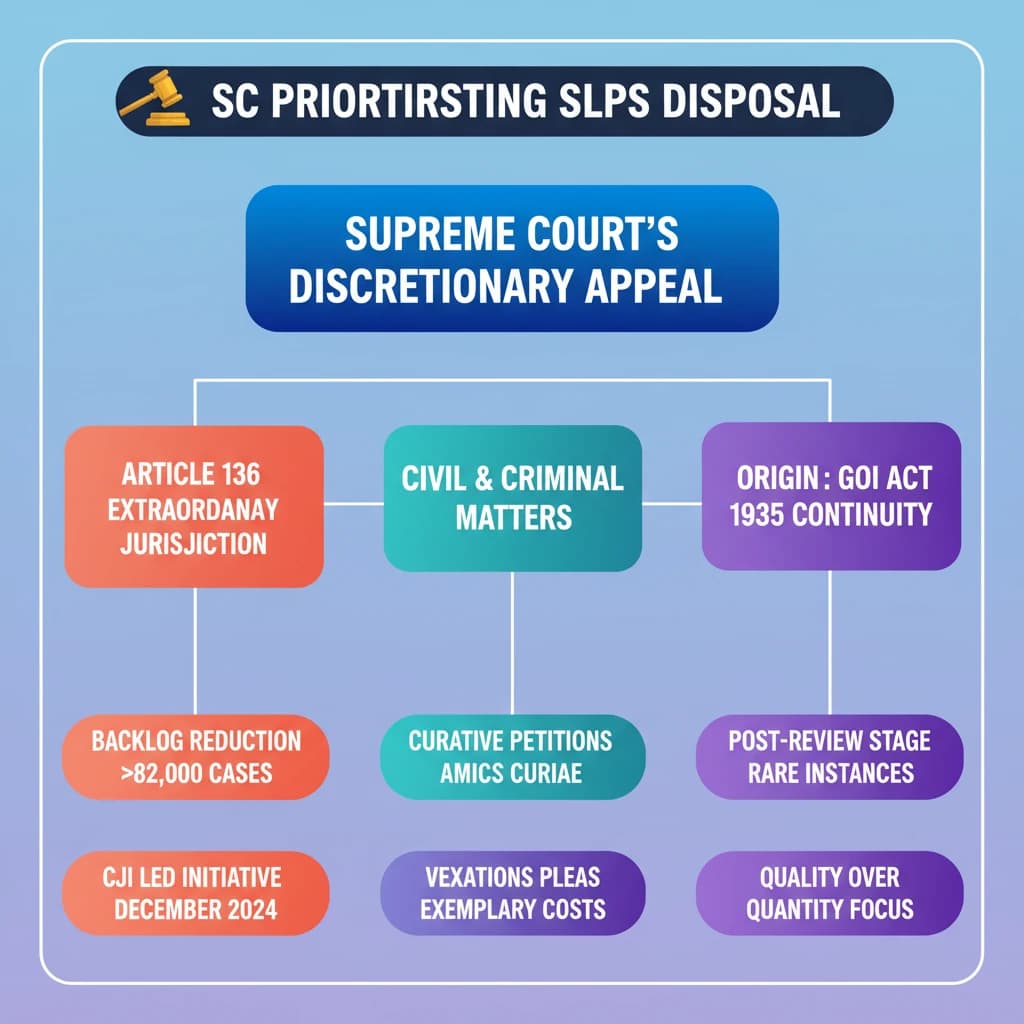
SC Prioritising SLPs Disposal is a key topic under Polity And Governance for UPSC Civil Services Examination. Key points include: SLP is a discretionary appeal mechanism under Article 136, allowing SC to hear appeals from any court/tribunal (except Armed Forces).. It is an extraordinary jurisdiction, granted solely at SC's discretion, for both civil and criminal matters.. Originates from the Government of India Act, 1935, reflecting historical continuity.. Understanding this topic is essential for both UPSC Prelims and Mains preparation.

Why is SC Prioritising SLPs Disposal important for UPSC exam?

SC Prioritising SLPs Disposal is a Medium-level topic in UPSC Polity And Governance. It is tested in both Prelims (factual MCQs) and Mains (analytical answer writing). Previous year UPSC questions have frequently covered aspects of SC Prioritising SLPs Disposal, making it essential for comprehensive IAS preparation.

How to prepare SC Prioritising SLPs Disposal for UPSC?

To prepare SC Prioritising SLPs Disposal for UPSC: (1) Study the comprehensive notes covering all key concepts on Vaidra. (2) Practice previous year questions on this topic. (3) Connect it with current affairs using daily updates. (4) Revise using key takeaways and mind maps available for Polity And Governance. (5) Write practice answers linking SC Prioritising SLPs Disposal to related GS Paper topics.

Key takeaways of SC Prioritising SLPs Disposal for UPSC

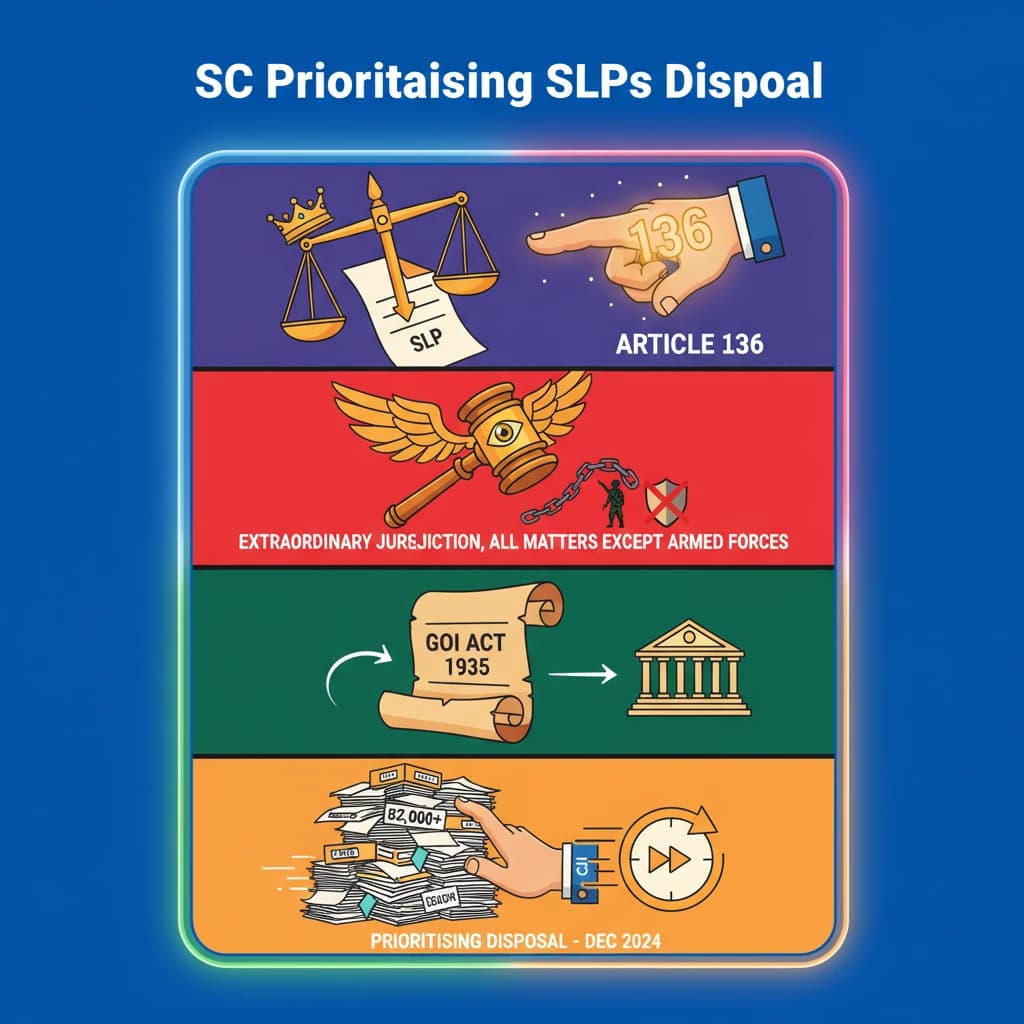
  • SLP is a discretionary appeal mechanism under Article 136, allowing SC to hear appeals from any court/tribunal (except Armed Forces).
  • It is an extraordinary jurisdiction, granted solely at SC's discretion, for both civil and criminal matters.
  • Originates from the Government of India Act, 1935, reflecting historical continuity.
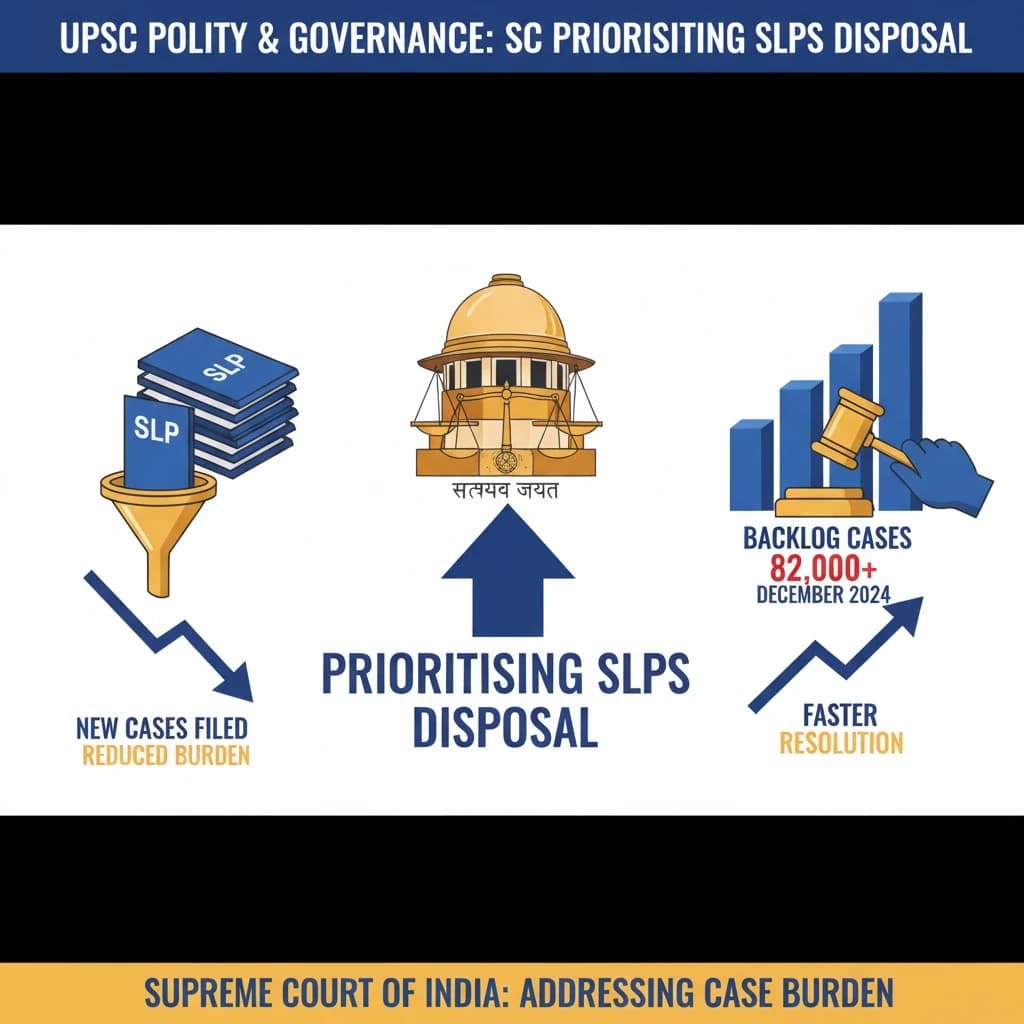
  • SC is prioritising SLP disposal to reduce a backlog of over 82,000 cases (Dec 2024), led by the CJI.
  • Curative petitions (post-review) involve Amicus Curiae, potential exemplary costs for vexatious pleas, and are emphasised as rare by the SC.
SC Prioritising SLPs Disposal

SC Prioritising SLPs Disposal

Medium⏱️ 6 min read✓ 98% Verified
polity and governance

📖 Introduction

<h4>Context: SC Prioritising SLPs Disposal</h4><p>The <strong>Supreme Court (SC)</strong> has initiated a strategy to prioritise the hearing of <strong>Special Leave Petitions (SLPs)</strong>. This move aims to significantly reduce the substantial burden of new cases filed annually, alongside addressing the existing backlog.</p><p>As of <strong>December 2024</strong>, the <strong>Supreme Court</strong> faces a backlog of over <strong>82,000 cases</strong>. This pressing situation has prompted the <strong>Chief Justice of India (CJI)</strong> to implement proactive measures like this prioritisation.</p><div class='exam-tip-box'><p><strong>UPSC Insight:</strong> This initiative reflects the judiciary's efforts towards judicial reforms and efficiency, a crucial topic for <strong>GS Paper II (Polity and Governance)</strong>. Understanding the reasons for backlog and proposed solutions is key.</p></div><h4>What is a Special Leave Petition (SLP)?</h4><p>A <strong>Special Leave Petition (SLP)</strong> is a unique and <strong>discretionary appeal mechanism</strong> provided under <strong>Article 136</strong> of the <strong>Constitution of India</strong>. It allows the <strong>Supreme Court</strong> to grant special leave to appeal against any judgment, decree, determination, sentence, or order passed by any court or tribunal in India.</p><div class='info-box'><p><strong>Key Fact:</strong> <strong>SLPs</strong> are <strong>not applicable</strong> to judgments or orders passed by <strong>Armed Forces Tribunals</strong>.</p></div><h4>Origin of Special Leave</h4><p>The concept of <strong>“special leave”</strong> has historical roots, tracing back to the <strong>Government of India Act, 1935</strong>. This Act recognised the prerogative of the highest court to grant special leave for appeals, a principle later enshrined in the Indian Constitution.</p><h4>Key Features of SLPs</h4><p><strong>SLPs</strong> represent an <strong>extraordinary jurisdiction</strong> of the <strong>Supreme Court</strong>. They are crucial in cases where no direct right to appeal exists, ensuring that justice can still be sought in exceptional circumstances.</p><ul><li>It is granted <strong>solely at the discretion</strong> of the <strong>Supreme Court</strong>. The Court may choose to deny leave without providing specific reasons.</li><li>This mechanism is applicable to a wide range of legal matters, covering both <strong>civil and criminal cases</strong>.</li></ul><div class='key-point-box'><p><strong>Important Concept:</strong> The discretionary nature of <strong>SLPs</strong> underscores the <strong>Supreme Court's</strong> role as the ultimate guardian of the Constitution and justice, allowing it to intervene in matters of significant public importance or grave injustice.</p></div><h4>Related Judicial Review Mechanisms: Curative Petitions</h4><p>While distinct from <strong>SLPs</strong>, <strong>Curative Petitions</strong> represent another layer of judicial review within the <strong>Supreme Court</strong>, typically filed after a review petition has been dismissed. The bench considering a curative petition may take specific actions.</p><h5>Role of Amicus Curiae</h5><p>During the consideration of a <strong>curative petition</strong>, the bench has the discretion to appoint a <strong>senior counsel</strong> to assist as an <strong>amicus curiae</strong> (friend of the court). This ensures comprehensive legal assistance and impartial advice in complex matters.</p><h5>Cost Implications</h5><p>If the bench determines that a <strong>curative petition</strong> lacks merit and is vexatious (filed without sufficient reason and intended to cause annoyance), it holds the power to impose <strong>exemplary costs</strong> on the petitioner. This discourages frivolous litigation.</p><h5>Judicial Discretion in Curative Petitions</h5><p>The <strong>Supreme Court</strong> strongly emphasises that <strong>curative petitions</strong> should be considered <strong>rare</strong> and reviewed with utmost <strong>caution</strong>. This approach is vital to maintain the sanctity and integrity of the overall judicial process, ensuring finality in judgments.</p>
Concept Diagram

💡 Key Takeaways

  • •SLP is a discretionary appeal mechanism under Article 136, allowing SC to hear appeals from any court/tribunal (except Armed Forces).
  • •It is an extraordinary jurisdiction, granted solely at SC's discretion, for both civil and criminal matters.
  • •Originates from the Government of India Act, 1935, reflecting historical continuity.
  • •SC is prioritising SLP disposal to reduce a backlog of over 82,000 cases (Dec 2024), led by the CJI.
  • •Curative petitions (post-review) involve Amicus Curiae, potential exemplary costs for vexatious pleas, and are emphasised as rare by the SC.

🧠 Memory Techniques
Memory Aid
98% Verified Content

📚 Reference Sources

•The Constitution of India (Article 136)
•Government of India Act, 1935

Related Topics

Loading related topics...
Explore:Polity And Governance Topics·All Subjects·Daily Current Affairs·Editorial Analysis·Previous Year Questions·UPSC GPT
SC Prioritising SLPs Disposal - UPSC Polity And Governance