Loading page, please wait…
Centre Scrapped “No Detention Policy” - UPSC Polity And Governance
What is Centre Scrapped “No Detention Policy” in UPSC Polity And Governance?
Centre Scrapped “No Detention Policy” is a key topic under Polity And Governance for UPSC Civil Services Examination. Key points include: Centre scrapped 'No Detention Policy' for Classes 5 and 8 in central schools via 'Right of Children to Free and Compulsory Education (Amendment) Rules, 2024'.. The original policy, under Section 16 of the RTE Act (2009), prohibited detaining or expelling students up to Class 8.. NDP aimed to reduce dropout rates and provide stress-free elementary education.. Understanding this topic is essential for both UPSC Prelims and Mains preparation.
Why is Centre Scrapped “No Detention Policy” important for UPSC exam?
Centre Scrapped “No Detention Policy” is a Medium-level topic in UPSC Polity And Governance. It is tested in both Prelims (factual MCQs) and Mains (analytical answer writing). Previous year UPSC questions have frequently covered aspects of Centre Scrapped “No Detention Policy”, making it essential for comprehensive IAS preparation.
How to prepare Centre Scrapped “No Detention Policy” for UPSC?
To prepare Centre Scrapped “No Detention Policy” for UPSC: (1) Study the comprehensive notes covering all key concepts on Vaidra. (2) Practice previous year questions on this topic. (3) Connect it with current affairs using daily updates. (4) Revise using key takeaways and mind maps available for Polity And Governance. (5) Write practice answers linking Centre Scrapped “No Detention Policy” to related GS Paper topics.
Key takeaways of Centre Scrapped “No Detention Policy” for UPSC
- Centre scrapped 'No Detention Policy' for Classes 5 and 8 in central schools via 'Right of Children to Free and Compulsory Education (Amendment) Rules, 2024'.
- The original policy, under Section 16 of the RTE Act (2009), prohibited detaining or expelling students up to Class 8.
- NDP aimed to reduce dropout rates and provide stress-free elementary education.
- Scrapping allows schools to detain students who fail to meet promotion criteria after re-examination.
- The move seeks to address concerns about declining learning outcomes and enhance accountability.
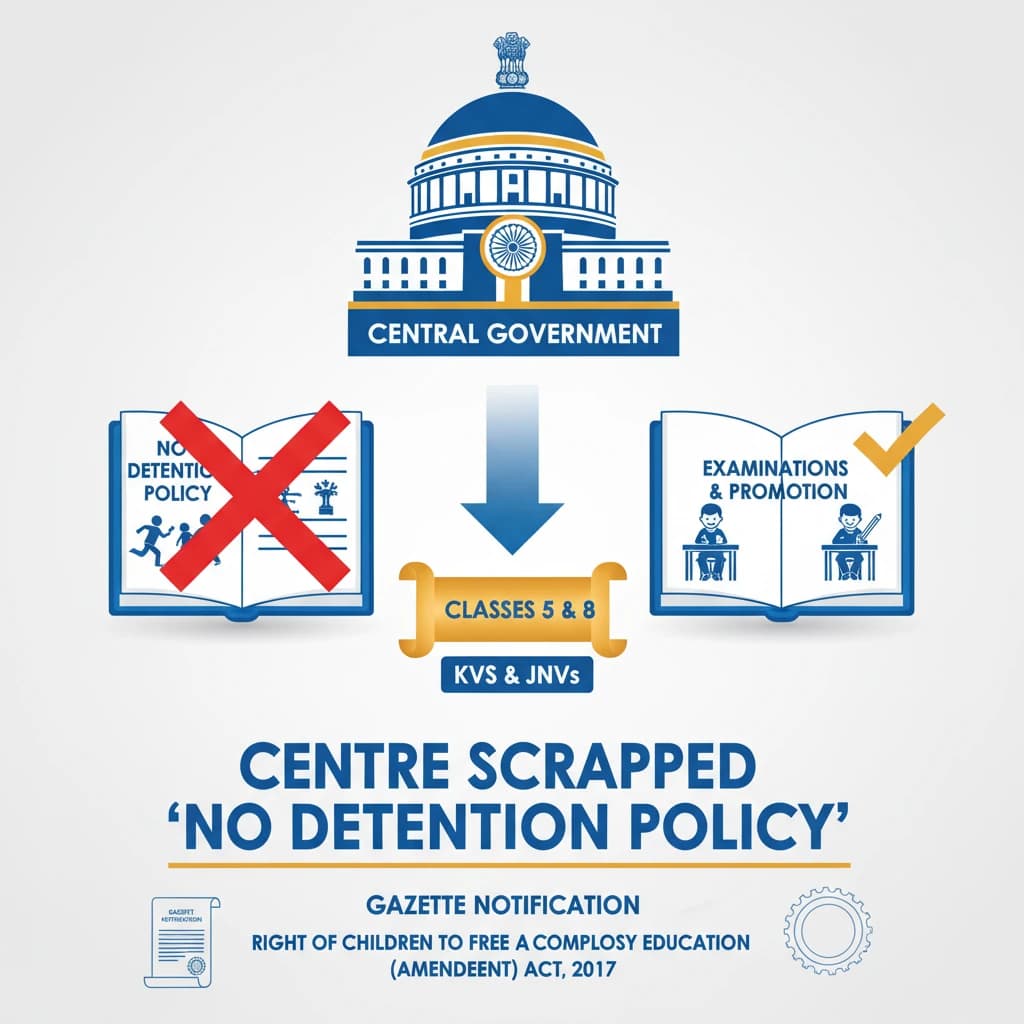
Centre Scrapped “No Detention Policy”
Medium⏱️ 7 min read
polity and governance
📖 Introduction
Introduction to the Scrapping of No Detention Policy
The Central Government recently announced the scrapping of the “no-detention policy” for students in Classes 5 and 8. This significant change applies to schools under its direct governance, including Kendriya Vidyalayas and Jawahar Navodaya Vidyalayas.
This decision was formalized through a gazette notification titled “Right of Children to Free and Compulsory Education (Amendment) Rules, 2024”. The amendment empowers schools to detain students who do not meet the specified promotion criteria.
Key Change: Schools can now hold back students in Classes 5 and 8 if they fail examinations, marking a departure from the previous policy.
Understanding the No Detention Policy (NDP)
The No Detention Policy (NDP) was a crucial component introduced under Section 16 of the Right to Education Act (RTE), 2009. Its primary aim was to ensure that children received elementary education without the fear of failure.
The policy sought to reduce dropout rates and promote a stress-free learning environment for students up to Class 8. It focused on continuous and comprehensive evaluation rather than annual exams.
Core Objective of NDP: To ensure universal elementary education by preventing expulsion and retention, thereby fostering an inclusive learning atmosphere.
Provisions of Section 16 of the RTE Act
Section 16 of the Right to Education Act (RTE) originally stipulated two fundamental provisions concerning elementary education:
- No Expulsion: No child receiving elementary education shall be expelled from school for any reason.
- No Retention: No child shall be retained or held back in any class up to Class 8, regardless of their academic performance.
These provisions collectively formed the basis of the no-detention policy, aiming to guarantee every child's right to complete elementary schooling.
UPSC Insight: Questions on education policy reforms, child rights, and the RTE Act are common in GS Paper II (Polity & Governance) and GS Paper I (Social Issues). Understanding the rationale behind both the original policy and its scrapping is vital.
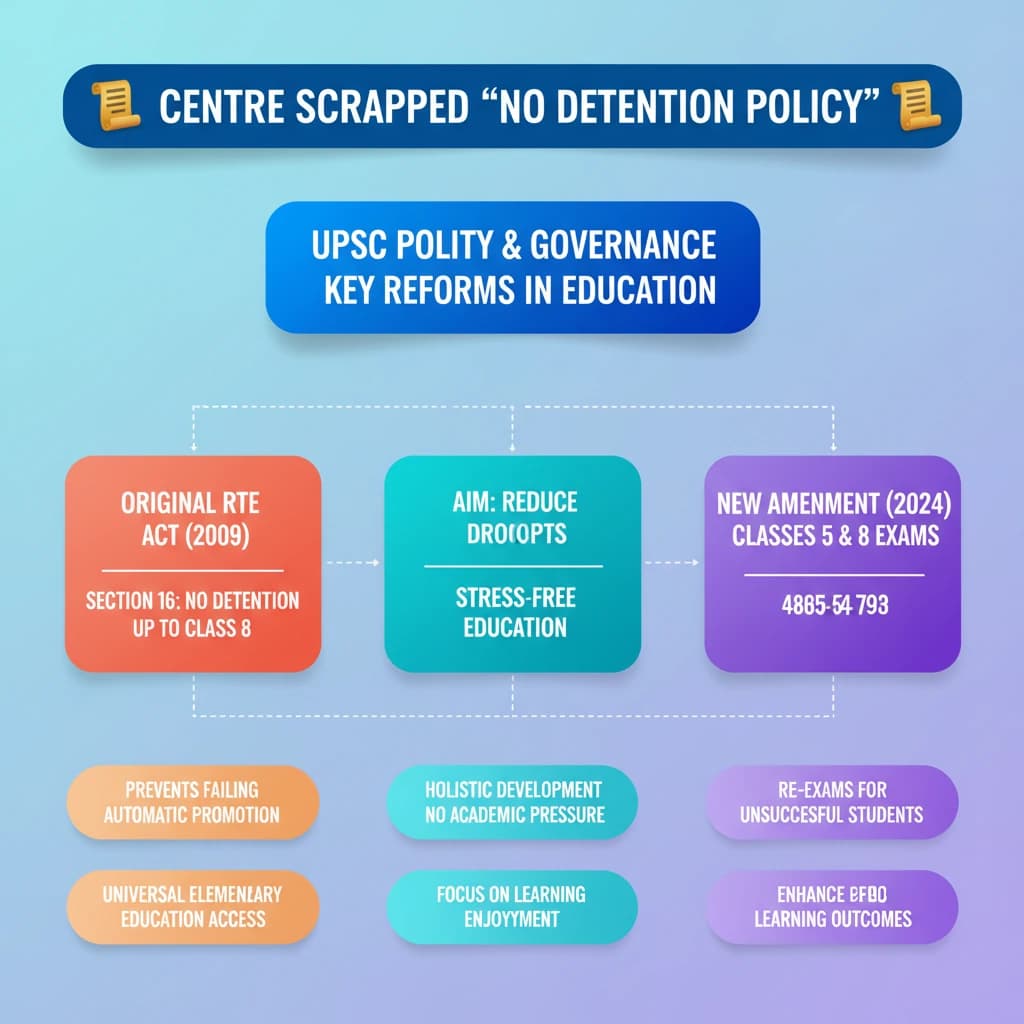
💡 Key Takeaways
- •Centre scrapped 'No Detention Policy' for Classes 5 and 8 in central schools via 'Right of Children to Free and Compulsory Education (Amendment) Rules, 2024'.
- •The original policy, under Section 16 of the RTE Act (2009), prohibited detaining or expelling students up to Class 8.
- •NDP aimed to reduce dropout rates and provide stress-free elementary education.
- •Scrapping allows schools to detain students who fail to meet promotion criteria after re-examination.
- •The move seeks to address concerns about declining learning outcomes and enhance accountability.
🧠 Memory Techniques
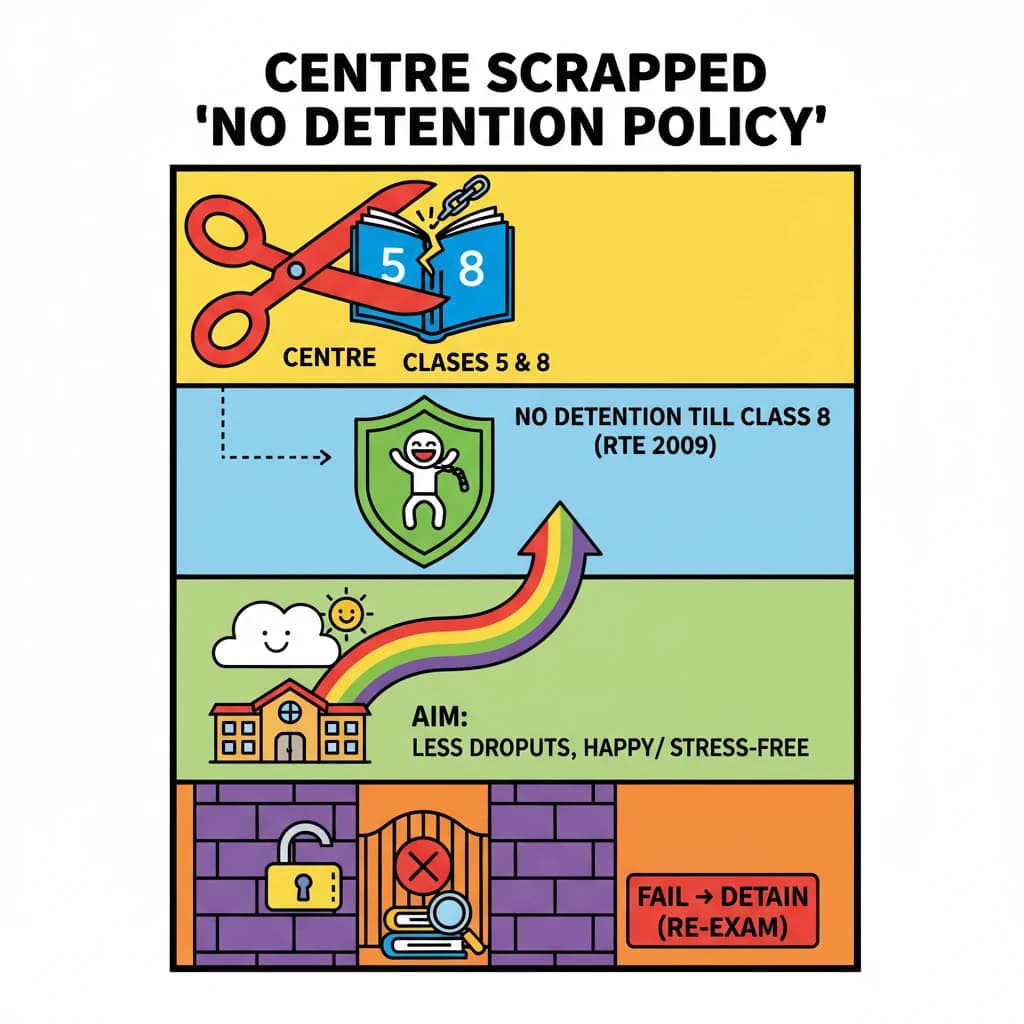
98% Verified Content
📚 Reference Sources
•Right of Children to Free and Compulsory Education Act, 2009
•Right of Children to Free and Compulsory Education (Amendment) Rules, 2024 (Gazette Notification)