📖 Introduction
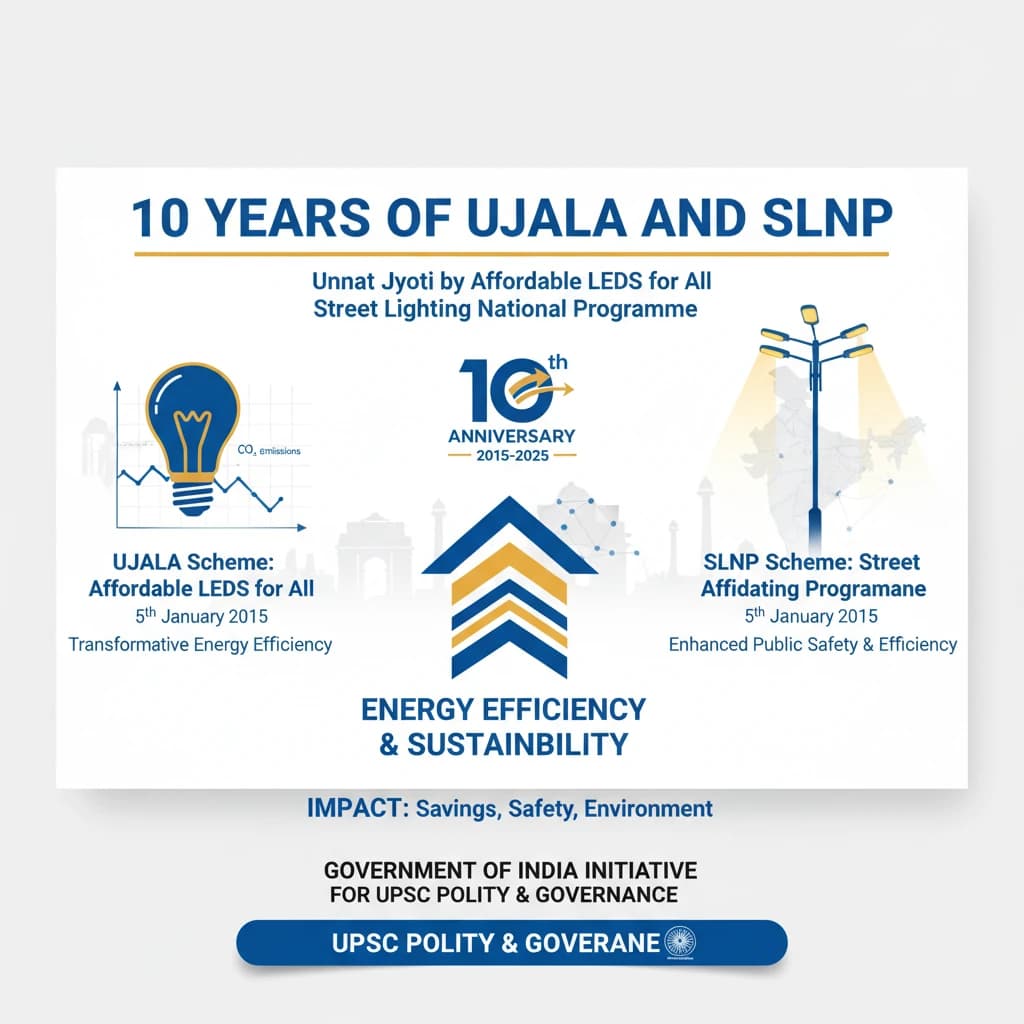
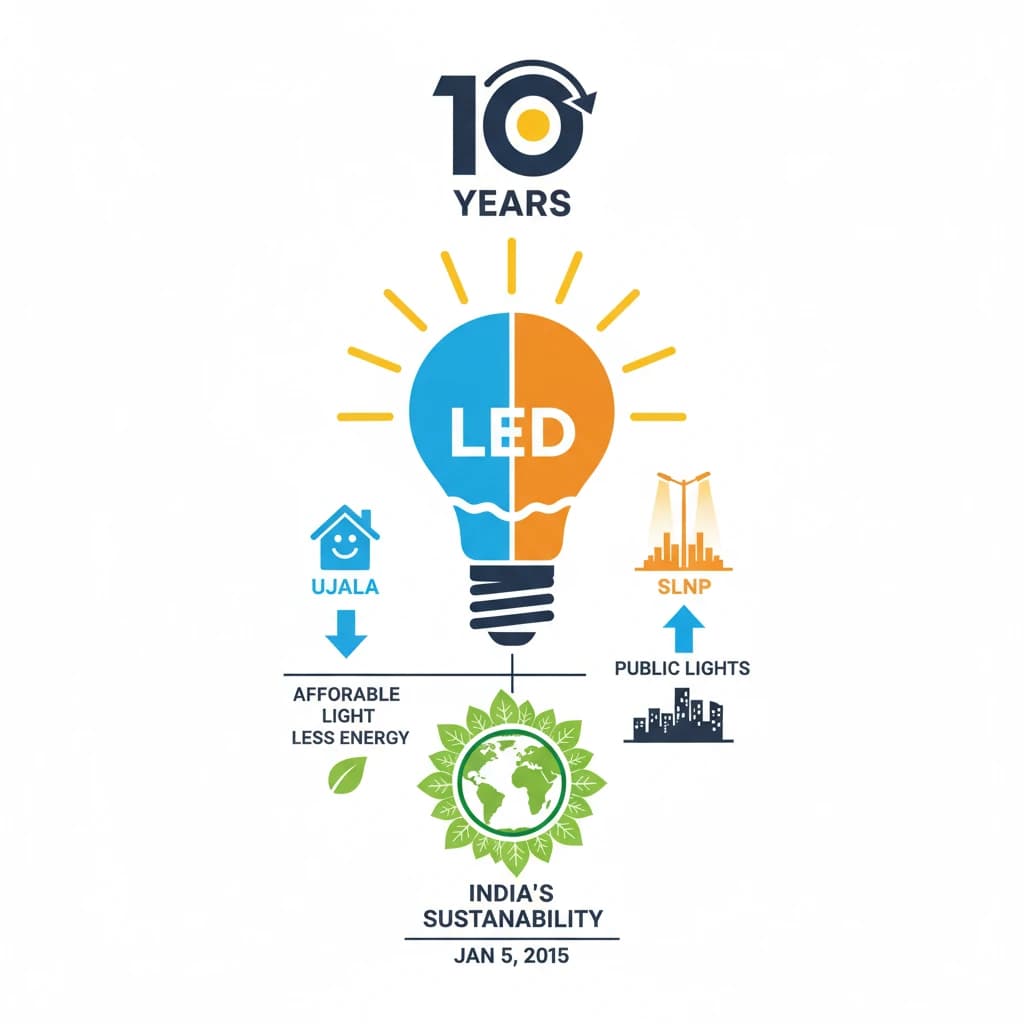
<h4>Introduction to UJALA and SLNP</h4><p>The <strong>Unnat Jyoti by Affordable LEDs for All (UJALA)</strong> scheme, launched on <strong>5th January 2015</strong>, has completed its <strong>10th anniversary</strong>. This initiative has been transformative in promoting <strong>energy efficiency</strong> across India.</p><p>Alongside UJALA, the <strong>Street Lighting National Programme (SLNP)</strong> was also launched. Both schemes have significantly contributed to revolutionizing lighting, reducing energy consumption, and advancing India’s environmental sustainability goals.</p><div class='info-box'><p><strong>Launch Date:</strong> 5th January 2015</p><p><strong>Key Objectives:</strong> Energy efficiency, reduced consumption, environmental sustainability.</p></div><h4>UJALA Scheme: Key Facts</h4><p>The <strong>UJALA Scheme</strong> was introduced in <strong>January 2015</strong> to promote energy efficiency. Its primary method is replacing traditional lighting systems with <strong>energy-saving LED bulbs</strong>.</p><p>It specifically targets the replacement of <strong>incandescent lamps (ICLs)</strong> and <strong>Compact Fluorescent Lamps (CFLs)</strong>, which were less efficient.</p><div class='key-point-box'><p><strong>Joint Project:</strong> The scheme is a collaboration between the <strong>Government of India’s Public Sector Undertakings</strong>, the <strong>Union Ministry of Power’s Energy Efficiency Services Limited (EESL)</strong>, and <strong>DISCOMs (Distribution Companies)</strong>.</p></div><h4>Objectives of UJALA</h4><p>The main objective of the <strong>UJALA Scheme</strong> is ambitious: to save <strong>85 lakh kWh of electricity</strong> annually. It also aims to reduce <strong>15,000 tonnes of Carbon dioxide (CO₂)</strong> emissions.</p><p>This is achieved by replacing an estimated <strong>77 crore traditional bulbs</strong> and <strong>3.5 crore street lights</strong> with efficient <strong>LEDs</strong>.</p><h4>Need for UJALA</h4><p>Before UJALA, lighting constituted a significant portion of residential electricity use in India, approximately <strong>18-27%</strong>. This highlighted a major area for potential energy savings.</p><p>In <strong>2011</strong>, Indian households utilized about <strong>one billion lighting points</strong>. The majority relied on less efficient options: <strong>CFLs (46%)</strong> and <strong>tube lights (41%)</strong>. Only a small fraction, <strong>0.4%</strong>, used <strong>LED bulbs</strong>.</p><h4>Efficiency of LEDs</h4><p><strong>LEDs</strong> offer substantial energy savings compared to older technologies. They save up to <strong>90% energy</strong> compared to <strong>ICLs</strong> and <strong>50%</strong> compared to <strong>CFLs</strong>.</p><p>Furthermore, <strong>LED bulbs</strong> use <strong>75% less energy</strong> and last <strong>25 times longer</strong> than incandescent bulbs. The high upfront cost of LEDs was a major barrier to their adoption prior to the scheme.</p><h4>Key Features of UJALA</h4><ul><li><strong>Subsidized LED Bulbs:</strong> The scheme dramatically reduced the cost of <strong>LED bulbs</strong>. The price was brought down to <strong>Rs 70 per LED bulb</strong>, a significant drop from <strong>Rs 450</strong> in <strong>2014</strong>.</li><li><strong>Distribution Mechanism:</strong> Bulbs are distributed through a unique <strong>demand aggregation-price crash model</strong>. This involves bulk buying to achieve lower prices.</li></ul><p>In <strong>2015</strong>, <strong>EESL</strong> initiated open bids for large-scale procurement of <strong>LED lamps</strong> and collaborated with state governments to establish an efficient distribution network.</p><h4>Progress and Achievements of UJALA</h4><p>The <strong>UJALA scheme</strong> has achieved remarkable success, distributing over <strong>36.87 crore LED bulbs</strong> across the country. This has led to substantial benefits:</p><ul><li><strong>Energy Savings:</strong> An impressive <strong>47,883 million kWh</strong> of energy is saved annually.</li><li><strong>Cost Savings:</strong> Households and the nation save approximately <strong>Rs. 19,153 crore</strong> annually.</li><li><strong>CO₂ Reduction:</strong> The scheme has helped avoid <strong>3.88 million tonnes of CO₂</strong> emissions annually.</li><li><strong>Peak Demand Avoided:</strong> A significant <strong>9,586 MW</strong> of peak electricity demand has been avoided.</li></ul><h4>GRAM UJALA Scheme</h4><p>The <strong>GRAM UJALA Scheme</strong> was launched in <strong>March 2021</strong>, specifically targeting <strong>rural households</strong>. It offers <strong>LED bulbs</strong> at a highly subsidized rate of <strong>Rs. 10 each</strong>.</p><p>This offer is provided in exchange for old <strong>incandescent bulbs</strong>. Under <strong>Phase-I</strong>, the goal was to distribute <strong>1.5 crore LED bulbs</strong>, aiming for energy savings of <strong>2025 million kWh/year</strong> and a <strong>CO₂ reduction</strong> of <strong>1.65 million tonnes per year</strong>.</p><h4>Street Lighting National Programme (SLNP): Key Facts</h4><p>The <strong>SLNP</strong> was launched concurrently with UJALA. Its core objectives include reducing energy consumption in public lighting and lowering operational costs for municipalities.</p><p>It also aims to foster a market transformation towards more <strong>energy-efficient appliances</strong> in the public domain.</p><div class='info-box'><p><strong>Implementing Agency:</strong> <strong>EESL</strong> was designated as the implementing agency for SLNP. It collaborates with various entities including <strong>Urban Local Bodies (ULBs)</strong>, <strong>Municipal bodies</strong>, <strong>Gram Panchayats (GPs)</strong>, and both <strong>Central and State Governments</strong>.</p></div><h4>SLNP Business Model</h4><p>The <strong>SLNP</strong> introduced an innovative business model. <strong>EESL</strong> covers the initial capital costs required for replacing conventional streetlights with <strong>LEDs</strong>.</p><p>The investment is then recovered through monthly or quarterly payments from the participating municipalities. This model ensures that local budgets are not strained by upfront expenses.</p><div class='key-point-box'><p><strong>Performance Guarantee:</strong> <strong>EESL</strong> also guarantees a <strong>95% uptime</strong> for the installed <strong>LED streetlights</strong>. This commitment enhances public safety and ensures reliable services for citizens.</p></div>