Loading page, please wait…
Vaidra Logo
Vaidra

Top 4 items + smart groups

UPSC GPT
New
Current Affairs
Daily Solutions
Daily Puzzle
Mains Evaluator

Version 2.0.0 • Built with ❤️ for UPSC aspirants

Loading...
Loading...
Loading...
Loading...
Loading...
Loading...
Loading...
Loading...
Loading...
Loading...
Loading...
Loading...
Loading...
SC's Use of Article 142 in Chandigarh Mayoral Election - UPSC Polity And Governance
Back
All Subjects

Topics

0 topics • 0 completed

Loading topics...
Loading...
Loading...
Loading...
Loading...
Loading...
Overall Progress0%

SC's Use of Article 142 in Chandigarh Mayoral Election - UPSC Polity And Governance

What is SC's Use of Article 142 in Chandigarh Mayoral Election in UPSC Polity And Governance?

SC's Use of Article 142 in Chandigarh Mayoral Election is a key topic under Polity And Governance for UPSC Civil Services Examination. Key points include: Article 142 empowers the Supreme Court to pass any order for "complete justice.". It is an extraordinary, residuary power, enforceable nationwide.. The Chandigarh Mayoral Election case is a recent example of its use to correct electoral malpractices.. Understanding this topic is essential for both UPSC Prelims and Mains preparation.

Why is SC's Use of Article 142 in Chandigarh Mayoral Election important for UPSC exam?

SC's Use of Article 142 in Chandigarh Mayoral Election is a Medium-level topic in UPSC Polity And Governance. It is tested in both Prelims (factual MCQs) and Mains (analytical answer writing). Previous year UPSC questions have frequently covered aspects of SC's Use of Article 142 in Chandigarh Mayoral Election, making it essential for comprehensive IAS preparation.

How to prepare SC's Use of Article 142 in Chandigarh Mayoral Election for UPSC?

To prepare SC's Use of Article 142 in Chandigarh Mayoral Election for UPSC: (1) Study the comprehensive notes covering all key concepts on Vaidra. (2) Practice previous year questions on this topic. (3) Connect it with current affairs using daily updates. (4) Revise using key takeaways and mind maps available for Polity And Governance. (5) Write practice answers linking SC's Use of Article 142 in Chandigarh Mayoral Election to related GS Paper topics.

Key takeaways of SC's Use of Article 142 in Chandigarh Mayoral Election for UPSC

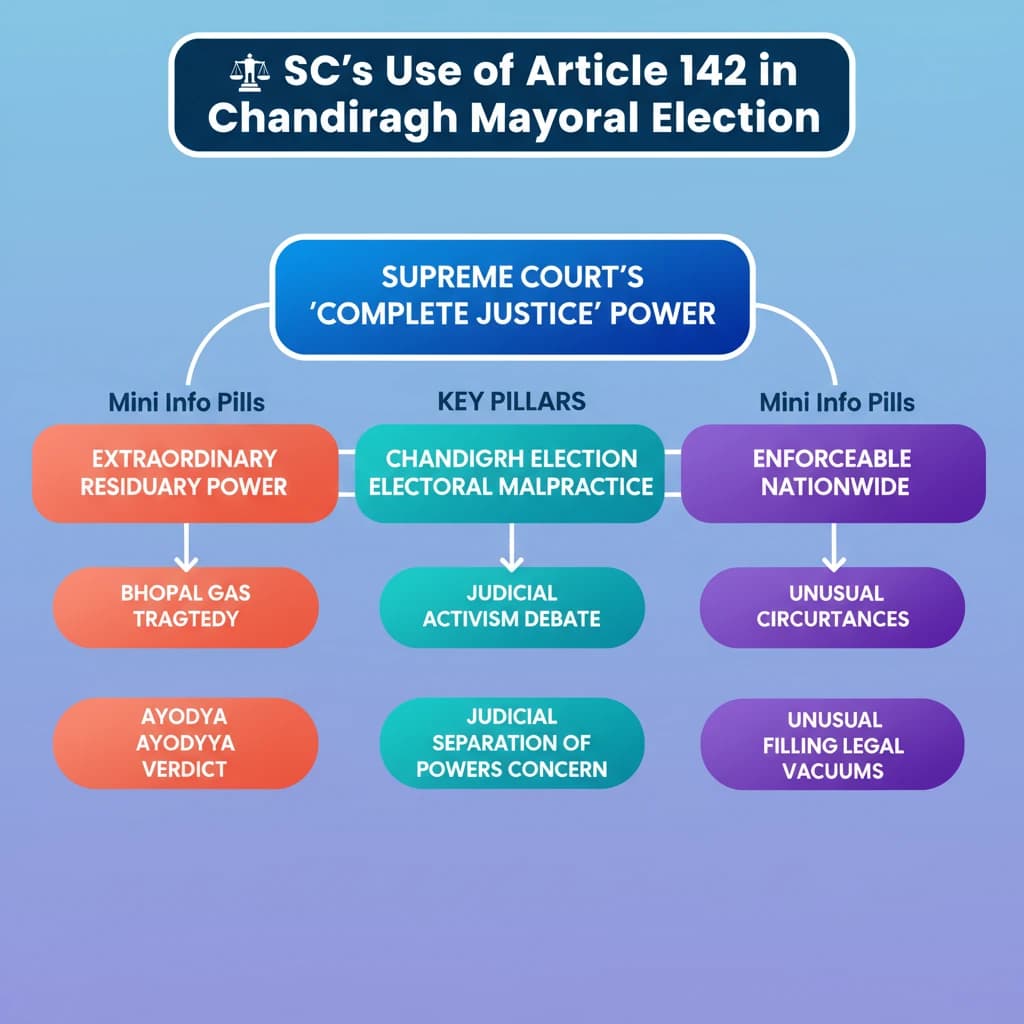
  • Article 142 empowers the Supreme Court to pass any order for "complete justice."
  • It is an extraordinary, residuary power, enforceable nationwide.
  • The Chandigarh Mayoral Election case is a recent example of its use to correct electoral malpractices.
  • Historically used in cases like the Bhopal Gas Tragedy and Ayodhya verdict.
  • Debates exist regarding its use in relation to judicial activism and separation of powers.
SC's Use of Article 142 in Chandigarh Mayoral Election

SC's Use of Article 142 in Chandigarh Mayoral Election

Medium⏱️ 5 min read✓ 95% Verified
polity and governance

📖 Introduction

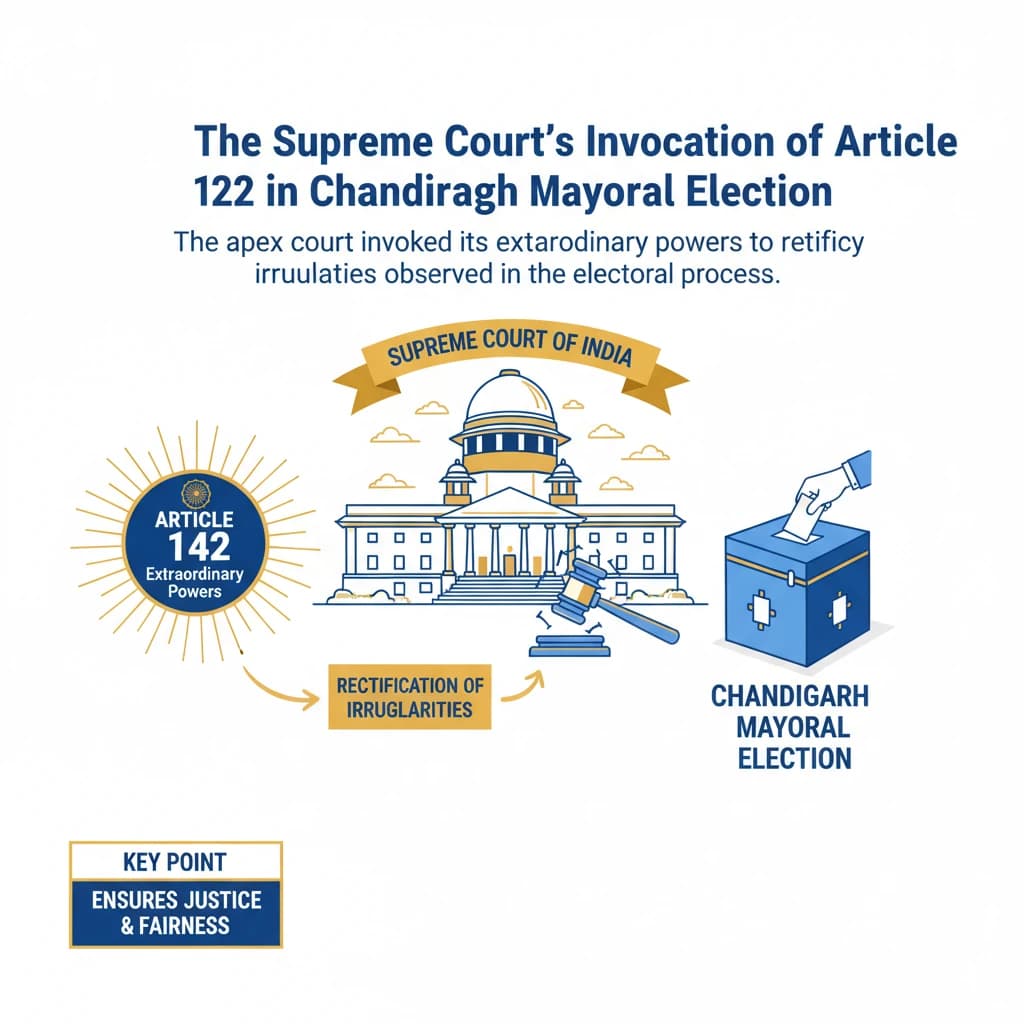
<h4>The Supreme Court's Invocation of Article 142 in Chandigarh Mayoral Election</h4><p>The <strong>Chandigarh mayoral election</strong> recently drew significant national attention due to the intervention of the <strong>Supreme Court of India</strong>.</p><p>The apex court invoked its extraordinary powers under <strong>Article 142</strong> of the <strong>Indian Constitution</strong> to rectify irregularities observed in the electoral process.</p><div class='key-point-box'><p>This intervention led to the <strong>overturning of the initial election results</strong>, underscoring the Supreme Court's role in ensuring justice and upholding democratic principles.</p></div><h4>Understanding Article 142 of the Indian Constitution</h4><p><strong>Article 142</strong> is a unique provision that grants wide-ranging powers to the <strong>Supreme Court of India</strong>.</p><p>It empowers the Court to issue any <strong>decree or order</strong> deemed necessary to deliver <strong>complete justice</strong> in any case or matter presented before it.</p><div class='info-box'><p><strong>Scope:</strong> These decrees and orders are <strong>enforceable throughout the territory of India</strong>, making them potent instruments for judicial intervention and resolution.</p></div><div class='exam-tip-box'><p><strong>UPSC Insight:</strong> Article 142 is often discussed in the context of <strong>judicial activism</strong> and the balance of power between the judiciary, executive, and legislature. Candidates should understand its constitutional basis and its implications for governance.</p></div>
Concept Diagram

💡 Key Takeaways

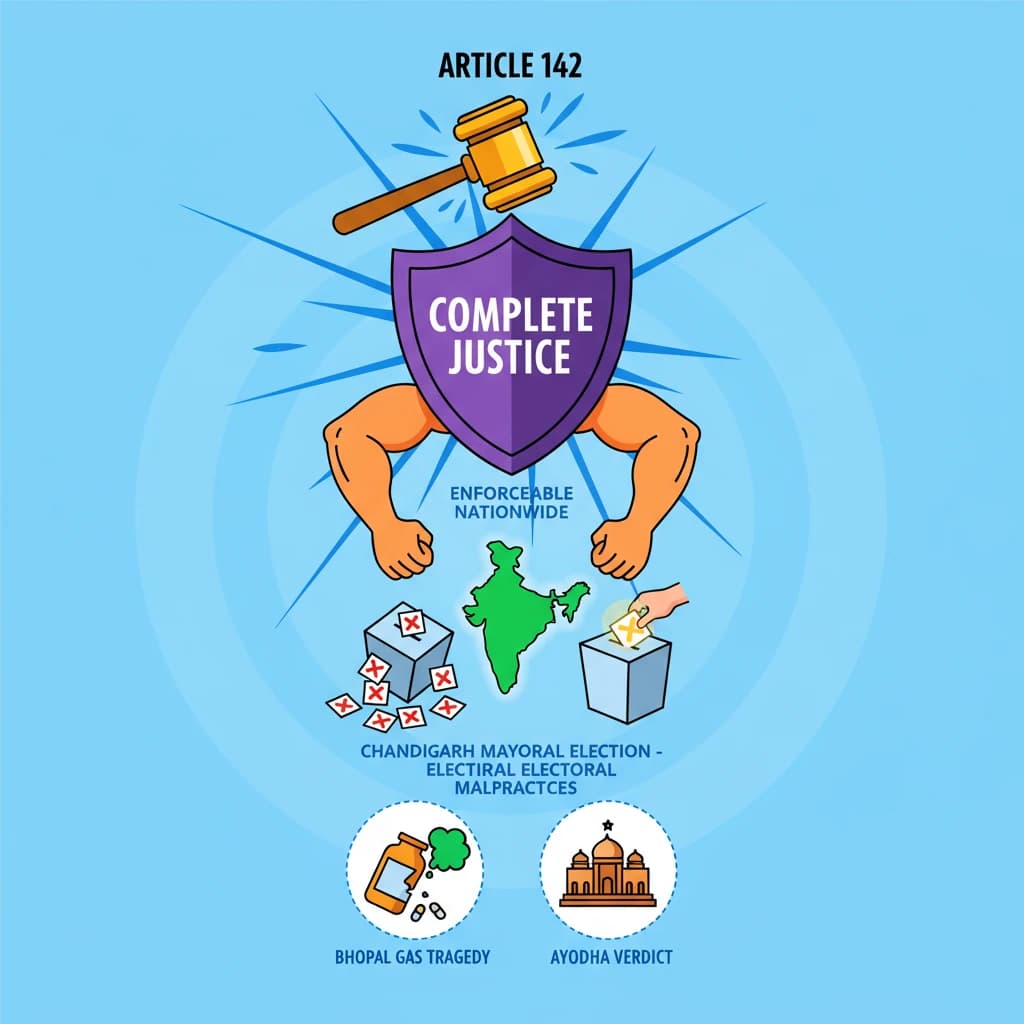
  • •Article 142 empowers the Supreme Court to pass any order for "complete justice."
  • •It is an extraordinary, residuary power, enforceable nationwide.
  • •The Chandigarh Mayoral Election case is a recent example of its use to correct electoral malpractices.
  • •Historically used in cases like the Bhopal Gas Tragedy and Ayodhya verdict.
  • •Debates exist regarding its use in relation to judicial activism and separation of powers.

🧠 Memory Techniques
Memory Aid
95% Verified Content

📚 Reference Sources

•Supreme Court of India judgments (e.g., Chandigarh Mayoral Election case, Bhopal Gas Tragedy case, Ayodhya Verdict)
•Drishti IAS (provided source material)
•Reports from reputable legal and news outlets on SC pronouncements

Related Topics

Loading related topics...
Explore:Polity And Governance Topics·All Subjects·Daily Current Affairs·Editorial Analysis·Previous Year Questions·UPSC GPT