Loading page, please wait…
Vaidra Logo
Vaidra

Top 4 items + smart groups

UPSC GPT
New
Current Affairs
Daily Solutions
Daily Puzzle
Mains Evaluator

Version 2.0.0 • Built with ❤️ for UPSC aspirants

Loading...
Loading...
Loading...
Loading...
Loading...
Loading...
Loading...
Loading...
Loading...
Loading...
Loading...
Loading...
Loading...
Back
All Subjects

Topics

0 topics • 0 completed

Loading topics...
Loading...
Loading...
Loading...
Loading...
Loading...
Overall Progress0%

Railway Accidents and Kavach System - UPSC Polity And Governance

What is Railway Accidents and Kavach System in UPSC Polity And Governance?

Railway Accidents and Kavach System is a key topic under Polity And Governance for UPSC Civil Services Examination. Key points include: Kavach is India's indigenous Automatic Train Protection (ATP) system, launched in 2020.. It is a cab signalling system with anti-collision features, adhering to Safety Integrity Level-4 (SIL-4).. Key functions include alerting loco pilots, automatic braking to prevent signal overshooting, and sending SoS messages.. Understanding this topic is essential for both UPSC Prelims and Mains preparation.

Why is Railway Accidents and Kavach System important for UPSC exam?

Railway Accidents and Kavach System is a Medium-level topic in UPSC Polity And Governance. It is tested in both Prelims (factual MCQs) and Mains (analytical answer writing). Previous year UPSC questions have frequently covered aspects of Railway Accidents and Kavach System, making it essential for comprehensive IAS preparation.

How to prepare Railway Accidents and Kavach System for UPSC?

To prepare Railway Accidents and Kavach System for UPSC: (1) Study the comprehensive notes covering all key concepts on Vaidra. (2) Practice previous year questions on this topic. (3) Connect it with current affairs using daily updates. (4) Revise using key takeaways and mind maps available for Polity And Governance. (5) Write practice answers linking Railway Accidents and Kavach System to related GS Paper topics.

Key takeaways of Railway Accidents and Kavach System for UPSC

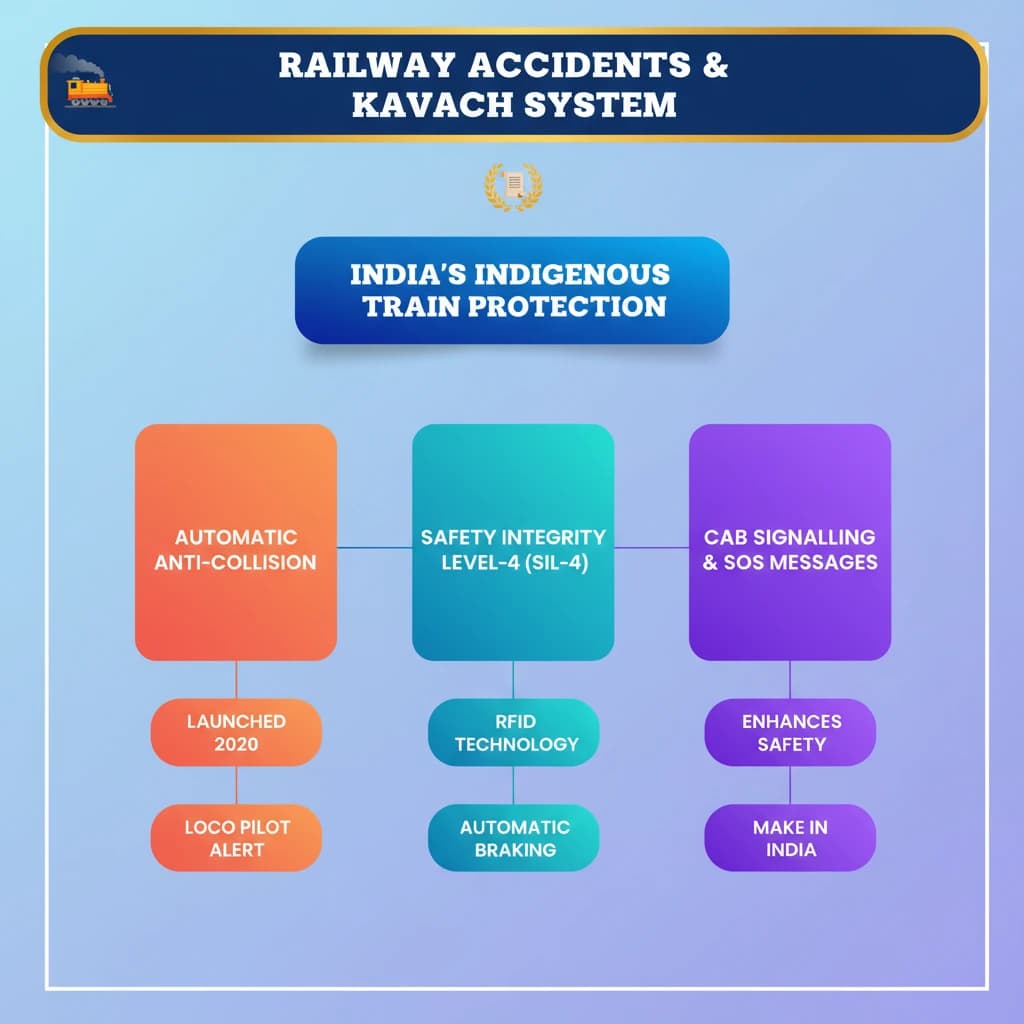
  • Kavach is India's indigenous Automatic Train Protection (ATP) system, launched in 2020.
  • It is a cab signalling system with anti-collision features, adhering to Safety Integrity Level-4 (SIL-4).
  • Key functions include alerting loco pilots, automatic braking to prevent signal overshooting, and sending SoS messages.
  • Components include Radio Frequency Identification (RFID) technology integrated into tracks.
  • Aims to enhance railway safety, reduce accidents, and support the 'Make in India' initiative.
  • Recent incidents like the Rangapani collision highlight its urgent need for widespread deployment.
Railway Accidents and Kavach System

Railway Accidents and Kavach System

Medium⏱️ 8 min read✓ 98% Verified
polity and governance

📖 Introduction

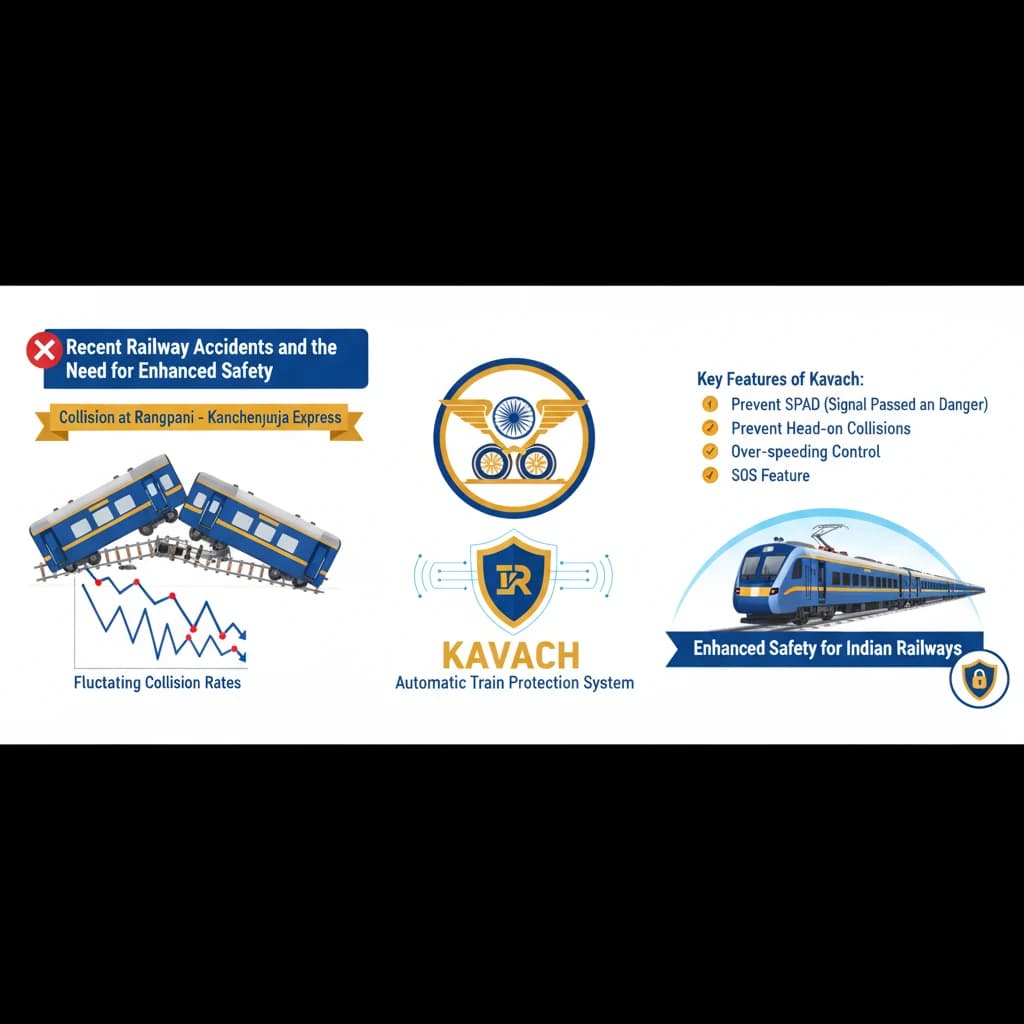
<h4>Recent Railway Accidents and the Need for Enhanced Safety</h4><p>The recent <strong>collision at Rangapani</strong> involving the <strong>Kanchenjunga Express</strong> has brought critical attention to the urgent need for enhanced safety measures within the Indian Railways system. This incident underscores the persistent challenges in ensuring complete operational safety.</p><p>Despite continuous safety enhancements, <strong>Indian Railways</strong> has experienced fluctuating rates of collisions. Data indicates <strong>six incidents</strong> in the fiscal year <strong>2022-23</strong> and <strong>four incidents</strong> in <strong>2023-24</strong>, highlighting the ongoing imperative to prevent such occurrences and safeguard passenger lives.</p><h4>Understanding the Kavach System</h4><p><strong>Kavach</strong>, an advanced <strong>cab signalling train control system</strong>, was officially launched in <strong>2020</strong>. It incorporates crucial <strong>anti-collision features</strong> designed to significantly improve railway safety across the network.</p><p>The system was indigenously developed by the <strong>Research Design and Standards Organisation (RDSO)</strong> in collaboration with three Indian vendors. It has been officially adopted as the <strong>National Automatic Train Protection (ATP) System</strong> for Indian Railways.</p><div class='key-point-box'><p><strong>Kavach</strong> adheres to <strong>Safety Integrity Level-4 (SIL-4)</strong> standards, representing the highest level of safety integrity. It functions as a vigilant watchdog, overseeing the existing signalling system and providing critical alerts.</p></div><p>When a loco pilot approaches a <strong>'red signal'</strong>, <strong>Kavach</strong> provides immediate alerts. If necessary, it automatically applies brakes to prevent the train from overshooting the signal, thereby averting potential collisions.</p><div class='info-box'><p><strong>Safety Integrity Level (SIL):</strong> This is a crucial measure in functional safety standards. It quantifies the level of risk reduction provided by a safety function. SILs range from <strong>SIL 1</strong> (lowest safety integrity) to <strong>SIL 4</strong> (highest safety integrity).</p></div><p>Beyond collision prevention, <strong>Kavach</strong> is equipped to relay <strong>SoS messages</strong> during emergency situations, ensuring prompt communication and response. It also facilitates <strong>centralised live monitoring</strong> of train movements through a dedicated <strong>Network Monitor System</strong>.</p><h4>Key Components of Kavach</h4><p>The successful deployment and operation of the <strong>Kavach system</strong> depend on the integration of several critical components. These components work in tandem to create a robust safety network.</p><p>One fundamental component involves the integration of <strong>Radio Frequency Identification (RFID) technology</strong> directly into the railway tracks. This technology forms the backbone for accurate train positioning and communication.</p><div class='info-box'><p><strong>Radio Frequency Identification (RFID):</strong> This technology uses <strong>electromagnetic fields</strong> to automatically identify and read information from a wireless device, known as an <strong>RFID tag</strong>. It operates from a distance, eliminating the need for physical contact or a direct line of sight.</p></div>
Concept Diagram

💡 Key Takeaways

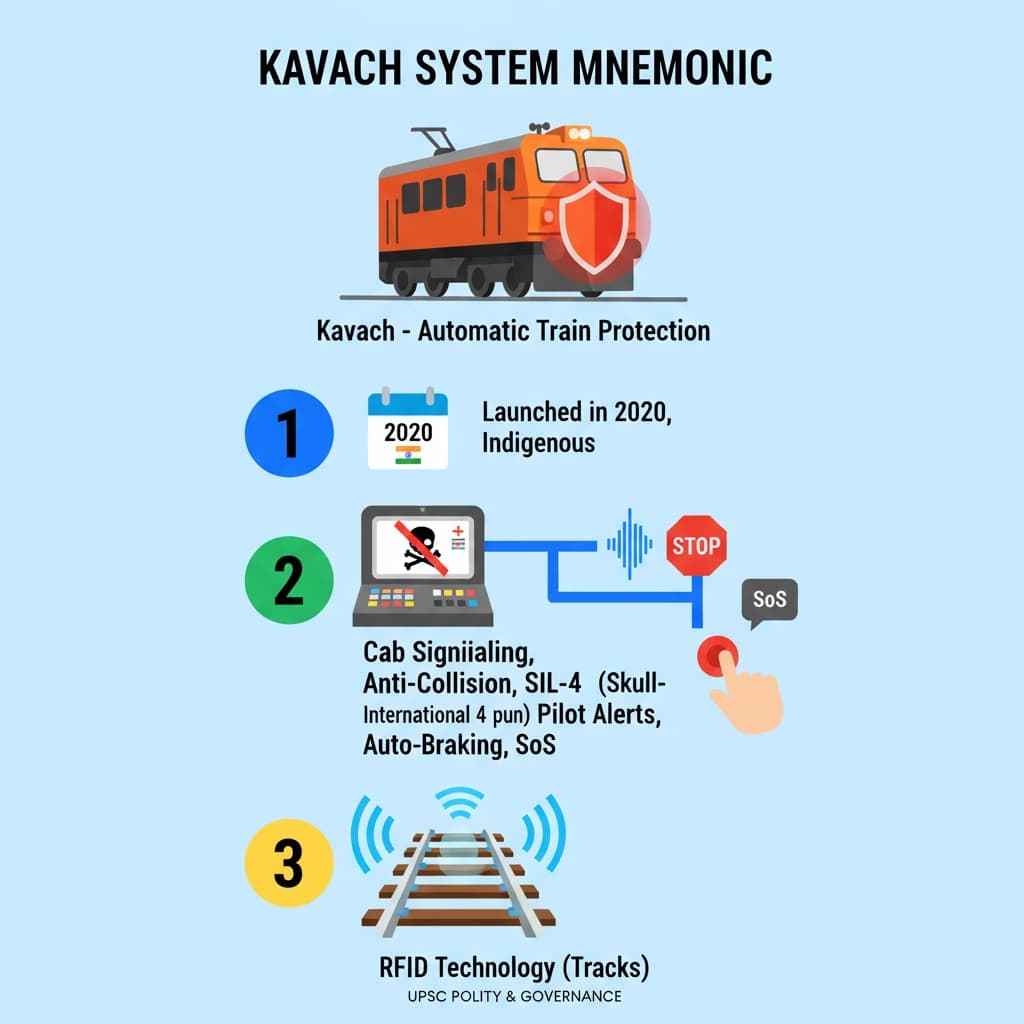
  • •Kavach is India's indigenous Automatic Train Protection (ATP) system, launched in 2020.
  • •It is a cab signalling system with anti-collision features, adhering to Safety Integrity Level-4 (SIL-4).
  • •Key functions include alerting loco pilots, automatic braking to prevent signal overshooting, and sending SoS messages.
  • •Components include Radio Frequency Identification (RFID) technology integrated into tracks.
  • •Aims to enhance railway safety, reduce accidents, and support the 'Make in India' initiative.
  • •Recent incidents like the Rangapani collision highlight its urgent need for widespread deployment.

🧠 Memory Techniques
Memory Aid
98% Verified Content

📚 Reference Sources

•Press Information Bureau (PIB) releases on Indian Railways and Kavach
•Official documents from the Ministry of Railways, Government of India
•Research Design and Standards Organisation (RDSO) publications

Related Topics

Loading related topics...
Explore:Polity And Governance Topics·All Subjects·Daily Current Affairs·Editorial Analysis·Previous Year Questions·UPSC GPT
Railway Accidents and Kavach System - UPSC Polity And Governance