Loading page, please wait…
Vaidra Logo
Vaidra

Top 4 items + smart groups

UPSC GPT
New
Current Affairs
Daily Solutions
Daily Puzzle
Mains Evaluator

Version 2.0.0 • Built with ❤️ for UPSC aspirants

Loading...
Loading...
Loading...
Loading...
Loading...
Loading...
Loading...
Loading...
Loading...
Loading...
Loading...
Loading...
Loading...
Back
All Subjects

Topics

0 topics • 0 completed

Loading topics...
Loading...
Loading...
Loading...
Loading...
Loading...
Overall Progress0%

What is the Death Penalty? - UPSC Polity And Governance

What is What is the Death Penalty? in UPSC Polity And Governance?

What is the Death Penalty? is a key topic under Polity And Governance for UPSC Civil Services Examination. Key points include: The Death Penalty (capital punishment) is the most severe punishment in India, involving execution by the state for grave offenses.. It is governed by the Bharatiya Nyay Sanhita (BNS, 2023), Bharatiya Nagarik Suraksha Sanhita (BNSS, 2023), and special laws like UAPA and NDPS Act.. The Constitution of India does not explicitly declare it unconstitutional; its validity rests on 'procedure established by law' (Article 21).. Understanding this topic is essential for both UPSC Prelims and Mains preparation.

Why is What is the Death Penalty? important for UPSC exam?

What is the Death Penalty? is a Medium-level topic in UPSC Polity And Governance. It is tested in both Prelims (factual MCQs) and Mains (analytical answer writing). Previous year UPSC questions have frequently covered aspects of What is the Death Penalty?, making it essential for comprehensive IAS preparation.

How to prepare What is the Death Penalty? for UPSC?

To prepare What is the Death Penalty? for UPSC: (1) Study the comprehensive notes covering all key concepts on Vaidra. (2) Practice previous year questions on this topic. (3) Connect it with current affairs using daily updates. (4) Revise using key takeaways and mind maps available for Polity And Governance. (5) Write practice answers linking What is the Death Penalty? to related GS Paper topics.

Key takeaways of What is the Death Penalty? for UPSC

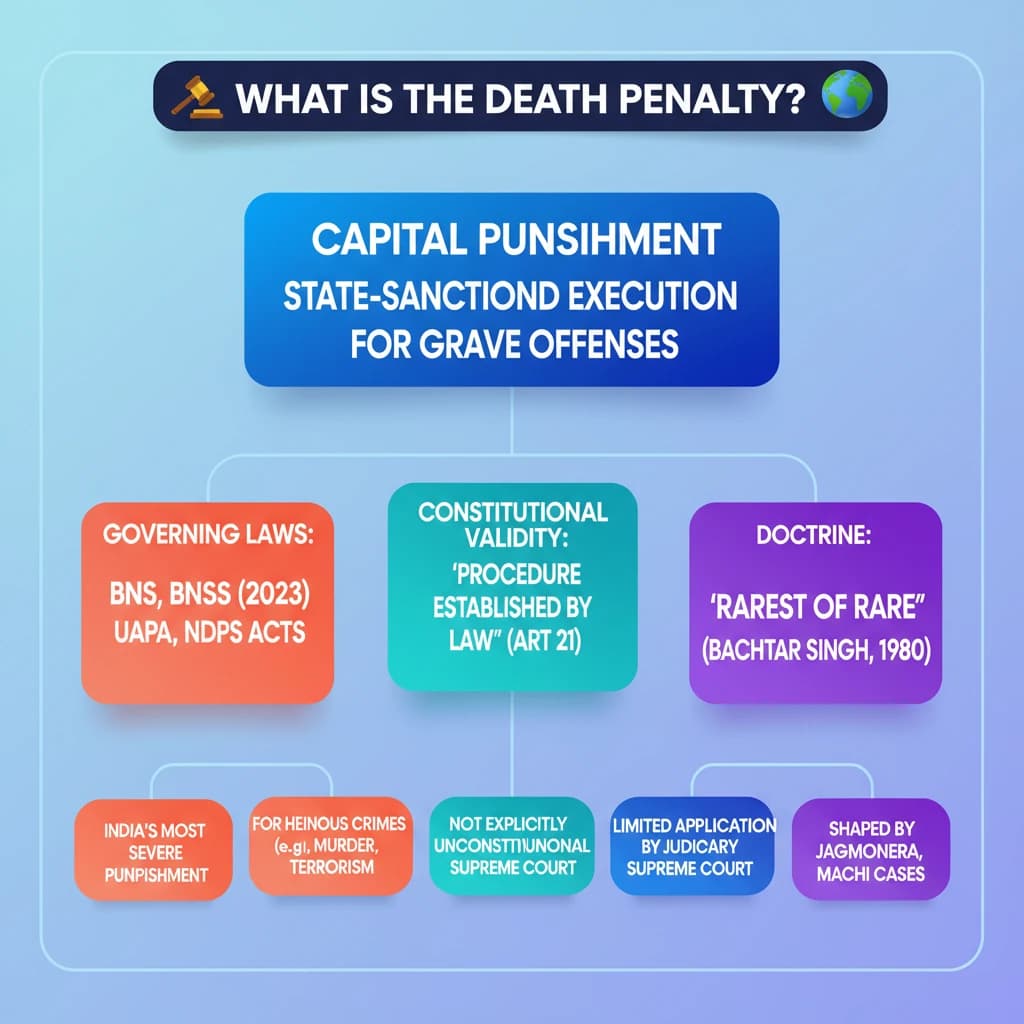
  • The Death Penalty (capital punishment) is the most severe punishment in India, involving execution by the state for grave offenses.
  • It is governed by the Bharatiya Nyay Sanhita (BNS, 2023), Bharatiya Nagarik Suraksha Sanhita (BNSS, 2023), and special laws like UAPA and NDPS Act.
  • The Constitution of India does not explicitly declare it unconstitutional; its validity rests on 'procedure established by law' (Article 21).
  • The Supreme Court, in Bachan Singh v. State of Punjab (1980), established the 'rarest of rare' doctrine, limiting its application.
  • Key judgments like Jagmohan Singh (1973), Rajendra Prasad (1979), and Machhi Singh (1983) have shaped its interpretation and application.
What is the Death Penalty?

What is the Death Penalty?

Medium⏱️ 10 min read✓ 98% Verified
polity and governance

📖 Introduction

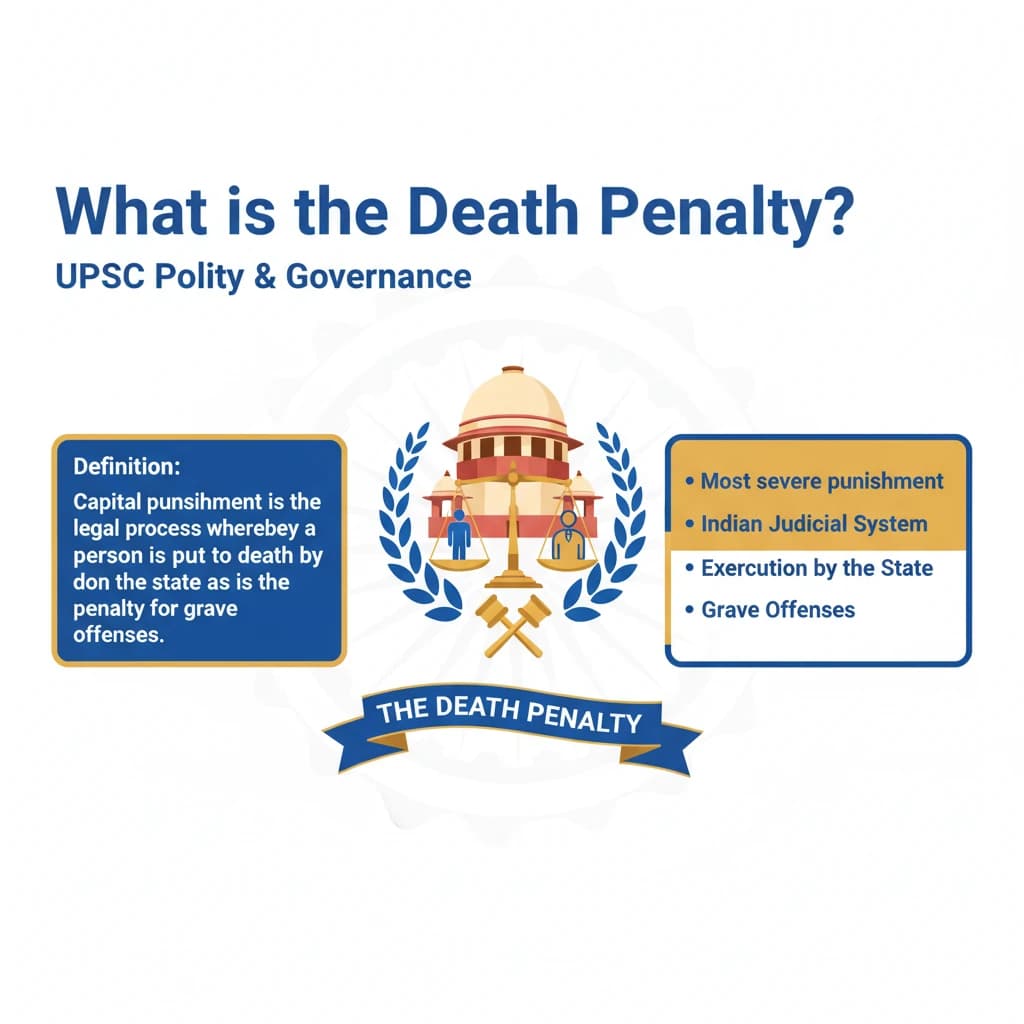
<h4>What is the Death Penalty?</h4><p>The <strong>Death Penalty</strong>, also known as <strong>capital punishment</strong>, represents the most severe form of punishment within the <strong>Indian judicial system</strong>. It involves the execution of an individual by the <strong>state</strong> as a penalty for certain grave offenses.</p><div class='info-box'><p><strong>Definition:</strong> <strong>Capital punishment</strong> is the legal process whereby a person is put to death by the state as a punishment for a crime.</p></div><h4>Legal Framework for Death Sentence</h4><p>In India, the imposition of the <strong>death penalty</strong> is governed by specific provisions outlined in the <strong>Bharatiya Nyay Sanhita (BNS, 2023)</strong>, the <strong>Bharatiya Nagarik Suraksha Sanhita (BNSS, 2023)</strong>, and other special laws.</p><p>The <strong>BNS (2023)</strong>, which replaced the <strong>Indian Penal Code (IPC)</strong>, mandates the <strong>death penalty</strong> for several heinous crimes. These include offenses such as <strong>rape causing death (Section 66)</strong>, <strong>gang rape of minors (Section 70(2))</strong>, and <strong>serial rape (Section 71)</strong>.</p><p><strong>Section 33</strong> of the <strong>BNS</strong> specifically provides for the punishment of death, alongside other forms like <strong>life imprisonment</strong> and general imprisonment. Beyond these, other specific offenses punishable by death include <strong>murder (Section 302)</strong>, acts of <strong>terrorism</strong> under the <strong>Unlawful Activities (Prevention) Act (UAPA)</strong>, and certain offenses related to <strong>drug trafficking</strong> under the <strong>Narcotic Drugs and Psychotropic Substances Act (NDPS)</strong>.</p><h4>Constitutional Stance on Death Penalty</h4><p>The <strong>Constitution of India</strong> does not explicitly declare <strong>capital punishment</strong> as unconstitutional. Its legality is affirmed through judicial interpretation.</p><p>The <strong>Supreme Court</strong>, particularly in the landmark case of <strong>Bachan Singh vs. State of Punjab (1980)</strong>, identified five categories of cases where capital punishment could be awarded. These categories often involve crimes of extreme brutality, depraved motives, and significant magnitude.</p><div class='key-point-box'><p><strong>Key Principle:</strong> The <strong>Indian Constitution</strong> allows for deprivation of life if done according to <strong>procedure established by law</strong>, as interpreted by the <strong>Supreme Court</strong>.</p></div><h4>Key Supreme Court Rulings</h4><p>The <strong>Supreme Court of India</strong> has delivered several pivotal judgments shaping the application of the <strong>death penalty</strong>:</p><ul><li><strong>Jagmohan Singh v. State of UP (1973):</strong> The SC held that deprivation of life is constitutionally permissible under <strong>Article 21</strong> if it is done according to the <strong>procedure established by law</strong>. Thus, a death sentence imposed after a fair trial, in accordance with legal procedures under the <strong>CrPC</strong> and <strong>Indian Evidence Act</strong>, is not unconstitutional under <strong>Article 21</strong>.</li><li><strong>Rajendra Prasad v. State of UP (1979):</strong> The SC opined that if a criminal's murderous actions persistently, planned, and perilously jeopardize <strong>social security</strong>, their enjoyment of fundamental rights, including life, may be justifiably annihilated.</li><li><strong>Bachan Singh v. State of Punjab (1980):</strong> This landmark case established the principle of awarding the <strong>death penalty</strong> only in the <strong>“rarest of rare” cases</strong>. This dictum signifies that capital punishment should be imposed only when the alternative sentence of <strong>life imprisonment</strong> is deemed inadequate due to the extreme nature and brutality of the crime.</li><li><strong>Machhi Singh v. State of Punjab (1983):</strong> The SC laid down specific considerations and guidelines for determining whether a particular case falls under the category of <strong>“rarest of rare”</strong>, providing a framework for lower courts.</li></ul><div class='exam-tip-box'><p>⚡️<strong>UPSC Insight:</strong> Understanding the evolution of the <strong>'rarest of rare' doctrine</strong> through these judgments is crucial for Mains answers, especially in <strong>GS-II Polity</strong> and <strong>GS-IV Ethics</strong>.</p></div>
Concept Diagram

💡 Key Takeaways

  • •The Death Penalty (capital punishment) is the most severe punishment in India, involving execution by the state for grave offenses.
  • •It is governed by the Bharatiya Nyay Sanhita (BNS, 2023), Bharatiya Nagarik Suraksha Sanhita (BNSS, 2023), and special laws like UAPA and NDPS Act.
  • •The Constitution of India does not explicitly declare it unconstitutional; its validity rests on 'procedure established by law' (Article 21).
  • •The Supreme Court, in Bachan Singh v. State of Punjab (1980), established the 'rarest of rare' doctrine, limiting its application.
  • •Key judgments like Jagmohan Singh (1973), Rajendra Prasad (1979), and Machhi Singh (1983) have shaped its interpretation and application.

🧠 Memory Techniques

Memory Aid
98% Verified Content

📚 Reference Sources

•The Constitution of India (Article 21)
•Bharatiya Nyay Sanhita (BNS, 2023)
•Bharatiya Nagarik Suraksha Sanhita (BNSS, 2023)
•Supreme Court judgments: Bachan Singh v. State of Punjab (1980)
•Supreme Court judgments: Jagmohan Singh v. State of UP (1973)
•Supreme Court judgments: Rajendra Prasad v. State of UP (1979)
•Supreme Court judgments: Machhi Singh v. State of Punjab (1983)
•Unlawful Activities (Prevention) Act (UAPA)
•Narcotic Drugs and Psychotropic Substances Act (NDPS)

Related Topics

Loading related topics...
Explore:Polity And Governance Topics·All Subjects·Daily Current Affairs·Editorial Analysis·Previous Year Questions·UPSC GPT
What is the Death Penalty? - UPSC Polity And Governance