📖 Introduction
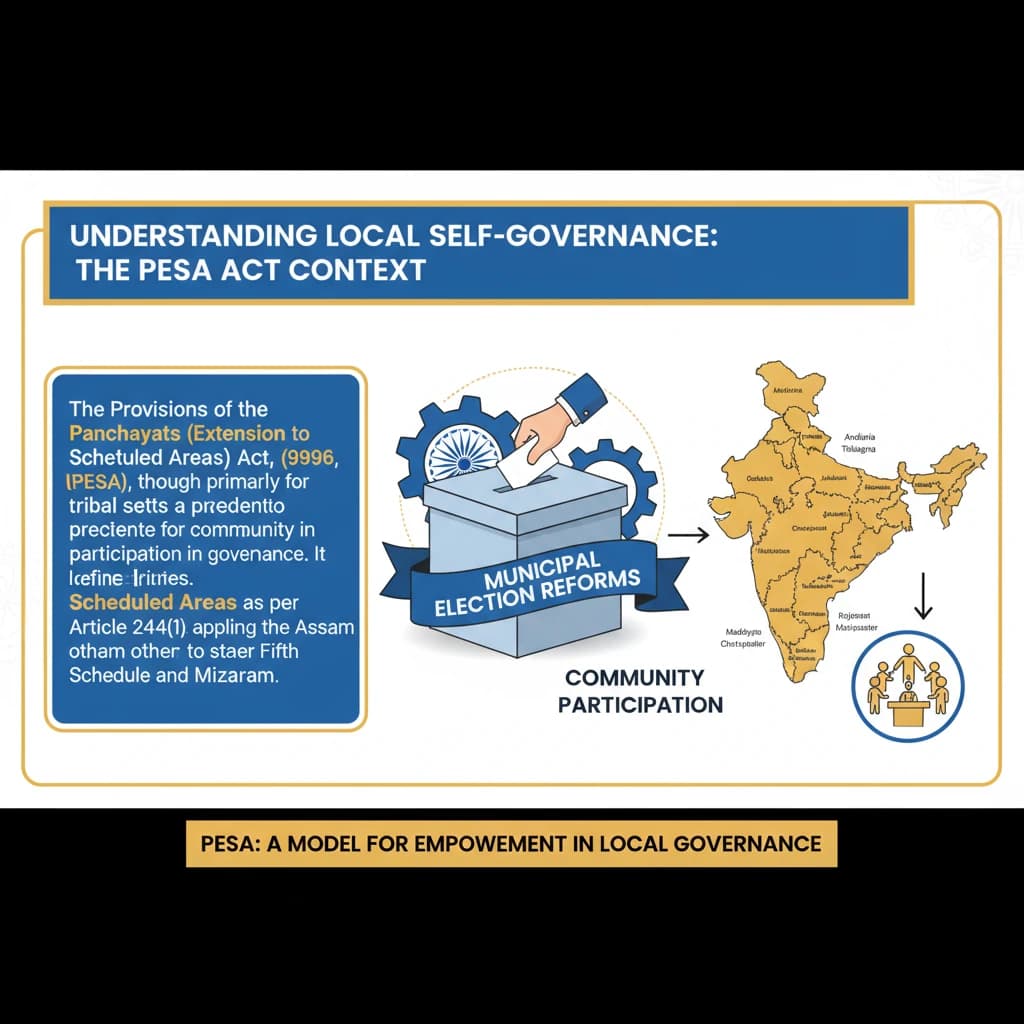
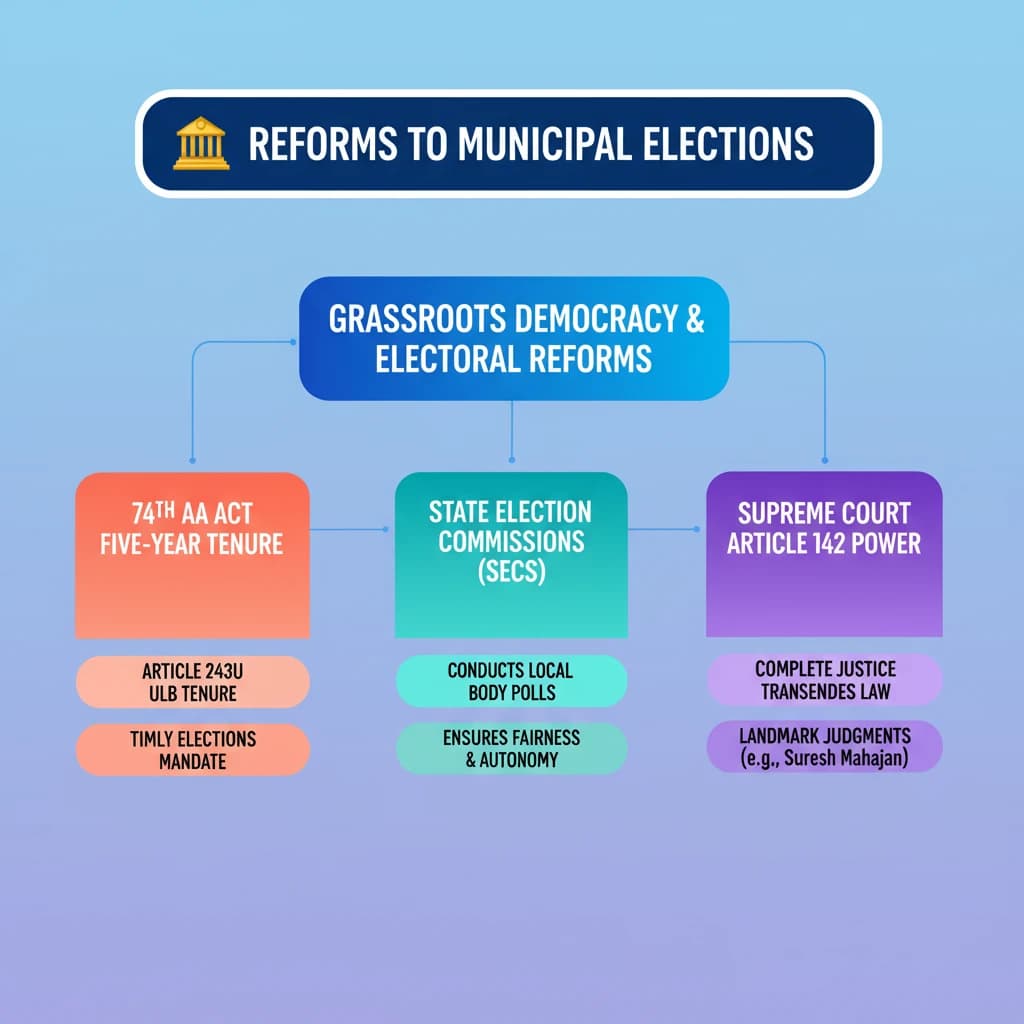
<h4>Understanding Local Self-Governance: The PESA Act Context</h4><p>The <strong>Provisions of the Panchayats (Extension to the Scheduled Areas) Act, 1996 (PESA)</strong>, though primarily for rural tribal areas, sets a precedent for community participation in local governance. It defines <strong>Scheduled Areas</strong> as per <strong>Article 244(1)</strong>, applying the <strong>Fifth Schedule</strong> to states other than Assam, Meghalaya, Tripura, and Mizoram.</p><div class='info-box'><p><strong>Scheduled Areas:</strong> These are regions predominantly inhabited by tribal communities, officially notified by the <strong>President of India</strong>. Currently, <strong>10 states</strong> have notified Fifth Schedule areas, covering parts or fully several districts. These states include <strong>Andhra Pradesh, Chhattisgarh, Gujarat, Himachal Pradesh, Jharkhand, Madhya Pradesh, Maharashtra, Odisha, Rajasthan, and Telangana</strong>.</p></div><p>The <strong>PESA Act</strong> establishes the <strong>Gram Sabha</strong> as a crucial forum for community engagement. It empowers the <strong>Gram Sabha</strong> to identify development projects, prepare plans, and oversee their implementation at the village level.</p><ul><li><strong>Village-level Institutions:</strong> The Act mandates the creation of institutions like the <strong>Gram Panchayat</strong>, <strong>Gram Sabha</strong>, and <strong>Panchayat Samiti</strong> to deliver basic services and manage development activities.</li><li><strong>Powers and Functions:</strong> Both the <strong>Gram Sabha</strong> and <strong>Gram Panchayat</strong> are granted significant authority over natural resource management and economic activity regulation.</li><li><strong>Consultation:</strong> Any development project or activity in <strong>Scheduled Areas</strong> requires mandatory consultation with the <strong>Gram Sabha</strong>.</li><li><strong>Funds:</strong> The Act ensures the transfer of funds to <strong>Gram Panchayats</strong> for effective functioning.</li><li><strong>Land Rights:</strong> It safeguards the <strong>land rights</strong> of tribal communities, requiring their consent for any land acquisition or transfer.</li><li><strong>Cultural and Social Practices:</strong> The Act protects the unique <strong>cultural and social practices</strong> of tribal communities, prohibiting interference.</li></ul><h4>Introduction to Municipal Election Challenges</h4><p>The recent <strong>Supreme Court judgment</strong> concerning the <strong>Chandigarh mayoral election</strong> has brought to light persistent issues within the electoral processes of <strong>local urban bodies</strong>. Unlike elections for the <strong>Lok Sabha</strong> and <strong>State Assemblies</strong>, municipal elections often grapple with challenges related to timely conduct and smooth power transitions.</p><div class='exam-tip-box'><p><strong>UPSC Insight:</strong> Understanding the distinction between electoral processes for central/state legislatures and local bodies is crucial for <strong>GS Paper II (Polity & Governance)</strong>. Focus on the constitutional provisions and the role of various institutions.</p></div><h4>Constitutional and Legal Framework for Local Body Elections</h4><p>The framework for conducting local body elections is enshrined in the <strong>Indian Constitution</strong> and reinforced by judicial pronouncements.</p><div class='info-box'><p><strong>Constitutional Provisions:</strong> The <strong>State Election Commission (SEC)</strong> is vested with the superintendence, direction, and control over the preparation of electoral rolls and the conduct of all elections to <strong>Panchayats</strong> and <strong>Municipalities</strong>.</p></div><p>The <strong>74th Constitutional Amendment Act</strong> plays a pivotal role by barring court interference in the electoral matters of <strong>municipalities</strong>, aiming to ensure the autonomy of the election process.</p><h4>Article 243U and the Mandate for Timely Elections</h4><p><strong>Article 243U</strong>, introduced by the <strong>74th Constitution Amendment Act</strong>, constitutionally mandates a <strong>five-year tenure</strong> for <strong>urban local governments</strong>. This provision is critical for ensuring democratic continuity and stability at the grassroots level.</p><div class='key-point-box'><p><strong>Key Point:</strong> The Supreme Court, in the <strong>Suresh Mahajan v. State of Madhya Pradesh Case (2022)</strong>, unequivocally emphasized the inviolability of this constitutional mandate for a fixed five-year term, highlighting the importance of timely elections.</p></div><h4>Article 142: Supreme Court's Extraordinary Powers</h4><p><strong>Article 142</strong> of the <strong>Indian Constitution</strong> grants the <strong>Supreme Court</strong> unique and expansive powers to deliver <strong>'complete justice'</strong>. This article allows the Court to issue any decree or order necessary, even if it transcends existing laws or statutes.</p><p>This extraordinary power enables the <strong>Supreme Court</strong> to perform functions that may extend beyond traditional adjudication, potentially encompassing executive and legislative roles when deemed necessary to ensure justice for all parties involved in a dispute.</p><div class='info-box'><p><strong>Supporting Provisions for Article 142:</strong></p><ul><li><strong>Article 32:</strong> Guarantees the <strong>right to constitutional remedies</strong>.</li><li><strong>Article 141:</strong> Mandates that all courts in India must abide by the <strong>Supreme Court's decisions</strong>.</li><li><strong>Article 136:</strong> Allows for <strong>Special Leave Petition (SLP)</strong>, granting the SC discretionary power to hear appeals.</li></ul></div><h4>Judicial Activism and its Implications</h4><p>The collective framework, including <strong>Article 142</strong> and its supporting provisions, is often referred to as <strong>'judicial activism'</strong>. This concept signifies the <strong>Supreme Court's</strong> proactive role in interpreting and enforcing the Constitution to protect rights and ensure justice.</p><p>While essential for upholding constitutional values, <strong>judicial activism</strong> has sometimes led to the <strong>Supreme Court</strong> stepping beyond parliamentary legislation to achieve <strong>'complete justice'</strong>, sparking debates about the separation of powers.</p><div class='key-point-box'><p><strong>Public Interest Interventions:</strong> <strong>Article 142</strong> empowers the <strong>Supreme Court</strong> to intervene in matters involving <strong>public interest</strong>, <strong>human rights</strong>, <strong>constitutional values</strong>, or <strong>fundamental rights</strong>. This reinforces its role as the guardian of the Constitution against violations.</p></div><h4>Landmark Judgments on Article 142's Scope</h4><p>The scope and limitations of <strong>Article 142</strong> have been clarified through several significant judgments:</p><ul><li><strong>Union Carbide Corporation vs Union of India (1991):</strong> The <strong>Supreme Court</strong> ordered <strong>UCC</strong> to pay <strong>USD 470 million</strong> in compensation to victims of the <strong>Bhopal gas tragedy</strong>. This judgment highlighted the wide scope of <strong>Article 142(1)</strong>, clarifying that its powers are of a different quality and not subject to express statutory prohibitions.</li><li><strong>Supreme Court Bar Association vs Union of India (1998):</strong> The apex court emphasized that powers under <strong>Article 142</strong> are <strong>supplementary</strong> and should not be used to override substantive laws. The Court stated these powers are <strong>curative in nature</strong>, meant to address specific injustices, and should not be used to ignore litigants' rights or bypass statutory provisions.</li></ul>