Loading page, please wait…
Vaidra Logo
Vaidra

Top 4 items + smart groups

UPSC GPT
New
Current Affairs
Daily Solutions
Daily Puzzle
Mains Evaluator

Version 2.0.0 • Built with ❤️ for UPSC aspirants

Loading...
Loading...
Loading...
Loading...
Loading...
Loading...
Loading...
Loading...
Loading...
Loading...
Loading...
Loading...
Loading...
PM Vishwakarma Scheme: MSME Skill Development & Credit Support - UPSC Polity And Governance
Back
All Subjects

Topics

0 topics • 0 completed

Loading topics...
Loading...
Loading...
Loading...
Loading...
Loading...
Overall Progress0%

PM Vishwakarma Scheme: MSME Skill Development & Credit Support - UPSC Polity And Governance

What is PM Vishwakarma Scheme: MSME Skill Development & Credit Support in UPSC Polity And Governance?

PM Vishwakarma Scheme: MSME Skill Development & Credit Support is a key topic under Polity And Governance for UPSC Civil Services Examination. Key points include: PM-WANI is a 2020 DoT framework for public Wi-Fi hotspots, part of Digital India.. It aims to provide affordable, widespread internet, especially in rural areas.. Ecosystem includes PDOs (hotspot operators), PDOAs (aggregators), App Providers, and a Central Registry.. Understanding this topic is essential for both UPSC Prelims and Mains preparation.

Why is PM Vishwakarma Scheme: MSME Skill Development & Credit Support important for UPSC exam?

PM Vishwakarma Scheme: MSME Skill Development & Credit Support is a Medium-level topic in UPSC Polity And Governance. It is tested in both Prelims (factual MCQs) and Mains (analytical answer writing). Previous year UPSC questions have frequently covered aspects of PM Vishwakarma Scheme: MSME Skill Development & Credit Support, making it essential for comprehensive IAS preparation.

How to prepare PM Vishwakarma Scheme: MSME Skill Development & Credit Support for UPSC?

To prepare PM Vishwakarma Scheme: MSME Skill Development & Credit Support for UPSC: (1) Study the comprehensive notes covering all key concepts on Vaidra. (2) Practice previous year questions on this topic. (3) Connect it with current affairs using daily updates. (4) Revise using key takeaways and mind maps available for Polity And Governance. (5) Write practice answers linking PM Vishwakarma Scheme: MSME Skill Development & Credit Support to related GS Paper topics.

Key takeaways of PM Vishwakarma Scheme: MSME Skill Development & Credit Support for UPSC

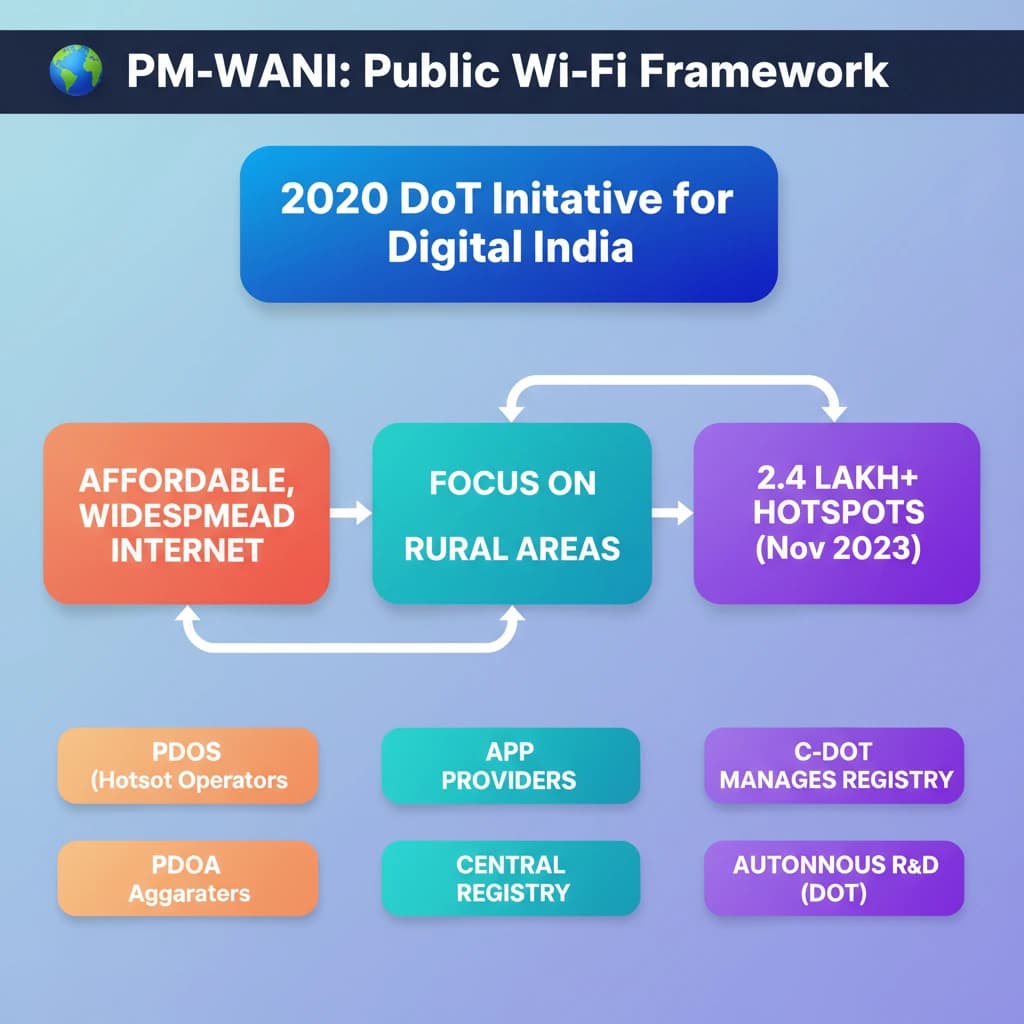
  • PM-WANI is a 2020 DoT framework for public Wi-Fi hotspots, part of Digital India.
  • It aims to provide affordable, widespread internet, especially in rural areas.
  • Ecosystem includes PDOs (hotspot operators), PDOAs (aggregators), App Providers, and a Central Registry.
  • C-DoT manages the Central Registry, an autonomous R&D centre of DoT.
  • As of Nov 2023, over 2.4 lakh hotspots are installed.
  • Distinct from PM Vishwakarma, which supports artisans with skill training and credit.
  • Crucial for bridging the digital divide, promoting economic growth, and enhancing e-governance.
PM Vishwakarma Scheme: MSME Skill Development & Credit Support

PM Vishwakarma Scheme: MSME Skill Development & Credit Support

Medium⏱️ 10 min read✓ 98% Verified
polity and governance

📖 Introduction

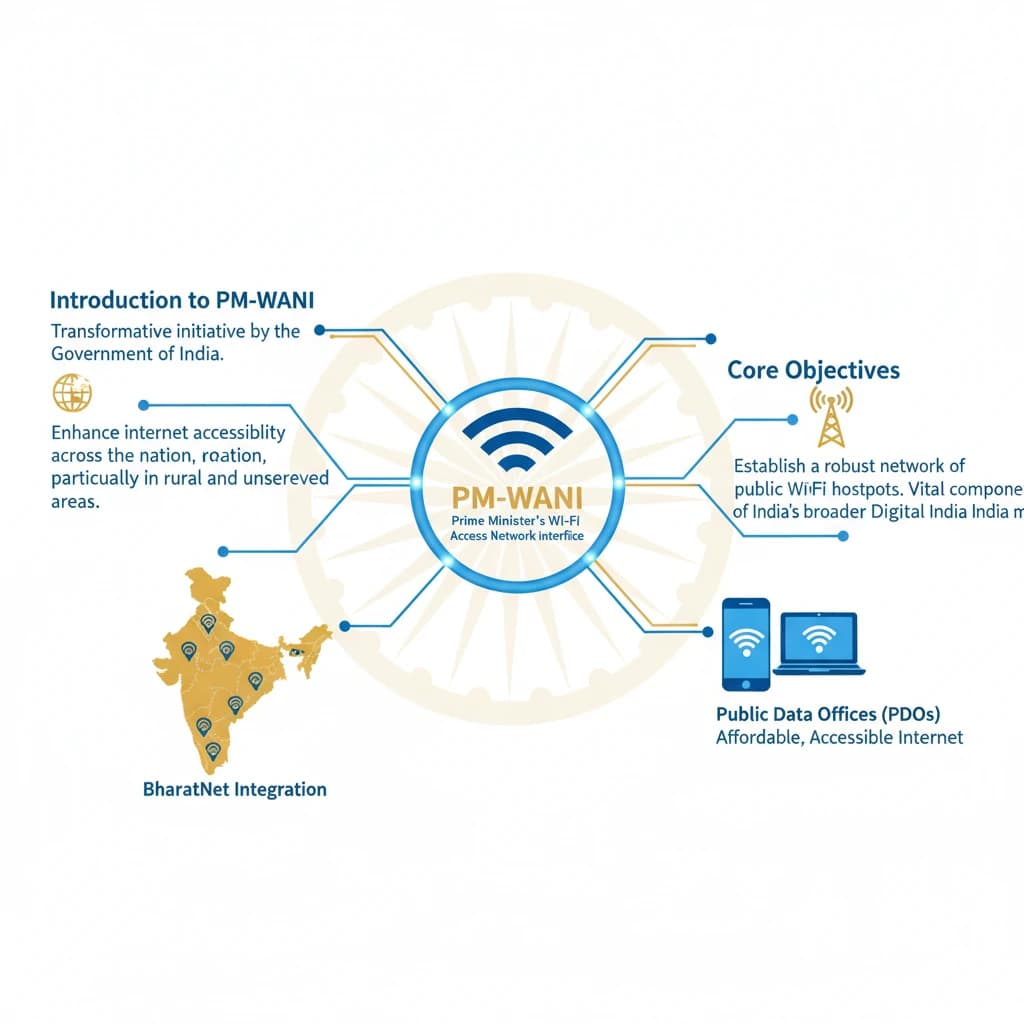
<h4>Introduction to PM-WANI</h4><p>The <strong>Prime Minister's Wi-Fi Access Network Interface (PM-WANI)</strong> framework is a transformative initiative by the Government of India. It aims to significantly enhance <strong>internet accessibility</strong> across the nation, particularly in rural and underserved areas.</p><p>The core objective is to establish a robust network of <strong>public Wi-Fi hotspots</strong>. This initiative is a vital component of India's broader <strong>Digital India mission</strong>, striving to provide widespread and affordable internet access to all citizens.</p><div class='info-box'><p><strong>Launch:</strong> Launched in <strong>2020</strong> by the <strong>Department of Telecom (DoT)</strong>.</p><p><strong>Status:</strong> As of <strong>November 2023</strong>, <strong>246,993 hotspots</strong> have been installed across India, demonstrating rapid progress in its deployment.</p></div><h4>Understanding the PM-WANI Ecosystem</h4><p>The <strong>PM-WANI framework</strong> operates through a decentralized and collaborative ecosystem involving four key entities. Each plays a crucial role in delivering seamless public Wi-Fi services.</p><ul><li><strong>Public Data Office (PDO):</strong> This is the entity responsible for establishing, maintaining, and operating <strong>PM-WANI compliant Wi-Fi hotspots</strong>. PDOs procure internet bandwidth from telecom or internet service providers and deliver broadband services directly to subscribers, ensuring <strong>last-mile connectivity</strong>.</li><li><strong>Public Data Office Aggregator (PDOA):</strong> The PDOA provides essential aggregation services to PDOs. These services include <strong>authorization</strong> and <strong>accounting</strong>, which are critical for managing the network and facilitating service delivery to end consumers.</li><li><strong>App Provider:</strong> This entity develops a dedicated application that allows users to register and easily discover nearby <strong>PM-WANI compliant Wi-Fi hotspots</strong>. The app also authenticates potential broadband users for accessing the internet service.</li><li><strong>Central Registry:</strong> This is a central database that maintains the details of all registered <strong>App Providers</strong>, <strong>PDOAs</strong>, and <strong>PDOs</strong>. It acts as the backbone for the entire ecosystem, ensuring smooth operation and compliance.</li></ul><h4>Role of C-DoT in PM-WANI</h4><p>The <strong>Central Registry</strong> for the PM-WANI framework is currently managed by the <strong>Centre for Development of Telematics (C-DoT)</strong>. C-DoT plays a pivotal role in ensuring the integrity and functionality of the PM-WANI ecosystem.</p><div class='info-box'><p><strong>About C-DoT:</strong> Established in <strong>1984</strong>, C-DoT is an autonomous <strong>Telecom R&D (Research and Development) centre</strong> under the <strong>Department of Telecom (DoT)</strong>, <strong>Ministry of Communications</strong>. It is registered as a society under the <strong>Societies Registration Act, 1860</strong>.</p></div><h4>Distinguishing PM-WANI from PM Vishwakarma Scheme</h4><p>It is crucial for UPSC aspirants to differentiate between similar-sounding government schemes. The initial description in the source material, though provided under the PM-WANI heading, actually refers to the <strong>PM Vishwakarma Scheme</strong>.</p><p>While <strong>PM-WANI</strong> focuses on expanding <strong>public Wi-Fi access</strong>, the <strong>PM Vishwakarma Scheme</strong> is designed to support traditional artisans and craftspeople, empowering them through skill development and financial assistance.</p><div class='info-box'><p><strong>PM Vishwakarma Scheme Key Details:</strong></p><ul><li><strong>Beneficiaries:</strong> Provides recognition through a <strong>PM Vishwakarma Certificate</strong> and an <strong>ID Card</strong> to traditional artisans.</li><li><strong>Training & Tools:</strong> Offers a stipend of <strong>Rs 500 per day</strong> for skill training and a <strong>Rs 15,000 grant</strong> for purchasing modern tools.</li><li><strong>Category:</strong> A <strong>Central Sector Scheme</strong>.</li><li><strong>Nodal Ministry:</strong> <strong>Ministry of Micro, Small and Medium Enterprises (MoMSME)</strong>.</li><li><strong>Lending Institutions:</strong> Includes <strong>Scheduled Commercial Banks</strong>, <strong>Regional Rural Banks</strong>, <strong>Small Finance Banks</strong>, <strong>Cooperative Banks</strong>, <strong>NBFCs</strong>, and <strong>Micro Finance Institutions</strong>.</li><li><strong>Credit Support:</strong> Beneficiaries are eligible for <strong>collateral-free credit support</strong> of up to <strong>Rs 1 lakh</strong> (first tranche) and <strong>Rs 2 lakh</strong> (second tranche) at a low interest rate.</li><li><strong>Eligibility:</strong> Targeted specifically for the <strong>MSME sector</strong>, open to individuals from school dropouts to those with an <strong>M.Tech degree</strong>.</li></ul></div><div class='exam-tip-box'><p><strong>UPSC Insight:</strong> Always pay close attention to the specific objectives and target beneficiaries of different government schemes. Confusing <strong>PM-WANI</strong> with <strong>PM Vishwakarma</strong> can lead to incorrect answers in both Prelims and Mains. Understand their distinct mandates.</p></div>
Concept Diagram

💡 Key Takeaways

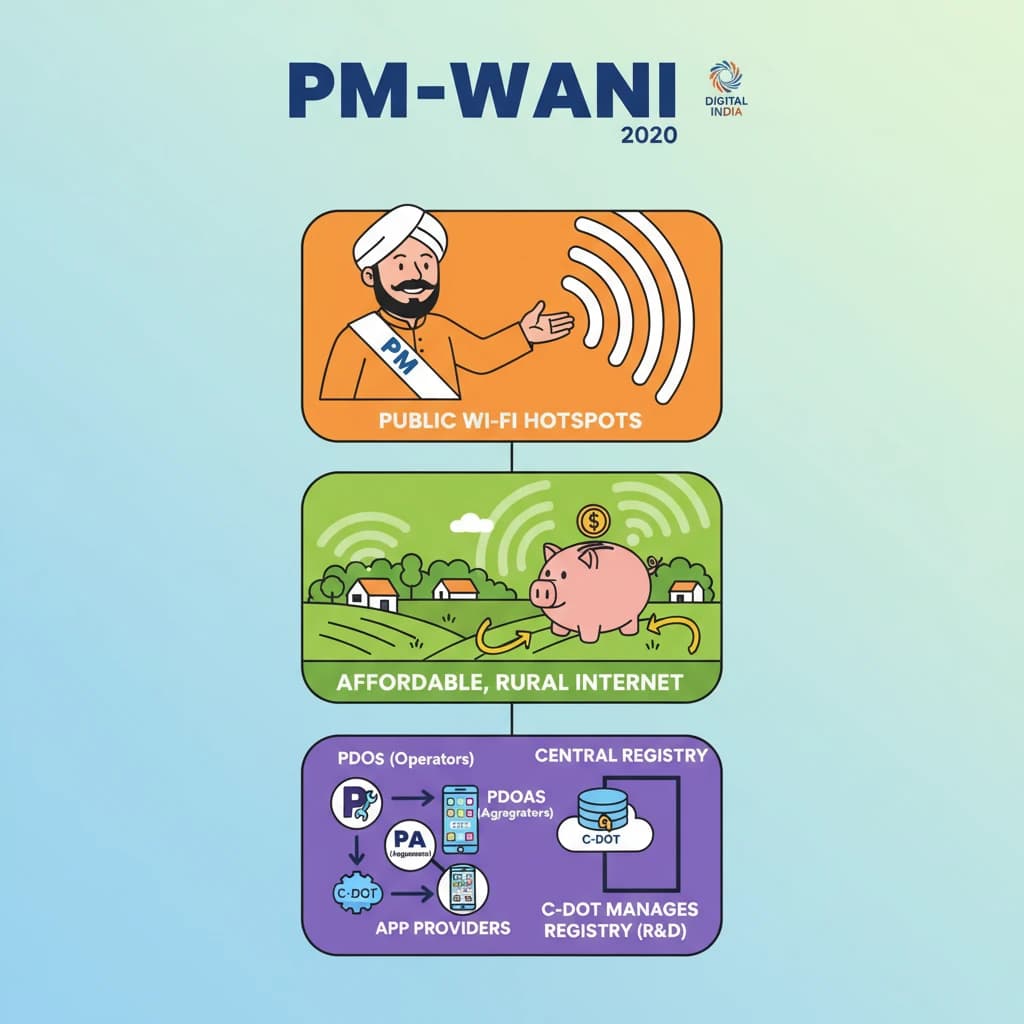
  • •PM-WANI is a 2020 DoT framework for public Wi-Fi hotspots, part of Digital India.
  • •It aims to provide affordable, widespread internet, especially in rural areas.
  • •Ecosystem includes PDOs (hotspot operators), PDOAs (aggregators), App Providers, and a Central Registry.
  • •C-DoT manages the Central Registry, an autonomous R&D centre of DoT.
  • •As of Nov 2023, over 2.4 lakh hotspots are installed.
  • •Distinct from PM Vishwakarma, which supports artisans with skill training and credit.
  • •Crucial for bridging the digital divide, promoting economic growth, and enhancing e-governance.

🧠 Memory Techniques
Memory Aid
98% Verified Content

📚 Reference Sources

•Department of Telecommunications (DoT) official website - PM-WANI guidelines and updates
•Centre for Development of Telematics (C-DoT) official website - details on C-DoT's role and history
•Press Information Bureau (PIB) releases regarding PM-WANI progress (e.g., hotspot numbers)

Related Topics

Loading related topics...
Explore:Polity And Governance Topics·All Subjects·Daily Current Affairs·Editorial Analysis·Previous Year Questions·UPSC GPT