Loading page, please wait…
Vaidra Logo
Vaidra

Top 4 items + smart groups

UPSC GPT
New
Current Affairs
Daily Solutions
Daily Puzzle
Mains Evaluator

Version 2.0.0 • Built with ❤️ for UPSC aspirants

Loading...
Loading...
Loading...
Loading...
Loading...
Loading...
Loading...
Loading...
Loading...
Loading...
Loading...
Loading...
Loading...
Back
All Subjects

Topics

0 topics • 0 completed

Loading topics...
Loading...
Loading...
Loading...
Loading...
Loading...
Overall Progress0%

What is a Curative Petition? - UPSC Polity And Governance

What is What is a Curative Petition? in UPSC Polity And Governance?

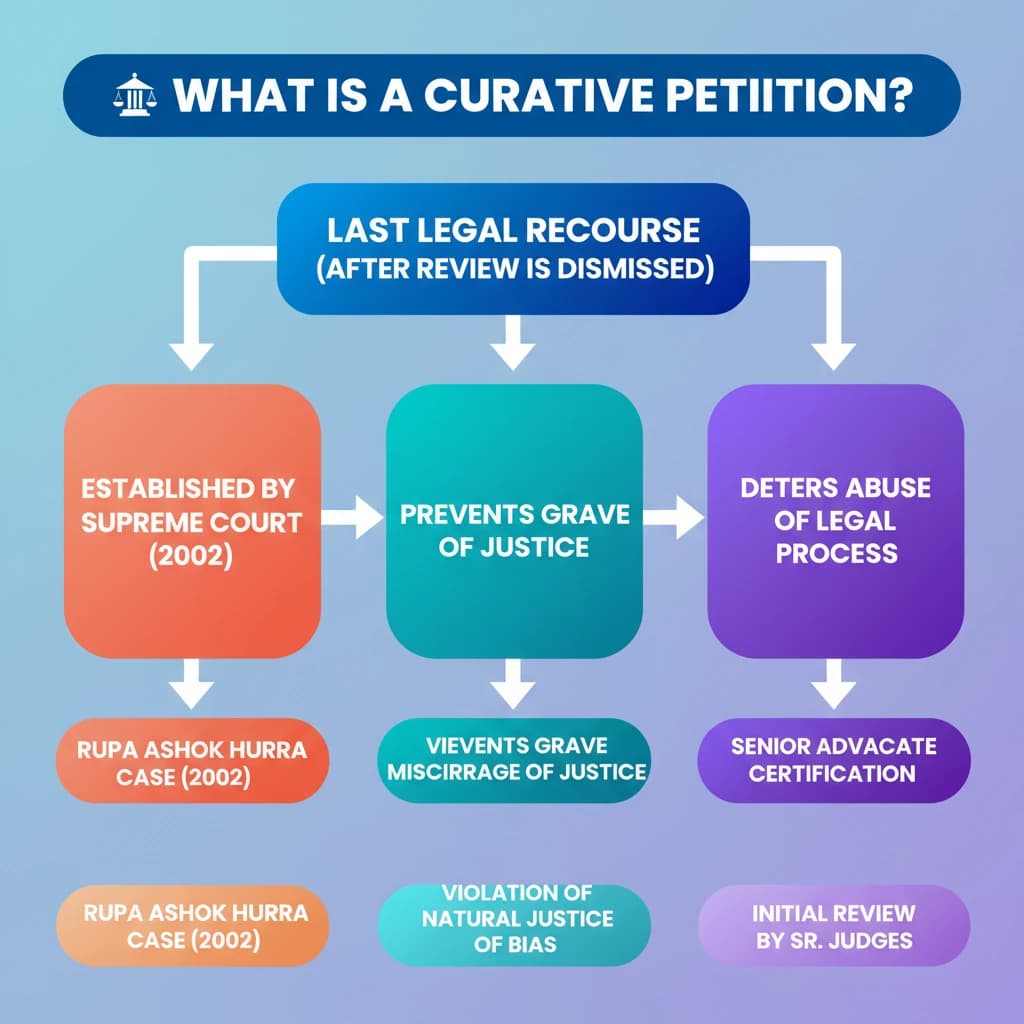
What is a Curative Petition? is a key topic under Polity And Governance for UPSC Civil Services Examination. Key points include: A curative petition is the last legal recourse after a review petition is dismissed.. It was established by the Supreme Court in the Rupa Ashok Hurra case (2002).. Its objective is to prevent grave miscarriage of justice and deter abuse of legal process.. Understanding this topic is essential for both UPSC Prelims and Mains preparation.

Why is What is a Curative Petition? important for UPSC exam?

What is a Curative Petition? is a Medium-level topic in UPSC Polity And Governance. It is tested in both Prelims (factual MCQs) and Mains (analytical answer writing). Previous year UPSC questions have frequently covered aspects of What is a Curative Petition?, making it essential for comprehensive IAS preparation.

How to prepare What is a Curative Petition? for UPSC?

To prepare What is a Curative Petition? for UPSC: (1) Study the comprehensive notes covering all key concepts on Vaidra. (2) Practice previous year questions on this topic. (3) Connect it with current affairs using daily updates. (4) Revise using key takeaways and mind maps available for Polity And Governance. (5) Write practice answers linking What is a Curative Petition? to related GS Paper topics.

Key takeaways of What is a Curative Petition? for UPSC

  • A curative petition is the last legal recourse after a review petition is dismissed.
  • It was established by the Supreme Court in the Rupa Ashok Hurra case (2002).
  • Its objective is to prevent grave miscarriage of justice and deter abuse of legal process.
  • Criteria for admission include violation of natural justice or apprehension of bias.
  • Requires senior advocate certification and initial review by senior judges.
  • Usually decided in chambers, open-court hearing is rare.
What is a Curative Petition?

What is a Curative Petition?

Medium⏱️ 8 min read✓ 100% Verified
polity and governance

📖 Introduction

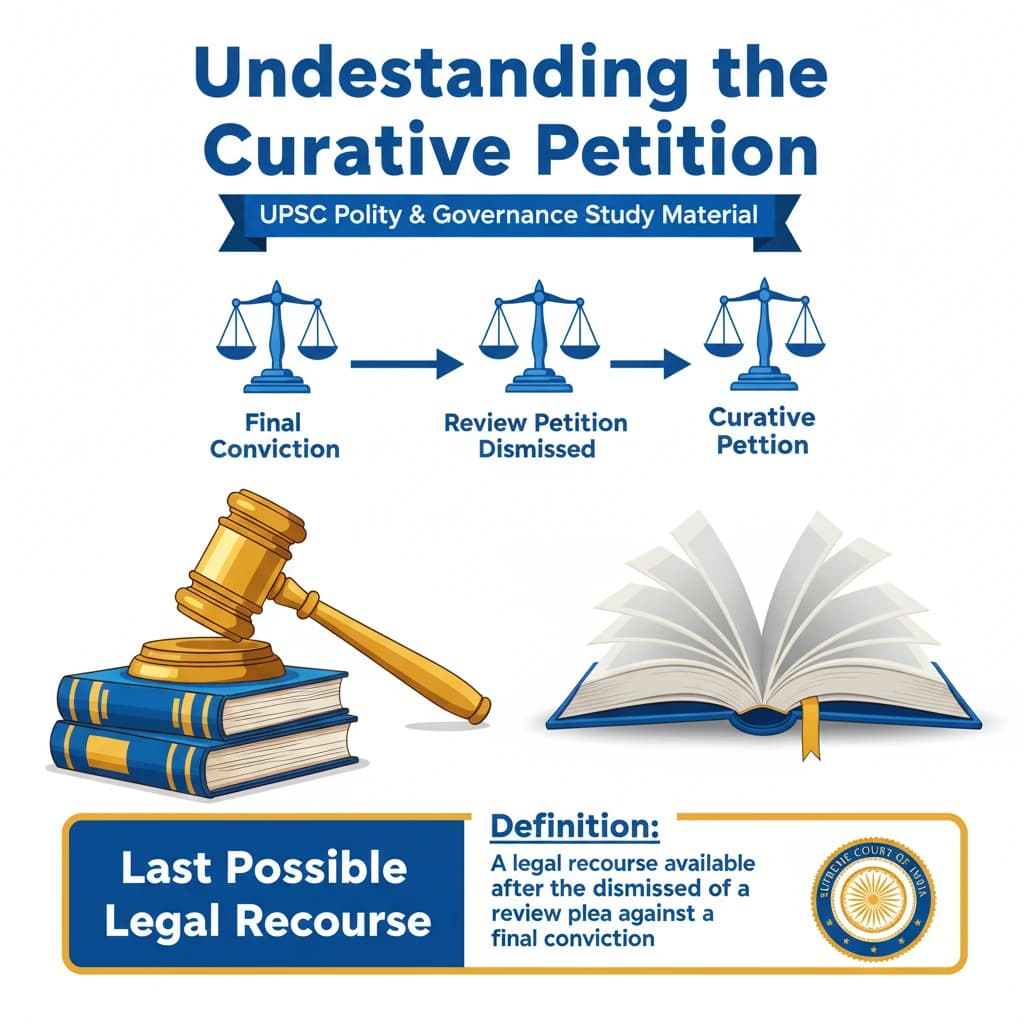
<h4>Understanding the Curative Petition</h4><p>A <strong>curative petition</strong> is a crucial legal remedy available in the Indian judicial system. It serves as the <strong>last possible legal recourse</strong> after a <strong>review petition</strong> against a final conviction has already been dismissed.</p><div class='info-box'><p><strong>Definition:</strong> A <strong>curative petition</strong> is a legal recourse available after the dismissal of a review plea against a final conviction.</p></div><p>Constitutionally, a final ruling by the <strong>Supreme Court</strong> is typically challenged through a <strong>review petition</strong>. However, such review petitions are generally limited to very narrow procedural grounds.</p><div class='key-point-box'><p>The <strong>curative petition</strong> is a <strong>sparingly used judicial innovation</strong>. Its primary purpose is to rectify a <strong>grave miscarriage of justice</strong> that might have occurred even after the review process.</p></div><h4>Objective of a Curative Petition</h4><p>The core objective behind the introduction of the <strong>curative petition</strong> is two-fold:</p><ul><li>To <strong>prevent miscarriage of justice</strong>, ensuring that no individual suffers due to an error that went uncorrected.</li><li>To <strong>deter abuse of the legal process</strong>, providing a final check against judicial errors.</li></ul><h4>Decision Process and Hearing</h4><p>The process for deciding <strong>curative petitions</strong> is distinct from regular appeals or review petitions.</p><div class='info-box'><p><strong>Typical Decision:</strong> Curative petitions are usually decided by judges in their <strong>chambers</strong>, meaning without an open court hearing.</p></div><p>However, an <strong>open-court hearing</strong> may be granted in exceptional circumstances, specifically upon a <strong>specific request</strong> from the petitioner and if the court deems it necessary.</p><h4>Legal Basis and Origin</h4><p>The principles and guidelines governing the filing and consideration of <strong>curative petitions</strong> were not originally enshrined in the Constitution. They were established through a landmark judicial pronouncement.</p><div class='key-point-box'><p><strong>Landmark Case:</strong> The legal framework for <strong>curative petitions</strong> was laid down by the <strong>Supreme Court</strong> in the significant case of <strong>Rupa Ashok Hurra Vs Ashok Hurra & another Case</strong> in <strong>2002</strong>.</p></div><h4>Criteria for Entertaining a Curative Petition</h4><p>The Supreme Court has laid down strict criteria for a <strong>curative petition</strong> to be entertained, ensuring its use is limited to genuine cases of injustice.</p><ul><li><strong>Violation of Natural Justice:</strong> It must be clearly demonstrated that there was a <strong>breach of principles of natural justice</strong>. An example is the petitioner not being heard before the court passed an order.</li><li><strong>Apprehension of Bias:</strong> The petition may be admitted if there are strong grounds to suspect <strong>bias on the part of the judge</strong> who passed the original order, such as a failure to disclose relevant facts.</li></ul><h4>Guidelines for Filing a Curative Petition</h4><p>The filing process for a <strong>curative petition</strong> also involves specific procedural requirements:</p><ol><li><strong>Certification by Senior Advocate:</strong> The petition must be accompanied by a <strong>certification from a senior advocate</strong>. This certification must highlight substantial grounds for the court's consideration.</li><li><strong>Initial Review:</strong> It is first circulated to a bench comprising the <strong>three senior-most judges</strong> of the Supreme Court. Additionally, the judges who passed the <strong>original judgment</strong> (if available) are also part of this initial review bench.</li><li><strong>Hearing Decision:</strong> Only if a <strong>majority of these judges deem it necessary for a hearing</strong>, the petition is then listed for consideration. Preferably, this hearing takes place before the <strong>same bench that passed the initial judgment</strong>.</li></ol>
Concept Diagram

💡 Key Takeaways

  • •A curative petition is the last legal recourse after a review petition is dismissed.
  • •It was established by the Supreme Court in the Rupa Ashok Hurra case (2002).
  • •Its objective is to prevent grave miscarriage of justice and deter abuse of legal process.
  • •Criteria for admission include violation of natural justice or apprehension of bias.
  • •Requires senior advocate certification and initial review by senior judges.
  • •Usually decided in chambers, open-court hearing is rare.

🧠 Memory Techniques

Memory Aid
100% Verified Content

Related Topics

Loading related topics...
Explore:Polity And Governance Topics·All Subjects·Daily Current Affairs·Editorial Analysis·Previous Year Questions·UPSC GPT
What is a Curative Petition? - UPSC Polity And Governance