Loading page, please wait…
Vaidra Logo
Vaidra

Top 4 items + smart groups

UPSC GPT
New
Current Affairs
Daily Solutions
Daily Puzzle
Mains Evaluator

Version 2.0.0 • Built with ❤️ for UPSC aspirants

Loading...
Loading...
Loading...
Loading...
Loading...
Loading...
Loading...
Loading...
Loading...
Loading...
Loading...
Loading...
Loading...
SC Allows States to Regulate Industrial Alcohol - UPSC Polity And Governance
Back
All Subjects

Topics

0 topics • 0 completed

Loading topics...
Loading...
Loading...
Loading...
Loading...
Loading...
Overall Progress0%

SC Allows States to Regulate Industrial Alcohol - UPSC Polity And Governance

What is SC Allows States to Regulate Industrial Alcohol in UPSC Polity And Governance?

SC Allows States to Regulate Industrial Alcohol is a key topic under Polity And Governance for UPSC Civil Services Examination. Key points include: SC's 8:1 ruling grants states authority to regulate industrial alcohol, reversing a 1990 decision.. The ruling expands 'intoxicating liquor' definition beyond potable alcohol to include all alcohol harmful to public health.. Industrial alcohol is denatured ethanol used as a solvent, prone to diversion for illicit liquor.. Understanding this topic is essential for both UPSC Prelims and Mains preparation.

Why is SC Allows States to Regulate Industrial Alcohol important for UPSC exam?

SC Allows States to Regulate Industrial Alcohol is a Medium-level topic in UPSC Polity And Governance. It is tested in both Prelims (factual MCQs) and Mains (analytical answer writing). Previous year UPSC questions have frequently covered aspects of SC Allows States to Regulate Industrial Alcohol, making it essential for comprehensive IAS preparation.

How to prepare SC Allows States to Regulate Industrial Alcohol for UPSC?

To prepare SC Allows States to Regulate Industrial Alcohol for UPSC: (1) Study the comprehensive notes covering all key concepts on Vaidra. (2) Practice previous year questions on this topic. (3) Connect it with current affairs using daily updates. (4) Revise using key takeaways and mind maps available for Polity And Governance. (5) Write practice answers linking SC Allows States to Regulate Industrial Alcohol to related GS Paper topics.

Key takeaways of SC Allows States to Regulate Industrial Alcohol for UPSC

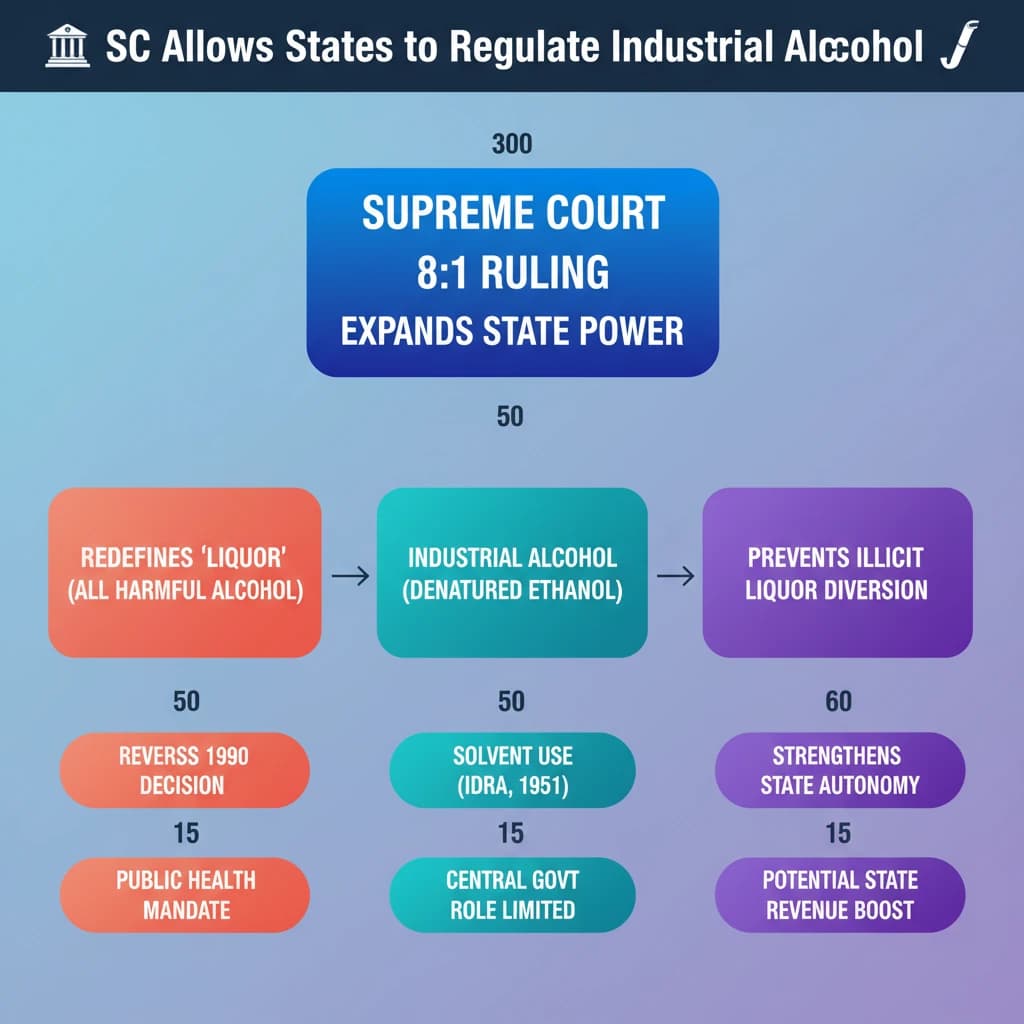
  • SC's 8:1 ruling grants states authority to regulate industrial alcohol, reversing a 1990 decision.
  • The ruling expands 'intoxicating liquor' definition beyond potable alcohol to include all alcohol harmful to public health.
  • Industrial alcohol is denatured ethanol used as a solvent, prone to diversion for illicit liquor.
  • Industries (Development and Regulation) Act, 1951 (IDRA) outlines central government's industrial regulatory powers.
  • The decision strengthens state autonomy, public health measures, and potentially state revenues.
  • Curative petition is the last legal remedy in the Supreme Court, used to correct grave errors.
SC Allows States to Regulate Industrial Alcohol

SC Allows States to Regulate Industrial Alcohol

Medium⏱️ 8 min read✓ 95% Verified
polity and governance

📖 Introduction

<h4>Context of the Ruling</h4><p>The <strong>Supreme Court</strong> recently delivered a landmark <strong>8:1 ruling</strong>, affirming the <strong>states' authority</strong> to regulate <strong>industrial alcohol</strong>.</p><p>This decision overturns a significant <strong>1990 judgment</strong> in the <strong>Synthetics & Chemicals v. State of Uttar Pradesh case (1989)</strong>, which had previously granted control to the <strong>central government</strong>.</p><div class='exam-tip-box'><p>This ruling is crucial for <strong>UPSC Mains GS-II (Polity & Governance)</strong>, especially topics related to <strong>Centre-State relations</strong> and <strong>judicial interpretation</strong> of legislative lists.</p></div><h4>SC Bench Ruling on Industrial Alcohol</h4><p>The majority <strong>Constitution Bench</strong> expanded the definition of <strong>“intoxicating liquor”</strong> beyond just potable alcohol.</p><p>It clarified that this term encompasses <strong>all types of alcohol</strong> that can potentially impact <strong>public health negatively</strong>, not just alcoholic beverages.</p><div class='key-point-box'><p>The court emphasized that substances like <strong>alcohol, opium, and drugs</strong> are prone to misuse. It ruled that <strong>Parliament cannot override state powers</strong> concerning intoxicating liquors, as “intoxicating” can also mean “<strong>poisonous</strong>,” allowing for a broader classification.</p></div><h4>Dissenting Opinion</h4><p><strong>Justice B.V. Nagarathna</strong> dissented, arguing against stretching <strong>Entry 8 – List II</strong> (State List) to include <strong>industrial alcohol</strong> merely due to its potential misuse.</p><p>She contended that allowing states to regulate industrial alcohol could lead to misinterpretations of the <strong>legislative intent</strong> behind alcohol regulation.</p><h4>Understanding Industrial Alcohol</h4><div class='info-box'><p><strong>Industrial alcohol</strong> is essentially <strong>impure alcohol</strong> primarily used as an <strong>industrial solvent</strong>. It is rendered unfit for human consumption through a process called <strong>denaturation</strong>.</p></div><p><strong>Denaturation</strong> involves mixing chemicals like <strong>benzene, pyridine, or gasoline</strong> with <strong>ethanol</strong>. This process significantly lowers its price and makes it dangerous to consume.</p><p><strong>Applications:</strong></p><ul><li>Used extensively in <strong>pharmaceuticals</strong>.</li><li>A key ingredient in <strong>cosmetics</strong>.</li><li>Found in various <strong>cleaning liquids</strong>.</li></ul><p><strong>Misuse:</strong> Despite denaturation, industrial alcohol is sometimes diverted to make <strong>illicit liquor</strong>, which is cheap, dangerous, and can cause severe health risks, including <strong>blindness and death</strong>.</p><h4>Industries (Development and Regulation) Act, 1951 (IDRA)</h4><p>The <strong>IDRA, 1951</strong>, provides the legal and conceptual framework for <strong>industrial development and regulation</strong> across India.</p><p><strong>Main Goals of the Act:</strong></p><ul><li>To <strong>control and direct</strong> the growth of national industries.</li><li>To promote <strong>fair resource distribution</strong>.</li><li>To prevent the <strong>concentration of economic power</strong>.</li><li>To ensure <strong>balanced and controlled industrial expansion</strong>.</li></ul><p><strong>Central Government Powers under IDRA:</strong></p><ul><li>Regulate the <strong>production, supply, and distribution</strong> of certain industries.</li><li>Impose restrictions on the establishment of <strong>new industries</strong>.</li><li>Grant <strong>licenses</strong> for industrial operations.</li><li>Create and run industries when deemed in the <strong>public interest</strong>.</li><li>Implement measures to prevent the <strong>concentration of economic power</strong>.</li></ul>
Concept Diagram

💡 Key Takeaways

  • •SC's 8:1 ruling grants states authority to regulate industrial alcohol, reversing a 1990 decision.
  • •The ruling expands 'intoxicating liquor' definition beyond potable alcohol to include all alcohol harmful to public health.
  • •Industrial alcohol is denatured ethanol used as a solvent, prone to diversion for illicit liquor.
  • •Industries (Development and Regulation) Act, 1951 (IDRA) outlines central government's industrial regulatory powers.
  • •The decision strengthens state autonomy, public health measures, and potentially state revenues.
  • •Curative petition is the last legal remedy in the Supreme Court, used to correct grave errors.

🧠 Memory Techniques
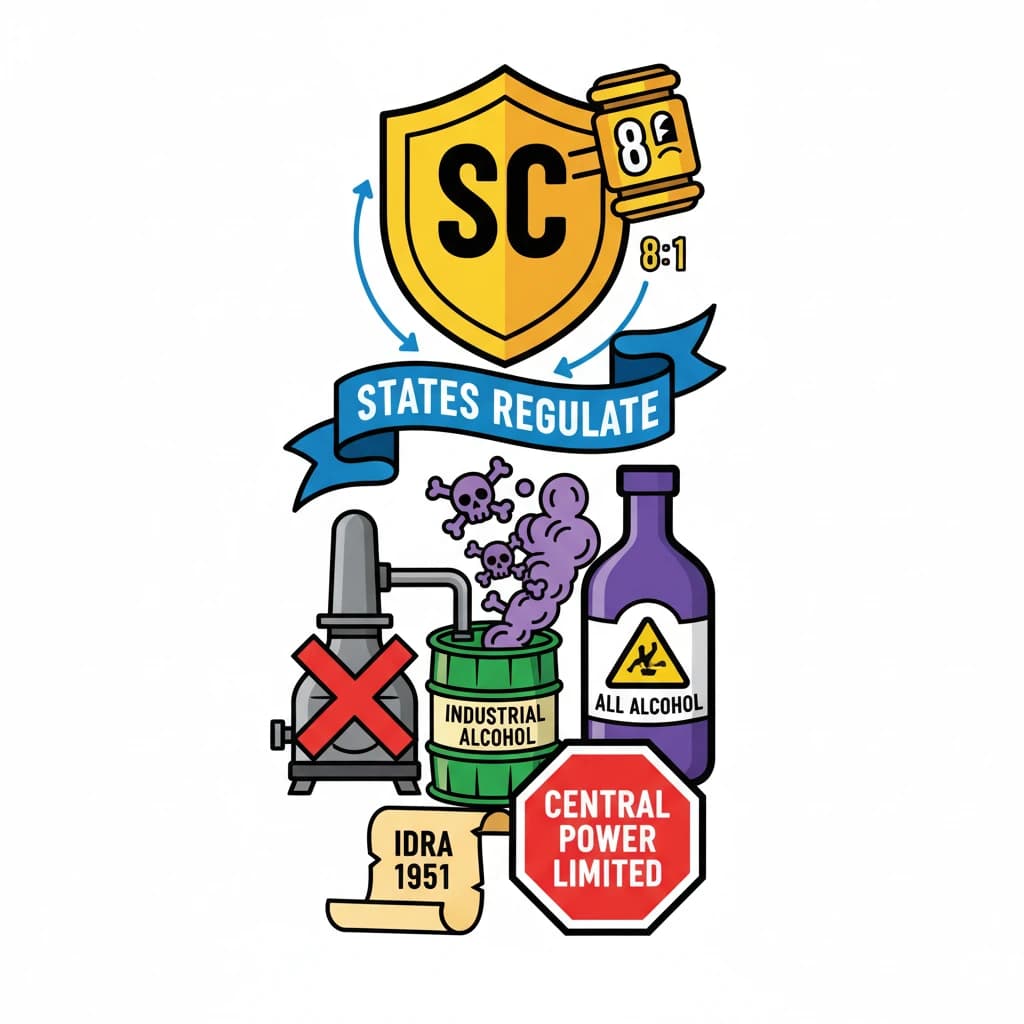
Memory Aid
95% Verified Content

📚 Reference Sources

•Supreme Court of India official pronouncements (implied by ruling details)

Related Topics

Loading related topics...
Explore:Polity And Governance Topics·All Subjects·Daily Current Affairs·Editorial Analysis·Previous Year Questions·UPSC GPT