Loading page, please wait…
Hindi Diwas 2024 - UPSC Polity And Governance
What is Hindi Diwas 2024 in UPSC Polity And Governance?
Hindi Diwas 2024 is a key topic under Polity And Governance for UPSC Civil Services Examination. Key points include: Hindi Diwas is celebrated on September 14th, commemorating Hindi's adoption as the official language in 1949.. The Munshi-Ayyangar formula led to Article 343, making Hindi (Devanagari script) the official language, with English continuing for 15 years.. The Official Languages Act 1963 ensured English's continued use alongside Hindi due to protests against imposition.. Understanding this topic is essential for both UPSC Prelims and Mains preparation.
Why is Hindi Diwas 2024 important for UPSC exam?
Hindi Diwas 2024 is a Medium-level topic in UPSC Polity And Governance. It is tested in both Prelims (factual MCQs) and Mains (analytical answer writing). Previous year UPSC questions have frequently covered aspects of Hindi Diwas 2024, making it essential for comprehensive IAS preparation.
How to prepare Hindi Diwas 2024 for UPSC?
To prepare Hindi Diwas 2024 for UPSC: (1) Study the comprehensive notes covering all key concepts on Vaidra. (2) Practice previous year questions on this topic. (3) Connect it with current affairs using daily updates. (4) Revise using key takeaways and mind maps available for Polity And Governance. (5) Write practice answers linking Hindi Diwas 2024 to related GS Paper topics.
Key takeaways of Hindi Diwas 2024 for UPSC
- Hindi Diwas is celebrated on September 14th, commemorating Hindi's adoption as the official language in 1949.
- The Munshi-Ayyangar formula led to Article 343, making Hindi (Devanagari script) the official language, with English continuing for 15 years.
- The Official Languages Act 1963 ensured English's continued use alongside Hindi due to protests against imposition.
- Articles 210 (language in legislature) and 351 (Union's duty to promote Hindi) are key constitutional provisions.
- Hindi is one of 22 languages in the Eighth Schedule but is not a classical language.
- The source material also briefly mentioned Article 44 (UCC) and the nature of Indian Socialism (Article 19(1)(g)).
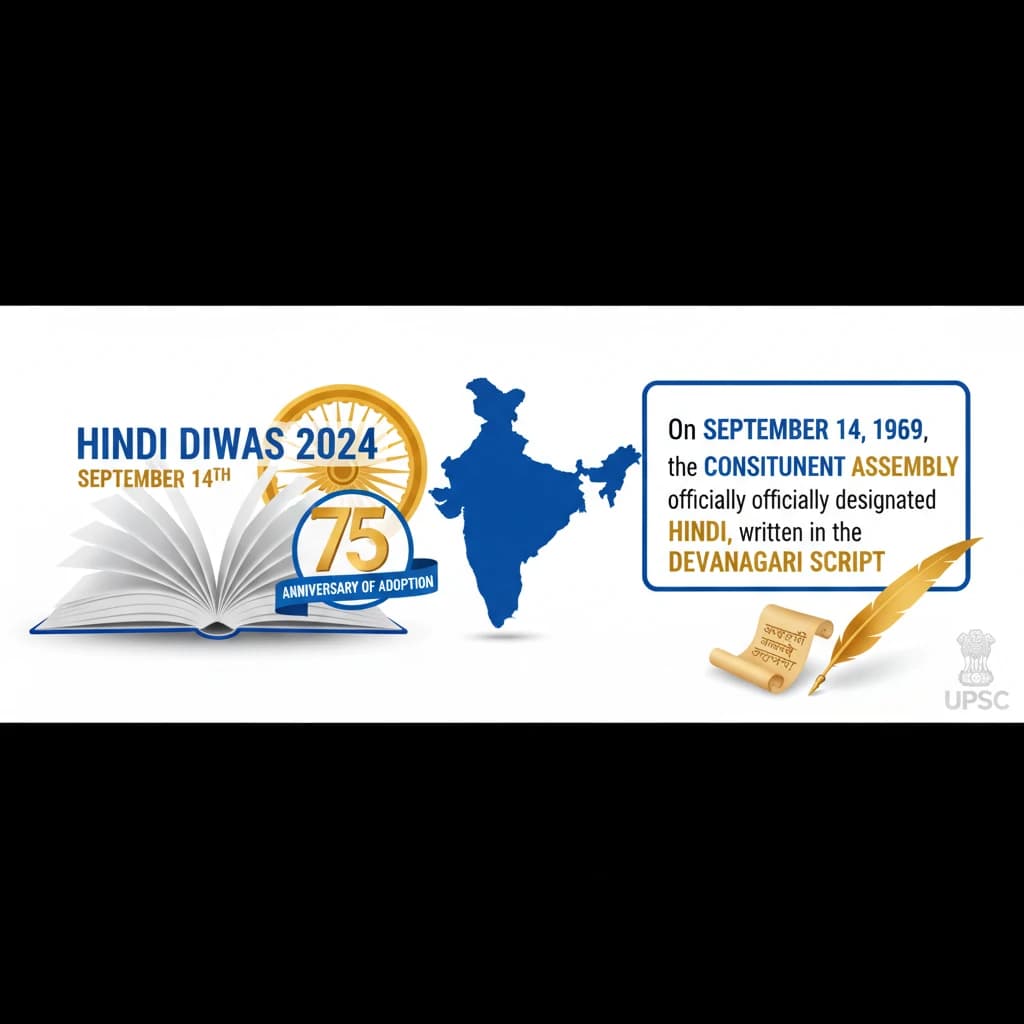
Hindi Diwas 2024
Medium⏱️ 7 min read
polity and governance
📖 Introduction
Introduction to Hindi Diwas 2024
Hindi Diwas 2024 was celebrated on September 14th, marking a significant milestone. This year commemorated the 75th anniversary of Hindi's adoption as the official language of the country.
On September 14, 1949, the Constituent Assembly officially designated Hindi, written in the Devanagari script, as the official language of the Union of India.
Constitutional Mentions (from Source Context)
The provided source material also briefly touched upon other constitutional provisions. It stated that Article 44 permits the government to strive for a Uniform Civil Code (UCC).
This pursuit of a UCC is not restricted by the term 'Secular' as mentioned in the Preamble of the Constitution.
Furthermore, the Socialism practiced in India aims for the economic and social upliftment of citizens. This form of socialism does not restrict private entrepreneurship or the right to do business, which is guaranteed as a fundamental right under Article 19(1)(g).
The Munshi-Ayyangar Formula
The decision to adopt Hindi as the official language was a result of the Munshi-Ayyangar formula. This was a crucial compromise reached between K.M. Munshi and N. Gopalaswamy Ayyangar during the Constituent Assembly debates.
This formula led to the inclusion of Article 343 in the Constitution. It adopted Hindi in the Devanagari script as the official language of the Union, while also allowing English to continue for official purposes for an initial period of fifteen years.
Official Languages Act 1963
As the initial 15-year period for the use of English was nearing its end, significant protests erupted. These protests were driven by the fear of Hindi imposition on non-Hindi speaking regions.
In response to these concerns, the Official Languages Act 1963 was enacted. This Act played a pivotal role in upholding English as an official language alongside Hindi, ensuring continuity and addressing regional sentiments.
Key Articles Related to Hindi
Article 210: This article states that the language to be used in the legislature of a state can be the official language of that state, Hindi, or English.
Article 351: This article mandates that it shall be the duty of the Union to promote the spread of the Hindi language. The goal is to develop it so that it may serve as a medium of expression for all elements of India's composite culture.
Status and Origin of Hindi
Hindi is one of the 22 languages officially recognized and listed in the Eighth Schedule of the Constitution of India.
It is important to note that Hindi is not a classical language, distinguishing it from languages like Sanskrit, Tamil, Telugu, Kannada, Malayalam, and Odia.
The name 'Hindi' itself has historical roots. It is derived from the Persian word 'Hind', which means 'land of the Indus River'. Linguistically, Hindi is a direct descendant of Sanskrit.
Understanding the constitutional provisions (Articles 343, 210, 351) and the historical context (Munshi-Ayyangar formula, Official Languages Act 1963) is crucial for UPSC Mains questions on language policy and federalism.
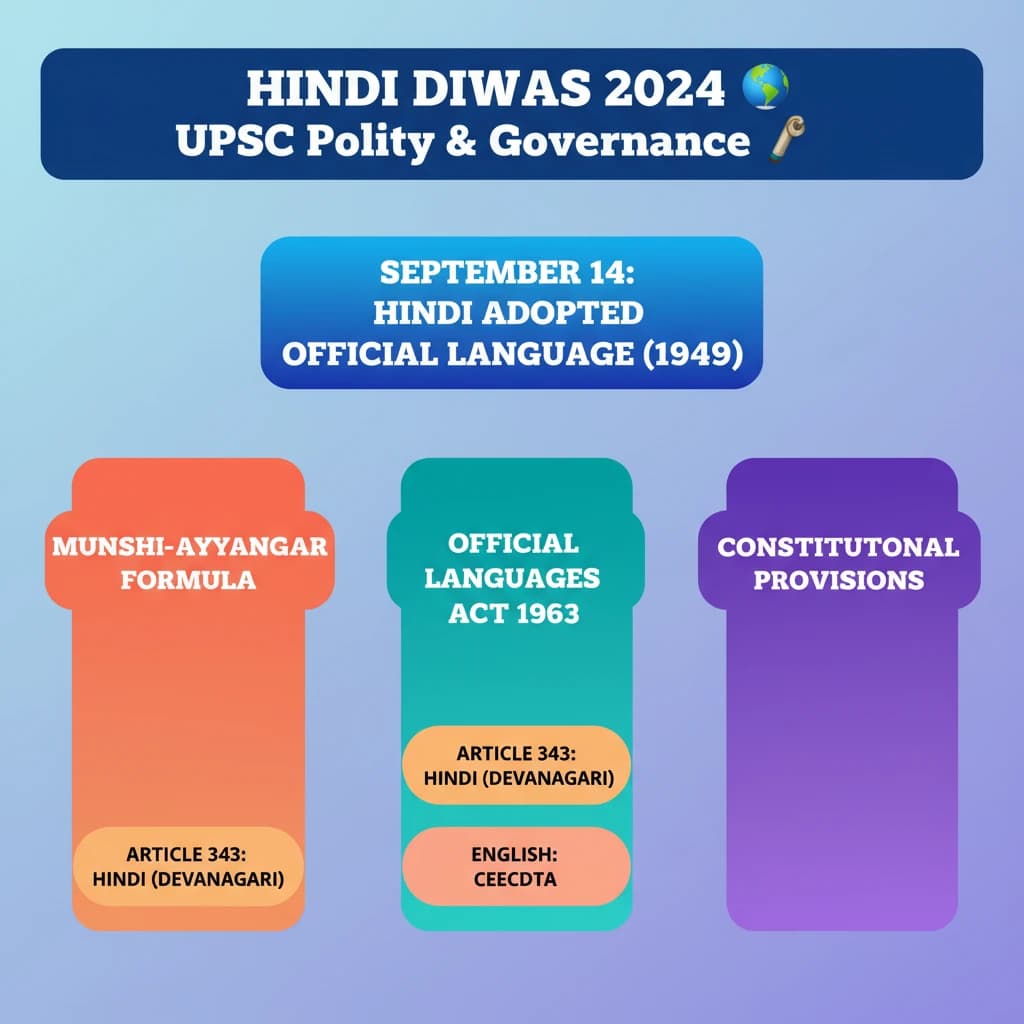
💡 Key Takeaways
- •Hindi Diwas is celebrated on September 14th, commemorating Hindi's adoption as the official language in 1949.
- •The Munshi-Ayyangar formula led to Article 343, making Hindi (Devanagari script) the official language, with English continuing for 15 years.
- •The Official Languages Act 1963 ensured English's continued use alongside Hindi due to protests against imposition.
- •Articles 210 (language in legislature) and 351 (Union's duty to promote Hindi) are key constitutional provisions.
- •Hindi is one of 22 languages in the Eighth Schedule but is not a classical language.
- •The source material also briefly mentioned Article 44 (UCC) and the nature of Indian Socialism (Article 19(1)(g)).
🧠 Memory Techniques
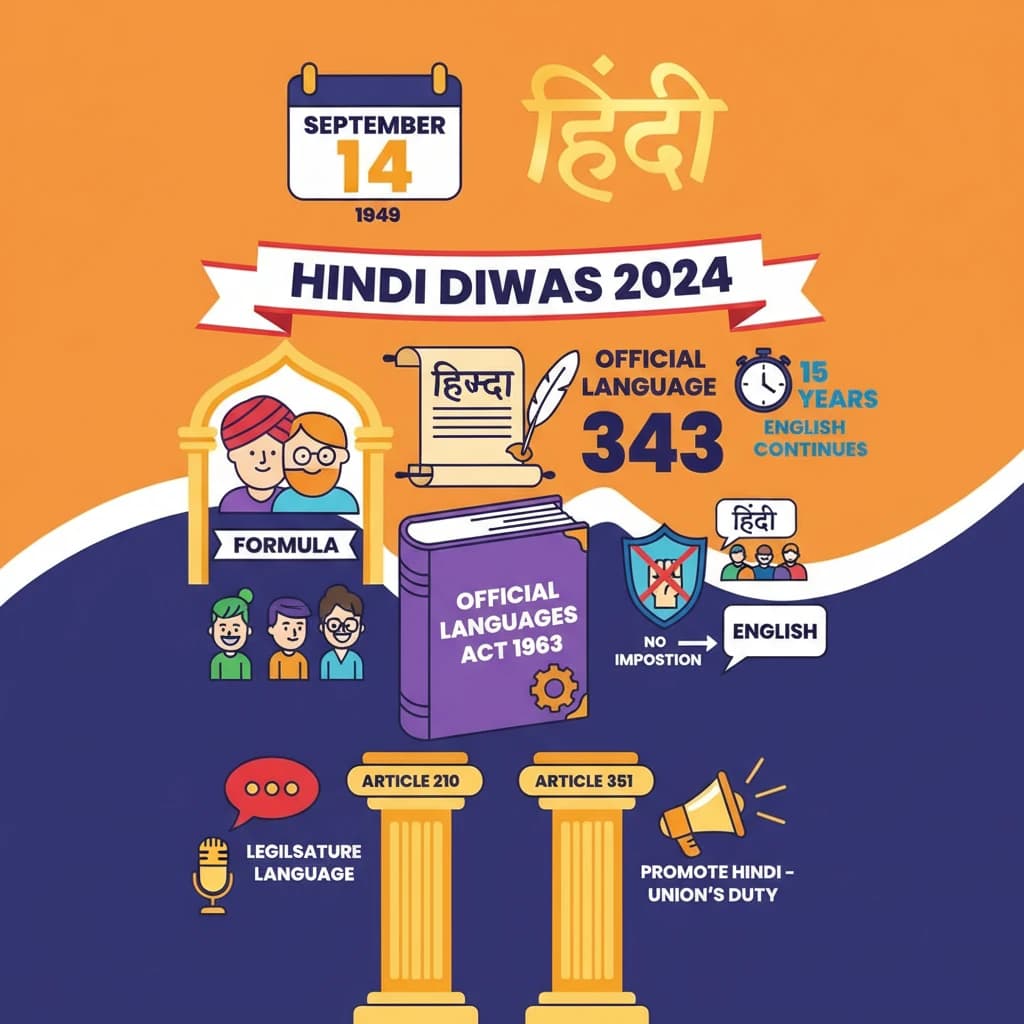
95% Verified Content
📚 Reference Sources
•The Constitution of India (Articles 44, 19(1)(g), 210, 343, 351, Preamble, Eighth Schedule)
•Official Languages Act, 1963