Loading page, please wait…
Indirect Election System - UPSC Polity And Governance
What is Indirect Election System in UPSC Polity And Governance?
Indirect Election System is a key topic under Polity And Governance for UPSC Civil Services Examination. Key points include: Rajya Sabha members are elected indirectly by MLAs using Proportional Representation by Single Transferable Vote (STV).. Candidates need to secure a specific 'quota' of votes to be elected, with MLAs' votes valued at 100 in multi-seat states.. The STV system involves ranking preferences, transferring surplus votes, and eliminating candidates with the fewest votes until all seats are filled.. Understanding this topic is essential for both UPSC Prelims and Mains preparation.
Why is Indirect Election System important for UPSC exam?
Indirect Election System is a Medium-level topic in UPSC Polity And Governance. It is tested in both Prelims (factual MCQs) and Mains (analytical answer writing). Previous year UPSC questions have frequently covered aspects of Indirect Election System, making it essential for comprehensive IAS preparation.
How to prepare Indirect Election System for UPSC?
To prepare Indirect Election System for UPSC: (1) Study the comprehensive notes covering all key concepts on Vaidra. (2) Practice previous year questions on this topic. (3) Connect it with current affairs using daily updates. (4) Revise using key takeaways and mind maps available for Polity And Governance. (5) Write practice answers linking Indirect Election System to related GS Paper topics.
Key takeaways of Indirect Election System for UPSC
- Rajya Sabha members are elected indirectly by MLAs using Proportional Representation by Single Transferable Vote (STV).
- Candidates need to secure a specific 'quota' of votes to be elected, with MLAs' votes valued at 100 in multi-seat states.
- The STV system involves ranking preferences, transferring surplus votes, and eliminating candidates with the fewest votes until all seats are filled.
- The 2015 SC judgment in Shailesh Manubhai Parmar v ECI denied NOTA for Rajya Sabha elections, citing Article 80(4).
- The 2024 SC judgment overruled the 1998 JMM Bribery Case, clarifying that parliamentary immunity (Article 105(2)) does not protect legislators taking bribes to vote or speak.
Indirect Election System
Medium⏱️ 9 min read
polity and governance
📖 Introduction
Introduction to Indirect Election System
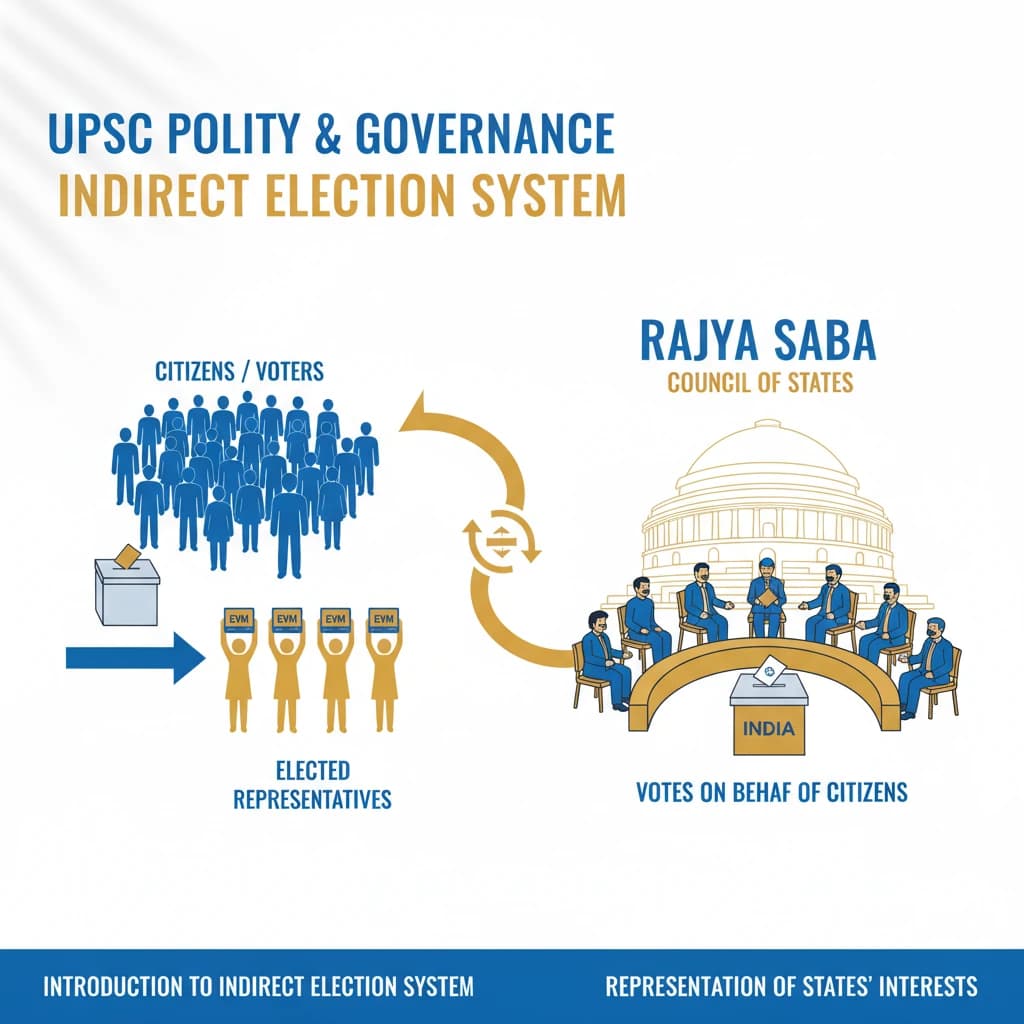
The Indirect Election System is a method where citizens do not directly vote for candidates. Instead, their elected representatives cast votes on their behalf.
In India, this system is primarily used for the election of members to the Rajya Sabha, the upper house of Parliament.
This ensures that the Rajya Sabha truly represents the interests of the states, as its members are chosen by the State Legislative Assemblies.
Key Features of Rajya Sabha Elections
Members of the Rajya Sabha are elected by the elected members of the State Legislative Assemblies.
The election follows the system of Proportional Representation by means of the Single Transferable Vote (STV).
This system aims to ensure that various political parties secure representation in proportion to their strength in the state assembly.
Understanding Proportional Representation and STV
Proportional Representation ensures that seats are allocated to parties in an assembly based on the percentage of votes they receive.
The Single Transferable Vote (STV) is a specific method within proportional representation. It allows voters to rank candidates in order of preference.
This system minimizes wasted votes and ensures a more accurate reflection of the electorate's will compared to a simple majority system.
The Quota System
To be declared elected in a Rajya Sabha election, a candidate must secure a specific number of votes, known as the quota.
The general formula for calculating the quota is: (Total valid votes / (Number of seats available + 1)) + 1.
In states with multiple seats, the initial value of each MLA's vote is typically fixed at 100. The quota is then calculated based on this value (e.g., number of MLAs x 100).
Preference Marking and Surplus Vote Transfer
MLAs mark their preferences on the ballot paper against the names of candidates. '1' indicates the first preference, '2' for the next, and so forth.
If a candidate receives enough first preferential votes to meet or exceed the quota, they are immediately elected.
If an elected candidate has surplus votes (votes beyond the quota), these votes are transferred to the voter's second choice (marked as '2'). The largest surplus is transferred first.
Elimination of Candidates and Vote Redistribution
If the required number of candidates are not elected after the transfer of surplus votes, the candidate with the fewest votes is eliminated.
Their unexhausted ballot papers are then redistributed among the remaining candidates based on the next available preference marked on them.
An "exhausted paper" refers to a ballot paper where no further preferences are recorded for any of the remaining candidates.
This process of surplus vote transfers and eliminations continues iteratively until all available seats are filled by candidates who reach the quota.
💡 Key Takeaways
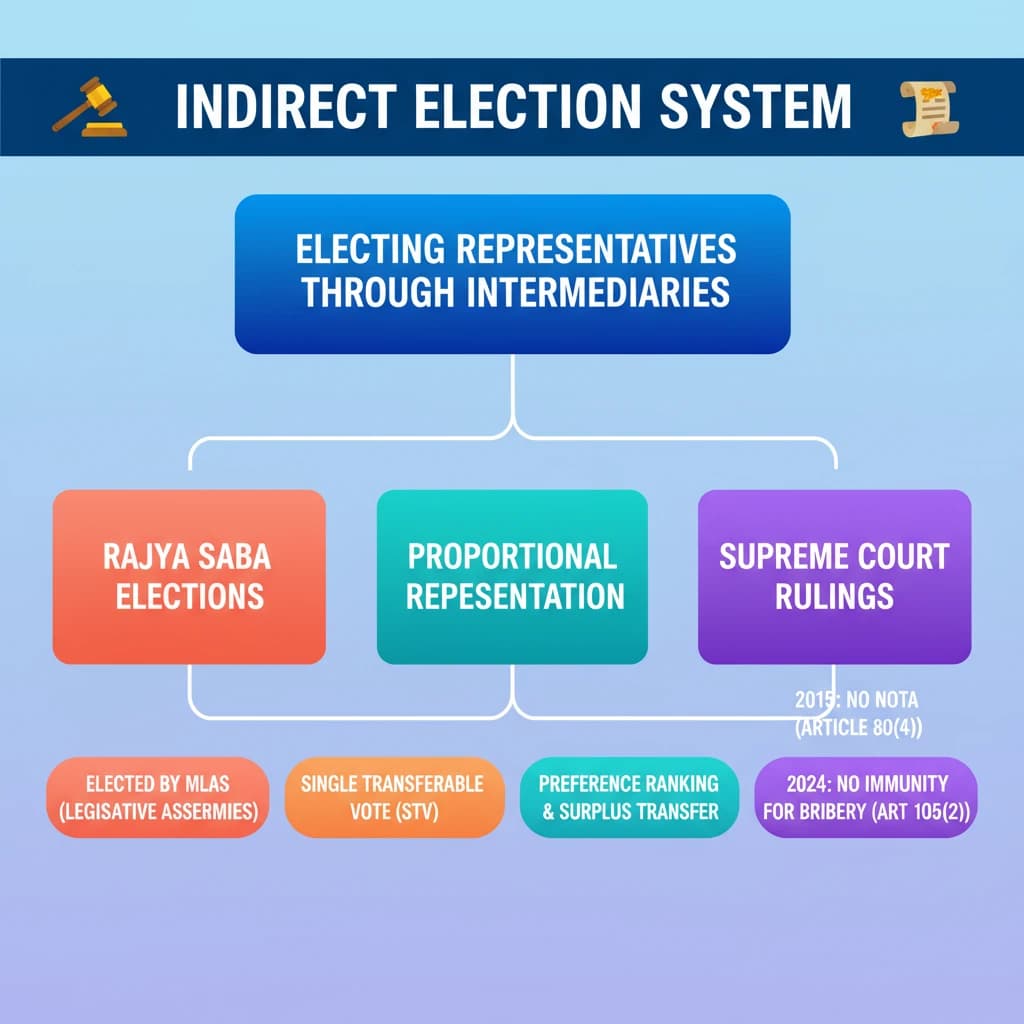
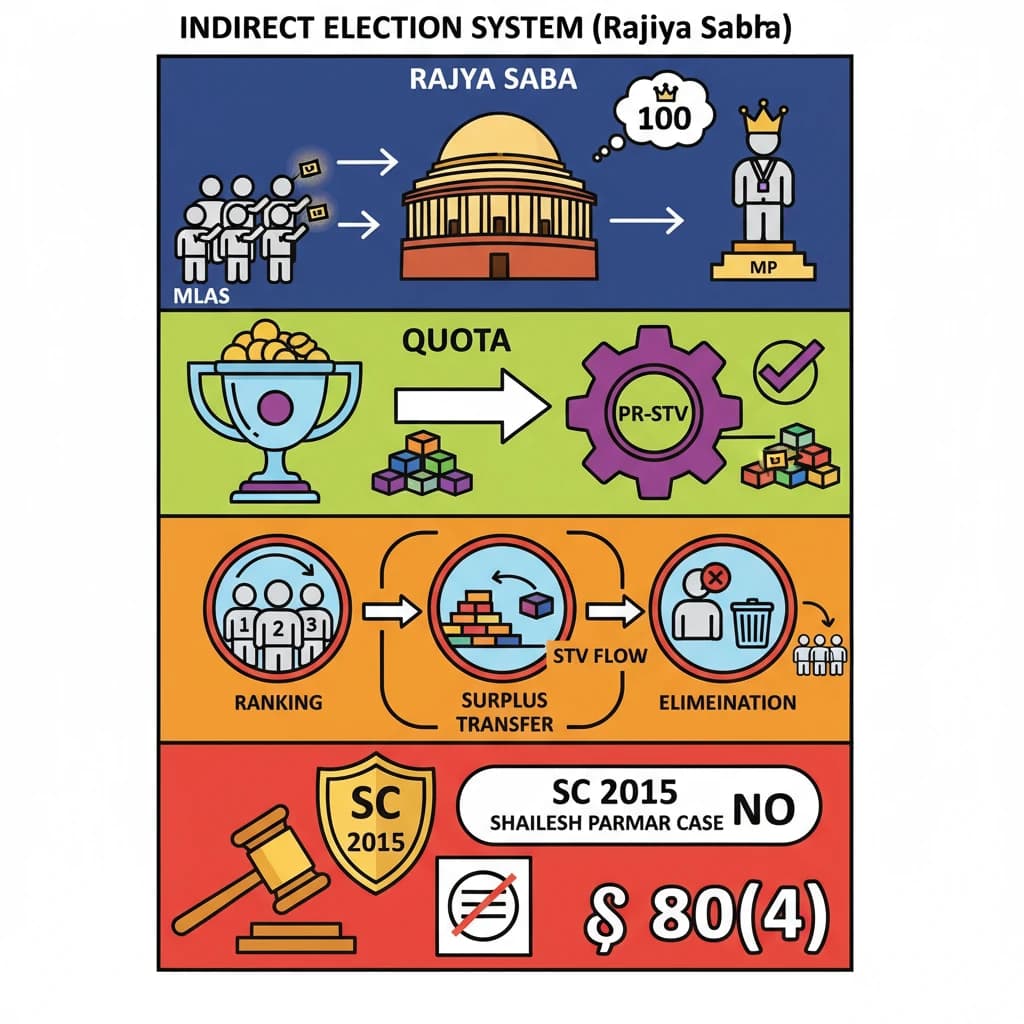
- •Rajya Sabha members are elected indirectly by MLAs using Proportional Representation by Single Transferable Vote (STV).
- •Candidates need to secure a specific 'quota' of votes to be elected, with MLAs' votes valued at 100 in multi-seat states.
- •The STV system involves ranking preferences, transferring surplus votes, and eliminating candidates with the fewest votes until all seats are filled.
- •The 2015 SC judgment in Shailesh Manubhai Parmar v ECI denied NOTA for Rajya Sabha elections, citing Article 80(4).
- •The 2024 SC judgment overruled the 1998 JMM Bribery Case, clarifying that parliamentary immunity (Article 105(2)) does not protect legislators taking bribes to vote or speak.
🧠 Memory Techniques
95% Verified Content
📚 Reference Sources
•The Constitution of India (specifically Articles 80(4), 105(2))
•Supreme Court judgments: Shailesh Manubhai Parmar v Election Commission of India (2015)
•Supreme Court judgments: JMM Bribery Case (1998) and the 2024 Seven-Judge Bench ruling overruling the 1998 judgment