Loading page, please wait…
Joint Sitting of Parliament and Leader of House - UPSC Polity And Governance
What is Joint Sitting of Parliament and Leader of House in UPSC Polity And Governance?
Joint Sitting of Parliament and Leader of House is a key topic under Polity And Governance for UPSC Civil Services Examination. Key points include: Joint Sittings are for Presidential addresses (Article 87) or resolving legislative deadlocks (Article 108).. Article 87 was amended in 1951 for addresses after general elections and at the start of each year.. Joint Sittings for bills are chaired by the Lok Sabha Speaker and follow Lok Sabha rules.. Understanding this topic is essential for both UPSC Prelims and Mains preparation.
Why is Joint Sitting of Parliament and Leader of House important for UPSC exam?
Joint Sitting of Parliament and Leader of House is a Medium-level topic in UPSC Polity And Governance. It is tested in both Prelims (factual MCQs) and Mains (analytical answer writing). Previous year UPSC questions have frequently covered aspects of Joint Sitting of Parliament and Leader of House, making it essential for comprehensive IAS preparation.
How to prepare Joint Sitting of Parliament and Leader of House for UPSC?
To prepare Joint Sitting of Parliament and Leader of House for UPSC: (1) Study the comprehensive notes covering all key concepts on Vaidra. (2) Practice previous year questions on this topic. (3) Connect it with current affairs using daily updates. (4) Revise using key takeaways and mind maps available for Polity And Governance. (5) Write practice answers linking Joint Sitting of Parliament and Leader of House to related GS Paper topics.
Key takeaways of Joint Sitting of Parliament and Leader of House for UPSC
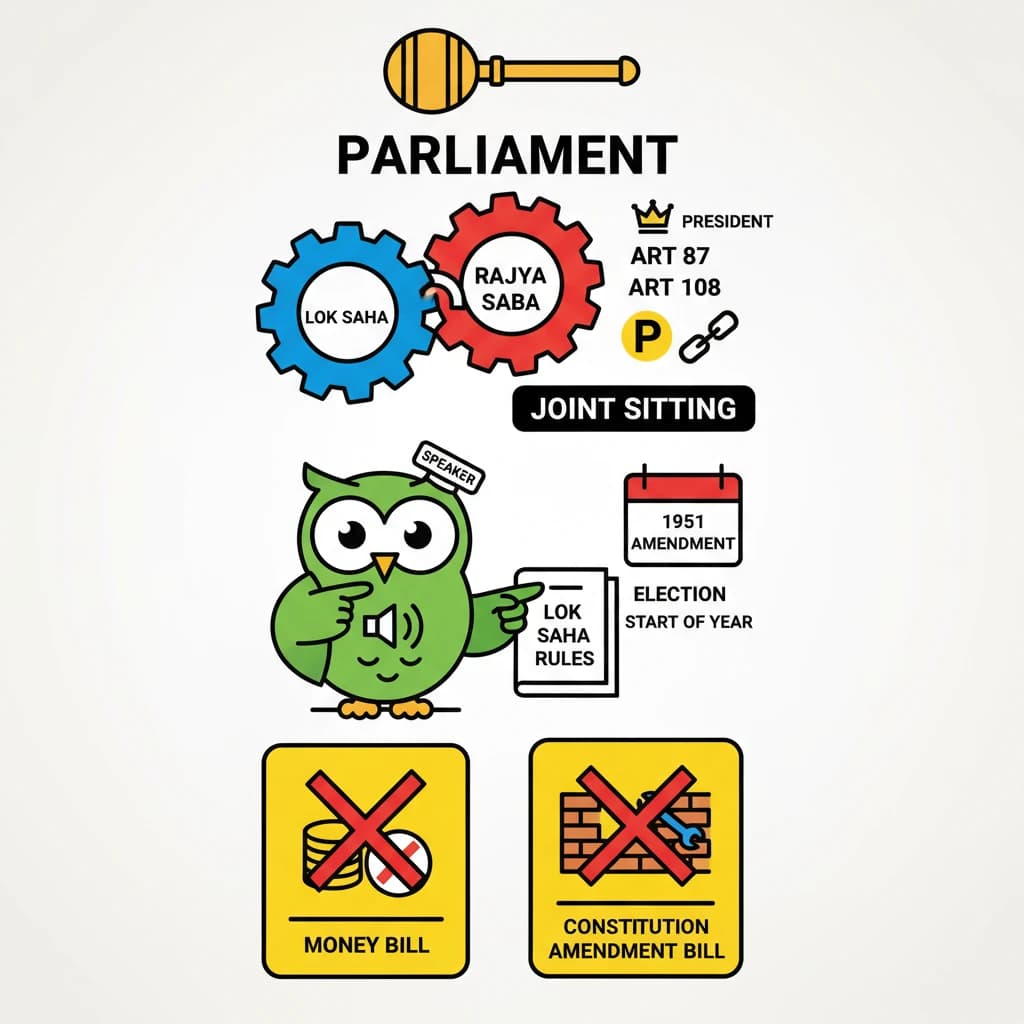
- Joint Sittings are for Presidential addresses (Article 87) or resolving legislative deadlocks (Article 108).
- Article 87 was amended in 1951 for addresses after general elections and at the start of each year.
- Joint Sittings for bills are chaired by the Lok Sabha Speaker and follow Lok Sabha rules.
- Money Bills and Constitution Amendment Bills are exceptions to joint sittings.
- Only three bills (Dowry Prohibition, Banking Service Commission Repeal, POTA) have passed via joint sittings.
- The Leader of the House manages government business; PM is usually LoH in Lok Sabha, a nominated minister in Rajya Sabha.
- LoH is defined by parliamentary rules, not the Constitution.
Joint Sitting of Parliament and Leader of House
Medium⏱️ 10 min read
polity and governance
📖 Introduction
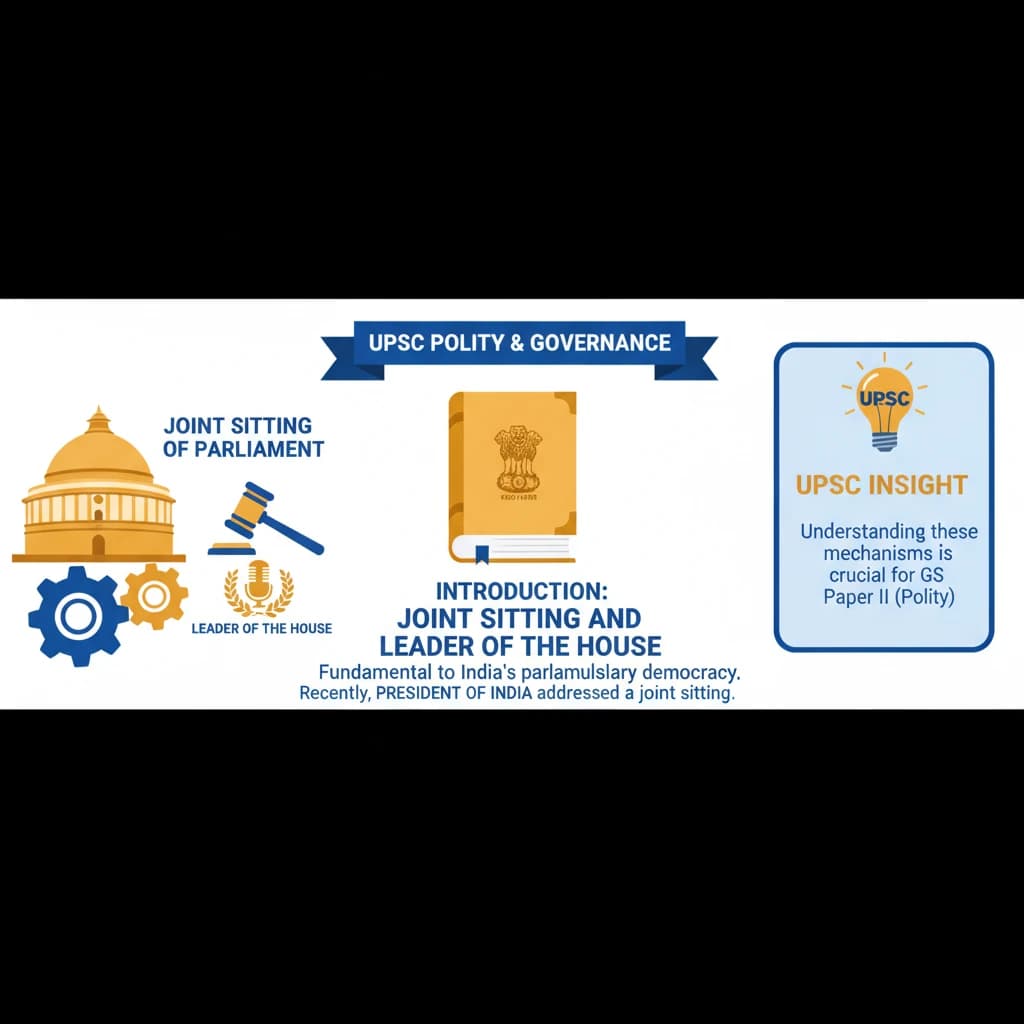
Introduction: Joint Sitting and Leader of the House
The concepts of Joint Sitting of Parliament and the Leader of the House are fundamental to the functioning of India's parliamentary democracy. Recently, the President of India addressed a joint sitting, bringing these provisions into focus.
UPSC Insight: Understanding these mechanisms is crucial for GS Paper II (Polity), especially for questions on parliamentary procedures, constitutional provisions, and the roles of key functionaries.
What is a Joint Sitting of Parliament?
A joint sitting involves both houses of Parliament – the Lok Sabha (House of the People) and the Rajya Sabha (Council of States) – convening together as a single body.
Constitutional Basis: Joint sittings are primarily governed by Article 87 and Article 108 of the Indian Constitution.
Types of Joint Sittings
The Indian parliamentary system recognizes two primary scenarios for a joint sitting:
- Presidential Address (Article 87): This occurs when the President addresses both Houses.
- Resolution of Legislative Deadlocks (Article 108): This is convened to resolve disagreements between the two Houses on a legislative bill.
Presidential Address under Article 87
Article 87 mandates specific occasions for the President to address both Houses of Parliament. This address outlines the government's agenda.
- The President addresses the Rajya Sabha and Lok Sabha at the beginning of the first session after each general election.
- The President also addresses both Houses at the beginning of the first session of each year.
Historical Amendment: The Constitution (First Amendment) Act of 1951 modified Article 87. It replaced the phrase "every session" with "the first session after each general election to the House of the People and at the commencement of the first session of each year."
Significance of the Presidential Address
The President's address is a significant event in the parliamentary calendar. It serves several key purposes:
- It provides an opportunity for the President to outline the government's policy priorities and its legislative agenda.
- The address delivered after a general election is particularly important, as it often reflects the mandate and priorities of the newly elected government.
Joint Sitting for Legislative Deadlocks (Article 108)
Article 108 allows for a joint sitting to resolve a legislative deadlock between the Lok Sabha and Rajya Sabha. This mechanism is invoked in specific scenarios:
- When a bill passed by one house is rejected by the other house.
- When a bill is passed by one house, but the other house has not returned it within a stipulated period.
- When more than six months have elapsed from the date of receipt of a bill by the other House without the bill being passed by it.
Key Provisions for Joint Sittings (Article 108)
Specific rules govern the conduct of a joint sitting convened under Article 108:
- The joint sitting is chaired by the Speaker of the Lok Sabha.
- The proceedings of the joint sitting follow the rules of procedure of the Lok Sabha.
- A quorum for a joint sitting is one-tenth of the total members from both houses.
- It is considered a last resort to resolve legislative deadlocks, emphasizing the importance of bicameral consensus.
Exceptions to Joint Sittings
Not all legislative deadlocks can be resolved through a joint sitting. There are two crucial exceptions:
- Money Bills (Article 110): The Rajya Sabha has limited powers regarding Money Bills; therefore, a deadlock on such a bill does not warrant a joint sitting.
- Constitution Amendment Bills (Article 368): These bills require passage by a special majority in each House separately, precluding the possibility of a joint sitting.
Important Fact: Only three bills have been passed through joint sittings since 1950.
- Dowry Prohibition Bill, 1960
- Banking Service Commission (Repeal) Bill, 1977
- Prevention of Terrorism Bill, 2002 (POTA)
Who is the Leader of the House (LoH)?
The Leader of the House (LoH) is a pivotal functionary in the parliamentary system, responsible for coordinating government business and maintaining decorum.
Legal Backing: While not explicitly defined in the Constitution, the term Leader of the House is officially recognized and defined in the Rules of Procedure of Parliament.
Leader of the House in Rajya Sabha
In the Rajya Sabha, the Leader of the House is typically a senior minister.
- He is a minister and a member of the Rajya Sabha.
- He is nominated by the Prime Minister to function in this role.
- The Leader of the House has the authority to appoint a Deputy Leader of the House.
Current LoH in Rajya Sabha: As of the 264th session of the Rajya Sabha, Health Minister Jagat Prakash Nadda was officially appointed as the Leader of the House.
Responsibilities of the Leader of the House (Rajya Sabha)
The Leader of the House in the Rajya Sabha performs several crucial functions:
- Oversees the overall legislative process, especially debates and discussions.
- Works to maintain harmony among members of the House.
- Upholds the respect and dignity of the Rajya Sabha.
- Ensures standard proceedings during parliamentary debates and legislative business.
Leader of the House in Lok Sabha
The role of the Leader of the House in the Lok Sabha is equally significant.
- By strong convention, the Prime Minister is always the Leader of the Lok Sabha if they are a member of the House.
- If the Prime Minister is not a member of the Lok Sabha, then a minister who is a member of the House is nominated by the Prime Minister for this role.
International Comparison: In the United States, a comparable position to the Leader of the House is known as the 'majority leader'.
💡 Key Takeaways
- •Joint Sittings are for Presidential addresses (Article 87) or resolving legislative deadlocks (Article 108).
- •Article 87 was amended in 1951 for addresses after general elections and at the start of each year.
- •Joint Sittings for bills are chaired by the Lok Sabha Speaker and follow Lok Sabha rules.
- •Money Bills and Constitution Amendment Bills are exceptions to joint sittings.
- •Only three bills (Dowry Prohibition, Banking Service Commission Repeal, POTA) have passed via joint sittings.
- •The Leader of the House manages government business; PM is usually LoH in Lok Sabha, a nominated minister in Rajya Sabha.
- •LoH is defined by parliamentary rules, not the Constitution.
🧠 Memory Techniques
95% Verified Content
📚 Reference Sources
•The Constitution of India (Articles 87, 108, 110, 368)
•Rules of Procedure and Conduct of Business in Lok Sabha
•Rules of Procedure and Conduct of Business in Rajya Sabha