Loading page, please wait…
Office of Governor and Related Concerns - UPSC Polity And Governance
What is Office of Governor and Related Concerns in UPSC Polity And Governance?
Office of Governor and Related Concerns is a key topic under Polity And Governance for UPSC Civil Services Examination. Key points include: Governor is the constitutional head of the state (Article 153, 154), appointed by the President (Article 155).. Qualifications: Indian citizen, 35+ years, not MP/MLA. Oath under Article 159 before HC Chief Justice.. Key legislative powers include dissolving assembly (Article 174), floor test (Article 175(2)), addressing legislature (Article 176).. Understanding this topic is essential for both UPSC Prelims and Mains preparation.
Why is Office of Governor and Related Concerns important for UPSC exam?
Office of Governor and Related Concerns is a Medium-level topic in UPSC Polity And Governance. It is tested in both Prelims (factual MCQs) and Mains (analytical answer writing). Previous year UPSC questions have frequently covered aspects of Office of Governor and Related Concerns, making it essential for comprehensive IAS preparation.
How to prepare Office of Governor and Related Concerns for UPSC?
To prepare Office of Governor and Related Concerns for UPSC: (1) Study the comprehensive notes covering all key concepts on Vaidra. (2) Practice previous year questions on this topic. (3) Connect it with current affairs using daily updates. (4) Revise using key takeaways and mind maps available for Polity And Governance. (5) Write practice answers linking Office of Governor and Related Concerns to related GS Paper topics.
Key takeaways of Office of Governor and Related Concerns for UPSC
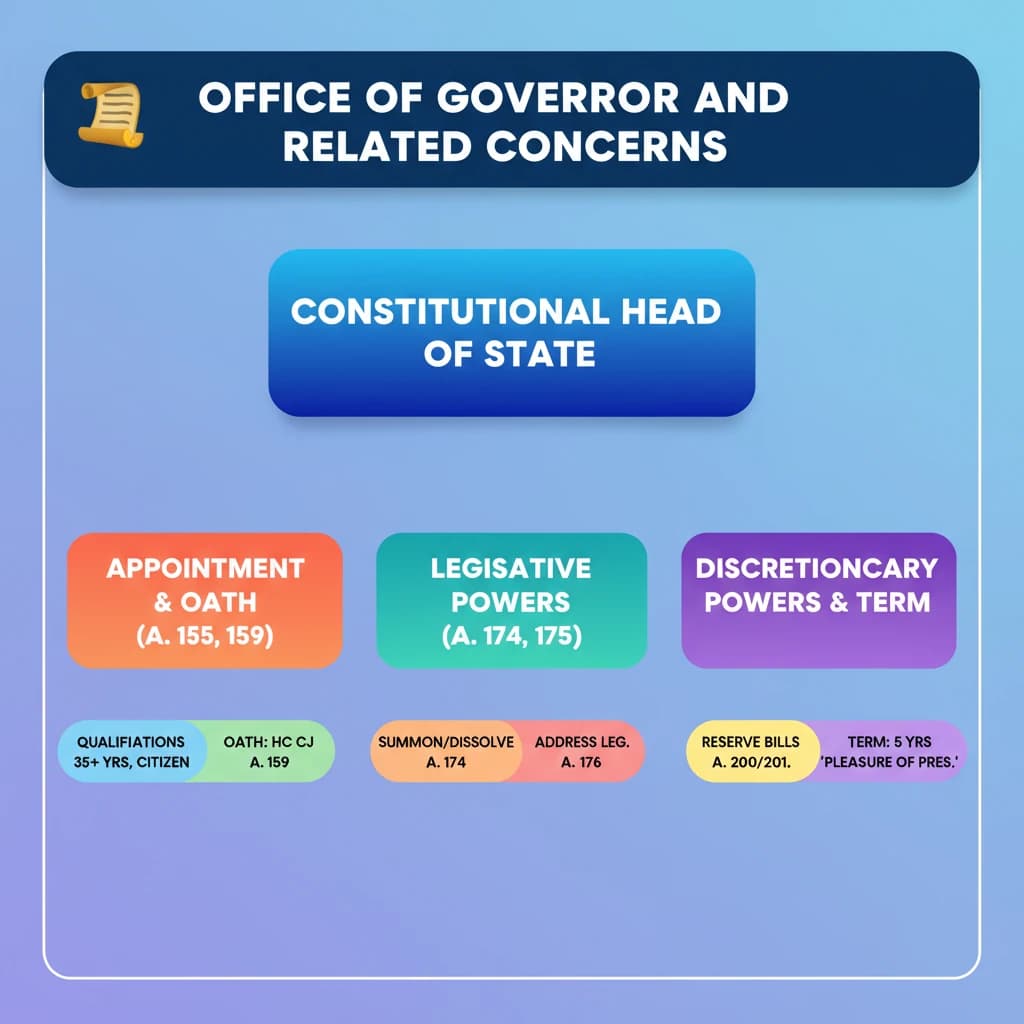
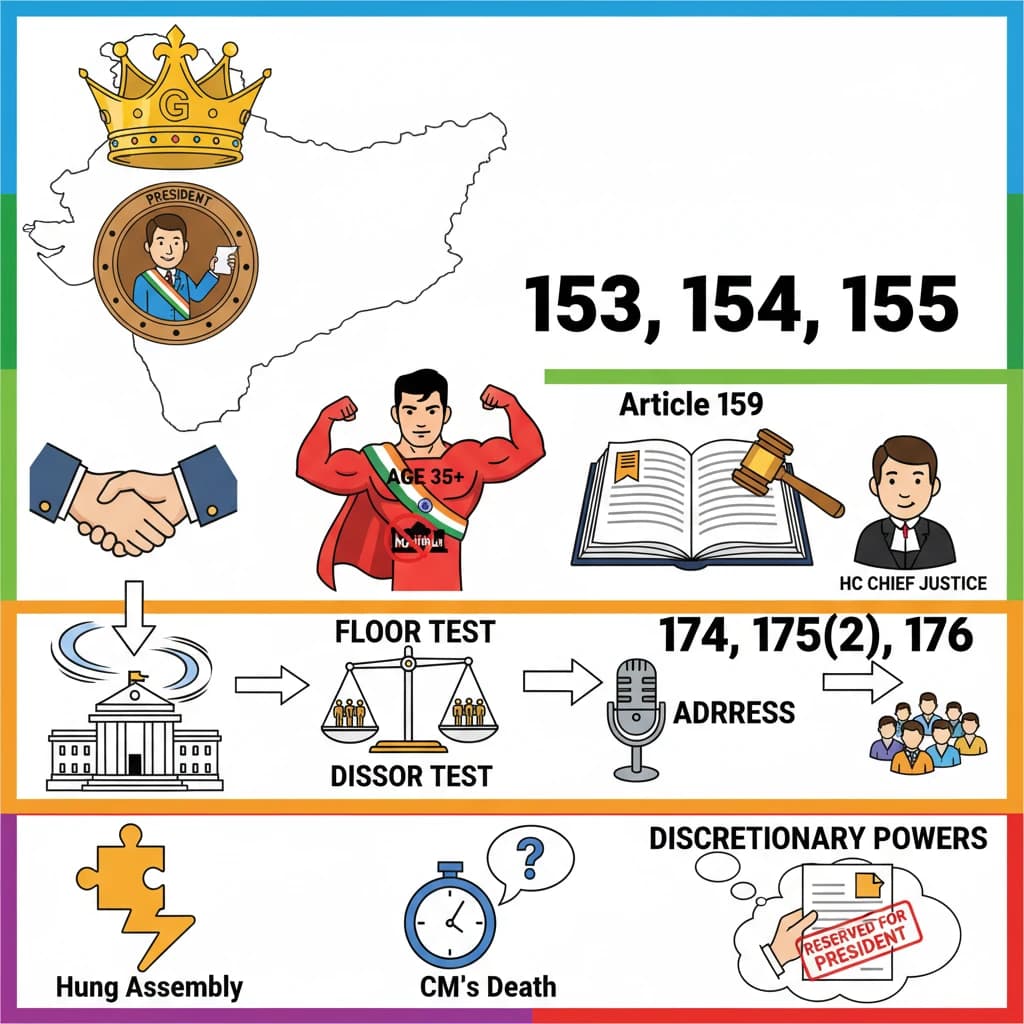
- Governor is the constitutional head of the state (Article 153, 154), appointed by the President (Article 155).
- Qualifications: Indian citizen, 35+ years, not MP/MLA. Oath under Article 159 before HC Chief Justice.
- Key legislative powers include dissolving assembly (Article 174), floor test (Article 175(2)), addressing legislature (Article 176).
- Constitutional discretionary powers are crucial in hung assemblies, CM's sudden death, or reserving bills for President.
- Term is 5 years, 'pleasure of President' (Article 156), can be dismissed by President on PM's advice.
- Article 361 grants comprehensive immunities: no court answerability, no criminal proceedings, no arrest, limited civil proceedings after notice.
- The office is a vital link between Union and State, often subject to debates on impartiality and federal balance, prompting reform recommendations.

Office of Governor and Related Concerns
Medium⏱️ 8 min read
polity and governance
📖 Introduction
Introduction: The Office of Governor
The Governor serves as the constitutional head of a State in India, acting as a vital link between the Union and State governments.
Recently, the appointment and reappointment of Governors for various states like Manipur, Mizoram, and Bihar have brought the office into public discourse.
The Office of Governor is a recurring topic in UPSC Civil Services Exam, particularly in GS Paper II (Polity), focusing on its constitutional provisions, powers, and controversies.
Constitutional Provisions for the Governor
The Constitution of India outlines the framework for the Governor's office through several key articles.
- Article 153: Mandates a Governor for each State. It also allows the same person to be appointed as Governor for two or more States.
- Article 154: Vests the executive power of the State in the Governor. This power can be exercised directly or through subordinate officers.
The Governor is generally bound by the advice of the Council of Ministers, making them a nominal head, similar to the President at the Union level.
Appointment and Qualifications of the Governor
The process for selecting a Governor is distinct from elected offices, emphasizing their role as a central appointee.
- Appointment: Article 155 states that the President of India appoints the Governor of a State.
- Nature of Office: Although appointed by the President, the Governor is not considered an employee of the Government of India.
- Office of Profit: A Governor must not hold any office of profit during their tenure.
Specific criteria are laid down to ensure the suitability of candidates for this high constitutional office.
Qualifications for Governor:
- Must be a citizen of India.
- Must be at least 35 years old.
- Must not be a member of Parliament or any State Legislature.
Oath of Office for the Governor
Before assuming duties, the Governor undergoes a formal oath-taking ceremony, as prescribed by the Constitution.
Article 159 mandates that the Governor takes an oath or affirmation before the Chief Justice of the High Court of the concerned State, or in their absence, the senior-most available judge of that High Court.
Legislative Powers of the Governor
The Governor plays a crucial role in the State Legislature, exercising powers that impact the legislative process and government stability.
- Dissolution of Assembly: Under Article 174, the Governor may recommend dissolving the Legislative Assembly. This power is exercised if no party can form a government or upon the Chief Minister's advice, but it is not entirely discretionary and is subject to specific conditions.
- Floor Test and Messages: Article 175(2) empowers the Governor to call for a floor test to verify the government's majority. They can also send messages to the legislature for consideration of bills or other matters.
- Address to Legislature: As per Article 176, the Governor addresses the legislature at the first session after general elections and annually, explaining the reasons for summoning the assembly or both Houses.
- Assent to Bills: Similar to the President, the Governor can delay assent to Money Bills and make recommendations. However, the legislature is not obligated to accept these recommendations.
Constitutional Discretionary Powers of the Governor
While generally bound by advice, the Governor possesses certain discretionary powers that allow them to act independently in specific situations.
Key Discretionary Powers:
- Appointment of Chief Minister: When no party has a clear majority in the State Legislative Assembly, or when the incumbent Chief Minister dies suddenly without an obvious successor.
- Dismissal of Council of Ministers: If the Council of Ministers cannot prove the confidence of the State Legislature.
- Dissolution of Assembly: If the Council of Ministers has lost its majority and the Governor believes a stable government cannot be formed.
- Reserving a Bill for President's Consideration: This is an important discretionary power, enabling the Governor to refer certain state bills to the President for assent, especially those affecting central laws or national interest.
Term of Office and Removal of the Governor
The Governor's term is linked to the President's pleasure, highlighting the central government's influence over the office.
- Term Duration: Article 156 stipulates that the Governor holds office during the pleasure of the President. The typical term is five years from the date of assuming office.
- Removal: The Governor can be dismissed by the President, usually on the advice of the Union Council of Ministers headed by the Prime Minister.
- Continuity: A Governor remains in office until their successor assumes charge, even if their five-year term has expired, ensuring no vacuum in the office.
Immunities Provided to the Governor under Article 361
To ensure the independent functioning of the Governor's office, the Constitution grants specific immunities from legal proceedings.
Origin and Rationale of Governor's Immunity
The concept of immunity for high constitutional functionaries has historical roots and was debated during the drafting of the Indian Constitution.
The origin is linked to the Latin maxim "rex non potest peccare", meaning "the king can do no wrong".
During the Constituent Assembly discussions on Article 361, member H. V. Kamath raised concerns about the extent of criminal immunity for the President and Governors, questioning the initiation of proceedings for criminal acts.
Despite these concerns, Article 361 was adopted without significant amendments, underscoring the framers' intent to provide robust protection to these offices.
Specific Immunities under Article 361
Article 361 provides comprehensive protection, making the Governor largely immune from legal challenges during their tenure.
Key Immunities:
- Non-Answerable to Courts (Article 361(1)): The President or Governor is not answerable to any court for the exercise and performance of their powers and duties, or for any act done in the exercise of those powers and duties. This provision is an exception to Article 14 (Right to Equality).
- Protection from Criminal Proceedings (Article 361(2)): No criminal proceedings whatsoever can be instituted or continued against the President or Governor in any court during their term of office.
- No Arrest or Imprisonment (Article 361(3)): No process for the arrest or imprisonment of the President or Governor can be issued from any court during their term of office.
- Protection from Civil Proceedings (Article 361(4)): No civil lawsuits can be filed against the President or Governor during their term of office for any personal acts until two months after giving written notice.
Understanding Article 361 is crucial for Mains answers, especially when discussing the checks and balances or the special privileges of constitutional functionaries.
💡 Key Takeaways
- •Governor is the constitutional head of the state (Article 153, 154), appointed by the President (Article 155).
- •Qualifications: Indian citizen, 35+ years, not MP/MLA. Oath under Article 159 before HC Chief Justice.
- •Key legislative powers include dissolving assembly (Article 174), floor test (Article 175(2)), addressing legislature (Article 176).
- •Constitutional discretionary powers are crucial in hung assemblies, CM's sudden death, or reserving bills for President.
- •Term is 5 years, 'pleasure of President' (Article 156), can be dismissed by President on PM's advice.
- •Article 361 grants comprehensive immunities: no court answerability, no criminal proceedings, no arrest, limited civil proceedings after notice.
- •The office is a vital link between Union and State, often subject to debates on impartiality and federal balance, prompting reform recommendations.
🧠 Memory Techniques
95% Verified Content
📚 Reference Sources
•Constitution of India (Articles 153-156, 159, 174-176, 361)