Loading page, please wait…
Pardoning Powers of President in India - UPSC Polity And Governance
What is Pardoning Powers of President in India in UPSC Polity And Governance?
Pardoning Powers of President in India is a key topic under Polity And Governance for UPSC Civil Services Examination. Key points include: President's pardoning power (Article 72) applies to Court Martial, death sentences, and Union law offenses.. Types of clemency include Pardon, Commutation, Remission, Respite, and Reprieve, each with distinct effects.. President acts on the binding advice of the Council of Ministers; power is not arbitrary (Maru Ram case).. Understanding this topic is essential for both UPSC Prelims and Mains preparation.
Why is Pardoning Powers of President in India important for UPSC exam?
Pardoning Powers of President in India is a Medium-level topic in UPSC Polity And Governance. It is tested in both Prelims (factual MCQs) and Mains (analytical answer writing). Previous year UPSC questions have frequently covered aspects of Pardoning Powers of President in India, making it essential for comprehensive IAS preparation.
How to prepare Pardoning Powers of President in India for UPSC?
To prepare Pardoning Powers of President in India for UPSC: (1) Study the comprehensive notes covering all key concepts on Vaidra. (2) Practice previous year questions on this topic. (3) Connect it with current affairs using daily updates. (4) Revise using key takeaways and mind maps available for Polity And Governance. (5) Write practice answers linking Pardoning Powers of President in India to related GS Paper topics.
Key takeaways of Pardoning Powers of President in India for UPSC
- President's pardoning power (Article 72) applies to Court Martial, death sentences, and Union law offenses.
- Types of clemency include Pardon, Commutation, Remission, Respite, and Reprieve, each with distinct effects.
- President acts on the binding advice of the Council of Ministers; power is not arbitrary (Maru Ram case).
- Judicial review is limited to procedural fairness, not the merits of the decision (Kehar Singh case).
- Governor's pardoning power (Article 161) is limited: cannot pardon death sentences or Court Martial cases.
Pardoning Powers of President in India
Medium⏱️ 8 min read
polity and governance
📖 Introduction
Introduction to Pardoning Powers
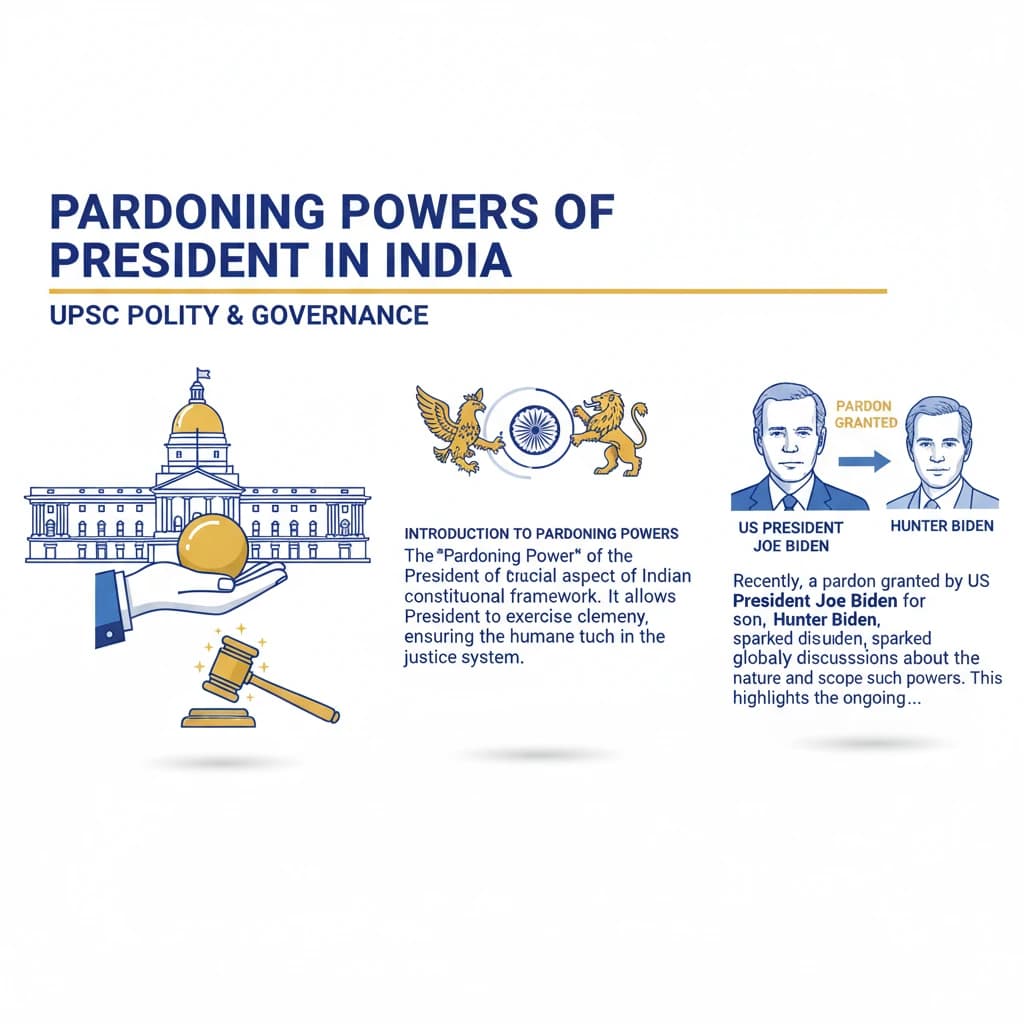
The Pardoning Power of the President of India is a crucial aspect of the Indian constitutional framework. It allows the President to exercise clemency, ensuring a humane touch in the justice system.
Recently, a pardon granted by the US President Joe Biden for his son, Hunter Biden, sparked discussions globally about the nature and scope of such powers. This highlights the ongoing relevance of executive clemency.
Constitutional Basis: Article 72
Article 72 of the Indian Constitution vests the President of India with the power to grant pardons, remit or commute sentences, grant respites or remissions of punishment, or reprieve the sentence of any person convicted of an offense.
This power is applicable in specific scenarios:
- When the punishment is by a Court Martial.
- When the sentence involves capital punishment (death sentence).
- When the conviction is for offenses under Union laws.
Significance of Pardoning Powers
The President's pardoning power serves a vital role in the justice delivery system. It acts as a safety valve against potential miscarriages of justice.
Key Significance:
- Rectifying Judicial Errors: It provides an avenue to remedy potential errors that may have occurred in judicial proceedings.
- Humanitarian Considerations: It allows for the exercise of clemency in situations demanding humanitarian considerations, such as the convict's health or family circumstances.
Limitations on Presidential Pardoning Power
While extensive, the President's pardoning power is not absolute and is subject to certain constitutional limitations. The President cannot exercise this power independently or arbitrarily.
Decisions regarding pardons must always align with the advice of the Council of Ministers. This principle ensures that the power is exercised responsibly and democratically.
Landmark Supreme Court Judgments
The Supreme Court of India has clarified the scope and limitations of the President's pardoning power through several landmark judgments.
- Maru Ram vs Union of India, 1980: The SC held that the power to grant pardons must be exercised fairly, reasonably, and without arbitrariness. It emphasized the need for justice and balance in its application.
- Kehar Singh v. Union of India, 1988: The SC affirmed that the President's pardoning power is independent of the judiciary. However, it can be reviewed to ensure procedural fairness, focusing on adherence to constitutional principles and procedural requirements, not the merits of the decision itself.
UPSC Insight: Remember these landmark cases (Maru Ram and Kehar Singh) as they are frequently asked in both Prelims and Mains to discuss the scope and judicial review of pardoning powers. Highlight the balance between executive clemency and judicial oversight.
Types of Clemency Powers
Article 72 outlines various forms of clemency that the President can grant. Each type has a distinct effect on the sentence and conviction.
| Clemency Type | Definition |
|---|---|
| Pardon | Removes both the sentence and the conviction, absolving the convict from all punishments and disqualifications. |
| Commutation | Substitutes one form of punishment for a lighter one (e.g., death sentence to rigorous imprisonment). |
| Remission | Reduces the period of a sentence without changing its nature (e.g., 10 years rigorous imprisonment to 5 years rigorous imprisonment). |
| Respite | Awards a lesser sentence due to special circumstances like physical disability or pregnancy of the convict. |
| Reprieve | Temporarily stays the execution of a sentence (especially death sentence) to allow time to seek pardon or commutation. |
Pardoning Power of the US President
The US Constitution also grants its President significant pardoning powers. This power is explicitly stated in their constitution.
The US President can "grant Reprieves and Pardons for Offences against the United States, except in Cases of Impeachment."
- This executive power applies exclusively to federal crimes.
- It does not extend to state-level offenses or impeachment cases.
Comparison: President vs. Governor's Pardoning Powers
Similar to the President, the Governor of a state also exercises pardoning powers under Article 161 of the Indian Constitution. However, there are significant limitations compared to the President's power.
| Aspect | President (Article 72) | Governor (Article 161) |
|---|---|---|
| Applicability | Offenses against Union laws. | Offenses against State laws. |
| Death Sentence | Can pardon, reprieve, respite, remit, suspend, or commute a death sentence. Is the only authority to pardon a death sentence. | Cannot pardon a death sentence. Can only suspend, remit, or commute a death sentence. |
| Court Martial | Can grant pardon, reprieve, respite, suspension, remission, or commutation in respect to punishment or sentence by a court-martial (military court). | Does not possess any such power regarding court-martial sentences. |
Crucial Distinction: Even if a state law provides for a death sentence, the ultimate power to grant a pardon for it lies solely with the President, not the Governor.
💡 Key Takeaways
- •President's pardoning power (Article 72) applies to Court Martial, death sentences, and Union law offenses.
- •Types of clemency include Pardon, Commutation, Remission, Respite, and Reprieve, each with distinct effects.
- •President acts on the binding advice of the Council of Ministers; power is not arbitrary (Maru Ram case).
- •Judicial review is limited to procedural fairness, not the merits of the decision (Kehar Singh case).
- •Governor's pardoning power (Article 161) is limited: cannot pardon death sentences or Court Martial cases.
🧠 Memory Techniques

98% Verified Content
📚 Reference Sources
•The Constitution of India (Article 72, Article 161)