Loading page, please wait…
Personality Rights - UPSC Polity And Governance
What is Personality Rights in UPSC Polity And Governance?
Personality Rights is a key topic under Polity And Governance for UPSC Civil Services Examination. Key points include: Personality Rights protect an individual's public persona, including name, voice, image, and likeness.. They encompass the Right to Privacy and the Right of Publicity.. In India, they are protected through Article 21 (Right to Privacy), Copyright Act (passing off/deception), and Trademark Act.. Understanding this topic is essential for both UPSC Prelims and Mains preparation.
Why is Personality Rights important for UPSC exam?
Personality Rights is a Medium-level topic in UPSC Polity And Governance. It is tested in both Prelims (factual MCQs) and Mains (analytical answer writing). Previous year UPSC questions have frequently covered aspects of Personality Rights, making it essential for comprehensive IAS preparation.
How to prepare Personality Rights for UPSC?
To prepare Personality Rights for UPSC: (1) Study the comprehensive notes covering all key concepts on Vaidra. (2) Practice previous year questions on this topic. (3) Connect it with current affairs using daily updates. (4) Revise using key takeaways and mind maps available for Polity And Governance. (5) Write practice answers linking Personality Rights to related GS Paper topics.
Key takeaways of Personality Rights for UPSC
- Personality Rights protect an individual's public persona, including name, voice, image, and likeness.
- They encompass the Right to Privacy and the Right of Publicity.
- In India, they are protected through Article 21 (Right to Privacy), Copyright Act (passing off/deception), and Trademark Act.
- The Puttuswamy judgment (2017) strengthened the constitutional basis for privacy, indirectly aiding personality rights.
- AI technologies (voice cloning, deepfakes) pose significant contemporary challenges to personality rights, necessitating new legal frameworks.
Personality Rights
Medium⏱️ 8 min read
polity and governance
📖 Introduction
Understanding Personality Rights
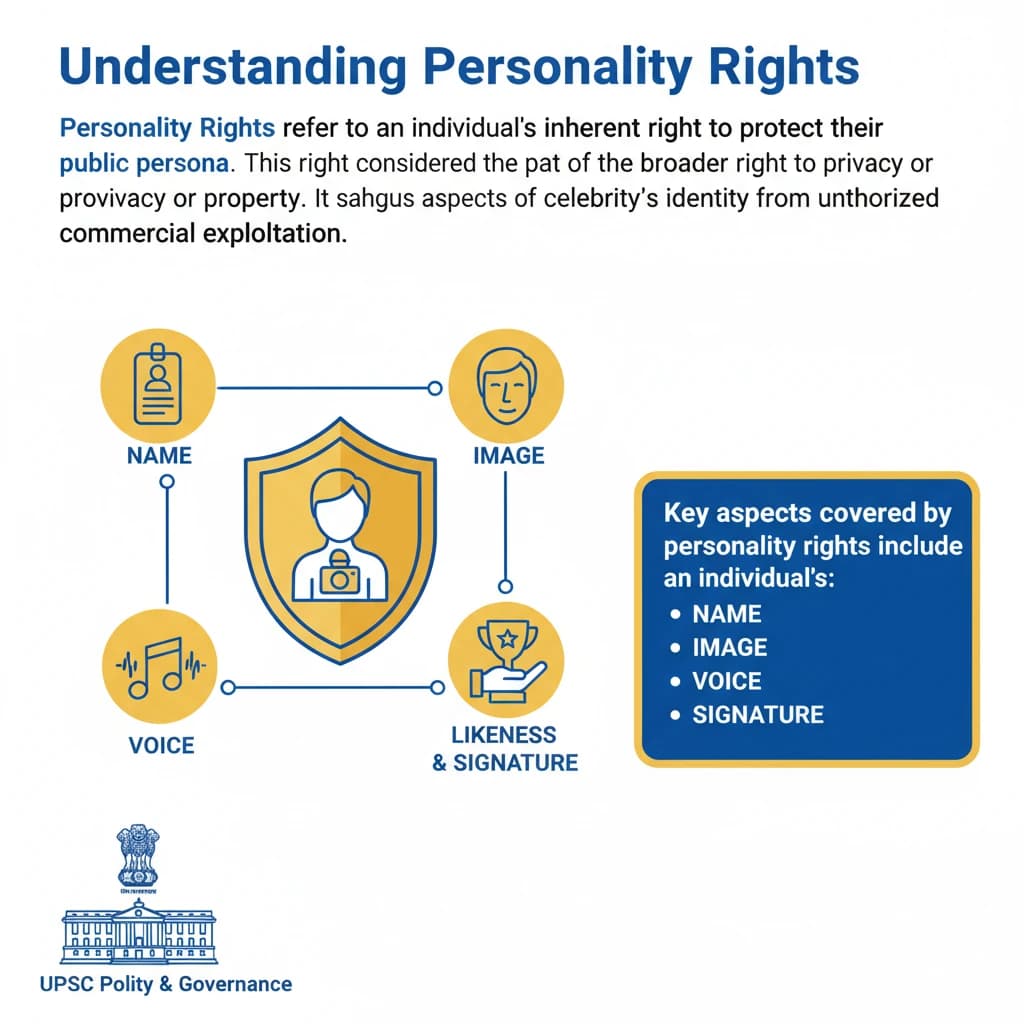
Personality Rights refer to an individual's inherent right to protect their public persona. This right is considered a part of the broader right to privacy or property. It safeguards various aspects of a celebrity's identity from unauthorized commercial exploitation.
Key aspects covered by personality rights include an individual's name, voice, signature, images, distinctive features, mannerisms, and even specific poses.
Types of Personality Rights
Personality rights are generally categorized into two main types, often overlapping but distinct in their focus:
- Right to Privacy: This aspect protects an individual's control over their personal information and private affairs. It aims to prevent unauthorized disclosure of private details or intrusion into one's personal life.
- Right of Publicity: This grants individuals control over the commercial use of their identity. It specifically pertains to the use of their name, image, likeness, or other recognizable characteristics for commercial purposes like product endorsements or advertising.
Importance of Personality Rights
These rights are particularly crucial for celebrities and public figures. Their unique identity elements, such as their names, photographs, or voices, can be easily misused by various companies.
Unauthorized commercial use can boost sales for businesses without fair compensation or consent, undermining the celebrity's control over their own brand and image.
Status of Personality Rights in India
In India, Personality Rights are not explicitly codified in a single statute. However, they are protected through established principles related to privacy and property rights, recognized and upheld by various legal provisions and judicial pronouncements.
While there isn't a dedicated law, Indian courts have increasingly recognized and enforced these rights, especially the Right of Publicity, allowing public figures to protect their commercial interests.
Key Legal Provisions and Interpretations in India
- Article 21 of the Indian Constitution: The Right to Privacy, enshrined under Article 21, offers the most direct constitutional protection for personality rights in India. The Supreme Court affirmed this in the landmark Puttuswamy v Union Of India, 2017 case.
- Copyright Act, 1957: While not directly addressing personality rights, this Act offers tangential protection through concepts like “passing off” and “deception” in Intellectual Property Rights (IPR) cases.
Understanding “Passing Off”: This occurs when someone misrepresents their goods or services as belonging to, or being associated with, someone else. In the context of personality rights, it can apply if:
- A celebrity’s name or image is used without permission to endorse a product, creating a false impression of association.
- A character or image is created that is deceptively similar to a well-known personality, leading the public to believe it's the real person.
Understanding “Deception”: This involves using a person’s name or likeness in a way that is deceptive or misleading, potentially harming their reputation. This can also be argued under copyright infringement.
- Indian Trademarks Act, 1999: Section 14 of this Act places restrictions on the unauthorized use of individual names and representations, providing another layer of protection.
- Court Judgments: Indian courts have consistently recognized and enforced the Right of Publicity, empowering celebrities to protect their identity and commercial interests.
💡 Key Takeaways
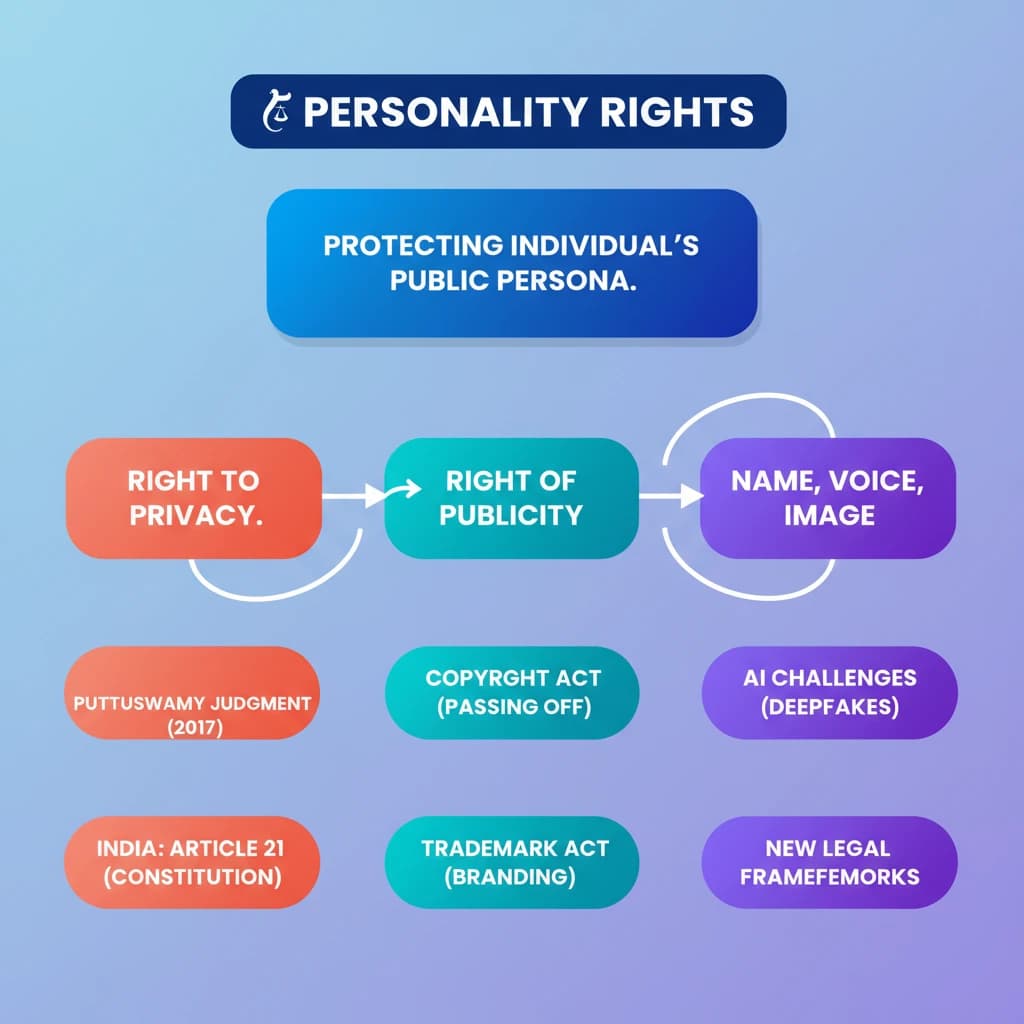
- •Personality Rights protect an individual's public persona, including name, voice, image, and likeness.
- •They encompass the Right to Privacy and the Right of Publicity.
- •In India, they are protected through Article 21 (Right to Privacy), Copyright Act (passing off/deception), and Trademark Act.
- •The Puttuswamy judgment (2017) strengthened the constitutional basis for privacy, indirectly aiding personality rights.
- •AI technologies (voice cloning, deepfakes) pose significant contemporary challenges to personality rights, necessitating new legal frameworks.
🧠 Memory Techniques

95% Verified Content