Loading page, please wait…
Pradhan Mantri Awas Yojana-Gramin - UPSC Polity And Governance
What is Pradhan Mantri Awas Yojana-Gramin in UPSC Polity And Governance?
Pradhan Mantri Awas Yojana-Gramin is a key topic under Polity And Governance for UPSC Civil Services Examination. Key points include: PMAY-G (launched 2016) aims to provide 'Housing for All' in rural areas by building pucca houses.. Beneficiary selection is rigorous, involving SECC 2011 data, Gram Sabha approval, and geo-tagging.. Financial assistance varies: Rs 1.20 lakh (plain areas) and Rs 1.30 lakh (hilly/NE/UTs).. Understanding this topic is essential for both UPSC Prelims and Mains preparation.
Why is Pradhan Mantri Awas Yojana-Gramin important for UPSC exam?
Pradhan Mantri Awas Yojana-Gramin is a Medium-level topic in UPSC Polity And Governance. It is tested in both Prelims (factual MCQs) and Mains (analytical answer writing). Previous year UPSC questions have frequently covered aspects of Pradhan Mantri Awas Yojana-Gramin, making it essential for comprehensive IAS preparation.
How to prepare Pradhan Mantri Awas Yojana-Gramin for UPSC?
To prepare Pradhan Mantri Awas Yojana-Gramin for UPSC: (1) Study the comprehensive notes covering all key concepts on Vaidra. (2) Practice previous year questions on this topic. (3) Connect it with current affairs using daily updates. (4) Revise using key takeaways and mind maps available for Polity And Governance. (5) Write practice answers linking Pradhan Mantri Awas Yojana-Gramin to related GS Paper topics.
Key takeaways of Pradhan Mantri Awas Yojana-Gramin for UPSC
- PMAY-G (launched 2016) aims to provide 'Housing for All' in rural areas by building pucca houses.
- Beneficiary selection is rigorous, involving SECC 2011 data, Gram Sabha approval, and geo-tagging.
- Financial assistance varies: Rs 1.20 lakh (plain areas) and Rs 1.30 lakh (hilly/NE/UTs).
- Scheme relies on convergence for toilets (SBM-G), employment (MGNREGA), and basic amenities (water, LPG, electricity).
- Cost sharing is 60:40 (Centre:State) for plain areas, 90:10 for special category states, and 100% for other UTs.
- Recent updates (Aug 2024) include 2 crore additional houses and relaxed eligibility (income up to Rs 15,000, bike/scooter owners now eligible).
Pradhan Mantri Awas Yojana-Gramin
Medium⏱️ 10 min read
polity and governance
📖 Introduction
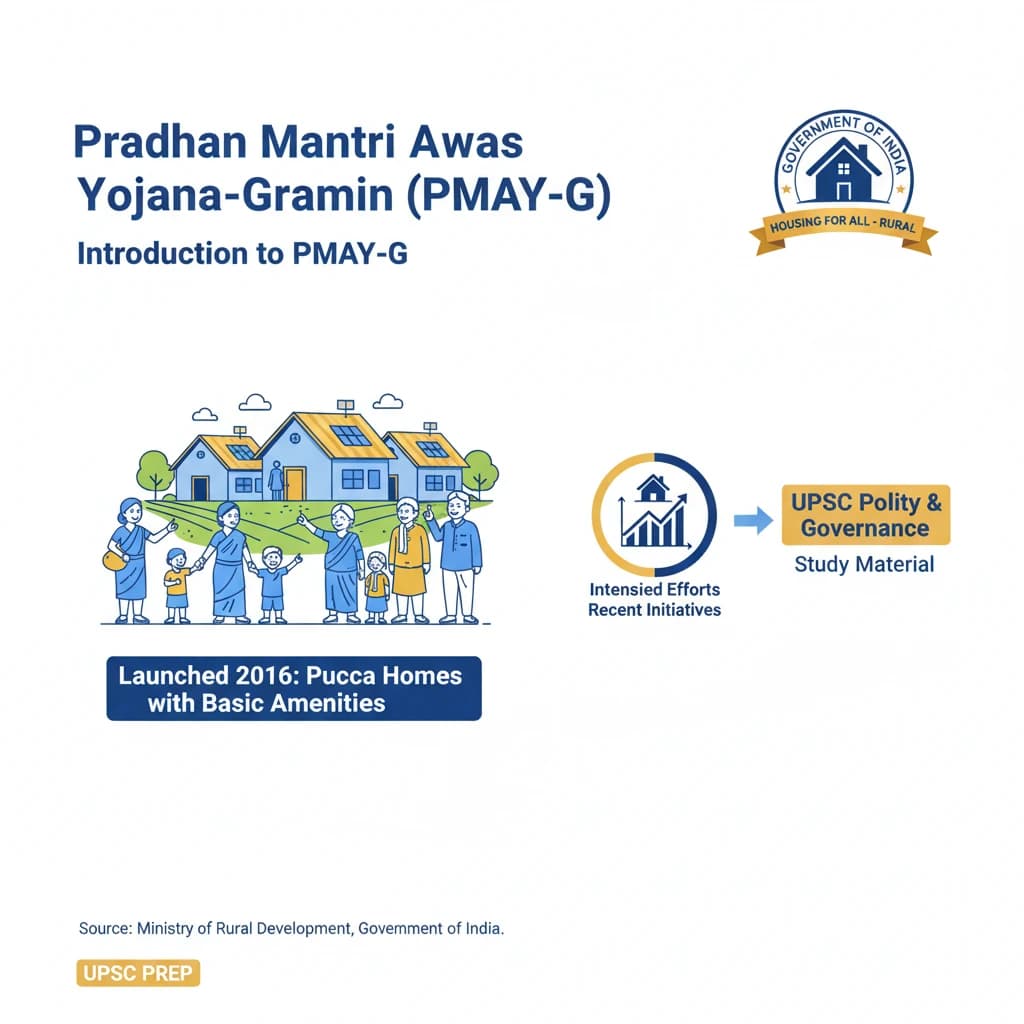
Introduction to Pradhan Mantri Awas Yojana-Gramin (PMAY-G)
The **Pradhan Mantri Awas Yojana-Gramin (PMAY-G)** is a flagship initiative by the **Indian government** aimed at providing housing for the most vulnerable sections of society in rural areas. Launched in **2016**, it seeks to ensure that every rural household has access to a **pucca (all-weather) home** with basic amenities.
Recent Initiatives and Context
Recently, the government has intensified its efforts under **PMAY-G** by initiating a nationwide **survey of kutcha houses**. This crucial step aims to identify new eligible beneficiaries who currently lack adequate housing.
Alongside the survey, the **Awas Sakhi mobile app** has been launched. This application is designed to streamline the identification process and enhance the efficiency of the scheme's implementation on the ground.
UPSC Insight: Recent developments like the survey and mobile app highlight the government's commitment to achieving its 'Housing for All' objective and are important for current affairs sections in **Prelims** and **Mains GS-II**.
Core Objective and Launch
The primary objective of **PMAY-G**, which commenced in **2016**, is to provide financial assistance for the construction of **pucca houses** to all eligible rural households. This includes those living in **kutcha** or dilapidated houses.
The scheme specifically targets the **poorest segments of society**, ensuring that aid reaches those who are most in need of safe and dignified shelter.
Beneficiary Selection Process
Beneficiary selection under **PMAY-G** follows a rigorous **three-stage validation process** to ensure transparency and prevent leakages. This multi-layered approach helps identify the most deserving individuals.
- Stage 1: Utilizes data from the **Socio-Economic Caste Census (SECC) 2011** to identify potential beneficiaries based on deprivation criteria.
- Stage 2: Requires **Gram Sabha approvals**, where the provisional list of beneficiaries is publicly displayed and verified by the community.
- Stage 3: Involves **geo-tagging** of the houses, which helps in monitoring construction progress and ensures that assistance is provided for actual construction.
Key Provisions and Support
Under **PMAY-G**, beneficiaries receive comprehensive support to construct their homes. This includes direct financial aid and convergence with other government schemes for essential facilities.
Financial Assistance:
- Plain Areas: Beneficiaries receive Rs 1.20 lakh.
- Hilly States, Northeastern States, and Union Territories: Beneficiaries receive Rs 1.30 lakh due to higher construction costs.
Additional Support for Toilets:
- An additional Rs 12,000 is provided for the construction of toilets.
- This support is facilitated through convergence with schemes like **Swachh Bharat Mission - Gramin (SBM-G)** or **Mahatma Gandhi National Rural Employment Guarantee Scheme (MGNREGS)**, or other dedicated funding sources.
Employment Support:
- Beneficiaries are mandatorily provided with **90/95/100-person-days** of **unskilled wage employment**.
- This employment is channeled through the **Mahatma Gandhi National Rural Employment Guarantee Act (MGNREGA)** for the construction of their houses, providing both income and labor.
Basic Amenities:
- Access to essential amenities such as **water**, **liquefied petroleum gas (LPG)**, and **electricity connections** is ensured.
- This is achieved through convergence with relevant schemes of other ministries and departments, promoting holistic development.
Funding and Cost Sharing Mechanism
The financial burden of **PMAY-G** is shared between the **Central** and **State governments**, with varying ratios depending on the geographical region to account for diverse economic conditions.
Cost Sharing Ratios:
- Plain Areas: The Centre and State share expenses in a **60:40 ratio**.
- Northeastern States, Two Himalayan States (Himachal Pradesh and Uttarakhand), and the Union Territory (UT) of J&K: The sharing ratio is **90:10** (Centre:State).
- Other Union Territories (including Ladakh): The **Centre bears 100% of the cost**.
Progress and Achievements
The **PMAY-G** scheme has demonstrated significant progress towards its ambitious goals, positively impacting millions of rural families across India.
The government had set an ambitious target to build **2.95 crore houses** under the scheme.
As of **August 2023**, **2.94 crore houses** have been sanctioned, indicating nearly full sanctioning of the target.
A total of **2.54 crore houses** have been successfully completed, significantly improving the living conditions of millions.
Future Outlook and Eligibility Revisions
The government continues to expand the scope and reach of **PMAY-G** to address ongoing housing needs and ensure wider coverage.
In **August 2024**, the **Union Cabinet** approved financial assistance for the construction of **two crore additional houses**. These will be built at the existing unit assistance rates.
Significantly, the **PMAY-G eligibility criteria have been relaxed**. Individuals owning **bikes or scooters** can now be included in the beneficiary list, expanding the pool of eligible households.
The income limit for eligibility has also been increased. People earning up to **Rs 15,000 a month** are now eligible, up from the earlier limit of **Rs 10,000**.
This amendment, spanning from **FY 2024-2029**, aims to benefit nearly **10 crore individuals** by ensuring safe, hygienic, and socially inclusive housing for those without proper shelter or living in dilapidated conditions.
💡 Key Takeaways
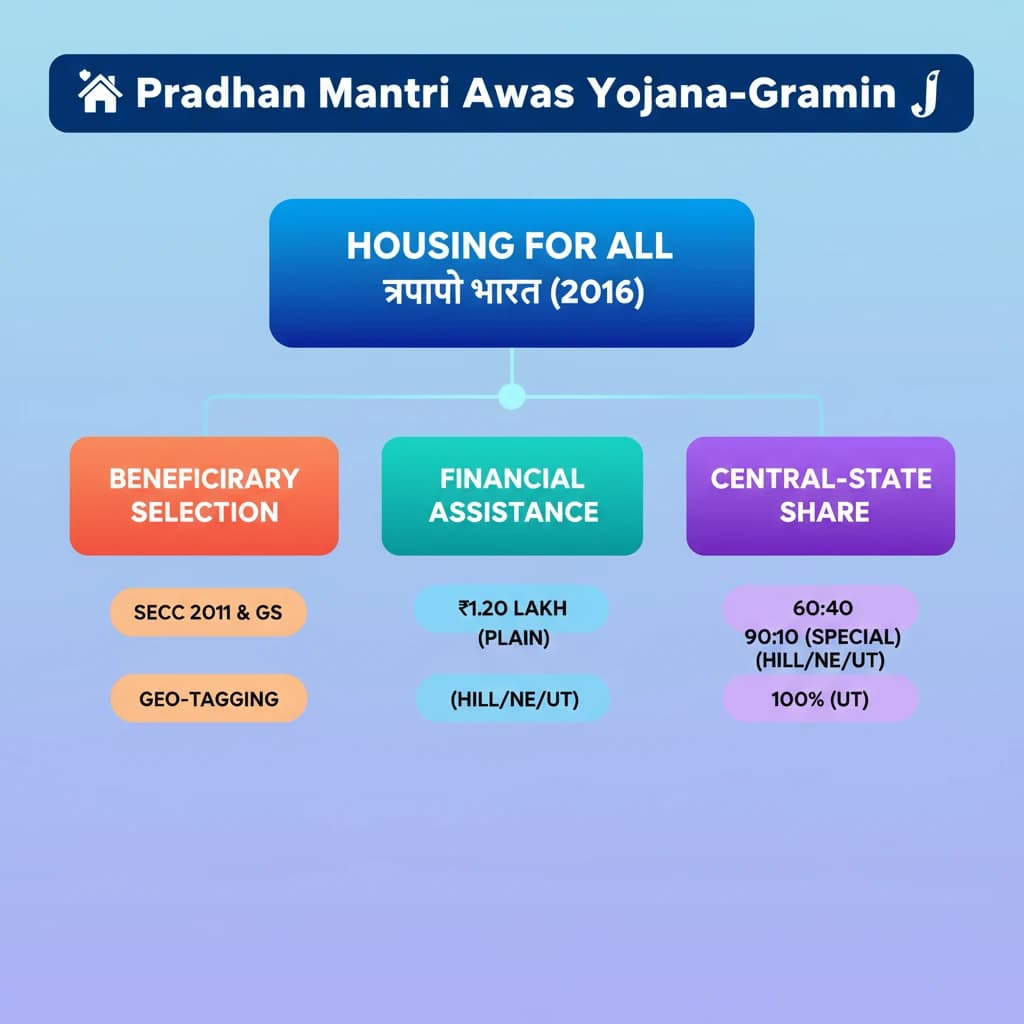
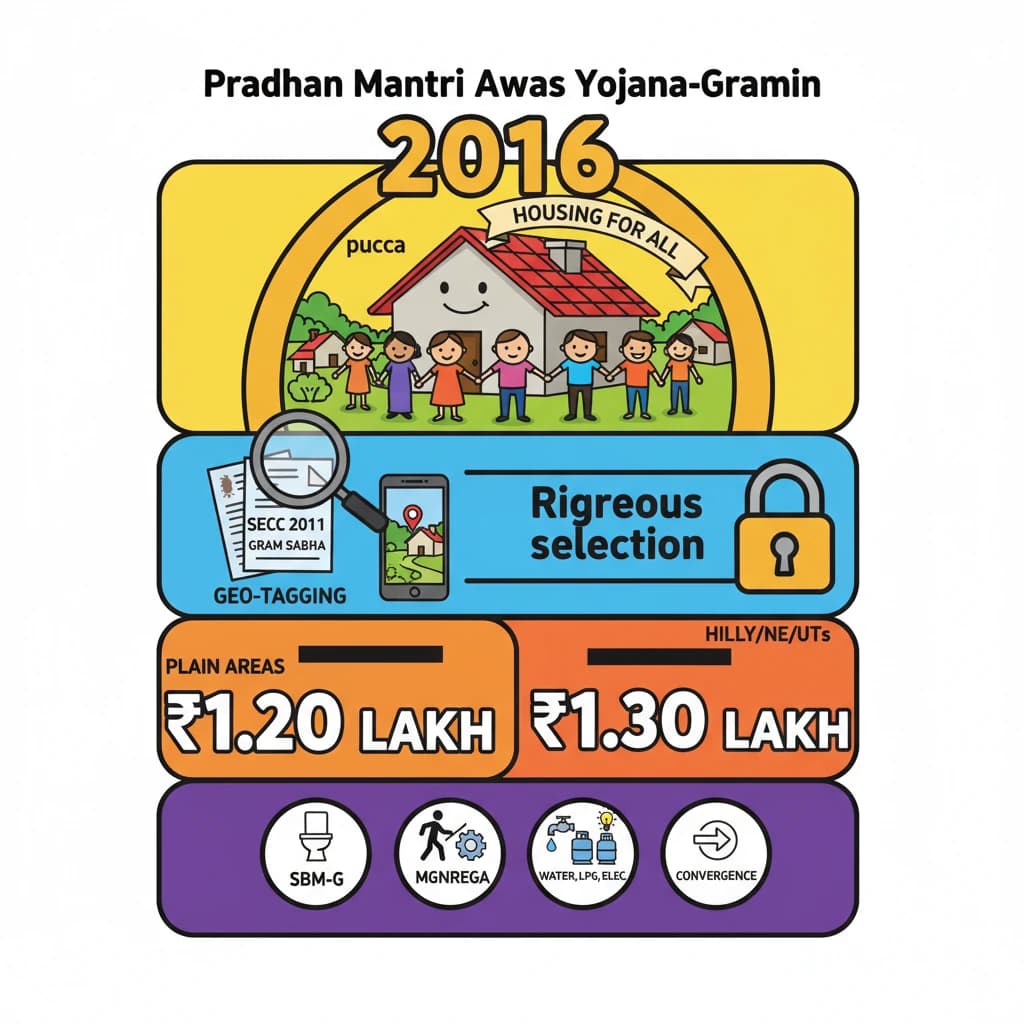
- •PMAY-G (launched 2016) aims to provide 'Housing for All' in rural areas by building pucca houses.
- •Beneficiary selection is rigorous, involving SECC 2011 data, Gram Sabha approval, and geo-tagging.
- •Financial assistance varies: Rs 1.20 lakh (plain areas) and Rs 1.30 lakh (hilly/NE/UTs).
- •Scheme relies on convergence for toilets (SBM-G), employment (MGNREGA), and basic amenities (water, LPG, electricity).
- •Cost sharing is 60:40 (Centre:State) for plain areas, 90:10 for special category states, and 100% for other UTs.
- •Recent updates (Aug 2024) include 2 crore additional houses and relaxed eligibility (income up to Rs 15,000, bike/scooter owners now eligible).
🧠 Memory Techniques
98% Verified Content
📚 Reference Sources
•Official PMAY-G website (for cross-referencing figures and dates if available outside summary)