Loading page, please wait…
President's Rule: What It Means - UPSC Polity And Governance
What is President's Rule: What It Means in UPSC Polity And Governance?
President's Rule: What It Means is a key topic under Polity And Governance for UPSC Civil Services Examination. Key points include: President's Rule (Article 356) allows central takeover of state administration due to failure of constitutional machinery.. It can be imposed on the Governor's report or the President's own assessment.. Initial duration is 6 months, extendable up to 3 years with parliamentary approval every 6 months.. Understanding this topic is essential for both UPSC Prelims and Mains preparation.
Why is President's Rule: What It Means important for UPSC exam?
President's Rule: What It Means is a Medium-level topic in UPSC Polity And Governance. It is tested in both Prelims (factual MCQs) and Mains (analytical answer writing). Previous year UPSC questions have frequently covered aspects of President's Rule: What It Means, making it essential for comprehensive IAS preparation.
How to prepare President's Rule: What It Means for UPSC?
To prepare President's Rule: What It Means for UPSC: (1) Study the comprehensive notes covering all key concepts on Vaidra. (2) Practice previous year questions on this topic. (3) Connect it with current affairs using daily updates. (4) Revise using key takeaways and mind maps available for Polity And Governance. (5) Write practice answers linking President's Rule: What It Means to related GS Paper topics.
Key takeaways of President's Rule: What It Means for UPSC
- President's Rule (Article 356) allows central takeover of state administration due to failure of constitutional machinery.
- It can be imposed on the Governor's report or the President's own assessment.
- Initial duration is 6 months, extendable up to 3 years with parliamentary approval every 6 months.
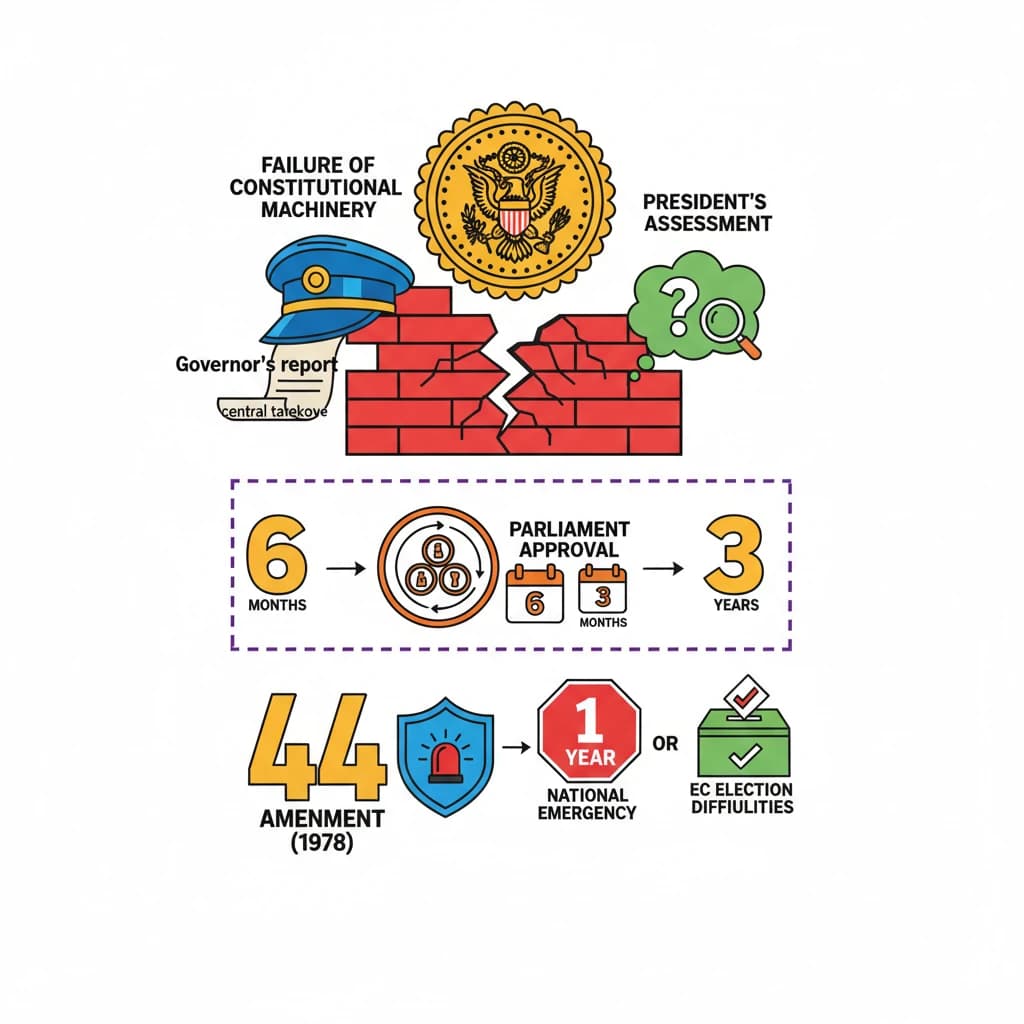
- The 44th Amendment (1978) restricts extension beyond 1 year, unless National Emergency is active or EC certifies election difficulties.
- The President can revoke it anytime without parliamentary approval.
- During President's Rule, executive authority is exercised through the Governor, acting as the President's agent.
President's Rule: What It Means
Medium⏱️ 10 min read
polity and governance
📖 Introduction
Introduction to President's Rule
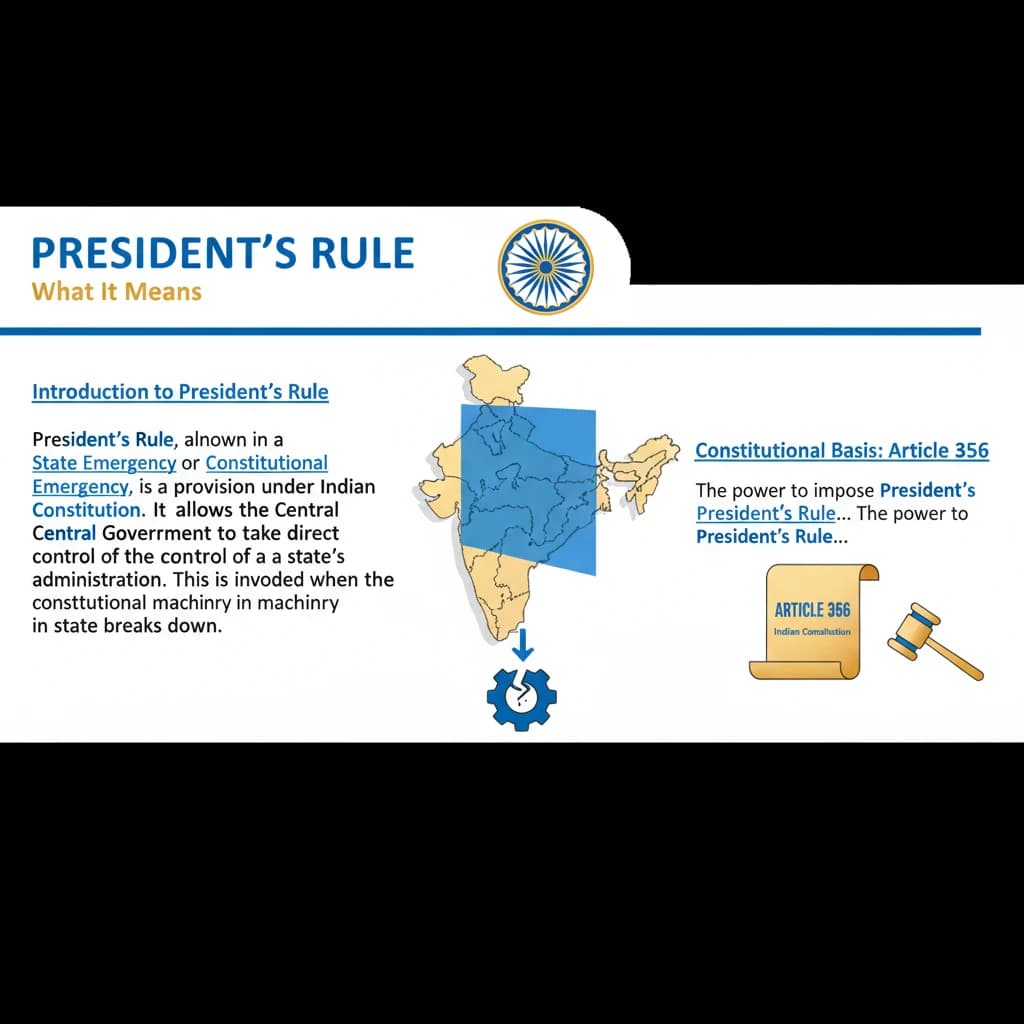
President's Rule, also known as State Emergency or Constitutional Emergency, is a provision under the Indian Constitution. It allows the Central Government to take direct control of a state's administration. This is invoked when the constitutional machinery in a state breaks down.
Constitutional Basis: Article 356
The power to impose President's Rule is primarily derived from Article 356 of the Indian Constitution. This article empowers the President of India to assume the functions of the state government. It is a critical aspect of India's quasi-federal structure, ensuring constitutional governance across all states.
Article 356: "Provisions in case of failure of constitutional machinery in States."
Grounds for Imposition
President's Rule can be imposed in a state under specific circumstances, indicating a failure of constitutional governance. The President acts upon a report from the Governor or otherwise. This implies the President can also act on their own assessment.
- Recommendation of Governor: The Governor of a state reports to the President that the state's government cannot be carried on in accordance with constitutional provisions.
- Failure of Constitutional Machinery: If a state legislature or executive is unable to function as per the Constitution. This could include a hung assembly or a government losing majority.
Duration and Extension
Once proclaimed, President's Rule has a specific duration, subject to parliamentary approval. It is not intended to be a permanent arrangement but a temporary measure to restore constitutional order.
- Initial Duration: A proclamation of President's Rule is initially valid for six months.
- Maximum Duration: It can be extended for a maximum period of three years.
- Parliamentary Approval: Each extension beyond the initial six months requires approval from Parliament, typically after every six months.
Termination of President's Rule
The President holds the power to revoke President's Rule at any time. This decision does not require the approval of Parliament. It can be terminated as soon as the conditions for its imposition cease to exist, or a stable government can be formed.
Executive Authority During President's Rule
During the period of President's Rule, the executive authority of the state is directly exercised by the Central Government. The President takes over all functions of the state government. The Governor, who is a centrally appointed representative, plays a crucial role.
The Governor acts as the President's agent in the state, carrying out the administration on behalf of the Union Government. The state legislative assembly may be suspended or dissolved.
Role of Parliament
Parliament's approval is essential for the imposition and continuation of President's Rule. This ensures a democratic check on the executive's power to intervene in state affairs. It underscores the principle of parliamentary oversight.
Every proclamation of President's Rule must be approved by both Houses of Parliament within two months from the date of its issue. Failure to secure approval leads to the cessation of the proclamation.
The 44th Constitutional Amendment (1978)
The 44th Constitutional Amendment Act of 1978 introduced significant restrictions on the extension of President's Rule. This amendment was a response to concerns about the potential misuse of Article 356 for political purposes. It aimed to safeguard the federal structure.
The 44th Amendment mandates that President's Rule cannot be extended beyond one year unless two specific conditions are met:
- A Proclamation of National Emergency (under Article 352) is in operation in the whole of India, or in the whole or any part of the state concerned.
- The Election Commission of India certifies that the continuance of President's Rule is necessary due to difficulties in holding Assembly elections in the state.
Remember the 44th Amendment Act, 1978 is crucial for understanding the limitations on the duration of President's Rule. It's a frequently tested concept in UPSC Prelims and Mains.
💡 Key Takeaways
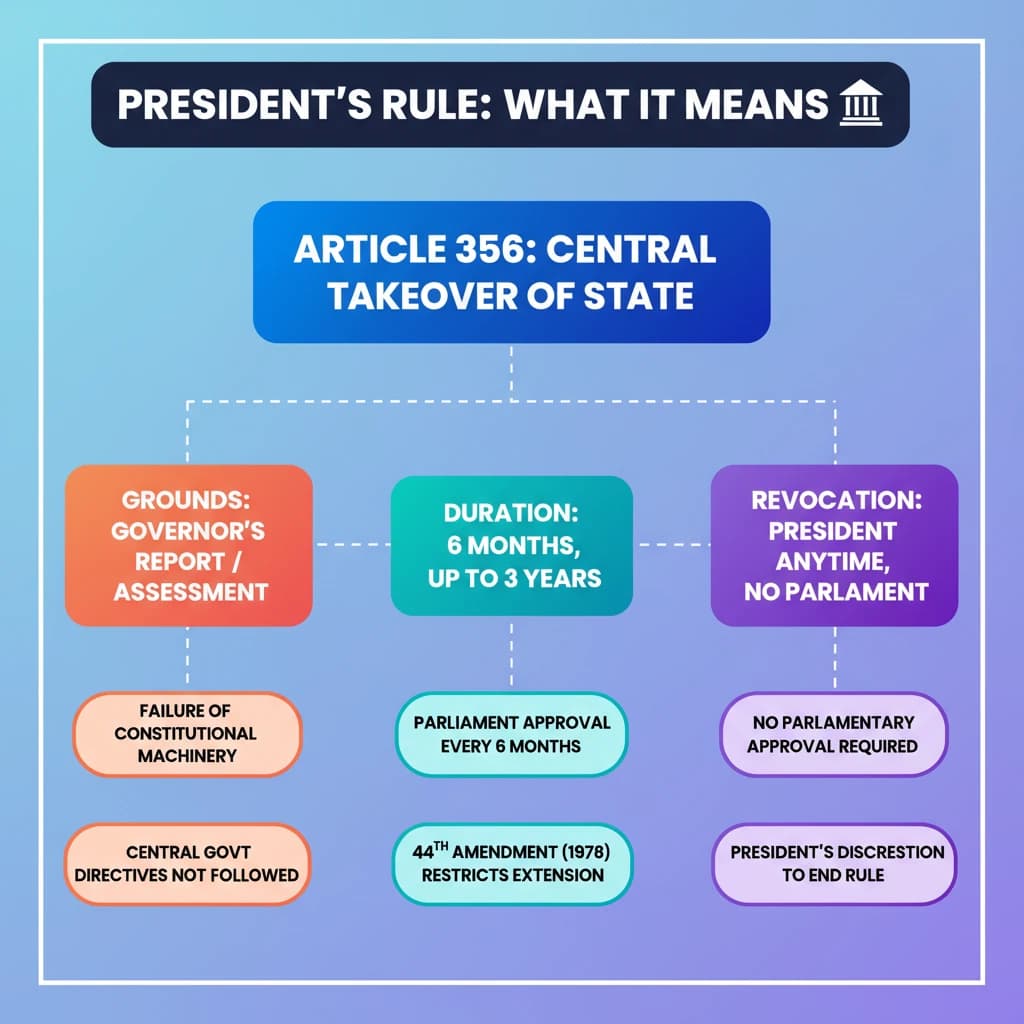
- •President's Rule (Article 356) allows central takeover of state administration due to failure of constitutional machinery.
- •It can be imposed on the Governor's report or the President's own assessment.
- •Initial duration is 6 months, extendable up to 3 years with parliamentary approval every 6 months.
- •The 44th Amendment (1978) restricts extension beyond 1 year, unless National Emergency is active or EC certifies election difficulties.
- •The President can revoke it anytime without parliamentary approval.
- •During President's Rule, executive authority is exercised through the Governor, acting as the President's agent.
🧠 Memory Techniques
98% Verified Content
📚 Reference Sources
•D.D. Basu's Commentary on the Constitution of India
•M. Laxmikanth, 'Indian Polity'
•Sarkaria Commission Report on Centre-State Relations (1988)
•Punchhi Commission Report on Centre-State Relations (2010)
•Supreme Court Judgement in S.R. Bommai v. Union of India (1994)