Loading page, please wait…
Property Restoration under MWPSC Act, 2007 - UPSC Polity And Governance
What is Property Restoration under MWPSC Act, 2007 in UPSC Polity And Governance?
Property Restoration under MWPSC Act, 2007 is a key topic under Polity And Governance for UPSC Civil Services Examination. Key points include: MWPSC Act, 2007 protects parents and senior citizens by ensuring maintenance and welfare.. Tribunals under the Act are empowered to restore property to parents if children neglect care obligations.. Section 23 allows tribunals to declare property transfers void if transferees fail to provide agreed-upon basic needs.. Understanding this topic is essential for both UPSC Prelims and Mains preparation.
Why is Property Restoration under MWPSC Act, 2007 important for UPSC exam?
Property Restoration under MWPSC Act, 2007 is a Medium-level topic in UPSC Polity And Governance. It is tested in both Prelims (factual MCQs) and Mains (analytical answer writing). Previous year UPSC questions have frequently covered aspects of Property Restoration under MWPSC Act, 2007, making it essential for comprehensive IAS preparation.
How to prepare Property Restoration under MWPSC Act, 2007 for UPSC?
To prepare Property Restoration under MWPSC Act, 2007 for UPSC: (1) Study the comprehensive notes covering all key concepts on Vaidra. (2) Practice previous year questions on this topic. (3) Connect it with current affairs using daily updates. (4) Revise using key takeaways and mind maps available for Polity And Governance. (5) Write practice answers linking Property Restoration under MWPSC Act, 2007 to related GS Paper topics.
Key takeaways of Property Restoration under MWPSC Act, 2007 for UPSC
- MWPSC Act, 2007 protects parents and senior citizens by ensuring maintenance and welfare.
- Tribunals under the Act are empowered to restore property to parents if children neglect care obligations.
- Section 23 allows tribunals to declare property transfers void if transferees fail to provide agreed-upon basic needs.
- The Act is administered by the Ministry of Social Justice & Empowerment.
- It establishes Tribunals and Appellate Tribunals for efficient processing and enforcement.
- Penalties include fines or imprisonment for failure to pay maintenance or for abandonment of senior citizens.
- Supreme Court rulings on Article 142 (e.g., Umadevi case) emphasize 'justice according to law' as a guiding principle for such welfare legislation.
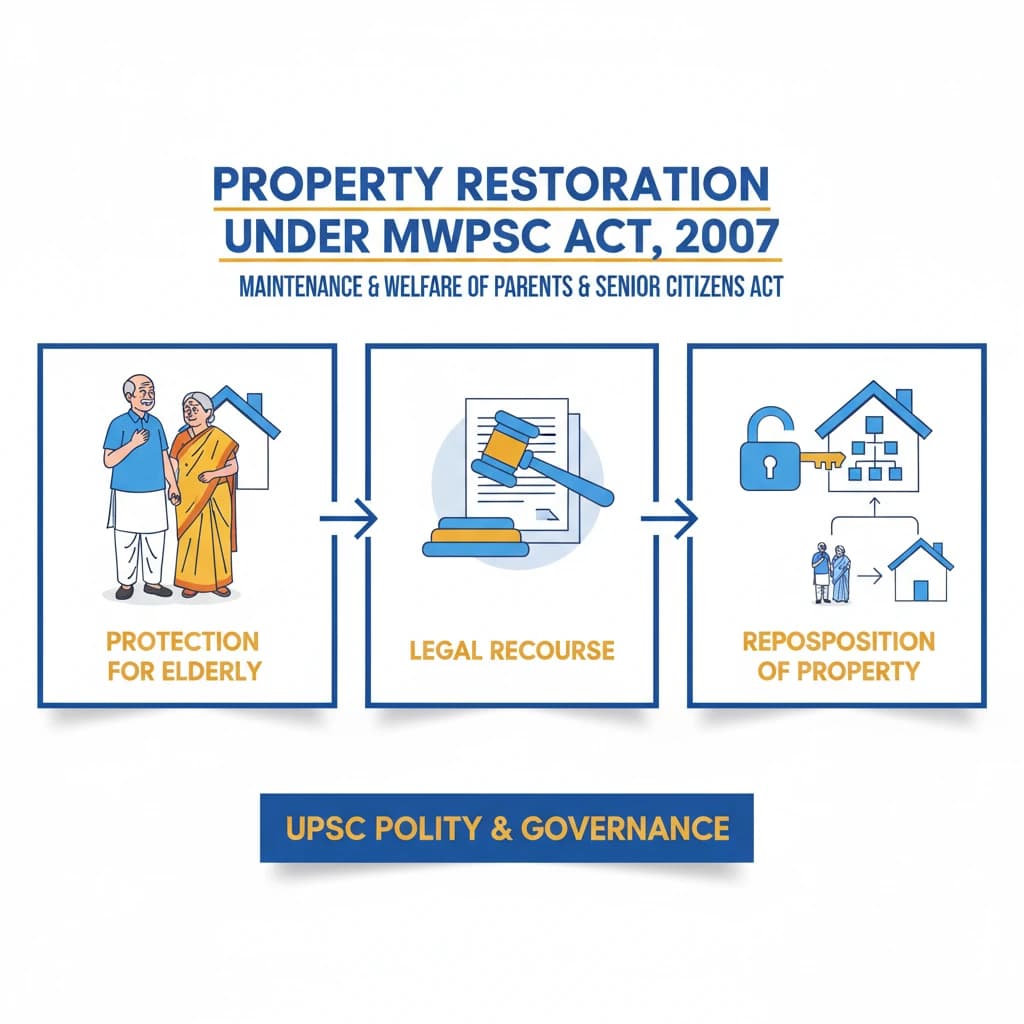
Property Restoration under MWPSC Act, 2007
Medium⏱️ 8 min read
polity and governance
📖 Introduction
Understanding the Maintenance and Welfare of Parents and Senior Citizens (MWPSC) Act, 2007
The Maintenance and Welfare of Parents and Senior Citizens (MWPSC) Act, 2007 is a landmark legislation aimed at providing legal recourse and protection for elderly citizens in India. It addresses the growing concern of neglect and abandonment of parents by their children or legal heirs.
The Act primarily focuses on ensuring that senior citizens, who are unable to maintain themselves, can seek maintenance. It also includes crucial provisions for the restoration of property, empowering tribunals to act decisively.
Empowerment for Property Restoration
A significant aspect of the MWPSC Act, 2007 is its emphasis on empowering Tribunals to restore property to parents. This power can be exercised if children or other transferees neglect their care obligations towards the senior citizens.
This provision is vital for senior citizens who may have transferred their property, such as a house or land, to their children with an implicit or explicit understanding of lifelong care and support.
Key Concept: Property Restoration
The Act allows for the reversal of property transfers made by senior citizens if the transferee (e.g., children) fails to provide the basic needs and physical comforts as agreed upon or implied.
Key Provision: Section 23 and Voidable Transfers
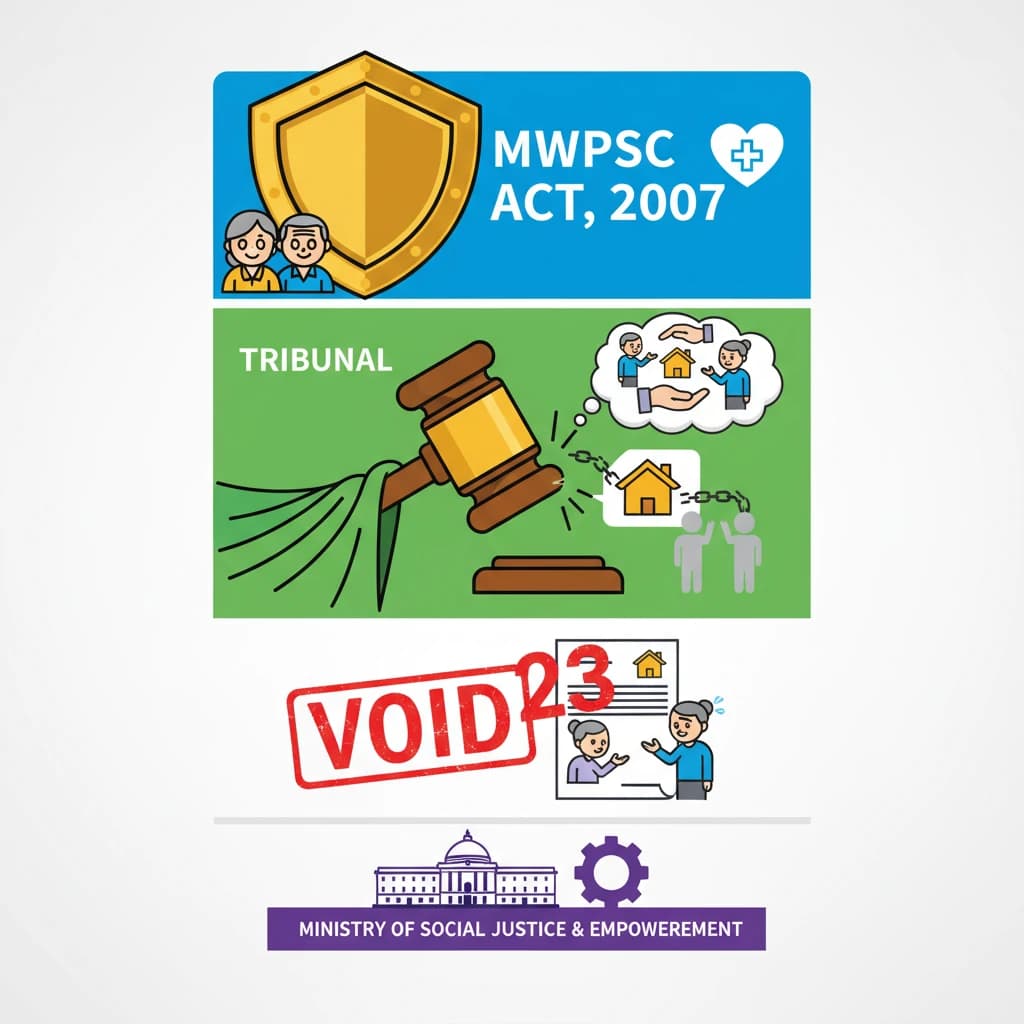
Section 23 of the MWPSC Act, 2007 is the cornerstone for property restoration. It specifically allows Tribunals to declare certain property transfers as void under specific conditions.
A transfer of property can be declared void if the transferee fails to provide the agreed-upon basic amenities and physical needs to the senior citizen. This ensures that the promise of care is legally binding.
Section 23: Conditions for Voiding Transfers
A property transfer by a senior citizen can be declared void if:
- The transfer was made subject to a condition that the transferee would provide basic amenities and physical needs to the transferor.
- The transferee fails or refuses to provide such amenities and needs.
Role of Tribunals and Enforcement Mechanisms
The MWPSC Act, 2007 establishes dedicated Tribunals and Appellate Tribunals at the district and sub-division levels. These bodies are crucial for the efficient processing of maintenance and property restoration cases.
These tribunals have significant powers, including the ability to levy fines or order imprisonment for individuals who fail to pay maintenance as directed. This ensures compliance and provides effective enforcement.
UPSC Insight: Quasi-Judicial Bodies
The establishment of Tribunals under the MWPSC Act highlights the government's strategy to create specialized, accessible, and faster quasi-judicial mechanisms for specific social issues, reducing the burden on conventional courts.
Administrative Authority
The MWPSC Act, 2007 is administered by the Ministry of Social Justice & Empowerment. This ministry plays a pivotal role in formulating policies and ensuring the effective implementation of the Act across the country.
Its oversight ensures that the provisions of the Act are utilized to provide maximum benefit and protection to senior citizens and parents.
Core Objectives and Statutory Protection
The primary objective of the Act is to provide statutory protection for elderly citizens. It enables them to seek maintenance from their children or legal heirs if they are unable to support themselves financially.
Beyond maintenance, the Act also criminalizes the abandonment of senior citizens by caregivers. Such acts can result in a fine or imprisonment, emphasizing the legal responsibility of care.
Salient Features of the MWPSC Act
The Act incorporates several key features designed to ensure comprehensive protection and swift justice for senior citizens.
- Tribunal System: Enforced through dedicated Tribunals and Appellate Tribunals at district and sub-division levels for efficient dispute resolution.
- Penalties for Non-Payment: Tribunals can levy fines or order imprisonment for individuals who fail to comply with maintenance orders.
- Punishment for Abandonment: Abandonment of senior citizens by caregivers can lead to a fine or imprisonment for up to 3 months, underscoring the seriousness of neglect.
- Property Restoration: Enables tribunals to declare property transfers void if care obligations are neglected (Section 23).
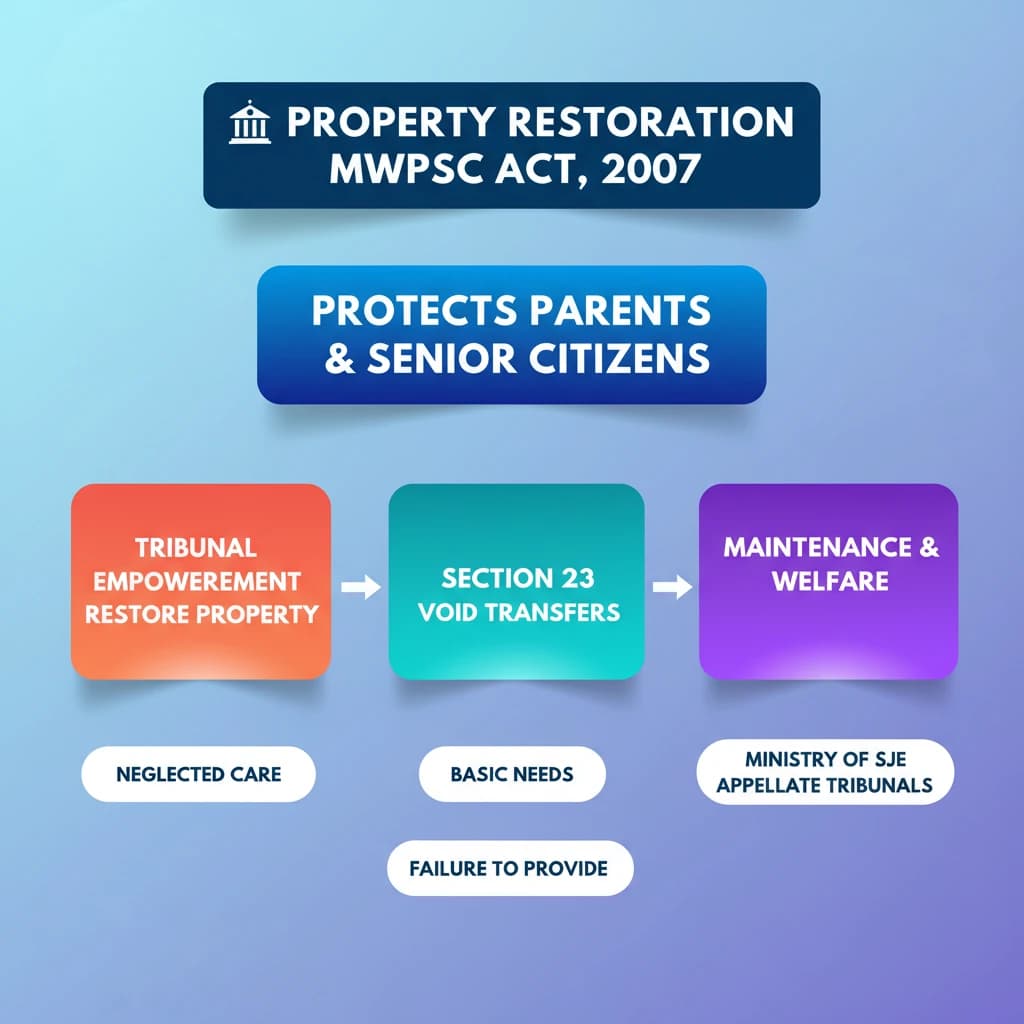
💡 Key Takeaways
- •MWPSC Act, 2007 protects parents and senior citizens by ensuring maintenance and welfare.
- •Tribunals under the Act are empowered to restore property to parents if children neglect care obligations.
- •Section 23 allows tribunals to declare property transfers void if transferees fail to provide agreed-upon basic needs.
- •The Act is administered by the Ministry of Social Justice & Empowerment.
- •It establishes Tribunals and Appellate Tribunals for efficient processing and enforcement.
- •Penalties include fines or imprisonment for failure to pay maintenance or for abandonment of senior citizens.
- •Supreme Court rulings on Article 142 (e.g., Umadevi case) emphasize 'justice according to law' as a guiding principle for such welfare legislation.
🧠 Memory Techniques
95% Verified Content
📚 Reference Sources
•Maintenance and Welfare of Parents and Senior Citizens (MWPSC) Act, 2007
•A. J.deranath vs Jubilee Hills Co-op House Building Society (2006) Supreme Court judgment
•State of Karnataka vs Umadevi (2006) Supreme Court judgment