Loading page, please wait…
Reforms to Municipal Elections - UPSC Polity And Governance
What is Reforms to Municipal Elections in UPSC Polity And Governance?
Reforms to Municipal Elections is a key topic under Polity And Governance for UPSC Civil Services Examination. Key points include: Municipal elections are crucial for grassroots democracy but face challenges in timely conduct and fairness.. The 74th Constitutional Amendment Act mandates a five-year tenure for Urban Local Bodies (ULBs) under Article 243U.. State Election Commissions (SECs) are constitutionally responsible for conducting local body elections.. Understanding this topic is essential for both UPSC Prelims and Mains preparation.
Why is Reforms to Municipal Elections important for UPSC exam?
Reforms to Municipal Elections is a Medium-level topic in UPSC Polity And Governance. It is tested in both Prelims (factual MCQs) and Mains (analytical answer writing). Previous year UPSC questions have frequently covered aspects of Reforms to Municipal Elections, making it essential for comprehensive IAS preparation.
How to prepare Reforms to Municipal Elections for UPSC?
To prepare Reforms to Municipal Elections for UPSC: (1) Study the comprehensive notes covering all key concepts on Vaidra. (2) Practice previous year questions on this topic. (3) Connect it with current affairs using daily updates. (4) Revise using key takeaways and mind maps available for Polity And Governance. (5) Write practice answers linking Reforms to Municipal Elections to related GS Paper topics.
Key takeaways of Reforms to Municipal Elections for UPSC
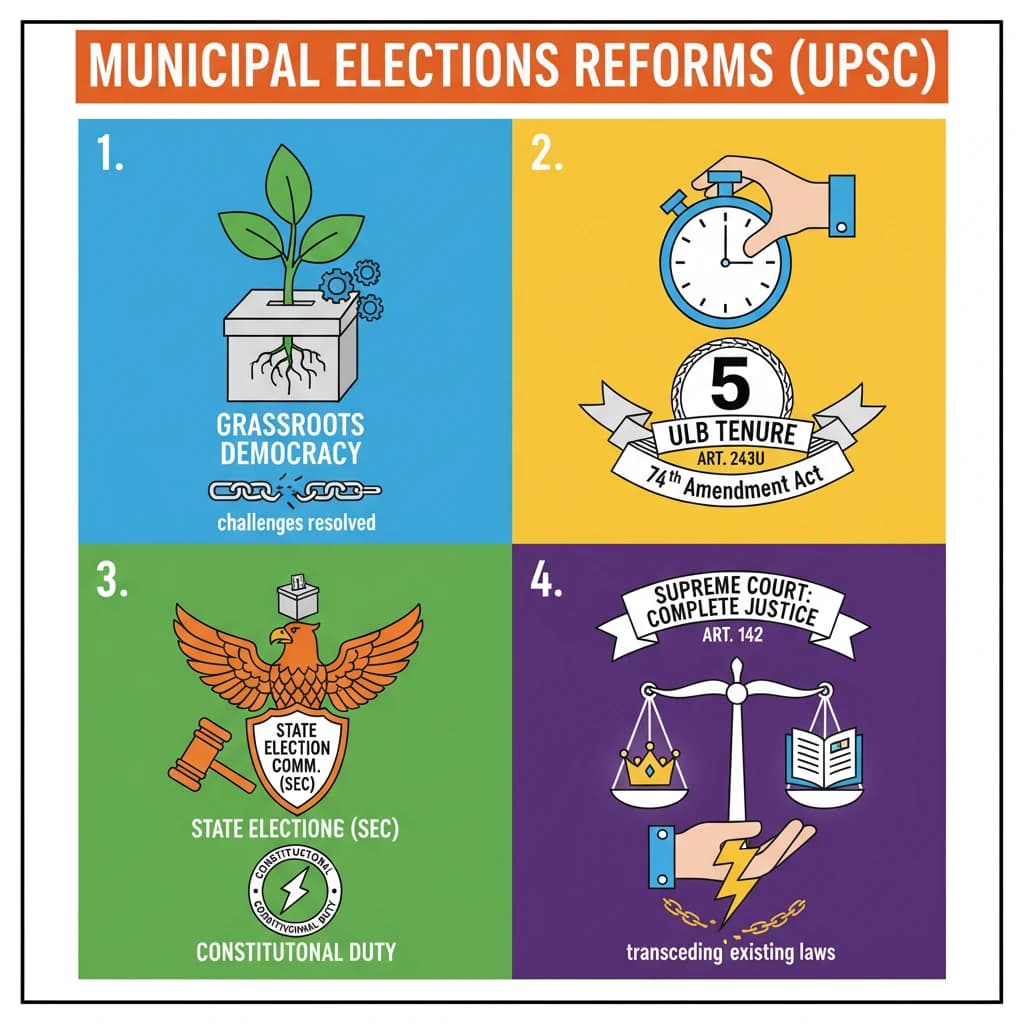
- Municipal elections are crucial for grassroots democracy but face challenges in timely conduct and fairness.
- The 74th Constitutional Amendment Act mandates a five-year tenure for Urban Local Bodies (ULBs) under Article 243U.
- State Election Commissions (SECs) are constitutionally responsible for conducting local body elections.
- Article 142 empowers the Supreme Court to deliver 'complete justice', even by transcending existing laws.
- Landmark judgments (e.g., Union Carbide, Suresh Mahajan) define the broad yet supplementary nature of Article 142.
- Recent interventions, like in the Chandigarh mayoral election, highlight the SC's role in upholding electoral integrity.
Reforms to Municipal Elections
Medium⏱️ 15 min read
polity and governance
📖 Introduction
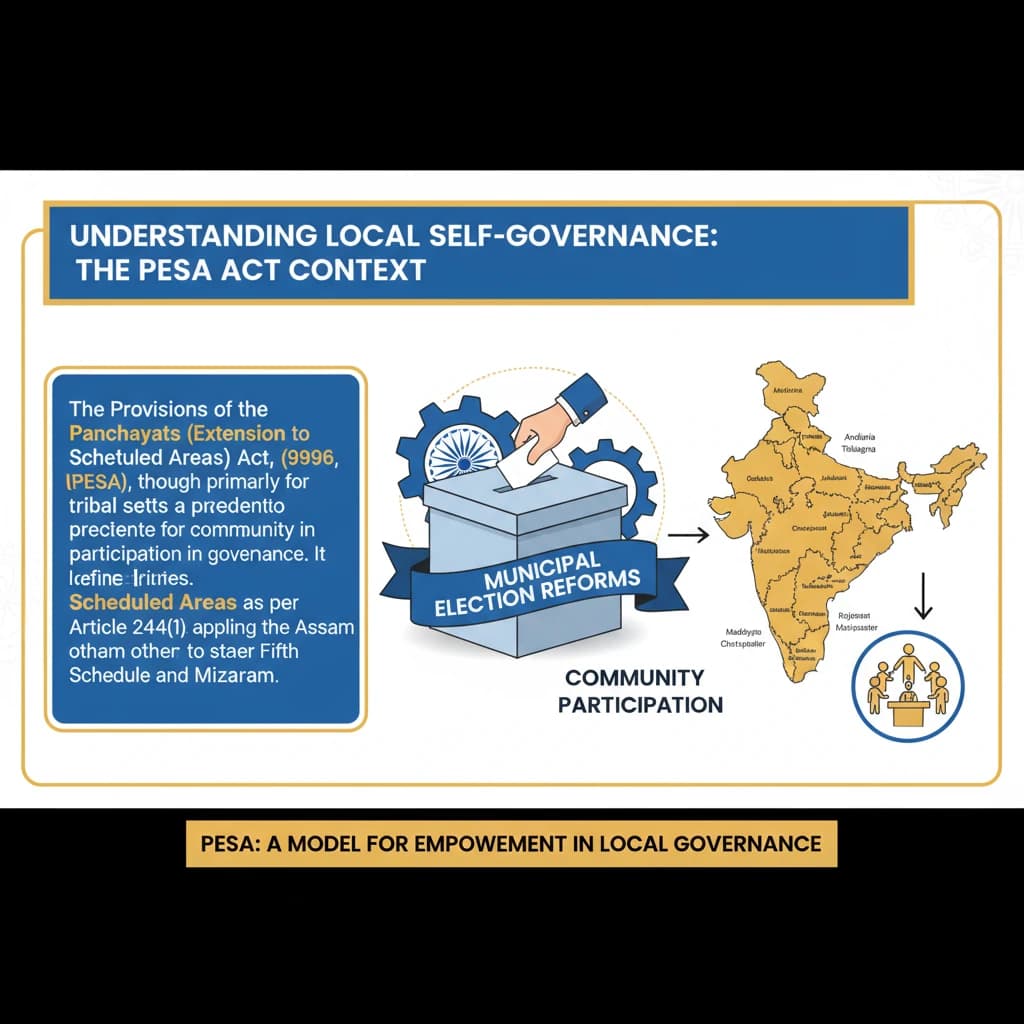
Understanding Local Self-Governance: The PESA Act Context
The Provisions of the Panchayats (Extension to the Scheduled Areas) Act, 1996 (PESA), though primarily for rural tribal areas, sets a precedent for community participation in local governance. It defines Scheduled Areas as per Article 244(1), applying the Fifth Schedule to states other than Assam, Meghalaya, Tripura, and Mizoram.
Scheduled Areas: These are regions predominantly inhabited by tribal communities, officially notified by the President of India. Currently, 10 states have notified Fifth Schedule areas, covering parts or fully several districts. These states include Andhra Pradesh, Chhattisgarh, Gujarat, Himachal Pradesh, Jharkhand, Madhya Pradesh, Maharashtra, Odisha, Rajasthan, and Telangana.
The PESA Act establishes the Gram Sabha as a crucial forum for community engagement. It empowers the Gram Sabha to identify development projects, prepare plans, and oversee their implementation at the village level.
- Village-level Institutions: The Act mandates the creation of institutions like the Gram Panchayat, Gram Sabha, and Panchayat Samiti to deliver basic services and manage development activities.
- Powers and Functions: Both the Gram Sabha and Gram Panchayat are granted significant authority over natural resource management and economic activity regulation.
- Consultation: Any development project or activity in Scheduled Areas requires mandatory consultation with the Gram Sabha.
- Funds: The Act ensures the transfer of funds to Gram Panchayats for effective functioning.
- Land Rights: It safeguards the land rights of tribal communities, requiring their consent for any land acquisition or transfer.
- Cultural and Social Practices: The Act protects the unique cultural and social practices of tribal communities, prohibiting interference.
Introduction to Municipal Election Challenges
The recent Supreme Court judgment concerning the Chandigarh mayoral election has brought to light persistent issues within the electoral processes of local urban bodies. Unlike elections for the Lok Sabha and State Assemblies, municipal elections often grapple with challenges related to timely conduct and smooth power transitions.
UPSC Insight: Understanding the distinction between electoral processes for central/state legislatures and local bodies is crucial for GS Paper II (Polity & Governance). Focus on the constitutional provisions and the role of various institutions.
Constitutional and Legal Framework for Local Body Elections
The framework for conducting local body elections is enshrined in the Indian Constitution and reinforced by judicial pronouncements.
Constitutional Provisions: The State Election Commission (SEC) is vested with the superintendence, direction, and control over the preparation of electoral rolls and the conduct of all elections to Panchayats and Municipalities.
The 74th Constitutional Amendment Act plays a pivotal role by barring court interference in the electoral matters of municipalities, aiming to ensure the autonomy of the election process.
Article 243U and the Mandate for Timely Elections
Article 243U, introduced by the 74th Constitution Amendment Act, constitutionally mandates a five-year tenure for urban local governments. This provision is critical for ensuring democratic continuity and stability at the grassroots level.
Key Point: The Supreme Court, in the Suresh Mahajan v. State of Madhya Pradesh Case (2022), unequivocally emphasized the inviolability of this constitutional mandate for a fixed five-year term, highlighting the importance of timely elections.
Article 142: Supreme Court's Extraordinary Powers
Article 142 of the Indian Constitution grants the Supreme Court unique and expansive powers to deliver 'complete justice'. This article allows the Court to issue any decree or order necessary, even if it transcends existing laws or statutes.
This extraordinary power enables the Supreme Court to perform functions that may extend beyond traditional adjudication, potentially encompassing executive and legislative roles when deemed necessary to ensure justice for all parties involved in a dispute.
Supporting Provisions for Article 142:
- Article 32: Guarantees the right to constitutional remedies.
- Article 141: Mandates that all courts in India must abide by the Supreme Court's decisions.
- Article 136: Allows for Special Leave Petition (SLP), granting the SC discretionary power to hear appeals.
Judicial Activism and its Implications
The collective framework, including Article 142 and its supporting provisions, is often referred to as 'judicial activism'. This concept signifies the Supreme Court's proactive role in interpreting and enforcing the Constitution to protect rights and ensure justice.
While essential for upholding constitutional values, judicial activism has sometimes led to the Supreme Court stepping beyond parliamentary legislation to achieve 'complete justice', sparking debates about the separation of powers.
Public Interest Interventions: Article 142 empowers the Supreme Court to intervene in matters involving public interest, human rights, constitutional values, or fundamental rights. This reinforces its role as the guardian of the Constitution against violations.
Landmark Judgments on Article 142's Scope
The scope and limitations of Article 142 have been clarified through several significant judgments:
- Union Carbide Corporation vs Union of India (1991): The Supreme Court ordered UCC to pay USD 470 million in compensation to victims of the Bhopal gas tragedy. This judgment highlighted the wide scope of Article 142(1), clarifying that its powers are of a different quality and not subject to express statutory prohibitions.
- Supreme Court Bar Association vs Union of India (1998): The apex court emphasized that powers under Article 142 are supplementary and should not be used to override substantive laws. The Court stated these powers are curative in nature, meant to address specific injustices, and should not be used to ignore litigants' rights or bypass statutory provisions.
💡 Key Takeaways
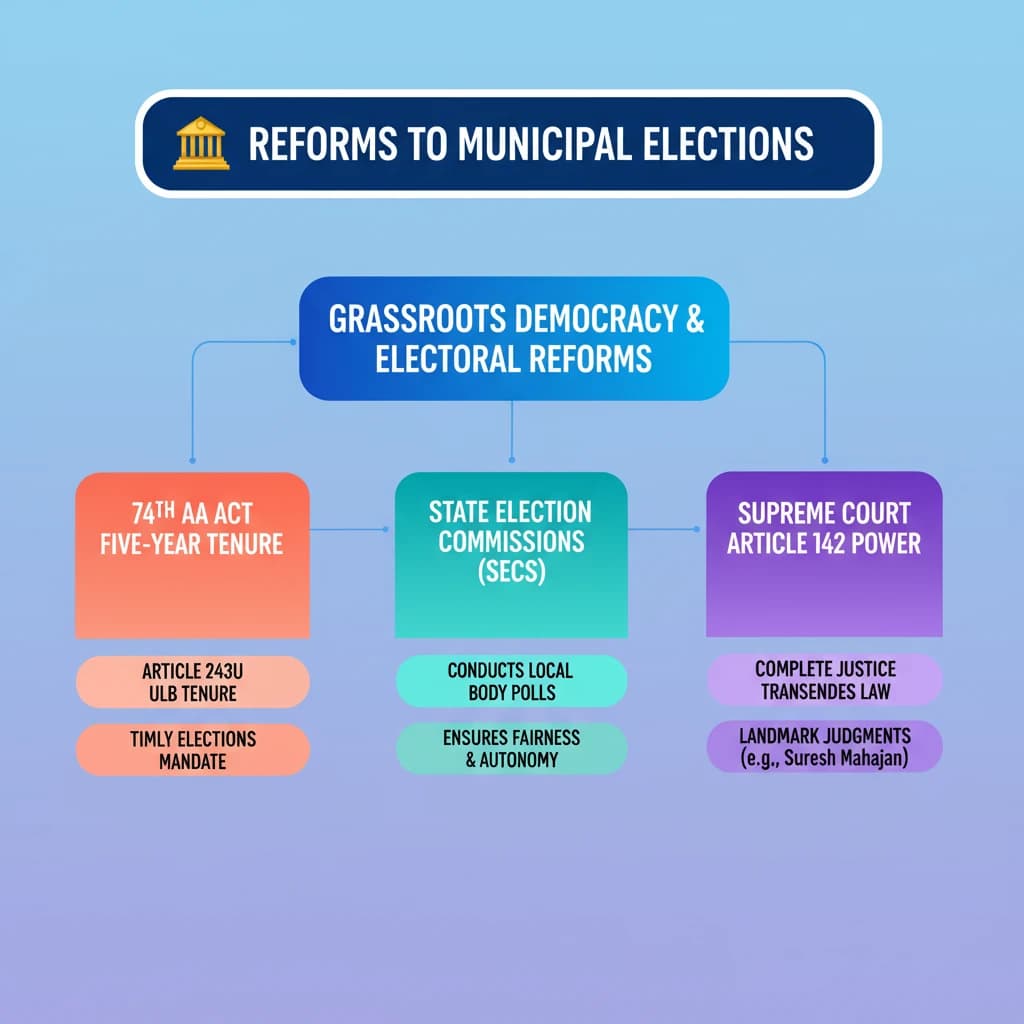
- •Municipal elections are crucial for grassroots democracy but face challenges in timely conduct and fairness.
- •The 74th Constitutional Amendment Act mandates a five-year tenure for Urban Local Bodies (ULBs) under Article 243U.
- •State Election Commissions (SECs) are constitutionally responsible for conducting local body elections.
- •Article 142 empowers the Supreme Court to deliver 'complete justice', even by transcending existing laws.
- •Landmark judgments (e.g., Union Carbide, Suresh Mahajan) define the broad yet supplementary nature of Article 142.
- •Recent interventions, like in the Chandigarh mayoral election, highlight the SC's role in upholding electoral integrity.
🧠 Memory Techniques
95% Verified Content
📚 Reference Sources
•The Constitution of India (Articles 243U, 142, 244(1), Fifth Schedule)
•Supreme Court Judgments: Union Carbide Corporation vs Union of India (1991), Supreme Court Bar Association vs Union of India (1998), Suresh Mahajan v. State of Madhya Pradesh (2022)
•74th Constitutional Amendment Act, 1992