Loading page, please wait…
Right To Education - UPSC Polity And Governance
What is Right To Education in UPSC Polity And Governance?
Right To Education is a key topic under Polity And Governance for UPSC Civil Services Examination. Key points include: Education moved from State List to Concurrent List by 42nd Amendment (1976).. 86th Amendment (2002) made education a Fundamental Right (Article 21A) for 6-14 years.. 86th Amendment also changed DPSP Article 45 (0-6 years) and added Fundamental Duty Article 51A(k).. Understanding this topic is essential for both UPSC Prelims and Mains preparation.
Why is Right To Education important for UPSC exam?
Right To Education is a Medium-level topic in UPSC Polity And Governance. It is tested in both Prelims (factual MCQs) and Mains (analytical answer writing). Previous year UPSC questions have frequently covered aspects of Right To Education, making it essential for comprehensive IAS preparation.
How to prepare Right To Education for UPSC?
To prepare Right To Education for UPSC: (1) Study the comprehensive notes covering all key concepts on Vaidra. (2) Practice previous year questions on this topic. (3) Connect it with current affairs using daily updates. (4) Revise using key takeaways and mind maps available for Polity And Governance. (5) Write practice answers linking Right To Education to related GS Paper topics.
Key takeaways of Right To Education for UPSC
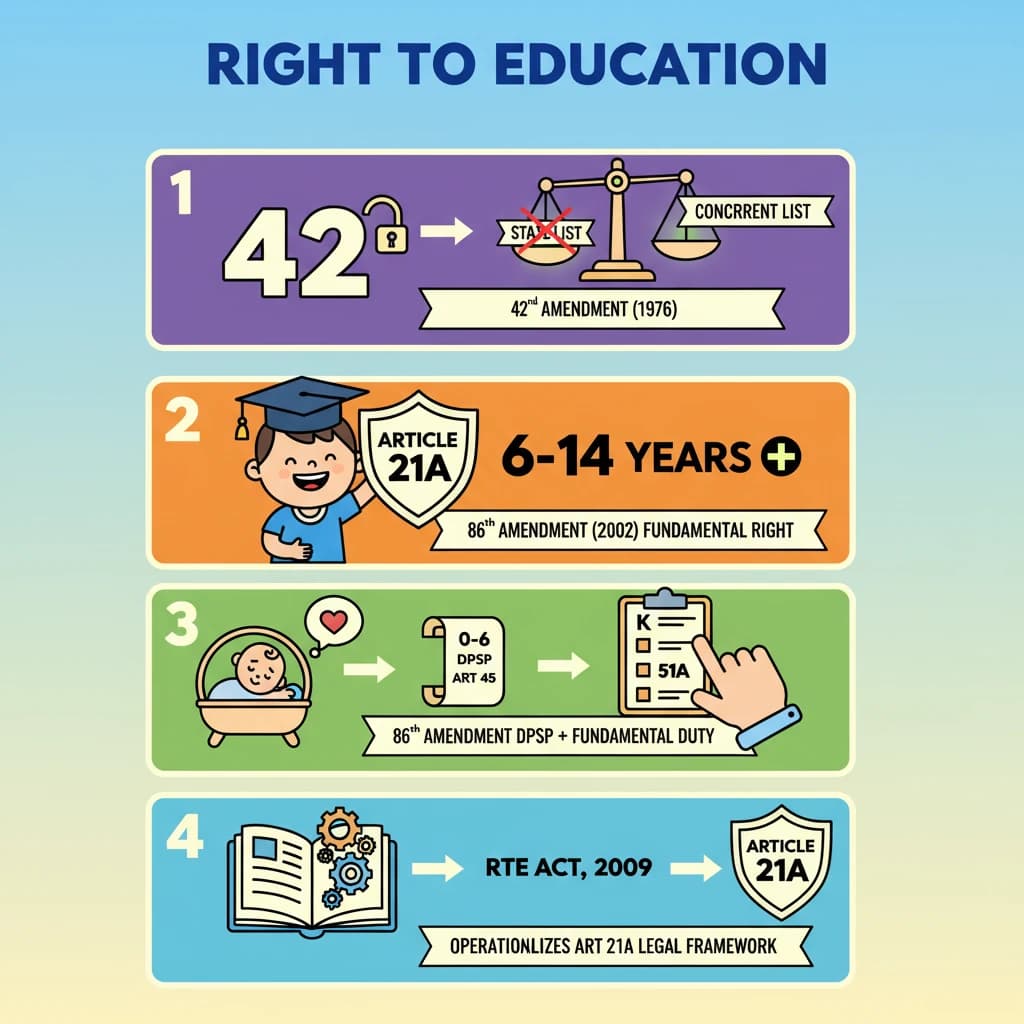
- Education moved from State List to Concurrent List by 42nd Amendment (1976).
- 86th Amendment (2002) made education a Fundamental Right (Article 21A) for 6-14 years.
- 86th Amendment also changed DPSP Article 45 (0-6 years) and added Fundamental Duty Article 51A(k).
- RTE Act, 2009, operationalized Article 21A, providing the legal framework.
- RTE is crucial for inclusive growth, social justice, and achieving SDG 4.
Right To Education
Medium⏱️ 7 min read
polity and governance
📖 Introduction
Evolution of Education's Status
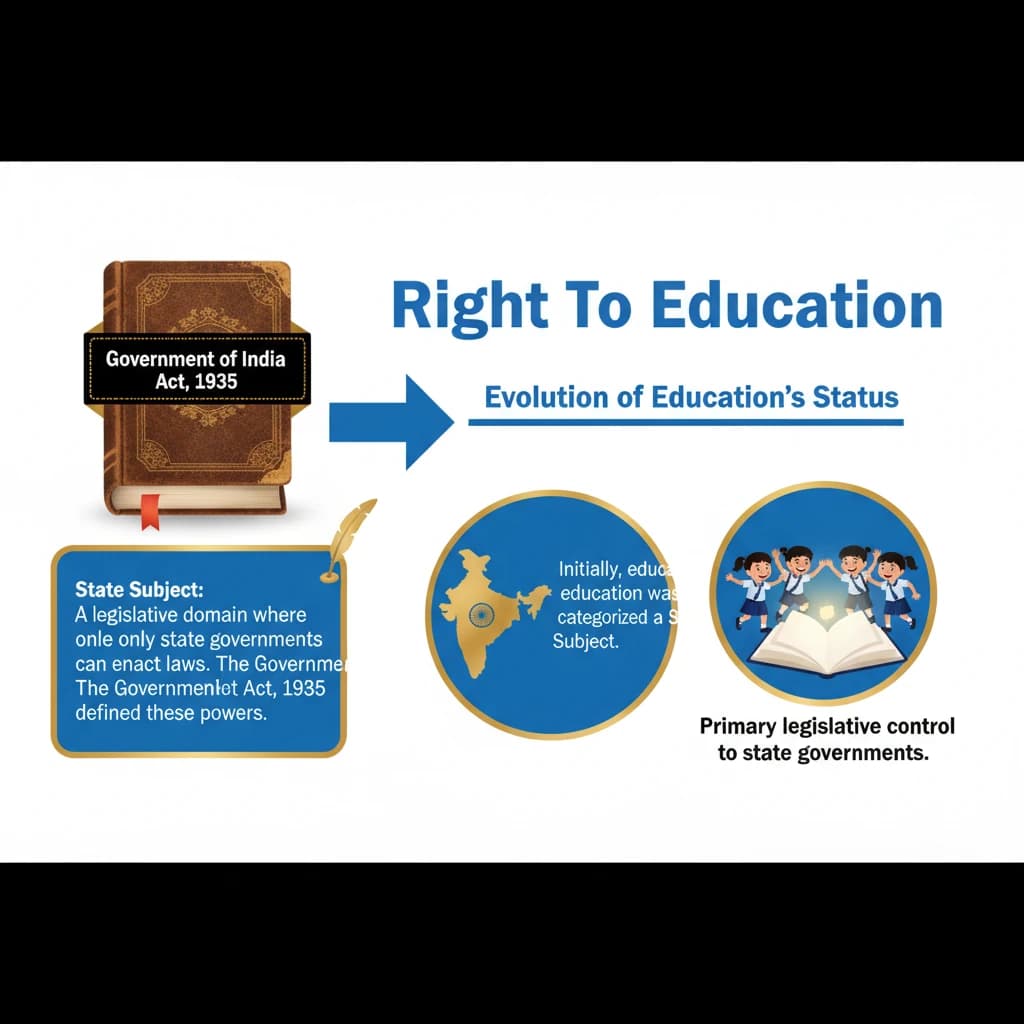
Initially, education was categorized as a State Subject in India. This classification was established under the Government of India Act, 1935, granting primary legislative control to state governments.
State Subject: A legislative domain where only state governments can enact laws. The Government of India Act, 1935 defined these powers.
A significant change occurred with the 42nd Constitutional Amendment Act of 1976. This amendment shifted education from the State List to the Concurrent List.
The move to the Concurrent List implies that both the Central Government and State Governments now possess the authority to legislate on matters pertaining to education.
The 86th Constitutional Amendment Act, 2002
The landmark Eighty-sixth Constitutional Amendment Act, enacted in 2002, introduced profound changes to the status of education in India.
Crucially, this amendment enshrined the Right to Education (RTE) as a Fundamental Right. It did so by inserting a new article, Article 21A, into Part III of the Constitution.
Article 21A: Mandates that the State shall provide free and compulsory education to all children between the ages of six and fourteen years in such manner as the State may, by law, determine.
This made education not merely a policy goal, but an enforceable right for a specific age group, emphasizing its importance for national development.
Impact on Directive Principles of State Policy (DPSP)
Concurrently with the introduction of Article 21A, the 86th Amendment Act, 2002 also modified Article 45 under the Directive Principles of State Policy (DPSP).
The original provision of Article 45, which dealt with free and compulsory education for all children until they complete fourteen years, was substituted.
New Article 45: Now directs the State to endeavor to provide early childhood care and education for all children until they complete the age of six years.
This modification clearly delineates the State's responsibility: Fundamental Right for 6-14 years and DPSP for 0-6 years, highlighting a comprehensive approach to child development.
Introduction of a Fundamental Duty
To further strengthen the commitment to education, the 86th Amendment Act, 2002 also introduced a new Fundamental Duty under Article 51A of the Constitution.
This addition placed a direct responsibility on parents and guardians regarding their children's education.
Article 51A(k): States that it shall be the duty of every citizen who is a parent or guardian to provide opportunities for education to his child or, as the case may be, ward between the age of six and fourteen years.
This amendment created a holistic framework, addressing education through Fundamental Rights, DPSPs, and Fundamental Duties.
The Right to Education Act, 2009
Following the constitutional mandate of Article 21A, the Parliament enacted the Right of Children to Free and Compulsory Education Act, 2009, commonly known as the RTE Act, 2009.
This act operationalized the provisions of Article 21A, providing the legal framework and mechanisms for its implementation across the country.
The RTE Act, 2009, details aspects such as norms for schools, pupil-teacher ratios, curriculum, and the prohibition of physical punishment and mental harassment.
Understanding the interplay between the 86th Amendment (2002) and the RTE Act (2009) is crucial for UPSC. The amendment provided the constitutional basis, while the Act provided the statutory framework.

💡 Key Takeaways
- •Education moved from State List to Concurrent List by 42nd Amendment (1976).
- •86th Amendment (2002) made education a Fundamental Right (Article 21A) for 6-14 years.
- •86th Amendment also changed DPSP Article 45 (0-6 years) and added Fundamental Duty Article 51A(k).
- •RTE Act, 2009, operationalized Article 21A, providing the legal framework.
- •RTE is crucial for inclusive growth, social justice, and achieving SDG 4.
🧠 Memory Techniques
95% Verified Content
📚 Reference Sources
•The Constitution of India (Articles 21A, 45, 51A)
•The Right of Children to Free and Compulsory Education Act, 2009