Loading page, please wait…
SC to Examine Use of Money Bills in Legislation - UPSC Polity And Governance
What is SC to Examine Use of Money Bills in Legislation in UPSC Polity And Governance?
SC to Examine Use of Money Bills in Legislation is a key topic under Polity And Governance for UPSC Civil Services Examination. Key points include: SC is examining petitions challenging the government's use of Money Bills to pass contentious laws.. Article 110 defines Money Bills as those dealing ONLY with specific financial matters.. The Speaker of the Lok Sabha's decision on a Money Bill is final and cannot be questioned.. Understanding this topic is essential for both UPSC Prelims and Mains preparation.
Why is SC to Examine Use of Money Bills in Legislation important for UPSC exam?
SC to Examine Use of Money Bills in Legislation is a Medium-level topic in UPSC Polity And Governance. It is tested in both Prelims (factual MCQs) and Mains (analytical answer writing). Previous year UPSC questions have frequently covered aspects of SC to Examine Use of Money Bills in Legislation, making it essential for comprehensive IAS preparation.
How to prepare SC to Examine Use of Money Bills in Legislation for UPSC?
To prepare SC to Examine Use of Money Bills in Legislation for UPSC: (1) Study the comprehensive notes covering all key concepts on Vaidra. (2) Practice previous year questions on this topic. (3) Connect it with current affairs using daily updates. (4) Revise using key takeaways and mind maps available for Polity And Governance. (5) Write practice answers linking SC to Examine Use of Money Bills in Legislation to related GS Paper topics.
Key takeaways of SC to Examine Use of Money Bills in Legislation for UPSC
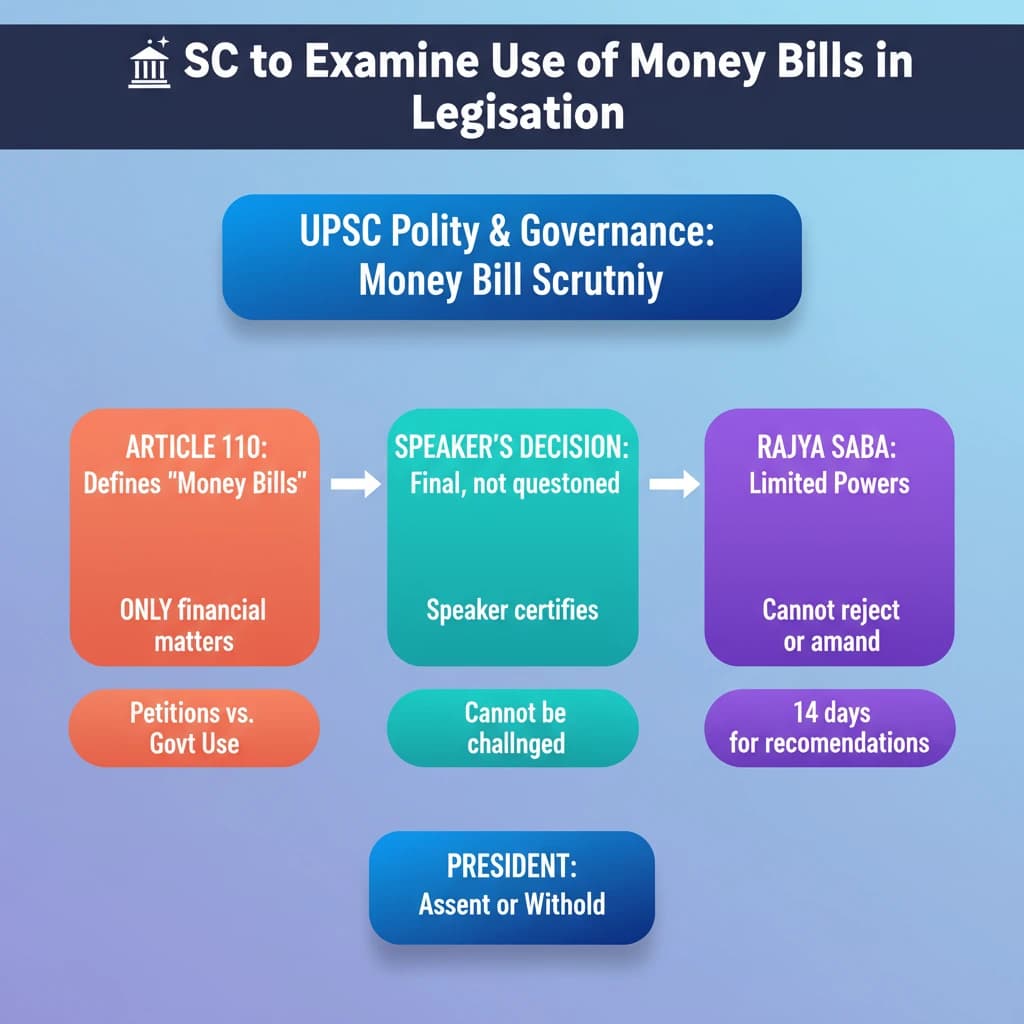
- SC is examining petitions challenging the government's use of Money Bills to pass contentious laws.
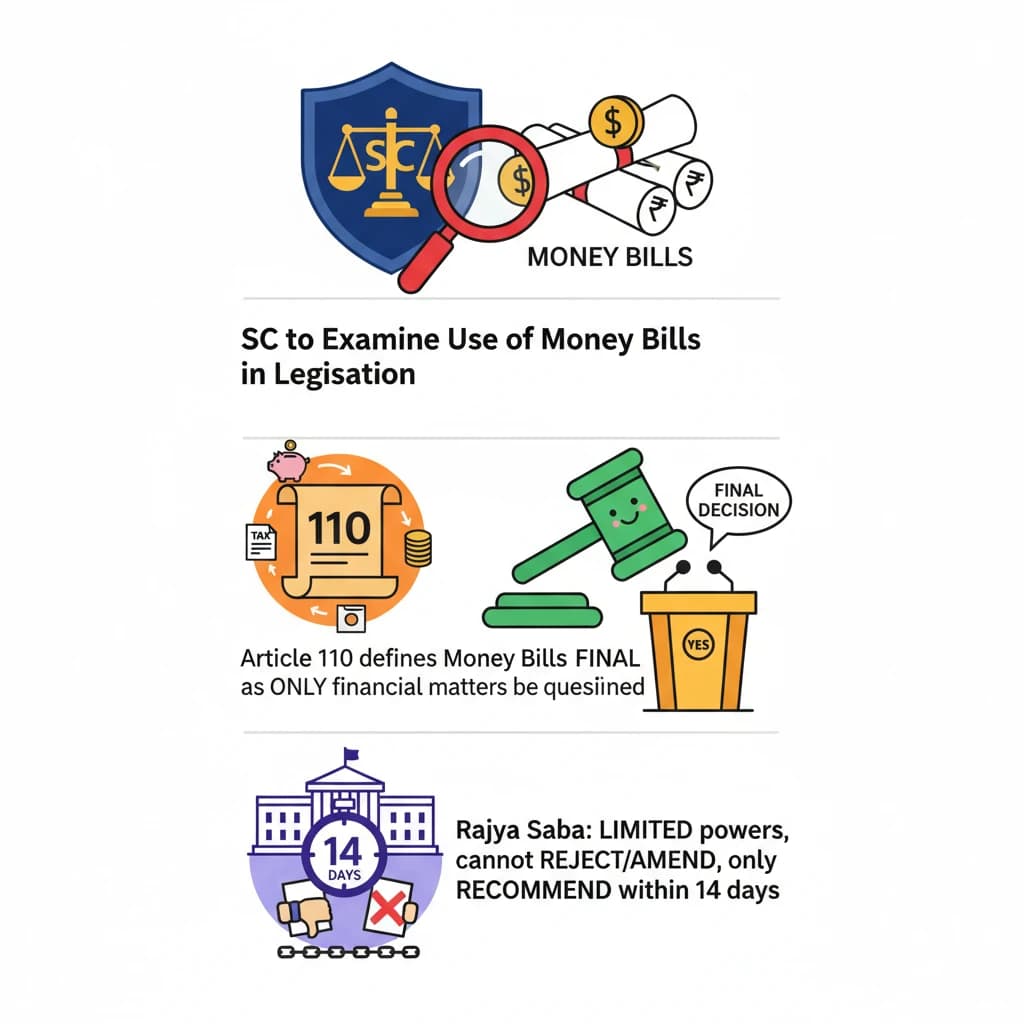
- Article 110 defines Money Bills as those dealing ONLY with specific financial matters.
- The Speaker of the Lok Sabha's decision on a Money Bill is final and cannot be questioned.
- Rajya Sabha has limited powers over Money Bills; it cannot reject or amend, only recommend within 14 days.
- The President cannot return a Money Bill for reconsideration, only assent or withhold.
- The core concern is the circumvention of Rajya Sabha's scrutiny, impacting legislative checks and balances.
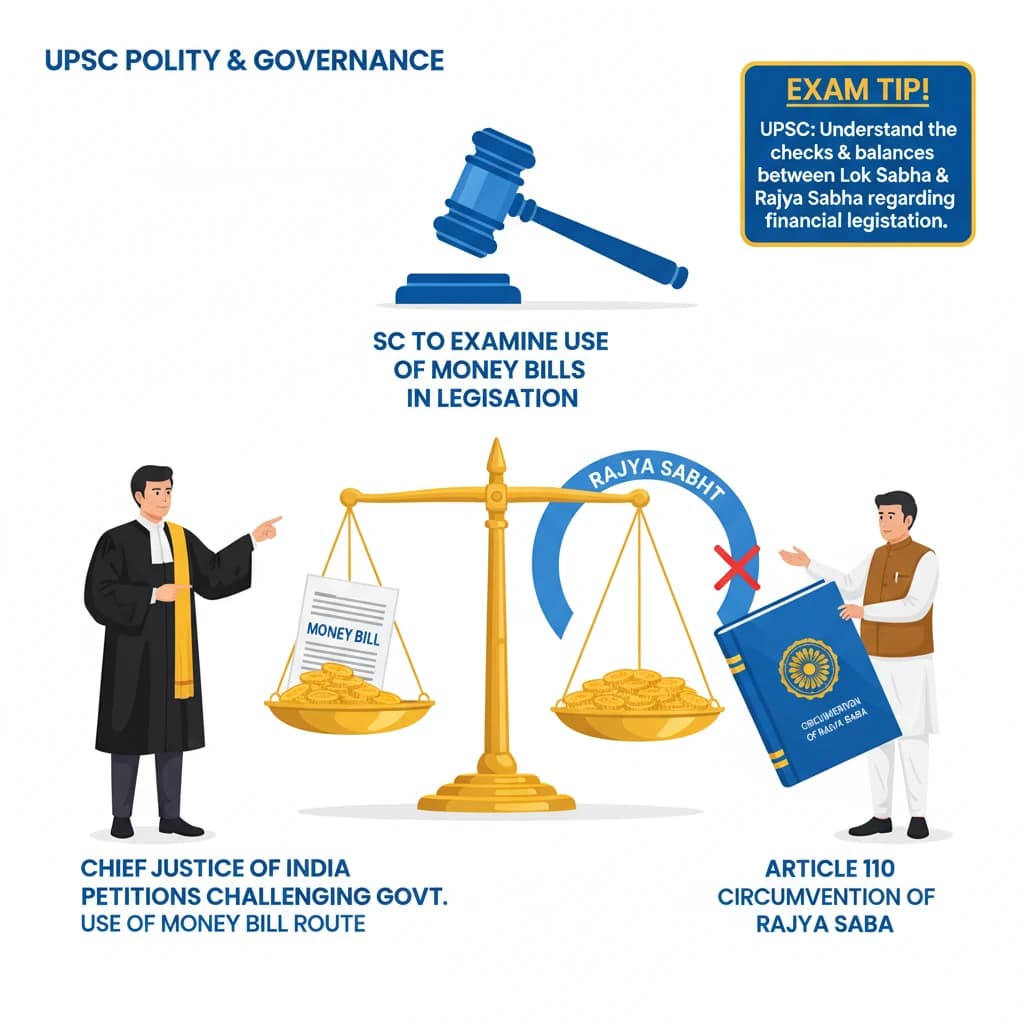
SC to Examine Use of Money Bills in Legislation
Medium⏱️ 12 min read
polity and governance
📖 Introduction
Context of the Supreme Court's Examination
Recently, the Chief Justice of India (CJI) has agreed to list petitions challenging the government's use of the Money Bill route to pass contentious amendments in the Parliament.
This issue is crucial as it concerns the circumvention of the Rajya Sabha and potential violations of Article 110 of the Constitution.
UPSC Insight: The SC's examination highlights the ongoing tension between legislative efficiency and constitutional checks and balances. Understanding the nuances of Money Bills is vital for GS Paper 2 (Polity).
Developments Following the 2019 Ruling
A seven-judge Bench, which was previously constituted, has yet to address key questions about what precisely constitutes a valid Money Bill.
This unresolved definition impacts subsequent legislation. The court has deliberately avoided resolving the Money Bill question in cases related to the Enforcement Directorate's powers and electoral laws, awaiting the larger Bench's definitive decision.
What is a Money Bill?
Article 110 of the Constitution of India defines a Money Bill. A bill is considered a Money Bill if it contains only provisions dealing with specific financial matters.
Key Financial Matters under Article 110:
- Taxation matters: Imposition, abolition, remission, alteration, or regulation of any tax.
- Borrowing Regulation: Regulation of the borrowing of money by the Union government.
- Custody of Funds: Management of the Consolidated Fund of India or the Contingency Fund.
- Appropriation of Funds: Appropriation of money out of the Consolidated Fund.
- Expenditure Declaration: Declaration of any expenditure charged on the Consolidated Fund.
- Receipt of Money: Receipt of money related to the Consolidated Fund or public accounts.
- Other Matters: Any matters incidental to the above provisions.
Speaker's Certification
The crucial decision on whether a bill is a Money Bill rests solely with the Speaker of the Lok Sabha.
The Speaker's decision is final and cannot be questioned in any court, by either House of Parliament, nor can it be contested by the President.
Upon certification, the Speaker endorses the bill as a Money Bill when it is transmitted to the Rajya Sabha for recommendations.
Legislative Procedure for Money Bills
Money Bills can only be introduced in the Lok Sabha and require the prior recommendation of the President.
They are treated as government bills and can only be introduced by a minister.
After passing in the Lok Sabha, the bill is sent to the Rajya Sabha, which has limited powers. The Rajya Sabha cannot reject or amend a Money Bill.
It can only make recommendations and must return the bill within 14 days, irrespective of whether it makes recommendations or not.
The Lok Sabha has the discretion to either accept or reject the Rajya Sabha's recommendations. If accepted, the bill is deemed passed in the modified form; if rejected, it passes in its original form.
Presidential Assent
Once a Money Bill is presented to the President, he can either give assent or withhold it.
Crucially, the President cannot return a Money Bill for reconsideration.
Generally, the President gives assent to Money Bills as they are introduced with his prior permission.
Exclusions from Money Bill Classification
A bill cannot be classified as a Money Bill simply because it involves:
- Imposition of fines or pecuniary penalties.
- Demand or payment of fees for licences or services.
- Taxation by local authorities for local purposes.
💡 Key Takeaways
- •SC is examining petitions challenging the government's use of Money Bills to pass contentious laws.
- •Article 110 defines Money Bills as those dealing ONLY with specific financial matters.
- •The Speaker of the Lok Sabha's decision on a Money Bill is final and cannot be questioned.
- •Rajya Sabha has limited powers over Money Bills; it cannot reject or amend, only recommend within 14 days.
- •The President cannot return a Money Bill for reconsideration, only assent or withhold.
- •The core concern is the circumvention of Rajya Sabha's scrutiny, impacting legislative checks and balances.
🧠 Memory Techniques
95% Verified Content
📚 Reference Sources
•The Constitution of India (Article 110, Article 109)
•Supreme Court judgments on Aadhaar Act (Justice D.Y. Chandrachud's dissenting opinion)
•Parliamentary debates and analyses on Money Bills