Loading page, please wait…
Self-Employment Scheme for Rehabilitation of Manual Scavengers (SRMS) - UPSC Polity And Governance
What is Self-Employment Scheme for Rehabilitation of Manual Scavengers (SRMS) in UPSC Polity And Governance?
Self-Employment Scheme for Rehabilitation of Manual Scavengers (SRMS) is a key topic under Polity And Governance for UPSC Civil Services Examination. Key points include: SRMS (Self-Employment Scheme for Rehabilitation of Manual Scavengers), launched in 2007, aims for dignity and sustainable livelihoods for sanitation workers.. SRMS has been renamed as NAMASTE (National Action for Mechanised Ecosystem Sanitation).. NAMASTE will be implemented across 4800 Urban Local Bodies (ULBs) by 2025-26.. Understanding this topic is essential for both UPSC Prelims and Mains preparation.
Why is Self-Employment Scheme for Rehabilitation of Manual Scavengers (SRMS) important for UPSC exam?
Self-Employment Scheme for Rehabilitation of Manual Scavengers (SRMS) is a Easy-level topic in UPSC Polity And Governance. It is tested in both Prelims (factual MCQs) and Mains (analytical answer writing). Previous year UPSC questions have frequently covered aspects of Self-Employment Scheme for Rehabilitation of Manual Scavengers (SRMS), making it essential for comprehensive IAS preparation.
How to prepare Self-Employment Scheme for Rehabilitation of Manual Scavengers (SRMS) for UPSC?
To prepare Self-Employment Scheme for Rehabilitation of Manual Scavengers (SRMS) for UPSC: (1) Study the comprehensive notes covering all key concepts on Vaidra. (2) Practice previous year questions on this topic. (3) Connect it with current affairs using daily updates. (4) Revise using key takeaways and mind maps available for Polity And Governance. (5) Write practice answers linking Self-Employment Scheme for Rehabilitation of Manual Scavengers (SRMS) to related GS Paper topics.
Key takeaways of Self-Employment Scheme for Rehabilitation of Manual Scavengers (SRMS) for UPSC
- SRMS (Self-Employment Scheme for Rehabilitation of Manual Scavengers), launched in 2007, aims for dignity and sustainable livelihoods for sanitation workers.
- SRMS has been renamed as NAMASTE (National Action for Mechanised Ecosystem Sanitation).
- NAMASTE will be implemented across 4800 Urban Local Bodies (ULBs) by 2025-26.
- The National Safai Karamchari Financial Development Corporation (NSKFDC) is the implementing agency for NAMASTE.
- Key objectives include rehabilitation of Manual Scavengers (MS) and Persons Engaged in Hazardous Cleaning of Sewer and Septic tanks (SSWs).
- NAMASTE also promotes safe and mechanised cleaning of sewers and septic tanks through trained and certified workers.
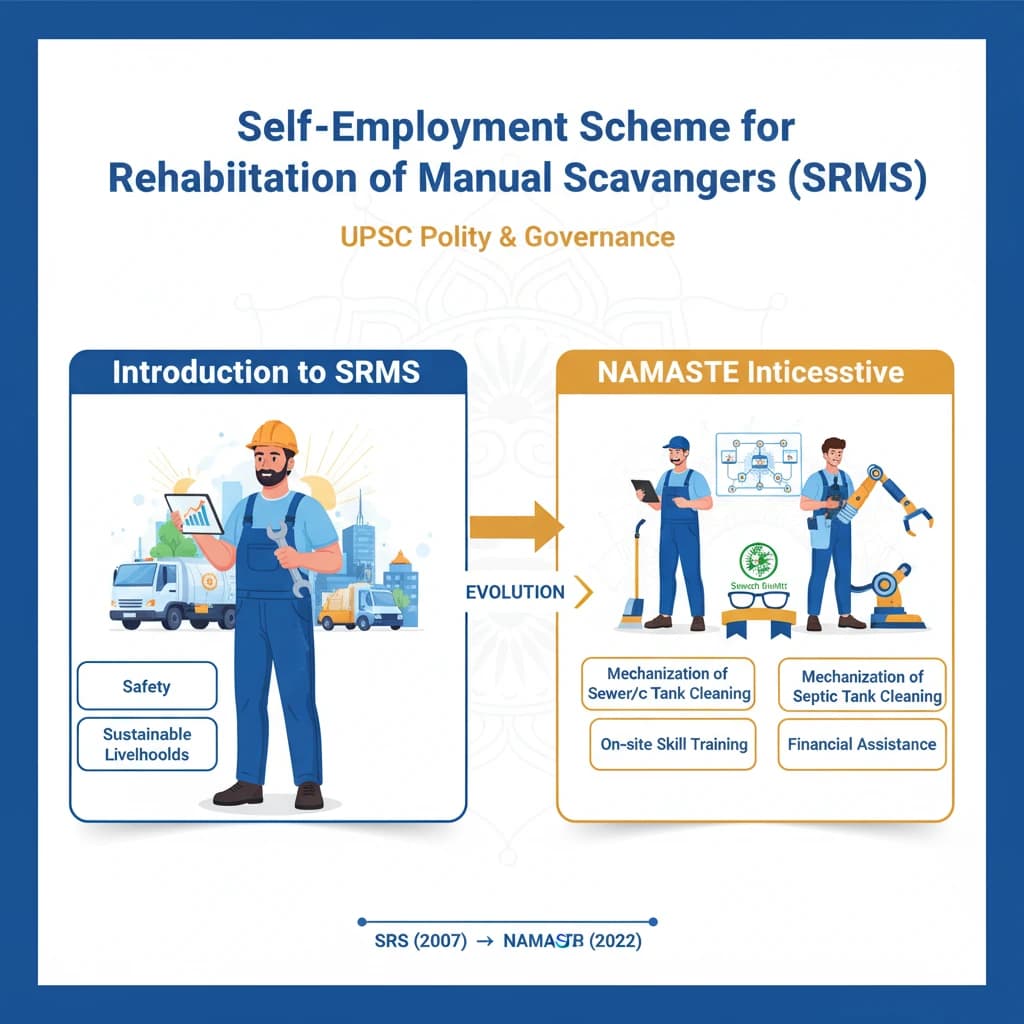
Self-Employment Scheme for Rehabilitation of Manual Scavengers (SRMS)
Easy⏱️ 5 min read
polity and governance
📖 Introduction
Introduction to SRMS and NAMASTE
The Self-Employment Scheme for Rehabilitation of Manual Scavengers (SRMS) was a pivotal initiative launched by the Indian government. Its primary goal was to ensure the safety, dignity, and provision of sustainable livelihoods for urban sanitation workers across the country.
This scheme was designed to address the deeply rooted social issue of manual scavenging, aiming to integrate affected individuals into dignified employment opportunities.
The SRMS Scheme, originally launched in 2007, has since been renamed. It is now known as the National Action for Mechanised Ecosystem Sanitation (NAMASTE) scheme.
Implementation Details of NAMASTE
The NAMASTE scheme represents an enhanced and expanded approach to the rehabilitation efforts. It is set to be implemented across a vast network of urban areas, reflecting a comprehensive national commitment.
This phased implementation ensures that a wide range of municipal bodies are covered, maximizing the scheme's reach and impact on sanitation workers.
The NAMASTE scheme is slated for implementation across 4800 Urban Local Bodies (ULBs) throughout India. This extensive rollout is planned over the next three years, specifically until the fiscal year 2025-26.
The primary implementing agency for the NAMASTE scheme is the National Safai Karamchari Financial Development Corporation (NSKFDC).
Core Objectives of the Scheme
The objectives of the scheme are multi-faceted, focusing on both the direct rehabilitation of individuals and the systemic transformation of sanitation practices. These goals underscore a commitment to human rights and modern sanitation.
- Rehabilitation of Manual Scavengers (MS): A key objective is the comprehensive rehabilitation of individuals identified as Manual Scavengers (MS). This also extends to Persons Engaged in Hazardous Cleaning of Sewer and Septic tanks (SSWs).
- Promotion of Safe and Mechanised Cleaning: The scheme actively promotes the adoption of safe and mechanised cleaning methods for sewers and septic tanks. This is facilitated through the training and certification of sanitation workers, ensuring professional and risk-free operations.
For UPSC Mains GS-I (Social Issues) and GS-II (Governance & Social Justice), understanding the evolution from SRMS to NAMASTE and its objectives is crucial. Highlight the shift towards mechanization and dignity in your answers.
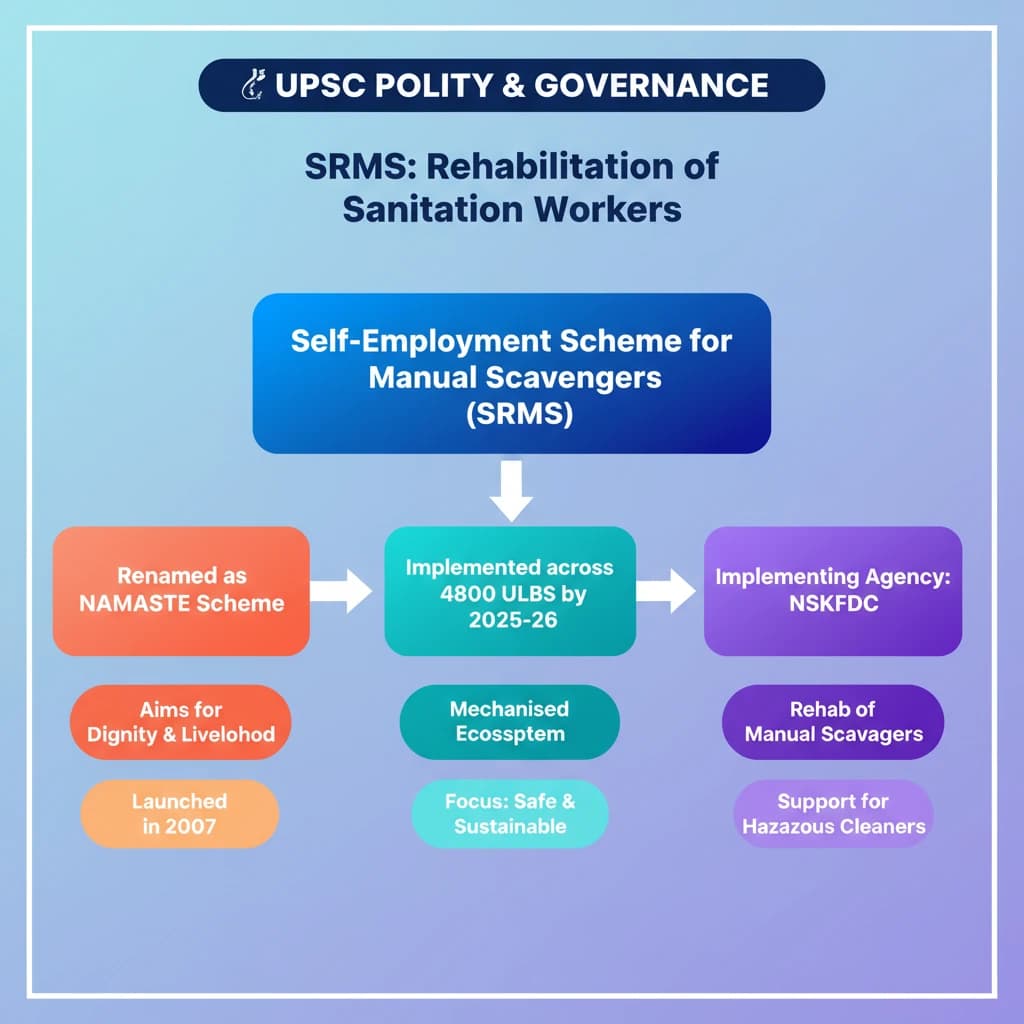
💡 Key Takeaways
- •SRMS (Self-Employment Scheme for Rehabilitation of Manual Scavengers), launched in 2007, aims for dignity and sustainable livelihoods for sanitation workers.
- •SRMS has been renamed as NAMASTE (National Action for Mechanised Ecosystem Sanitation).
- •NAMASTE will be implemented across 4800 Urban Local Bodies (ULBs) by 2025-26.
- •The National Safai Karamchari Financial Development Corporation (NSKFDC) is the implementing agency for NAMASTE.
- •Key objectives include rehabilitation of Manual Scavengers (MS) and Persons Engaged in Hazardous Cleaning of Sewer and Septic tanks (SSWs).
- •NAMASTE also promotes safe and mechanised cleaning of sewers and septic tanks through trained and certified workers.
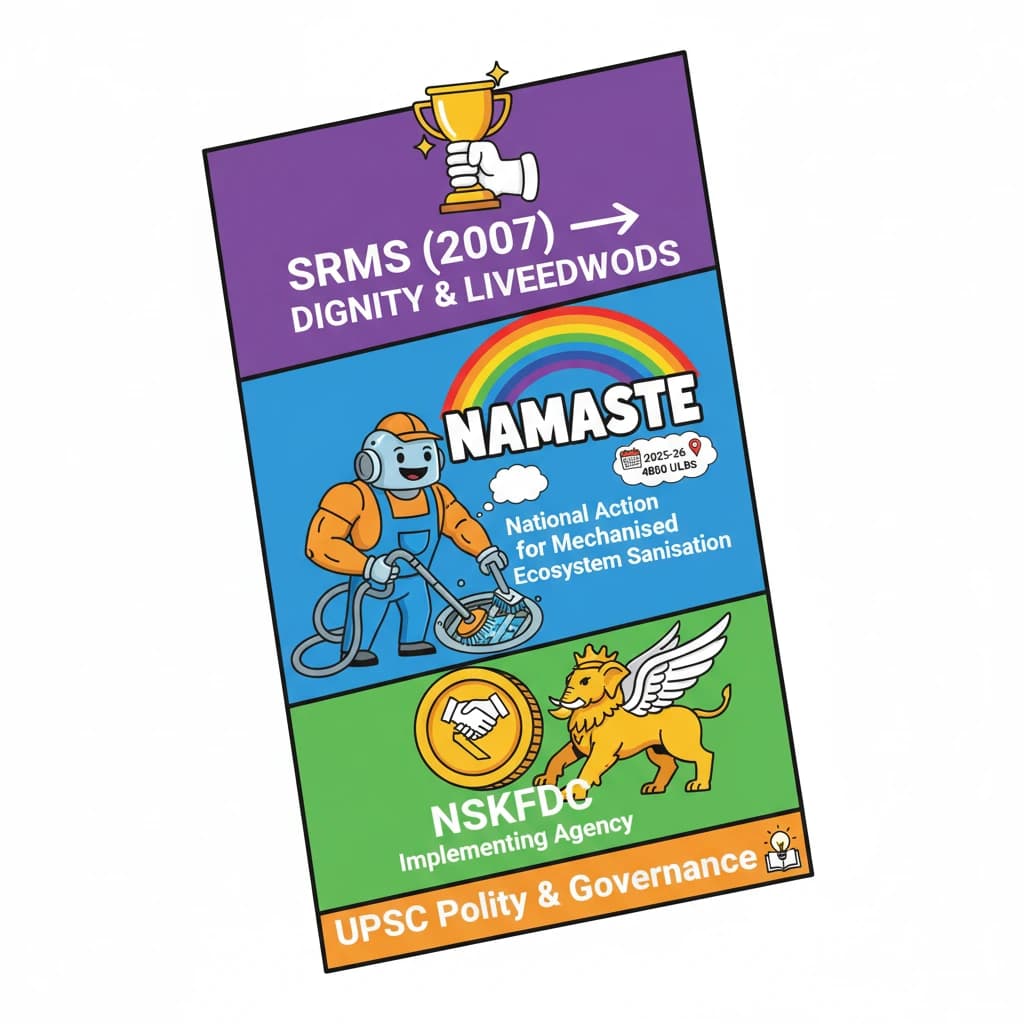
🧠 Memory Techniques
98% Verified Content
📚 Reference Sources
•Ministry of Social Justice and Empowerment (Government of India) reports and scheme guidelines
•Press Information Bureau (PIB) releases on NAMASTE scheme