Loading page, please wait…
Simultaneous Elections: 'One Nation, One Election' Plan & Implications - UPSC Polity And Governance
What is Simultaneous Elections: 'One Nation, One Election' Plan & Implications in UPSC Polity And Governance?
Simultaneous Elections: 'One Nation, One Election' Plan & Implications is a key topic under Polity And Governance for UPSC Civil Services Examination. Key points include: Simultaneous Elections (One Nation, One Election) mean holding Lok Sabha, State Assembly, and local body polls together.. Historically, India largely practiced simultaneous elections until 1967.. The cycle broke due to premature dismissals of state governments and collapse of coalition governments.. Understanding this topic is essential for both UPSC Prelims and Mains preparation.
Why is Simultaneous Elections: 'One Nation, One Election' Plan & Implications important for UPSC exam?
Simultaneous Elections: 'One Nation, One Election' Plan & Implications is a Medium-level topic in UPSC Polity And Governance. It is tested in both Prelims (factual MCQs) and Mains (analytical answer writing). Previous year UPSC questions have frequently covered aspects of Simultaneous Elections: 'One Nation, One Election' Plan & Implications, making it essential for comprehensive IAS preparation.
How to prepare Simultaneous Elections: 'One Nation, One Election' Plan & Implications for UPSC?
To prepare Simultaneous Elections: 'One Nation, One Election' Plan & Implications for UPSC: (1) Study the comprehensive notes covering all key concepts on Vaidra. (2) Practice previous year questions on this topic. (3) Connect it with current affairs using daily updates. (4) Revise using key takeaways and mind maps available for Polity And Governance. (5) Write practice answers linking Simultaneous Elections: 'One Nation, One Election' Plan & Implications to related GS Paper topics.
Key takeaways of Simultaneous Elections: 'One Nation, One Election' Plan & Implications for UPSC
- Simultaneous Elections (One Nation, One Election) mean holding Lok Sabha, State Assembly, and local body polls together.
- Historically, India largely practiced simultaneous elections until 1967.
- The cycle broke due to premature dismissals of state governments and collapse of coalition governments.
- The Ram Nath Kovind Committee recently submitted a report endorsing the 'one nation, one election' plan.
- The Union Cabinet has approved the proposal, necessitating constitutional amendments via two bills.
Simultaneous Elections: 'One Nation, One Election' Plan & Implications
Medium⏱️ 8 min read
polity and governance
📖 Introduction
Understanding Simultaneous Elections
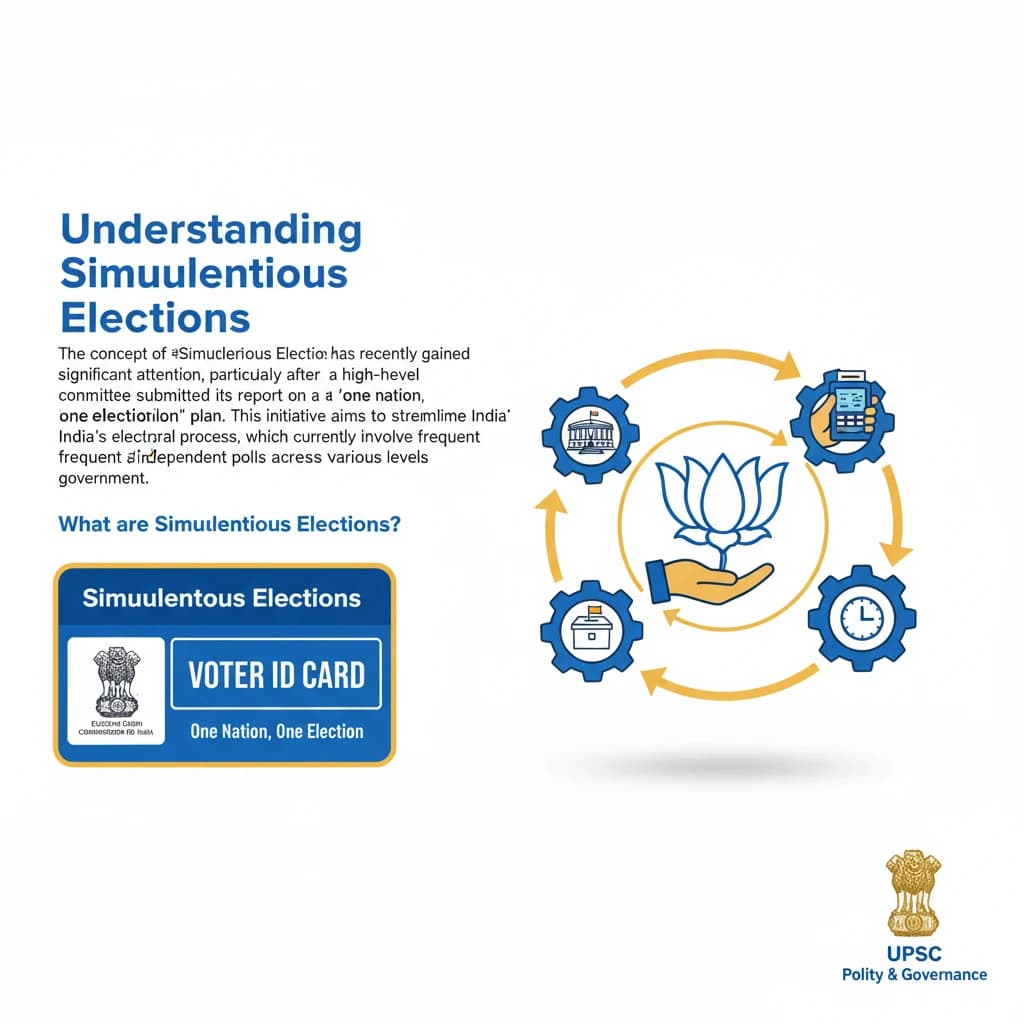
The concept of Simultaneous Elections has recently gained significant attention, particularly after a high-level committee submitted its report on the 'one nation, one election' plan.
This initiative aims to streamline India's electoral process, which currently involves frequent and independent polls across various levels of government.
What are Simultaneous Elections?
Definition: Simultaneous Elections refer to the practice of holding elections for the House of the People (Lok Sabha), all State Legislative Assemblies, and local bodies (Municipalities and Panchayats) together.
Essentially, a voter would cast their vote for electing representatives across all three tiers of government on a single day or within a synchronized phased manner.
Currently, these elections are conducted independently, following schedules determined by the terms of each individual elected body. This leads to a continuous cycle of elections throughout the year.
It is important to note that Simultaneous Elections do not necessarily mean that voting for Lok Sabha and State Assemblies must occur nationwide on a single calendar day. The process can be conducted in a phase-wise manner, similar to how general elections are often spread out.
The 'One Nation, One Election' Initiative
The idea of Simultaneous Elections is popularly known as 'One Nation, One Election'. It represents a significant electoral reform proposal aimed at addressing various challenges posed by the current fragmented election cycle.
Union Cabinet Approval and Kovind Committee Report
Recently, the Union Cabinet approved a proposal for Simultaneous Elections across the country. This approval signifies a major step towards aligning polls for the Lok Sabha, State Assemblies, and local bodies.
This decision followed the submission of a comprehensive report by a high-level committee, chaired by former President Ram Nath Kovind. The committee was tasked with examining the feasibility and implications of the 'one nation, one election' plan.
Key Recommendation: Constitutional Amendments
One of the primary recommendations of the Kovind Committee is that the Constitution of India should be amended to enable Simultaneous Elections. These amendments would likely be introduced through two separate bills.
For UPSC, understanding the constitutional provisions that would need amendment (e.g., Articles related to the term of Lok Sabha and State Assemblies, dissolution) is crucial. Also, be aware of the federal implications.
💡 Key Takeaways
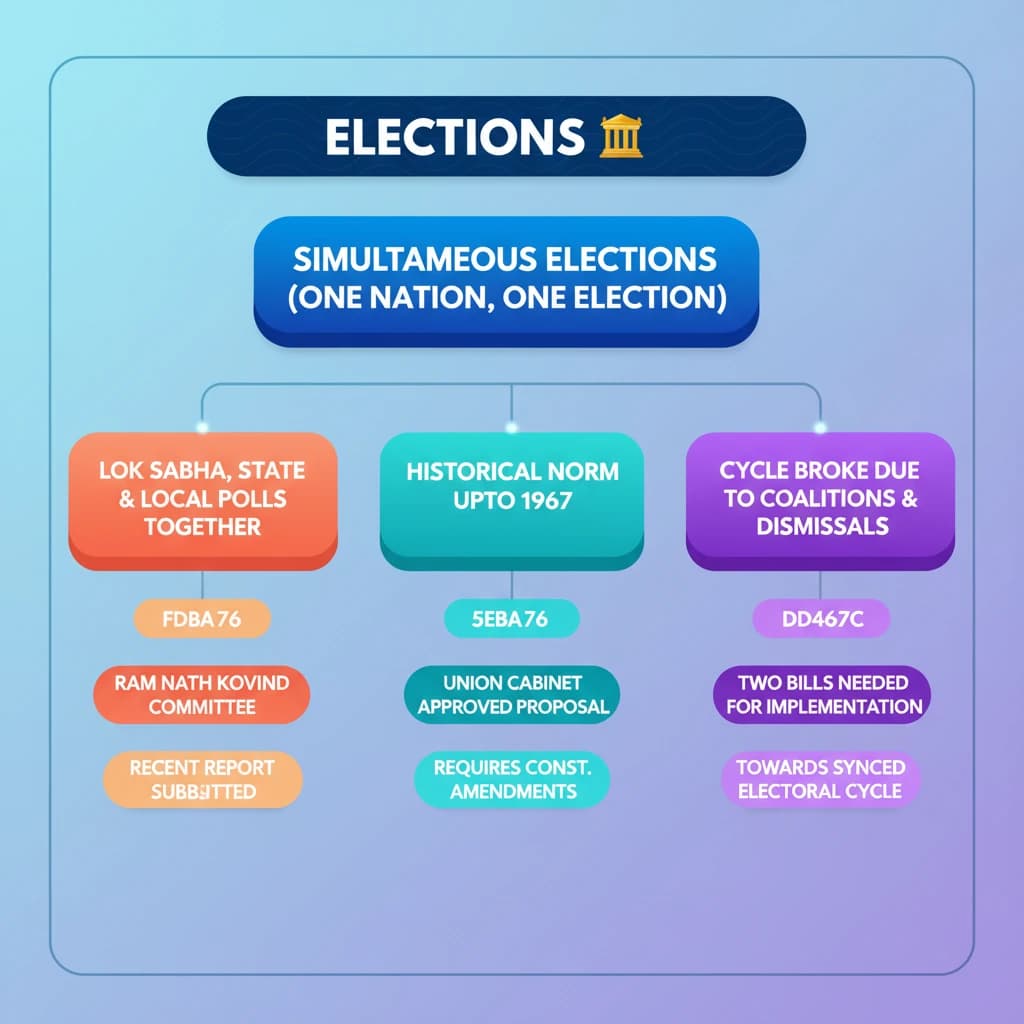
- •Simultaneous Elections (One Nation, One Election) mean holding Lok Sabha, State Assembly, and local body polls together.
- •Historically, India largely practiced simultaneous elections until 1967.
- •The cycle broke due to premature dismissals of state governments and collapse of coalition governments.
- •The Ram Nath Kovind Committee recently submitted a report endorsing the 'one nation, one election' plan.
- •The Union Cabinet has approved the proposal, necessitating constitutional amendments via two bills.
🧠 Memory Techniques
95% Verified Content
📚 Reference Sources
•Report of the High-Level Committee on One Nation, One Election (Chaired by Ram Nath Kovind)
•The Constitution of India
•Election Commission of India reports