Loading page, please wait…
Supreme Court Ruling on the SC and ST Act 1989 - UPSC Polity And Governance
What is Supreme Court Ruling on the SC and ST Act 1989 in UPSC Polity And Governance?
Supreme Court Ruling on the SC and ST Act 1989 is a key topic under Polity And Governance for UPSC Civil Services Examination. Key points include: SC ruled that insults/intimidation against SC/ST members require 'intent to humiliate based on caste identity' to be an offense under the SC/ST Act, 1989.. Anticipatory bail is not completely barred by Section 18; preliminary inquiry is needed to establish prima facie case.. The SC/ST Act, 1989, protects SCs/STs from caste-based atrocities, rooted in Articles 15 & 17 of the Constitution.. Understanding this topic is essential for both UPSC Prelims and Mains preparation.
Why is Supreme Court Ruling on the SC and ST Act 1989 important for UPSC exam?
Supreme Court Ruling on the SC and ST Act 1989 is a Medium-level topic in UPSC Polity And Governance. It is tested in both Prelims (factual MCQs) and Mains (analytical answer writing). Previous year UPSC questions have frequently covered aspects of Supreme Court Ruling on the SC and ST Act 1989, making it essential for comprehensive IAS preparation.
How to prepare Supreme Court Ruling on the SC and ST Act 1989 for UPSC?
To prepare Supreme Court Ruling on the SC and ST Act 1989 for UPSC: (1) Study the comprehensive notes covering all key concepts on Vaidra. (2) Practice previous year questions on this topic. (3) Connect it with current affairs using daily updates. (4) Revise using key takeaways and mind maps available for Polity And Governance. (5) Write practice answers linking Supreme Court Ruling on the SC and ST Act 1989 to related GS Paper topics.
Key takeaways of Supreme Court Ruling on the SC and ST Act 1989 for UPSC
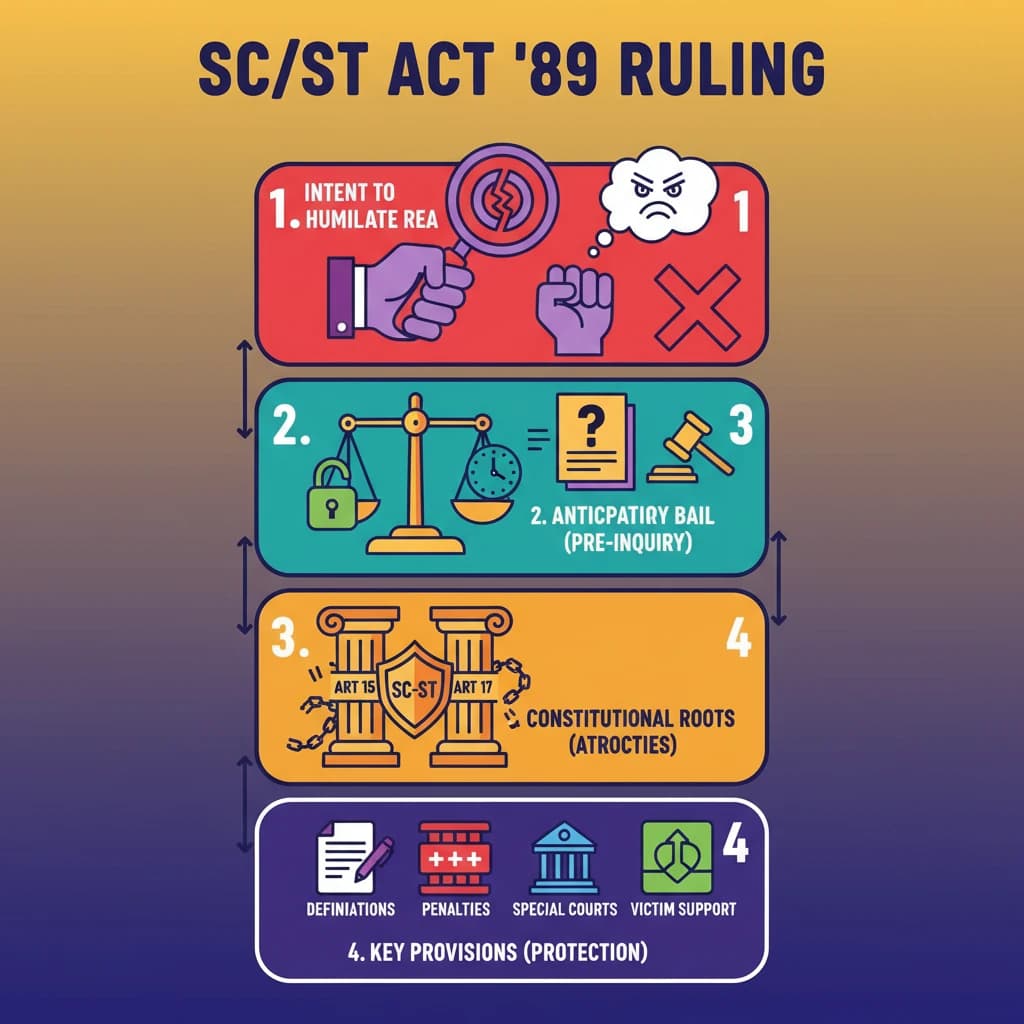
- SC ruled that insults/intimidation against SC/ST members require 'intent to humiliate based on caste identity' to be an offense under the SC/ST Act, 1989.
- Anticipatory bail is not completely barred by Section 18; preliminary inquiry is needed to establish prima facie case.
- The SC/ST Act, 1989, protects SCs/STs from caste-based atrocities, rooted in Articles 15 & 17 of the Constitution.
- Key provisions include defining 'atrocities,' stringent penalties, special courts, and victim rehabilitation.
- The 2018 Amendment strengthened the Act by adding new offenses and removing prior approval for arrests, restoring its original rigor.
Supreme Court Ruling on the SC and ST Act 1989
Medium⏱️ 8 min read
polity and governance
📖 Introduction
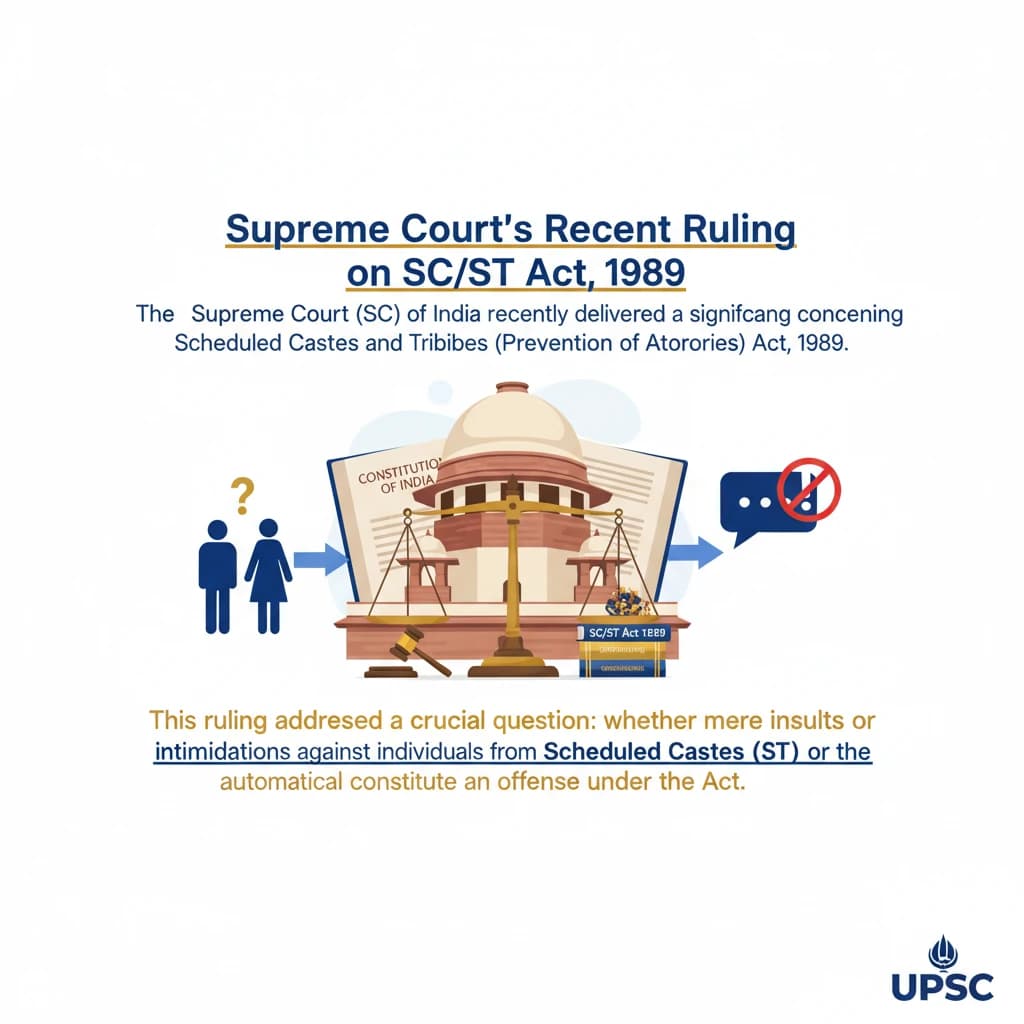
Supreme Court's Recent Ruling on SC/ST Act, 1989
The Supreme Court (SC) of India recently delivered a significant ruling concerning the Scheduled Castes and Scheduled Tribes (Prevention of Atrocities) Act, 1989.
This ruling addressed a crucial question: whether mere insults or intimidations against individuals from Scheduled Castes (SC) or Scheduled Tribes (ST) automatically constitute an offense under the Act.
The decision was made in the context of granting anticipatory bail to a YouTube channel editor accused under the Act.
Case Background: The allegations against the editor involved derogatory remarks made about a Member of the Legislative Assembly (MLA) belonging to the SC community.
Scope of the SC/ST Act on Insults and Intimidations
The Supreme Court clarified that not all insults or intimidations directed at SC/ST members automatically qualify as offenses under the SC/ST (Prevention of Atrocities) Act, 1989.
For the Act to be applicable, the insult or intimidation must be explicitly linked to the caste identity of the victim.
Under Section 3(1)(r) of the Act, the Court emphasized that the 'intent to humiliate' must be clearly associated with the victim's caste.
Key Interpretation: Simply knowing the victim's SC/ST status is insufficient. The insult must be specifically intended to humiliate based on their caste identity.
Anticipatory Bail under SC/ST Act: A Clarification
The Court provided an important clarification regarding Section 18 of the Act, which traditionally bars anticipatory bail.
It ruled that Section 18 does not completely prevent the granting of such bail in all circumstances.
Courts are mandated to conduct a preliminary inquiry to ascertain if the allegations genuinely meet the criteria for an offense under the Act before applying Section 18.
This ruling highlights the judiciary's role in preventing potential misuse of stringent laws while upholding their protective intent. It's crucial for understanding the balance between victim protection and accused rights for UPSC Mains Paper 2.
In the specific case, the Supreme Court granted anticipatory bail to the editor, concluding that there was no prima facie evidence of intent to humiliate the MLA due to his caste identity.
About the Scheduled Castes and Scheduled Tribes (Prevention of Atrocities) Act, 1989
The SC/ST (Prevention of Atrocities) Act, 1989, commonly known as the SC/ST Act, was enacted to protect members of Scheduled Castes and Scheduled Tribes from caste-based discrimination and violence.
Its foundation lies in Articles 15 and 17 of the Indian Constitution, aiming to ensure the protection of these marginalized communities.
Purpose: To address the inadequacies of previous laws and provide a stronger legal framework against atrocities.
Historical Context and Evolution of the Act
The SC/ST Act, 1989, builds upon earlier legislative efforts to combat caste discrimination.
- The Untouchability (Offences) Act, 1955, was the first major step to abolish untouchability.
- This was later renamed and strengthened as the Protection of Civil Rights Act, 1955.
- The SC/ST Act, 1989, further expanded the scope of protection by defining specific "atrocities" and prescribing stringent penalties.
Implementation and Administration of the Act
The Central Government holds the authority to frame rules for the Act's effective implementation.
State Governments and Union Territories are responsible for administering the Act, often with financial and logistical assistance from the central government.
Key Provisions of the SC/ST Act, 1989
The Act outlines specific offenses considered "atrocities" against SC/ST members.
- Definition of Offenses: Includes physical violence, harassment, and various forms of social discrimination.
- Stringent Penalties: Prescribes higher penalties for perpetrators compared to those under the Indian Penal Code (IPC).
- Exclusion of Anticipatory Bail (Section 18): Traditionally bars the application of Section 438 of the Code of Criminal Procedure for anticipatory bail, though recent SC rulings have clarified this.
- Special Courts: Mandates the establishment of special courts for speedy trials.
- SC/ST Protection Cells: Requires state-level cells led by senior police officers to oversee implementation.
- Investigation Protocol: Investigations must be conducted by officers not below the rank of Deputy Superintendent of Police (DSP) and completed within a stipulated timeframe.
- Victim Relief and Rehabilitation: Provides for financial compensation, legal aid, and support services for victims.
Exclusions: The Act does not cover offenses committed between members of SCs and STs; neither community can invoke the Act against the other.
Recent Amendments: The Scheduled Castes and Scheduled Tribes (Prevention of Atrocities) Amendment Act, 2018
The 2018 Amendment Act significantly strengthened the protections offered to SCs and STs by introducing more stringent provisions and broadening the Act's scope.
New Categories of Offenses:
- Garlanding with footwear, forcing manual scavenging.
- Imposing social or economic boycotts and any form of social ostracism.
- Sexual exploitation and intentional touching of SC/ST women without consent.
- Explicitly outlawing practices like dedicating SC/ST women as devadasis.
Accountability of Public Servants: Public servants who neglect their duties related to SC/ST protection now face imprisonment.
Arrest Procedures: The amendment removed the requirement for Senior Superintendent of Police (SSP) approval before arresting an accused, permitting immediate arrests without prior approval.
The 2018 Amendment aimed to restore the original spirit of the Act, which had been diluted by earlier judicial interpretations regarding immediate arrests and anticipatory bail.
💡 Key Takeaways
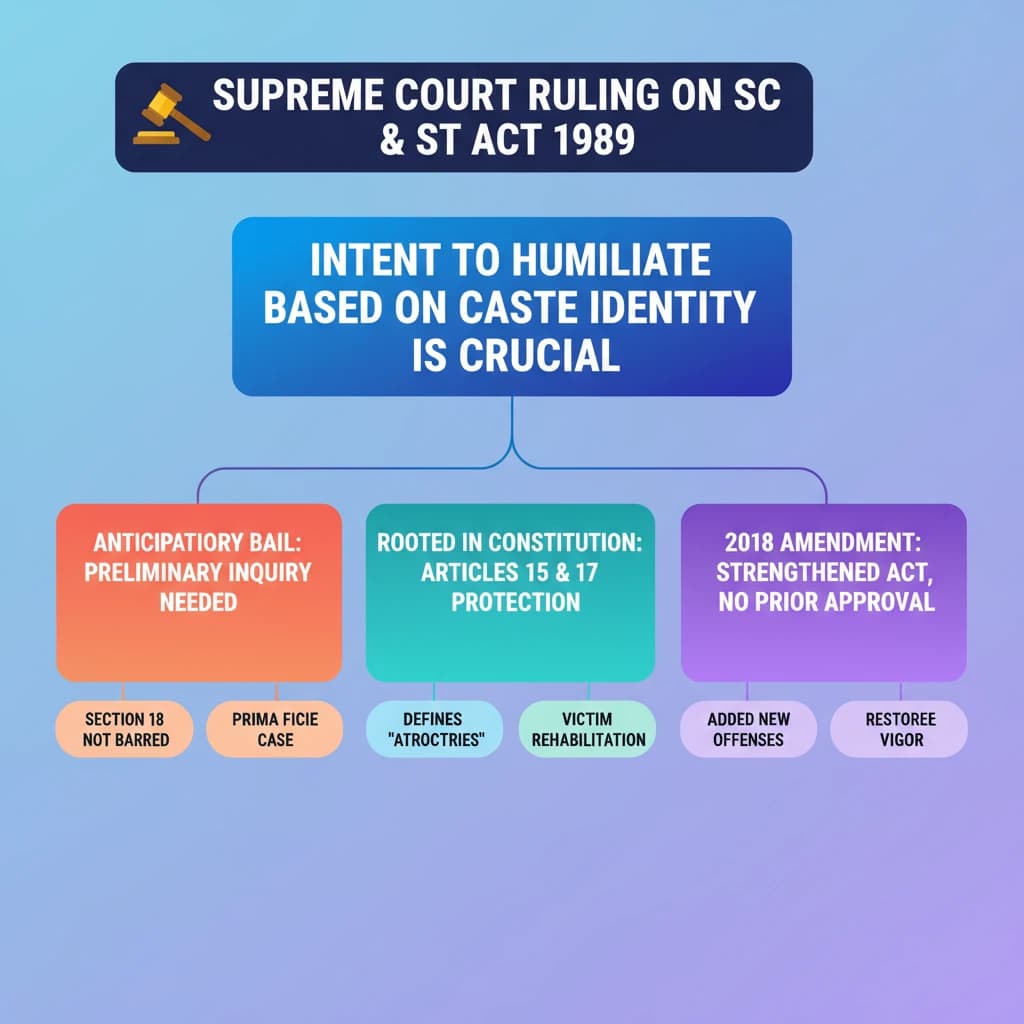
- •SC ruled that insults/intimidation against SC/ST members require 'intent to humiliate based on caste identity' to be an offense under the SC/ST Act, 1989.
- •Anticipatory bail is not completely barred by Section 18; preliminary inquiry is needed to establish prima facie case.
- •The SC/ST Act, 1989, protects SCs/STs from caste-based atrocities, rooted in Articles 15 & 17 of the Constitution.
- •Key provisions include defining 'atrocities,' stringent penalties, special courts, and victim rehabilitation.
- •The 2018 Amendment strengthened the Act by adding new offenses and removing prior approval for arrests, restoring its original rigor.
🧠 Memory Techniques
95% Verified Content