Loading page, please wait…
Vaidra Logo
Vaidra

Top 4 items + smart groups

UPSC GPT
New
Current Affairs
Daily Solutions
Daily Puzzle
Mains Evaluator

Version 2.0.0 • Built with ❤️ for UPSC aspirants

Loading...
Loading...
Loading...
Loading...
Loading...
Loading...
Loading...
Loading...
Loading...
Loading...
Loading...
Loading...
Loading...
Back
All Subjects

Topics

0 topics • 0 completed

Loading topics...
Loading...
Loading...
Loading...
Loading...
Loading...
Overall Progress0%

Sickle Cell Disease - UPSC Social Issues

What is Sickle Cell Disease in UPSC Social Issues?

Sickle Cell Disease is a key topic under Social Issues for UPSC Civil Services Examination. Key points include: Sickle Cell Disease (SCD) is an inherited red blood cell disorder, causing abnormal, C-shaped RBCs.. Symptoms include chronic anemia, painful crises, and delayed growth.. Treatments involve blood transfusions, Hydroxyurea, and bone marrow transplantation.. Understanding this topic is essential for both UPSC Prelims and Mains preparation.

Why is Sickle Cell Disease important for UPSC exam?

Sickle Cell Disease is a Easy-level topic in UPSC Social Issues. It is tested in both Prelims (factual MCQs) and Mains (analytical answer writing). Previous year UPSC questions have frequently covered aspects of Sickle Cell Disease, making it essential for comprehensive IAS preparation.

How to prepare Sickle Cell Disease for UPSC?

To prepare Sickle Cell Disease for UPSC: (1) Study the comprehensive notes covering all key concepts on Vaidra. (2) Practice previous year questions on this topic. (3) Connect it with current affairs using daily updates. (4) Revise using key takeaways and mind maps available for Social Issues. (5) Write practice answers linking Sickle Cell Disease to related GS Paper topics.

Key takeaways of Sickle Cell Disease for UPSC

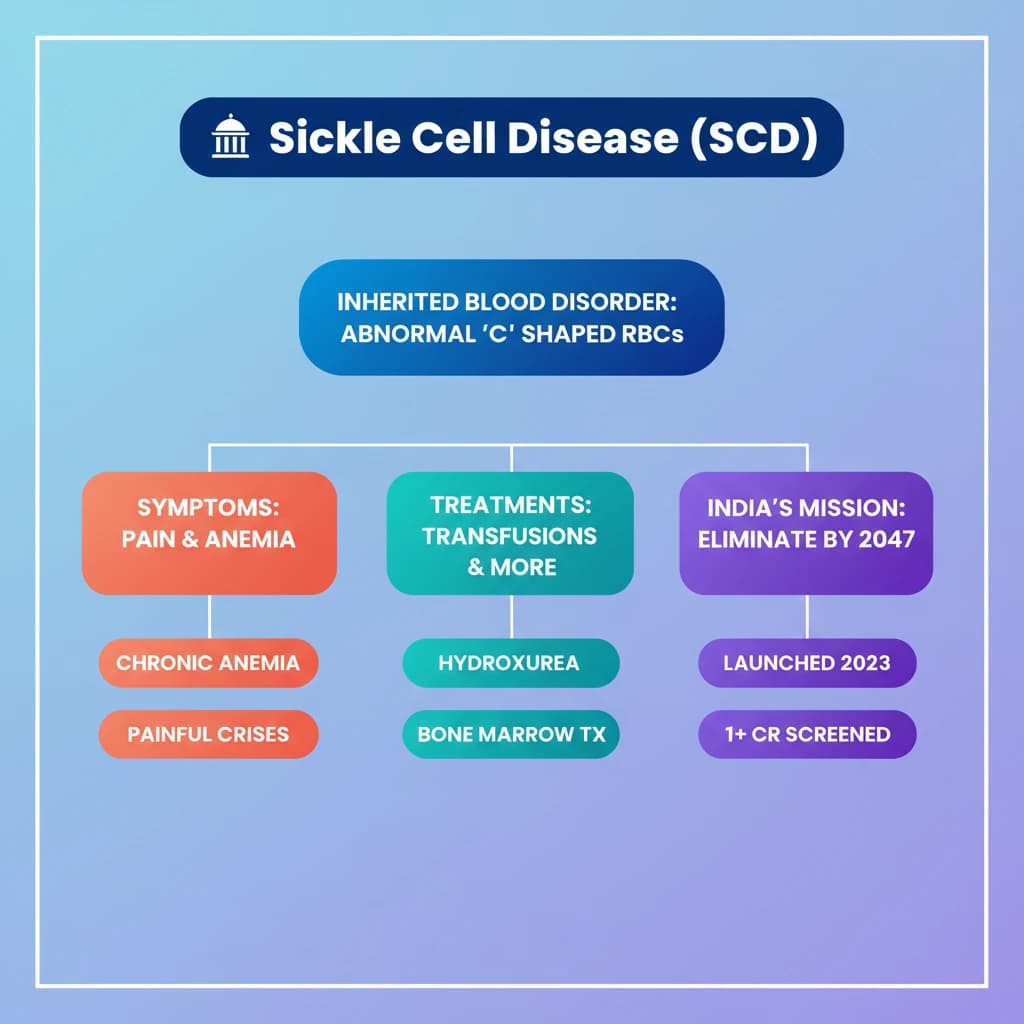
  • Sickle Cell Disease (SCD) is an inherited red blood cell disorder, causing abnormal, C-shaped RBCs.
  • Symptoms include chronic anemia, painful crises, and delayed growth.
  • Treatments involve blood transfusions, Hydroxyurea, and bone marrow transplantation.
  • National Sickle Cell Anaemia Elimination Mission launched in 2023 aims to eliminate SCD by 2047.
  • Over 1 crore people have been screened, highlighting the mission's scale and focus on early detection.
Sickle Cell Disease

Sickle Cell Disease

Easy⏱️ 5 min read✓ 95% Verified
social issues

📖 Introduction

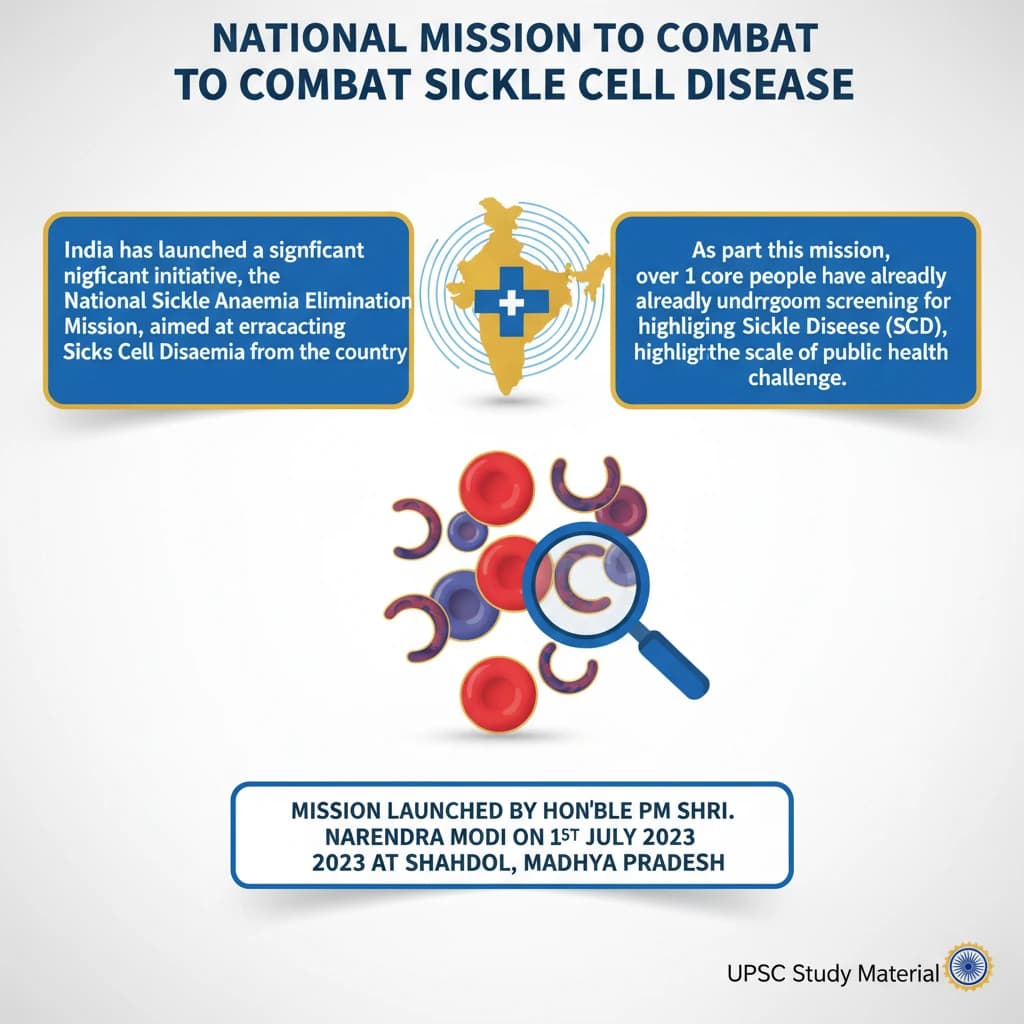
<h4>National Mission to Combat Sickle Cell Disease</h4><p>India has launched a significant initiative, the <strong>National Sickle Cell Anaemia Elimination Mission</strong>, aimed at eradicating <strong>Sickle Cell Anaemia</strong> from the country.</p><p>As part of this mission, over <strong>1 crore people</strong> have already undergone screening for <strong>Sickle Cell Disease (SCD)</strong>, highlighting the scale of the public health challenge.</p><div class='info-box'><p><strong>Mission Launch:</strong> <strong>2023</strong></p><p><strong>Elimination Target:</strong> By <strong>2047</strong></p></div><h4>Understanding Sickle Cell Disease (SCD)</h4><p><strong>Sickle Cell Disease (SCD)</strong> is a collective term for a group of <strong>inherited red blood cell (RBC) disorders</strong>. These conditions are genetic, meaning they are passed down from parents to their children.</p><div class='key-point-box'><p><strong>Healthy RBCs:</strong> Typically <strong>round</strong> and flexible, enabling them to move easily through blood vessels.</p><p><strong>Hemoglobin:</strong> A crucial <strong>protein</strong> within RBCs responsible for carrying <strong>oxygen</strong> throughout the body.</p></div><p>In individuals with <strong>SCD</strong>, the <strong>hemoglobin</strong> is abnormal. This abnormality causes the <strong>red blood cells</strong> to become rigid and sticky.</p><p>Crucially, these affected <strong>RBCs</strong> also change their shape, resembling a <strong>C-shaped farm tool</strong> known as a <strong>“sickle.”</strong> This characteristic shape is where the disease gets its name.</p><h4>Common Symptoms of SCD</h4><p>The symptoms of <strong>Sickle Cell Disease</strong> can vary significantly among individuals, but several common manifestations are observed.</p><ul><li><strong>Chronic Anemia:</strong> This is a persistent lack of healthy red blood cells, leading to symptoms such as severe <strong>fatigue</strong>, general <strong>weakness</strong>, and noticeable <strong>paleness</strong> of the skin.</li><li><strong>Painful Episodes (Sickle Cell Crisis):</strong> These are hallmark symptoms, characterized by sudden and intense pain. The pain can affect various parts of the body, including the <strong>bones</strong>, <strong>chest</strong>, <strong>back</strong>, <strong>arms</strong>, and <strong>legs</strong>.</li><li><strong>Delayed Growth and Puberty:</strong> Children and adolescents with <strong>SCD</strong> may experience delays in their physical development, including slower growth rates and a postponed onset of puberty.</li></ul><h4>Treatment Approaches for SCD</h4><p>While there is no universal cure for <strong>Sickle Cell Disease</strong>, several treatments are available to manage symptoms, prevent complications, and improve quality of life.</p><ul><li><strong>Blood Transfusions:</strong> This treatment involves receiving healthy blood from a donor. It helps to alleviate <strong>anemia</strong> and significantly reduces the frequency and severity of <strong>pain crises</strong>.</li><li><strong>Hydroxyurea:</strong> This is a specific medication prescribed to patients with <strong>SCD</strong>. It works by reducing the occurrence of painful episodes and preventing some of the long-term complications associated with the disease.</li><li><strong>Bone Marrow or Stem Cell Transplantation:</strong> For some patients, particularly children, <strong>bone marrow</strong> or <strong>stem cell transplantation</strong> can offer a curative option. This procedure replaces diseased bone marrow with healthy cells.</li></ul><h4>Government Initiatives Against SCD</h4><p>The Indian government has undertaken specific measures to address the burden of <strong>Sickle Cell Disease</strong> within the country.</p><p>In <strong>2016</strong>, the government released comprehensive <strong>technical operational guidelines</strong>. These guidelines are designed for the effective <strong>prevention and control</strong> of <strong>sickle cell anaemia</strong> across the nation.</p><div class='exam-tip-box'><p>The <strong>National Sickle Cell Anaemia Elimination Mission</strong> (launched <strong>2023</strong>, target <strong>2047</strong>) is a critical current affairs topic for <strong>UPSC Prelims</strong> and <strong>Mains (GS-II: Social Justice, Health)</strong>. Remember the key dates and the mission's ambitious goal.</p></div>
Concept Diagram

💡 Key Takeaways

  • •Sickle Cell Disease (SCD) is an inherited red blood cell disorder, causing abnormal, C-shaped RBCs.
  • •Symptoms include chronic anemia, painful crises, and delayed growth.
  • •Treatments involve blood transfusions, Hydroxyurea, and bone marrow transplantation.
  • •National Sickle Cell Anaemia Elimination Mission launched in 2023 aims to eliminate SCD by 2047.
  • •Over 1 crore people have been screened, highlighting the mission's scale and focus on early detection.

🧠 Memory Techniques

Memory Aid
95% Verified Content

Related Topics

Loading related topics...
Explore:Social Issues Topics·All Subjects·Daily Current Affairs·Editorial Analysis·Previous Year Questions·UPSC GPT
Sickle Cell Disease - UPSC Social Issues