Loading page, please wait…
Vaidra Logo
Vaidra

Top 4 items + smart groups

UPSC GPT
New
Current Affairs
Daily Solutions
Daily Puzzle
Mains Evaluator

Version 2.0.0 • Built with ❤️ for UPSC aspirants

Loading...
Loading...
Loading...
Loading...
Loading...
Loading...
Loading...
Loading...
Loading...
Loading...
Loading...
Loading...
Loading...
Back
All Subjects

Topics

0 topics • 0 completed

Loading topics...
Loading...
Loading...
Loading...
Loading...
Loading...
Overall Progress0%

National Tobacco Control Program (NTCP) 2007 - UPSC Social Issues

What is National Tobacco Control Program (NTCP) 2007 in UPSC Social Issues?

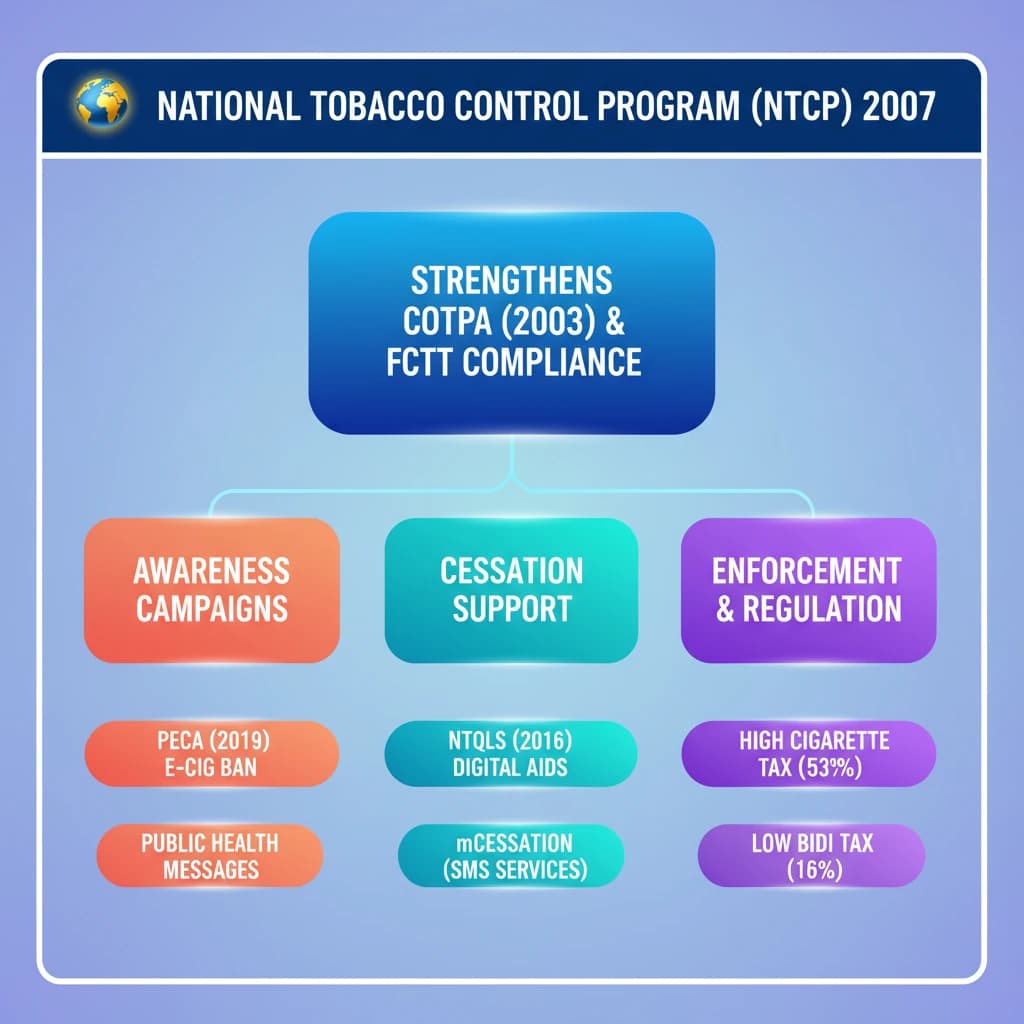
National Tobacco Control Program (NTCP) 2007 is a key topic under Social Issues for UPSC Civil Services Examination. Key points include: NTCP (2007) strengthens COTPA (2003) and FCTC compliance.. Key functions include awareness, cessation support, and enforcement.. PECA (2019) banned e-cigarettes in India.. Understanding this topic is essential for both UPSC Prelims and Mains preparation.

Why is National Tobacco Control Program (NTCP) 2007 important for UPSC exam?

National Tobacco Control Program (NTCP) 2007 is a Medium-level topic in UPSC Social Issues. It is tested in both Prelims (factual MCQs) and Mains (analytical answer writing). Previous year UPSC questions have frequently covered aspects of National Tobacco Control Program (NTCP) 2007, making it essential for comprehensive IAS preparation.

How to prepare National Tobacco Control Program (NTCP) 2007 for UPSC?

To prepare National Tobacco Control Program (NTCP) 2007 for UPSC: (1) Study the comprehensive notes covering all key concepts on Vaidra. (2) Practice previous year questions on this topic. (3) Connect it with current affairs using daily updates. (4) Revise using key takeaways and mind maps available for Social Issues. (5) Write practice answers linking National Tobacco Control Program (NTCP) 2007 to related GS Paper topics.

Key takeaways of National Tobacco Control Program (NTCP) 2007 for UPSC

  • NTCP (2007) strengthens COTPA (2003) and FCTC compliance.
  • Key functions include awareness, cessation support, and enforcement.
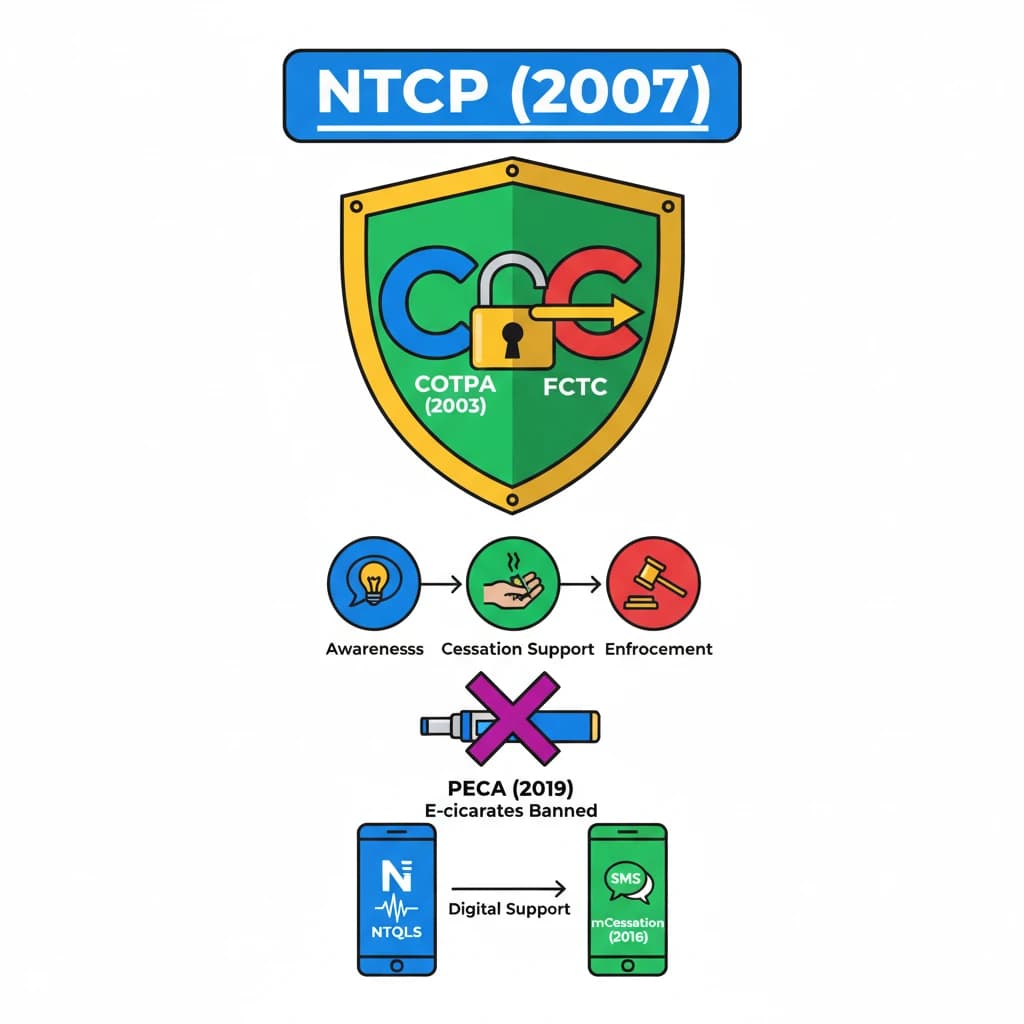
  • PECA (2019) banned e-cigarettes in India.
  • NTQLS and mCessation (2016) offer digital cessation support.
  • Tobacco taxation is high for cigarettes (53%) but low for bidis (16%), prompting calls for higher bidi taxes.
National Tobacco Control Program (NTCP) 2007

National Tobacco Control Program (NTCP) 2007

Medium⏱️ 7 min read✓ 95% Verified
social issues

📖 Introduction

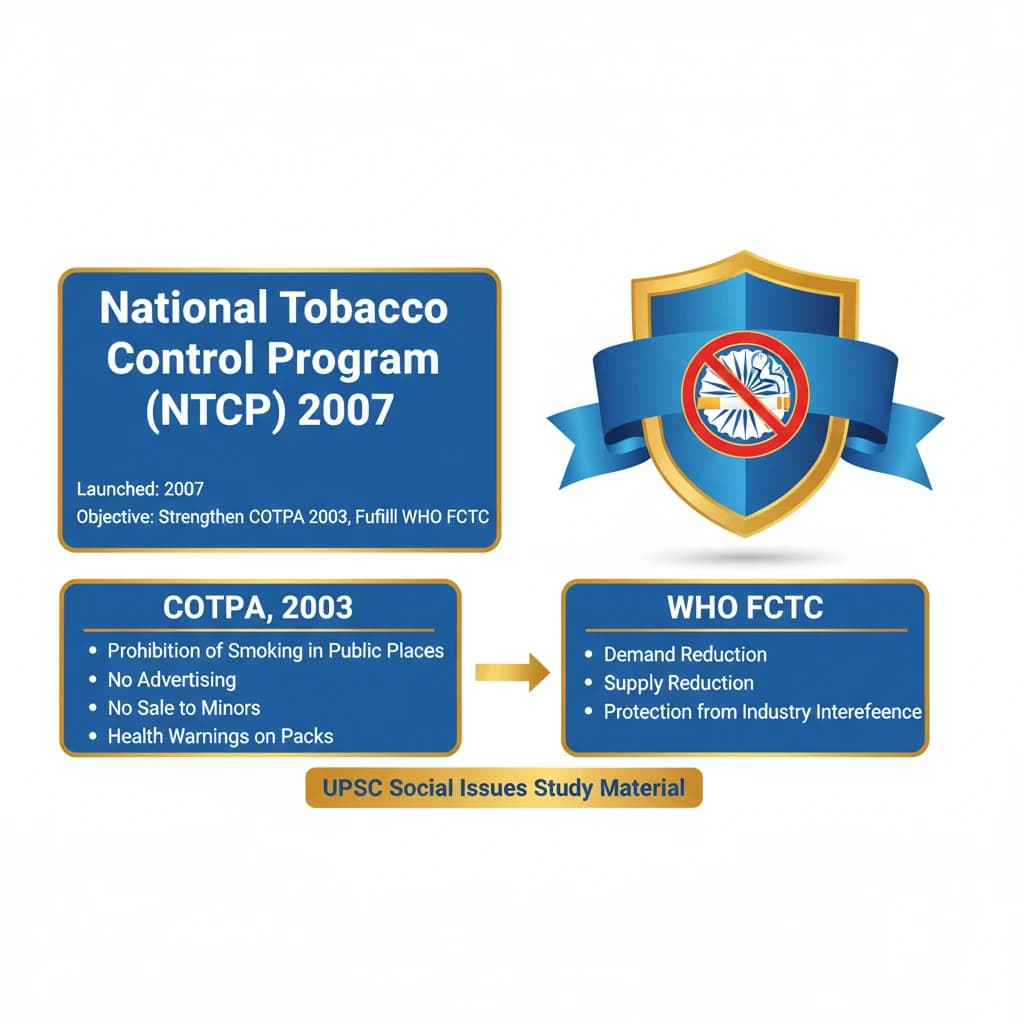
<h4>Introduction to National Tobacco Control Program (NTCP)</h4><p>The <strong>National Tobacco Control Program (NTCP)</strong> was launched in <strong>2007</strong> with a crucial mandate. Its primary objective is to strengthen the implementation of the <strong>Cigarettes and Other Tobacco Products Act (COTPA), 2003</strong>, and ensure India's compliance with the <strong>WHO Framework Convention on Tobacco Control (FCTC)</strong>.</p><div class='info-box'><p><strong>COTPA, 2003</strong> addresses various aspects of tobacco control, including <strong>production and supply</strong>, <strong>advertising and promotion</strong>, <strong>distribution and sale</strong>, as well as <strong>packaging and labeling</strong> of tobacco products.</p></div><h4>Key Functions of NTCP</h4><p>The <strong>NTCP</strong> operates through several key functions designed to curb tobacco consumption and mitigate its health impacts across the nation.</p><ul><li><strong>Public Awareness Campaigns:</strong> These involve extensive <strong>mass media campaigns</strong> aimed at educating the general public about the severe <strong>health risks</strong> associated with tobacco use.</li><li><strong>Smoking Cessation Initiatives:</strong> The program facilitates various initiatives to help individuals quit tobacco. These include dedicated <strong>quitlines</strong>, comprehensive <strong>counselling services</strong>, and effective <strong>behavioural interventions</strong>.</li><li><strong>Enforcement Mechanisms:</strong> A critical function is the rigorous enforcement of <strong>COTPA provisions</strong>. This is carried out with the active involvement and support of <strong>designated authorities</strong> at various levels.</li></ul><h4>Related Initiatives and Legislative Measures</h4><p>India's commitment to tobacco control extends beyond the NTCP, encompassing specific legislative acts and digital initiatives.</p><div class='key-point-box'><p>The <strong>Prohibition of Electronic Cigarette Act (PECA), 2019</strong>, represents a significant step. This act has unequivocally <strong>banned e-cigarettes</strong> across India, addressing emerging forms of nicotine delivery.</p></div><p>Complementing these efforts are specialized services for cessation support.</p><ul><li><strong>National Tobacco Quitline Services (NTQLS):</strong> Provides accessible support for individuals seeking to quit tobacco.</li><li><strong>MCessation Programme:</strong> Launched in <strong>2016</strong> as part of the government’s <strong>Digital India initiative</strong>, this program utilizes <strong>mobile technology</strong> to deliver tobacco cessation support and interventions.</li></ul><h4>Tobacco Taxation Policy</h4><p>Taxation is a powerful tool in public health, and India employs heavy taxes on tobacco products to discourage consumption.</p><div class='info-box'><p>Currently, <strong>cigarettes</strong> are taxed at approximately <strong>53%</strong> of their retail price. In contrast, <strong>bidis</strong>, which are a significantly cheaper tobacco option, face a much lower tax rate of around <strong>16%</strong>.</p></div><p>Public health experts consistently advocate for policy changes in this area. They strongly recommend <strong>higher taxes on bidis</strong> to effectively discourage their use and simultaneously generate increased government revenue for health initiatives.</p><div class='exam-tip-box'><p>Understanding the differential taxation on tobacco products like <strong>cigarettes</strong> and <strong>bidis</strong> is crucial for Mains answers, particularly in <strong>GS-II (Social Justice)</strong> and <strong>GS-III (Economy)</strong>, highlighting public health vs. economic implications.</p></div>
Concept Diagram

💡 Key Takeaways

  • •NTCP (2007) strengthens COTPA (2003) and FCTC compliance.
  • •Key functions include awareness, cessation support, and enforcement.
  • •PECA (2019) banned e-cigarettes in India.
  • •NTQLS and mCessation (2016) offer digital cessation support.
  • •Tobacco taxation is high for cigarettes (53%) but low for bidis (16%), prompting calls for higher bidi taxes.

🧠 Memory Techniques
Memory Aid
95% Verified Content

📚 Reference Sources

•Ministry of Health and Family Welfare (Government of India)
•WHO Framework Convention on Tobacco Control (FCTC)

Related Topics

Loading related topics...
Explore:Social Issues Topics·All Subjects·Daily Current Affairs·Editorial Analysis·Previous Year Questions·UPSC GPT
National Tobacco Control Program (NTCP) 2007 - UPSC Social Issues