📖 Introduction
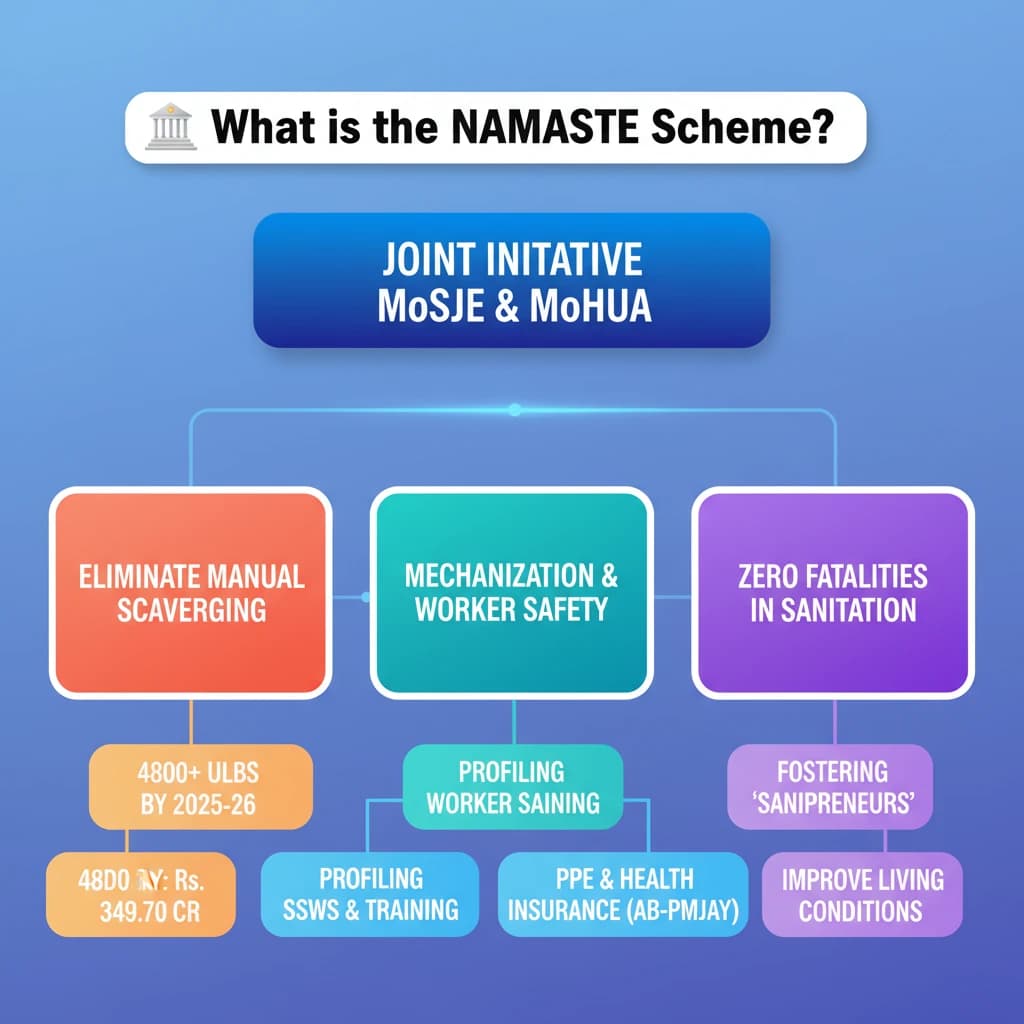
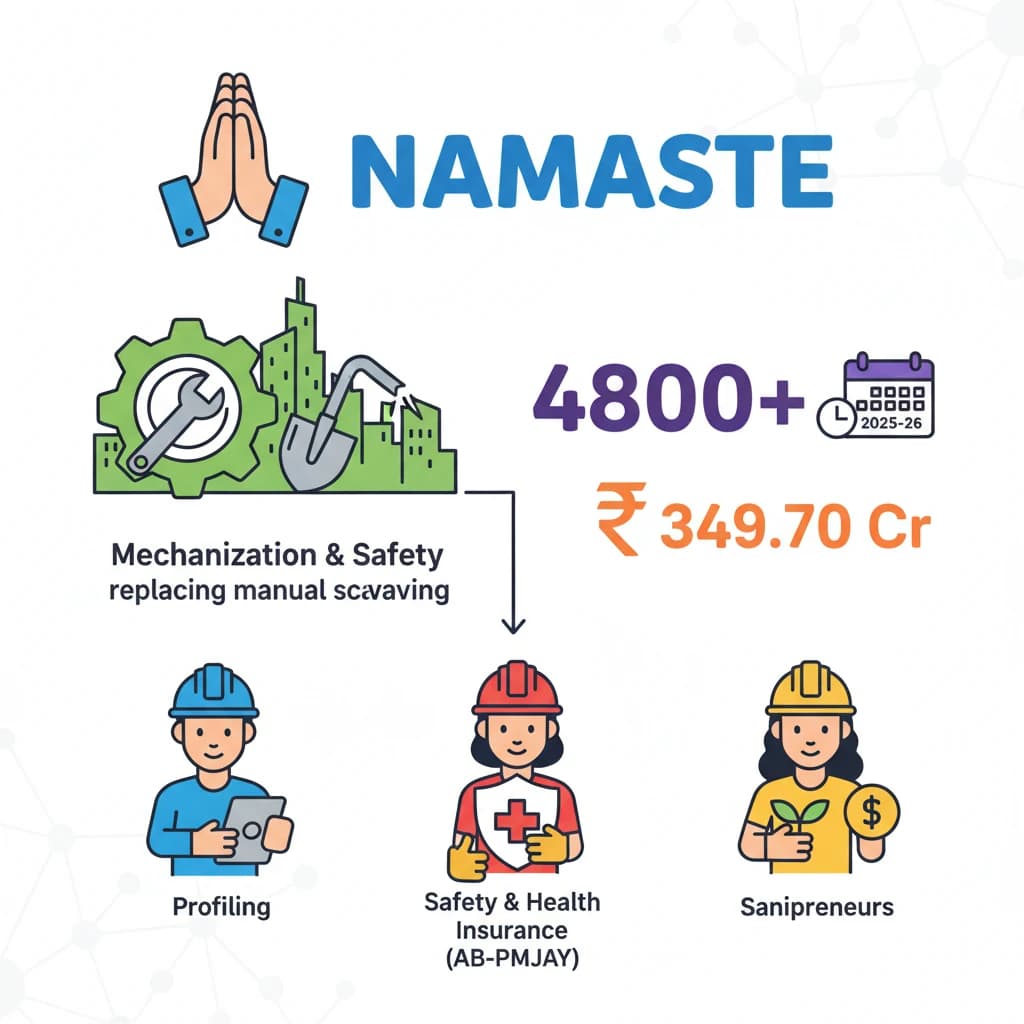
<h4>Introduction to NAMASTE</h4><p>The <strong>National Action for Mechanised Sanitation Ecosystem (NAMASTE)</strong> scheme is a crucial initiative aimed at transforming sanitation practices in India. It is a joint effort by the <strong>Ministry of Social Justice and Empowerment (MoSJE)</strong> and the <strong>Ministry of Housing and Urban Affairs (MoHUA)</strong>.</p><p>The primary focus of <strong>NAMASTE</strong> is the complete elimination of <strong>manual scavenging</strong>. It also seeks to significantly enhance the safety and dignity of <strong>sanitation workers</strong> across the country.</p><div class='key-point-box'><p><strong>NAMASTE</strong> replaces the earlier <strong>Self-Employment Scheme for Rehabilitation of Manual Scavengers (SRMS)</strong>, signifying a shift towards a more comprehensive and technology-driven approach.</p></div><h4>Financial Outlay and Coverage</h4><p>The <strong>NAMASTE</strong> scheme has been allocated a substantial budget to achieve its ambitious goals. This financial commitment underscores the government's resolve to address the issue of unsafe sanitation work.</p><div class='info-box'><p><strong>Outlay:</strong> <strong>Rs. 343.76 crore</strong></p><p><strong>Coverage Target:</strong> All <strong>4800+ Urban Local Bodies (ULBs)</strong> across India</p><p><strong>Timeline:</strong> By the financial year <strong>2025-26</strong></p></div><h4>Profiling of Sanitation Workers</h4><p>A fundamental step under the modified <strong>NAMASTE</strong> scheme is the systematic profiling of individuals involved in sanitation work. This ensures targeted interventions and benefits reach the intended beneficiaries.</p><p>The scheme specifically focuses on <strong>Sewer/Septic Tanks Workers (SSWs)</strong> who are engaged by <strong>Urban Local Bodies (ULBs)</strong>. This profiling helps in understanding their numbers, working conditions, and needs.</p><h4>Key Provisions for Sanitation Workers</h4><p><strong>NAMASTE</strong> outlines several critical provisions designed to safeguard and empower <strong>SSWs</strong>. These measures aim to provide them with the necessary tools, training, and social security.</p><ul><li><strong>Occupational Safety Training:</strong> <strong>SSWs</strong> receive comprehensive training to perform their duties safely.</li><li><strong>Personal Protective Equipment (PPE) Kits:</strong> Provision of essential gear to protect workers from hazards.</li><li><strong>Health Insurance:</strong> Inclusion under the <strong>Ayushman Bharat Pradhan Mantri Jan Arogya Yojana (AB-PMJAY)</strong>, ensuring access to healthcare.</li><li><strong>Capital Subsidies:</strong> Support to enable <strong>SSWs</strong> to transition into <strong>“sanipreneurs”</strong> or <strong>sanitation entrepreneurs</strong>.</li></ul><h4>Goals and Objectives of NAMASTE</h4><p>The overarching goals of the <strong>NAMASTE</strong> scheme are multifaceted, addressing both the immediate safety concerns and the long-term socio-economic upliftment of sanitation workers.</p><div class='key-point-box'><p><strong>Primary Goal:</strong> To eliminate <strong>fatalities</strong> in sanitation work, particularly in sewers and septic tanks.</p></div><p>Another crucial objective is to improve the overall living conditions and health outcomes for <strong>sanitation workers</strong>. This holistic approach aims to restore dignity to their profession.</p><p>The scheme also promotes self-employment and formal employment opportunities for <strong>SSWs</strong>, encouraging their transition into recognized roles within the sanitation ecosystem.</p><h4>Impact of Hazardous Sanitation Work</h4><p>Despite ongoing efforts, the dangers associated with hazardous cleaning of sewers and septic tanks remain a grim reality. Government data highlights the tragic loss of life in recent years.</p><div class='info-box'><p>Between <strong>2019</strong> and <strong>2023</strong>, at least <strong>377 people</strong> across the country have died due to hazardous cleaning of sewers and septic tanks, as reported in Parliament.</p></div><h4>Progress of Profiling (as of September 2024)</h4><p>Significant progress has been made in profiling <strong>Sewer/Septic Tanks Workers (SSWs)</strong> under the <strong>NAMASTE</strong> scheme, although challenges remain in comprehensive data collection.</p><ul><li><strong>Total ULBs Profiled:</strong> <strong>3,326 ULBs</strong></li><li><strong>Approximate SSWs Profiled:</strong> <strong>38,000 SSWs</strong></li><li><strong>ULBs Reporting Zero SSWs:</strong> <strong>283 ULBs</strong></li><li><strong>ULBs Reporting Fewer than 10 SSWs:</strong> <strong>2,364 ULBs</strong></li></ul><h4>State-Level Efforts and Challenges</h4><p>The implementation and reporting of <strong>NAMASTE</strong> vary across different states and Union Territories, indicating a need for more uniform and coordinated efforts.</p><p>Some states have successfully completed the profiling process, demonstrating effective local governance and commitment to the scheme's objectives.</p><ul><li><strong>States/UTs Completed Profiling:</strong> <strong>12 states and Union Territories</strong>, including <strong>Kerala</strong> and <strong>Rajasthan</strong>.</li><li><strong>States Still in Process:</strong> <strong>17 states</strong>, such as <strong>Andhra Pradesh</strong> and <strong>Uttar Pradesh</strong>.</li></ul><p>A challenge is that certain states are running their own parallel programs and are not fully integrating their data with the central <strong>NAMASTE</strong> framework.</p><div class='info-box'><p><strong>Examples of Independent Programs:</strong> <strong>Tamil Nadu</strong> and <strong>Odisha</strong> are running their own separate sanitation worker programs.</p></div><p>The <strong>Ministry of Housing and Urban Affairs</strong> estimates a larger population of sanitation workers, indicating the scale of the task ahead for comprehensive profiling and support.</p><div class='info-box'><p><strong>Estimated SSWs in Urban Areas:</strong> Around <strong>100,000 SSWs</strong> based on urban population statistics and decadal growth rates.</p></div><div class='exam-tip-box'><p>For <strong>UPSC Mains GS-II (Social Justice)</strong>, understanding the shift from <strong>SRMS</strong> to <strong>NAMASTE</strong> and its multi-pronged approach (safety, rehabilitation, entrepreneurship) is crucial. Emphasize the humane aspect and dignity of labour.</p></div>