Loading page, please wait…
Vaidra Logo
Vaidra

Top 4 items + smart groups

UPSC GPT
New
Current Affairs
Daily Solutions
Daily Puzzle
Mains Evaluator

Version 2.0.0 • Built with ❤️ for UPSC aspirants

Loading...
Loading...
Loading...
Loading...
Loading...
Loading...
Loading...
Loading...
Loading...
Loading...
Loading...
Loading...
Loading...
Back
All Subjects

Topics

0 topics • 0 completed

Loading topics...
Loading...
Loading...
Loading...
Loading...
Loading...
Overall Progress0%

Philosophy Behind the Movement - UPSC Social Issues

What is Philosophy Behind the Movement in UPSC Social Issues?

Philosophy Behind the Movement is a key topic under Social Issues for UPSC Civil Services Examination. Key points include: Gandhian principles of non-violence and harmony with nature were central to the movement's philosophy.. Empowerment of local communities in natural resource decision-making was a key objective.. The movement challenged exploitative practices by outside contractors and promoted participatory forest management.. Understanding this topic is essential for both UPSC Prelims and Mains preparation.

Why is Philosophy Behind the Movement important for UPSC exam?

Philosophy Behind the Movement is a Medium-level topic in UPSC Social Issues. It is tested in both Prelims (factual MCQs) and Mains (analytical answer writing). Previous year UPSC questions have frequently covered aspects of Philosophy Behind the Movement, making it essential for comprehensive IAS preparation.

How to prepare Philosophy Behind the Movement for UPSC?

To prepare Philosophy Behind the Movement for UPSC: (1) Study the comprehensive notes covering all key concepts on Vaidra. (2) Practice previous year questions on this topic. (3) Connect it with current affairs using daily updates. (4) Revise using key takeaways and mind maps available for Social Issues. (5) Write practice answers linking Philosophy Behind the Movement to related GS Paper topics.

Key takeaways of Philosophy Behind the Movement for UPSC

  • Gandhian principles of non-violence and harmony with nature were central to the movement's philosophy.
  • Empowerment of local communities in natural resource decision-making was a key objective.
  • The movement challenged exploitative practices by outside contractors and promoted participatory forest management.
  • It inspired significant environmental movements across India (e.g., Appiko, Narmada Bachao Andolan).
  • Internationally, it became a symbol of non-violent resistance against environmental destruction.
  • Its philosophy remains relevant for contemporary issues like climate change, FRA 2006, and SDGs.
Philosophy Behind the Movement

Philosophy Behind the Movement

Medium⏱️ 8 min read✓ 98% Verified
social issues

📖 Introduction

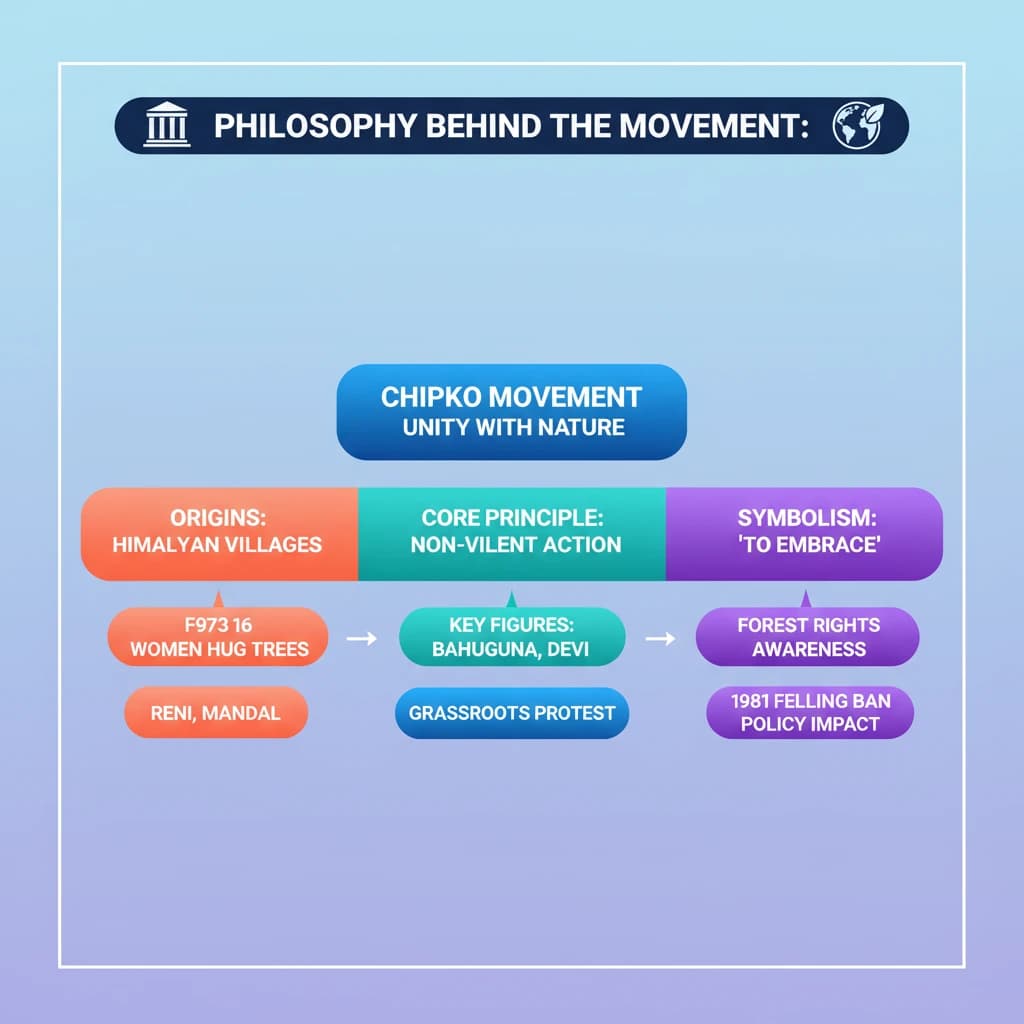
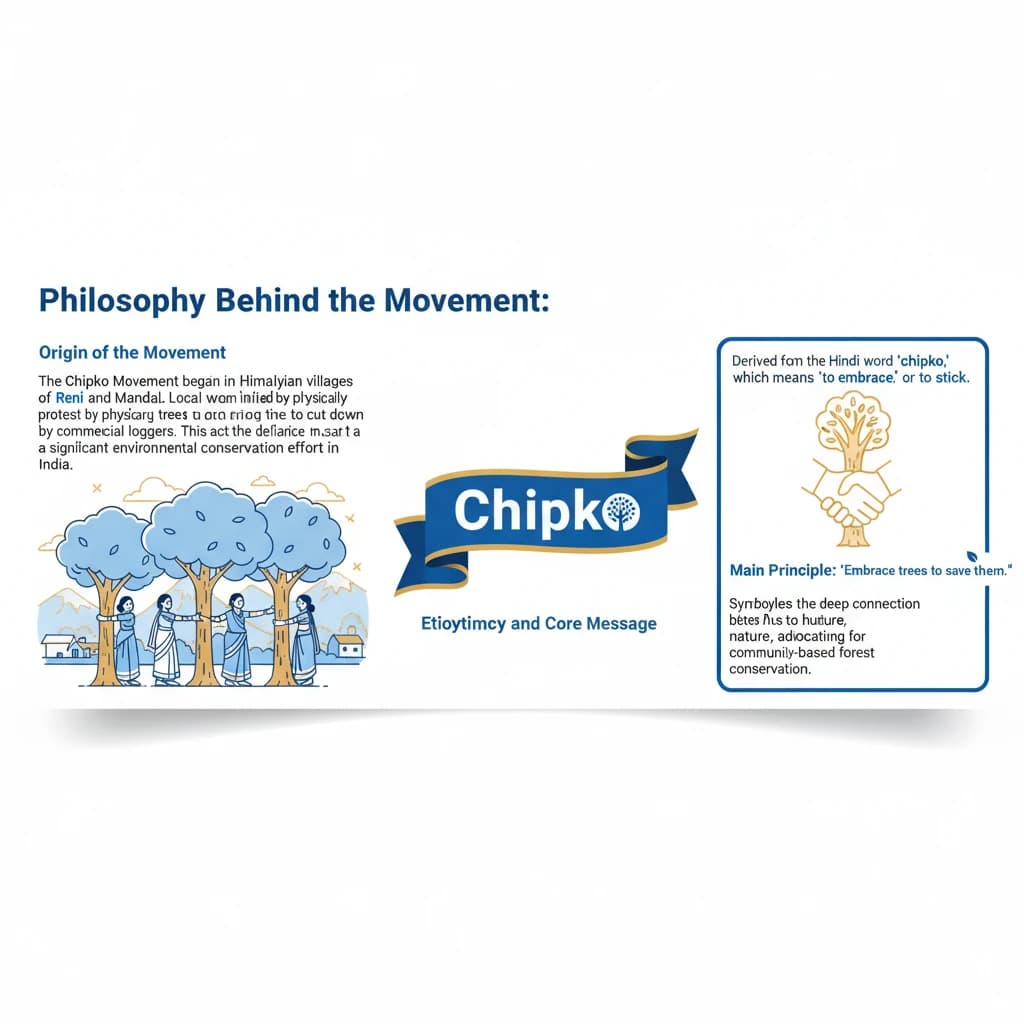
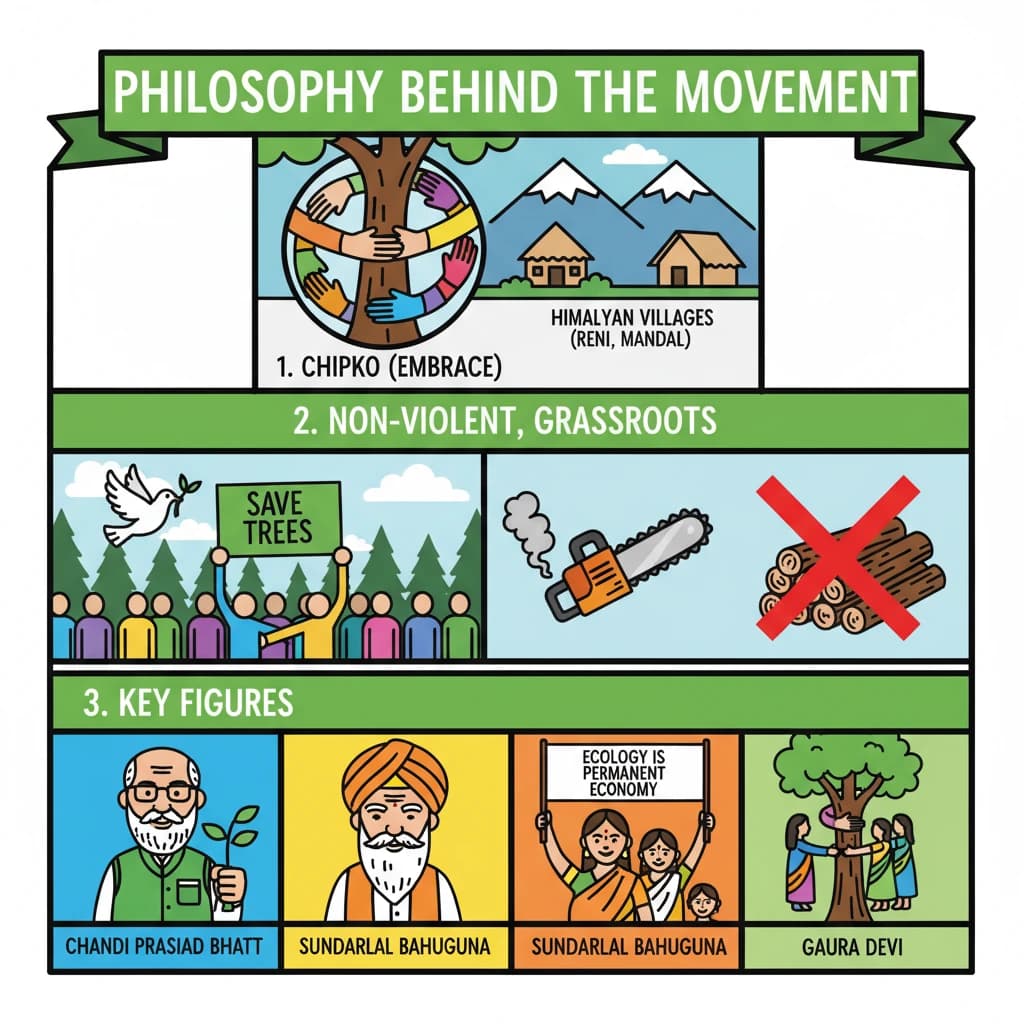
<h4>Philosophy Behind the Chipko Movement</h4><p>The philosophy underpinning the <strong>Chipko Movement</strong> was a powerful blend of traditional wisdom and modern environmentalism. It primarily drew inspiration from <strong>Gandhian principles</strong>, advocating for a harmonious coexistence with nature.</p><div class='key-point-box'><p>The core tenets included <strong>non-violence</strong> (<em>ahimsa</em>) as a method of protest and a deep respect for the natural world. This philosophy emphasized that humans are an integral part of nature, not separate from it, and must live in <strong>harmony with nature</strong>.</p></div><h4>Empowering Local Communities</h4><p>A crucial aspect of the movement's philosophy was the belief in <strong>empowering local communities</strong>. It sought to give them a significant <strong>voice in decision-making processes</strong> regarding the management and utilization of their <strong>natural resources</strong>, particularly forests.</p><p>This approach recognized that local populations, who depend directly on these resources for their livelihoods, possess invaluable traditional knowledge and have a vested interest in their sustainable management.</p><h4>Challenging Exploitative Practices</h4><p>The movement explicitly aimed to challenge and resist the <strong>exploitative practices</strong> of <strong>outside contractors</strong> and commercial logging companies. These practices often led to widespread deforestation and ecological degradation, ignoring the needs of local inhabitants.</p><p>It promoted a more <strong>inclusive and participatory approach</strong> to <strong>forest management</strong>, where the needs and rights of indigenous and forest-dwelling communities were prioritized over commercial interests.</p><h4>Impact and Inspiration</h4><p>The philosophical underpinnings of the Chipko Movement had a profound impact, both nationally and internationally. Its success demonstrated the power of grassroots movements rooted in non-violent resistance and community action.</p><div class='info-box'><p>It inspired similar movements across India, including the <strong>Narmada Bachao Andolan</strong> (Save Narmada Movement), the <strong>Appiko Movement</strong> in Karnataka, and the <strong>Silent Valley Movement</strong> in Kerala, all fighting against environmental destruction and for local rights.</p></div><div class='exam-tip-box'><p>Internationally, the <strong>Chipko Movement</strong> became a powerful symbol of resistance against <strong>environmental destruction</strong>. It showcased how local actions, guided by strong ethical principles, could have global resonance and influence environmental activism worldwide. This is vital for understanding India's role in global environmental movements for <strong>UPSC Mains GS-I and GS-III</strong>.</p></div>
Concept Diagram

💡 Key Takeaways

  • •Gandhian principles of non-violence and harmony with nature were central to the movement's philosophy.
  • •Empowerment of local communities in natural resource decision-making was a key objective.
  • •The movement challenged exploitative practices by outside contractors and promoted participatory forest management.
  • •It inspired significant environmental movements across India (e.g., Appiko, Narmada Bachao Andolan).
  • •Internationally, it became a symbol of non-violent resistance against environmental destruction.
  • •Its philosophy remains relevant for contemporary issues like climate change, FRA 2006, and SDGs.

🧠 Memory Techniques
Memory Aid
98% Verified Content

📚 Reference Sources

•NCERT Textbooks (Social Science, Environment)
•Ministry of Environment, Forest and Climate Change (MoEFCC) reports
•Academic articles on Indian environmental movements
•Official documents on Forest Rights Act (2006)

Related Topics

Loading related topics...
Explore:Social Issues Topics·All Subjects·Daily Current Affairs·Editorial Analysis·Previous Year Questions·UPSC GPT
Philosophy Behind the Movement - UPSC Social Issues