Loading page, please wait…
Vaidra Logo
Vaidra

Top 4 items + smart groups

UPSC GPT
New
Current Affairs
Daily Solutions
Daily Puzzle
Mains Evaluator

Version 2.0.0 • Built with ❤️ for UPSC aspirants

Loading...
Loading...
Loading...
Loading...
Loading...
Loading...
Loading...
Loading...
Loading...
Loading...
Loading...
Loading...
Loading...
Tobacco Epidemic in India - UPSC Social Issues
Back
All Subjects

Topics

0 topics • 0 completed

Loading topics...
Loading...
Loading...
Loading...
Loading...
Loading...
Overall Progress0%

Tobacco Epidemic in India - UPSC Social Issues

What is Tobacco Epidemic in India in UPSC Social Issues?

Tobacco Epidemic in India is a key topic under Social Issues for UPSC Civil Services Examination. Key points include: Tobacco is the world's leading preventable cause of disease and death.. India has the second-highest number of tobacco consumers globally (26 crore).. Tobacco kills over 8 million people annually worldwide, including 1.3 million non-smokers from second-hand smoke.. Understanding this topic is essential for both UPSC Prelims and Mains preparation.

Why is Tobacco Epidemic in India important for UPSC exam?

Tobacco Epidemic in India is a Medium-level topic in UPSC Social Issues. It is tested in both Prelims (factual MCQs) and Mains (analytical answer writing). Previous year UPSC questions have frequently covered aspects of Tobacco Epidemic in India, making it essential for comprehensive IAS preparation.

How to prepare Tobacco Epidemic in India for UPSC?

To prepare Tobacco Epidemic in India for UPSC: (1) Study the comprehensive notes covering all key concepts on Vaidra. (2) Practice previous year questions on this topic. (3) Connect it with current affairs using daily updates. (4) Revise using key takeaways and mind maps available for Social Issues. (5) Write practice answers linking Tobacco Epidemic in India to related GS Paper topics.

Key takeaways of Tobacco Epidemic in India for UPSC

  • Tobacco is the world's leading preventable cause of disease and death.
  • India has the second-highest number of tobacco consumers globally (26 crore).
  • Tobacco kills over 8 million people annually worldwide, including 1.3 million non-smokers from second-hand smoke.
  • In India, approximately 1.35 million deaths occur yearly due to tobacco use.
  • A vast majority (80%) of global tobacco users live in low- and middle-income countries.
Tobacco Epidemic in India

Tobacco Epidemic in India

Medium⏱️ 8 min read✓ 95% Verified
social issues

📖 Introduction

<h4>Understanding the Tobacco Epidemic in India</h4><p>The <strong>tobacco epidemic</strong> represents a significant global public health challenge. It is widely recognized as the most <strong>preventable cause of disease and death</strong> worldwide.</p><div class='key-point-box'><p>Despite global efforts, <strong>tobacco use</strong> continues to claim millions of lives annually, imposing a heavy burden on healthcare systems and economies.</p></div><h4>India's Alarming Tobacco Consumption</h4><p><strong>India</strong> holds the unfortunate distinction of having the <strong>second-highest number of tobacco consumers globally</strong>, surpassed only by <strong>China</strong>. This widespread usage contributes significantly to the nation's health crisis.</p><div class='info-box'><p>Approximately <strong>26 crore people</strong> in India are tobacco consumers, highlighting the massive scale of the problem within the country.</p></div><h4>Global and National Mortality Figures</h4><p>The health consequences of tobacco are severe. Tobacco use is directly responsible for the death of up to <strong>half of its users</strong> who do not quit, underscoring its lethal nature.</p><div class='info-box'><ul><li>Globally, <strong>more than 8 million people die each year</strong> due to tobacco-related illnesses.</li><li>A significant portion of these deaths, estimated at <strong>1.3 million non-smokers</strong>, are attributed to exposure to <strong>second-hand smoke</strong>.</li><li>In <strong>India</strong> alone, nearly <strong>1.35 million people die every year</strong> as a direct result of tobacco use.</li></ul></div><h4>Socio-Economic Dimensions of Tobacco Use</h4><p>The burden of tobacco use is disproportionately felt in certain regions. Around <strong>80% of the world’s 1.3 billion tobacco users</strong> reside in <strong>low- and middle-income countries</strong>.</p><p>This concentration suggests a complex interplay of socio-economic factors, accessibility, and public health infrastructure challenges in these nations.</p><div class='info-box'><p>In <strong>2020</strong>, global statistics indicated that <strong>22.3% of the world’s population</strong> used tobacco, emphasizing the pervasive nature of this habit.</p></div><h4>UPSC Relevance: Public Health and Governance</h4><div class='exam-tip-box'><p>Understanding the <strong>Tobacco Epidemic in India</strong> is crucial for <strong>UPSC Civil Services Exam</strong> aspirants. It touches upon topics like <strong>public health, social issues, governance, and national development</strong>. Be prepared to discuss its causes, impacts, and government interventions in various papers, especially <strong>GS-I (Social Issues)</strong> and <strong>GS-II (Governance, Health)</strong>.</p></div>
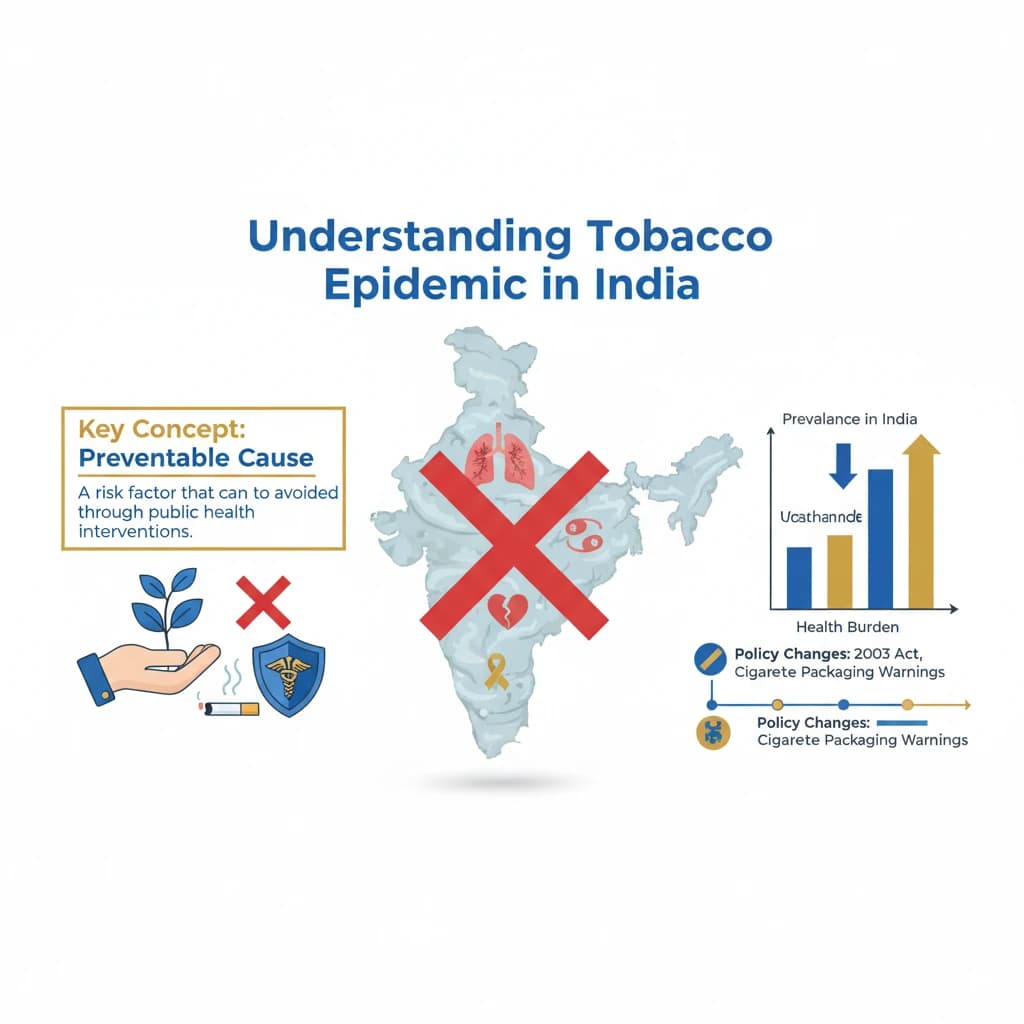
Concept Diagram

💡 Key Takeaways

  • •Tobacco is the world's leading preventable cause of disease and death.
  • •India has the second-highest number of tobacco consumers globally (26 crore).
  • •Tobacco kills over 8 million people annually worldwide, including 1.3 million non-smokers from second-hand smoke.
  • •In India, approximately 1.35 million deaths occur yearly due to tobacco use.
  • •A vast majority (80%) of global tobacco users live in low- and middle-income countries.

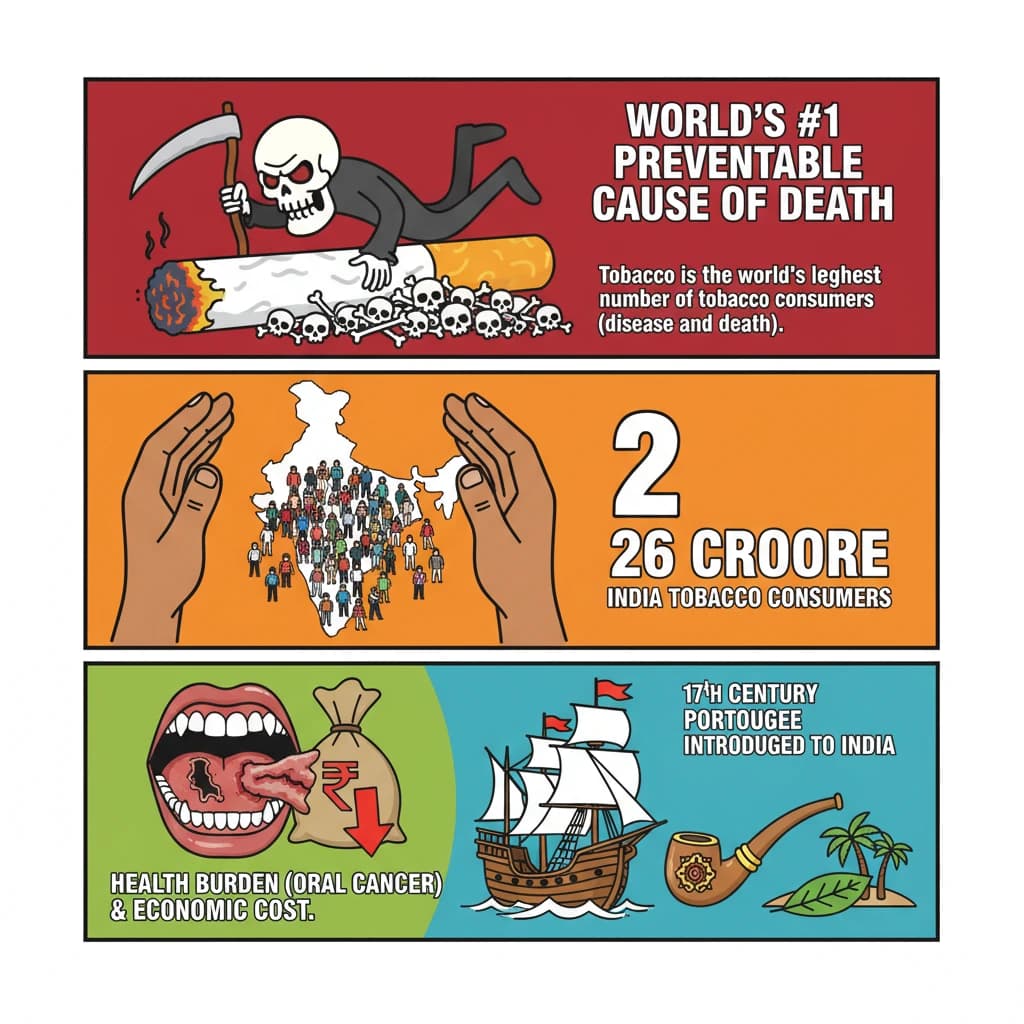
🧠 Memory Techniques
Memory Aid
95% Verified Content

📚 Reference Sources

•Ministry of Health & Family Welfare, Government of India
•Drishti IAS (original summary source)

Related Topics

Loading related topics...
Explore:Social Issues Topics·All Subjects·Daily Current Affairs·Editorial Analysis·Previous Year Questions·UPSC GPT