📖 Introduction
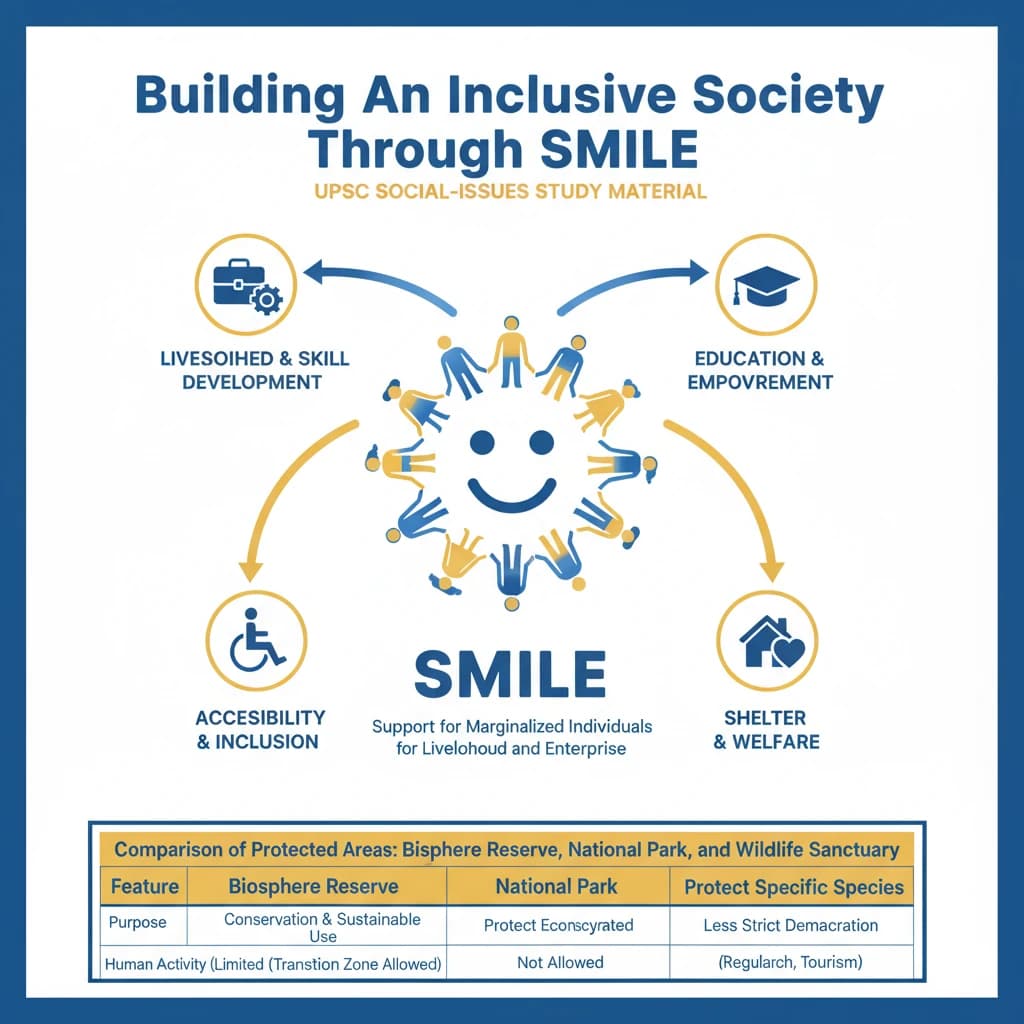
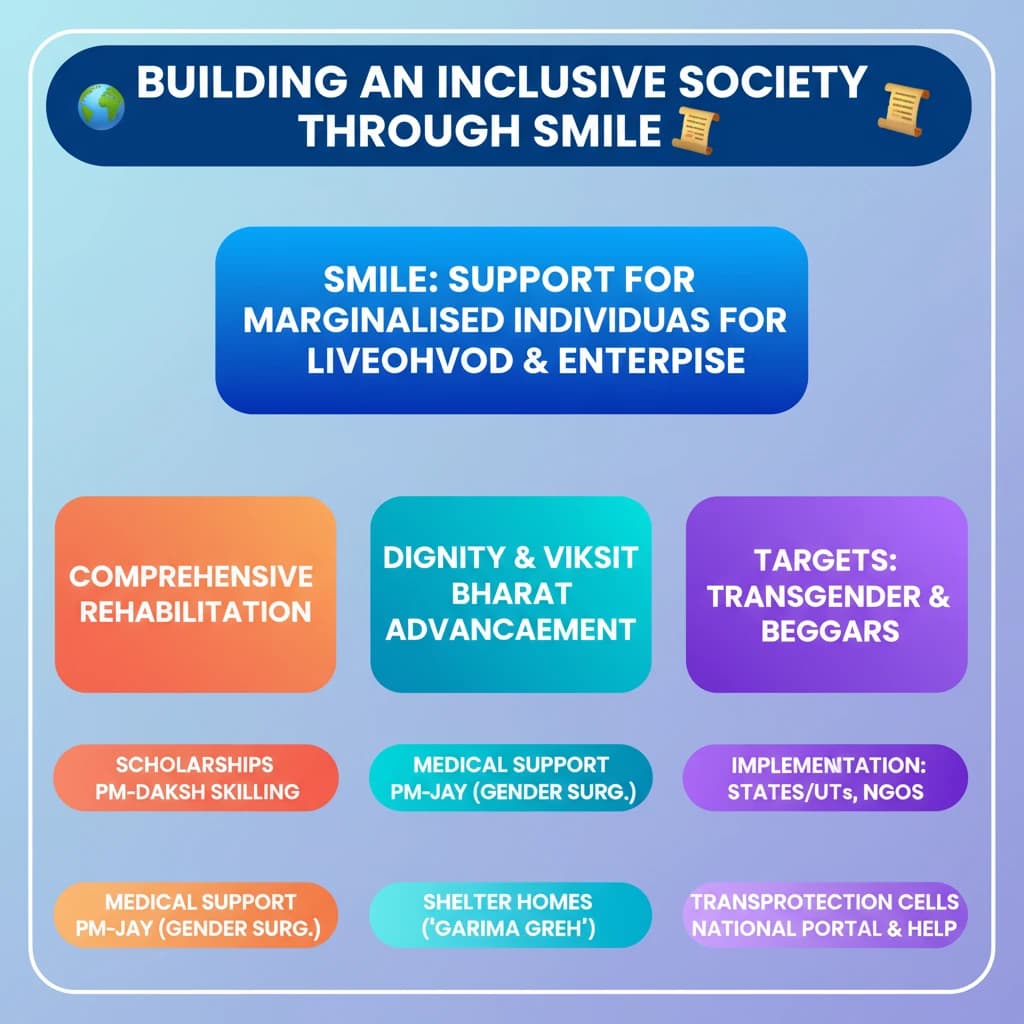
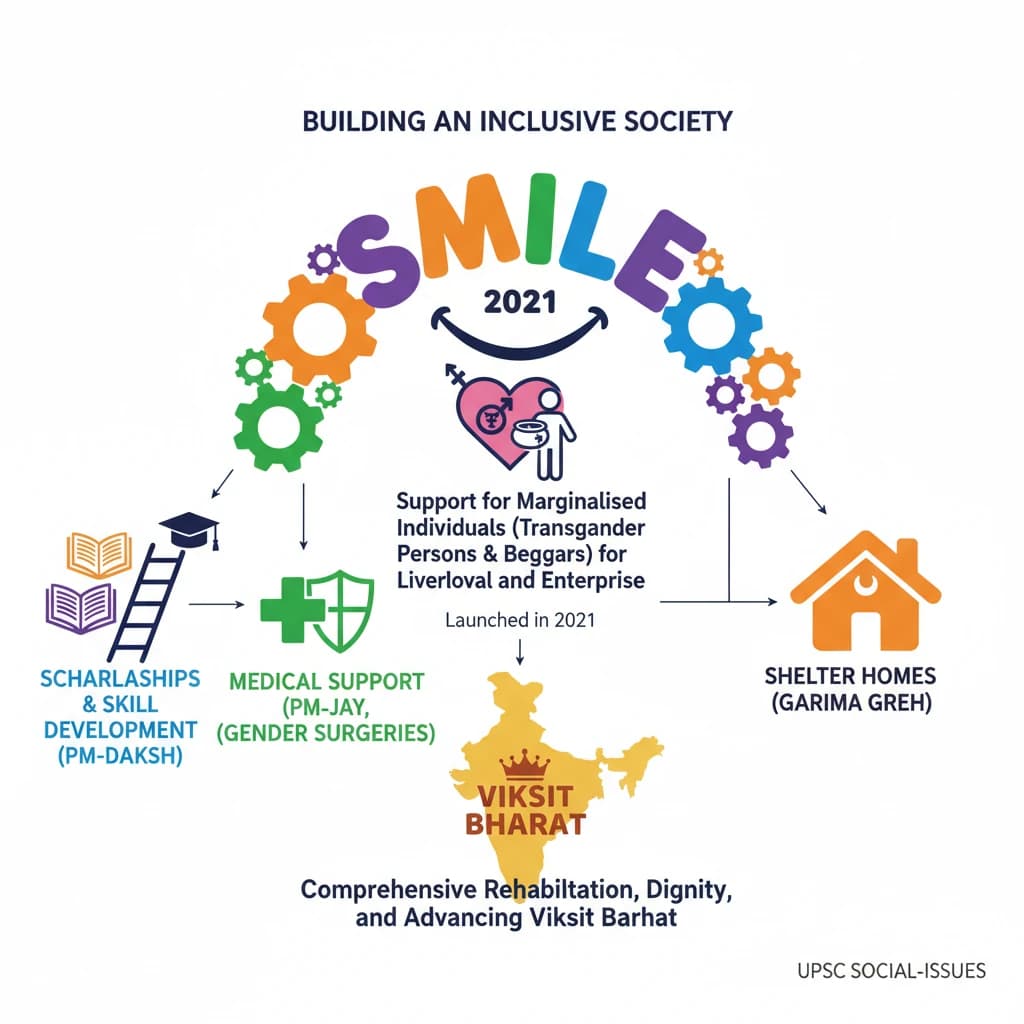
<h4>Comparison of Protected Areas: Biosphere Reserve, National Park, and Wildlife Sanctuary</h4><p>The provided source material included a comparison of different types of protected areas. While not directly related to the <strong>SMILE Scheme</strong>, this information is retained as per the instruction to include all content.</p><div class='info-box'><table class='info-table'><tr><th>Feature</th><th>Biosphere Reserve</th><th>National Park</th><th>Wildlife Sanctuary</th></tr><tr><td><strong>Purpose</strong></td><td>Promote <strong>sustainable development</strong>, conserve <strong>biodiversity</strong>, <strong>cultural heritage</strong>, and <strong>natural resources</strong>.</td><td>Conserve <strong>natural environment</strong>, protect from <strong>human interference</strong>.</td><td>Protect <strong>habitats of wild animals</strong>, promote <strong>breeding</strong>.</td></tr><tr><td><strong>Management</strong></td><td>Internationally recognized under <strong>UNESCO’s Man and Biosphere (MAB) program</strong> and owned by the <strong>government</strong>.</td><td><strong>Government</strong> has complete power over the <strong>national parks</strong>.</td><td>Can be under the <strong>government</strong> or owned under <strong>private entities</strong>.</td></tr><tr><td><strong>Zones</strong></td><td><strong>Core zone</strong> (strict protection), <strong>Buffer zone</strong> (limited human activities allowed), <strong>Transition zone</strong> (sustainable development encouraged).</td><td>Typically not divided into <strong>zones</strong>.</td><td>Generally not divided into <strong>zones</strong>.</td></tr><tr><td><strong>Human Activities</strong></td><td>Restricted in <strong>core zone</strong>, limited in <strong>buffer zone</strong>, encouraged in <strong>transition zone</strong>.</td><td>Restricted, mainly for <strong>recreational purposes</strong>.</td><td>Restricted to prevent disturbance to <strong>animals</strong>, limited <strong>educational access</strong>.</td></tr><tr><td><strong>Examples</strong></td><td><strong>Nanda Devi</strong> (Uttarakhand), <strong>Nokrek</strong> (Meghalaya).</td><td><strong>Jim Corbett</strong> (Uttarakhand), <strong>Bandhavgarh</strong> (Madhya Pradesh).</td><td><strong>Gir National Park</strong> (Gujarat), <strong>Chilka Lake Bird Sanctuary</strong> (Odisha).</td></tr></table></div><h4>Building An Inclusive Society Through SMILE</h4><p>In <strong>2021</strong>, the <strong>Support for Marginalised Individuals for Livelihood and Enterprise (SMILE) scheme</strong> was launched. This initiative aims to advance the vision of <strong>Viksit Bharat</strong>, focusing on the welfare of marginalized communities.</p><p>A key component of <strong>SMILE</strong> was the introduction of the <strong>Central Sector Scheme for Comprehensive Rehabilitation for the Welfare of Transgender Persons</strong>.</p><h4>Who is a Transgender Person?</h4><p>According to the <strong>Transgender Persons (Protection of Rights) Act, 2019</strong>, a <strong>transgender person</strong> is defined as an individual whose gender does not align with the gender assigned at birth.</p><div class='info-box'><p>This definition is comprehensive, encompassing:</p><ul><li><strong>Trans-persons with intersex variations</strong></li><li><strong>Gender-queer individuals</strong></li><li>Persons with socio-cultural identities such as <strong>kinnar</strong>, <strong>hijra</strong>, <strong>aravani</strong>, and <strong>jogta</strong>.</li></ul></div><p>The <strong>2011 Census of India</strong> was a landmark event, being the first in the nation's history to enumerate the '<strong>trans</strong>' population. It estimated that approximately <strong>4.8 million Indians</strong> identified as <strong>transgender</strong>.</p><h4>What is the SMILE Scheme?</h4><p>The <strong>SMILE scheme</strong> is a new, integrated initiative formed by merging existing welfare schemes for <strong>beggars</strong> and <strong>transgender persons</strong>. It represents a consolidated effort towards social inclusion.</p><div class='key-point-box'><p><strong>SMILE</strong> comprises two primary sub-schemes:</p><ol><li><strong>Central Sector Scheme for Comprehensive Rehabilitation for Welfare of Transgender Persons</strong></li><li><strong>Central Sector Scheme for Comprehensive Rehabilitation of persons engaged in the act of Begging</strong></li></ol><p>These sub-schemes are designed to provide extensive welfare and rehabilitation measures to both the <strong>transgender community</strong> and individuals engaged in <strong>begging</strong>.</p></div><h4>Focus Areas of SMILE</h4><p>The scheme's focus is broad and holistic, addressing multiple facets of rehabilitation and empowerment for marginalized individuals. It aims to provide a life of dignity.</p><ul><li><strong>Rehabilitation</strong> and provision of <strong>medical facilities</strong>.</li><li><strong>Counselling</strong> and assistance with <strong>basic documentation</strong>.</li><li>Support for <strong>education</strong> and <strong>skill development</strong>.</li><li>Facilitation of <strong>economic linkages</strong> for sustainable livelihoods.</li></ul><div class='info-box'><p>It is estimated that approximately <strong>60,000 of the poorest persons</strong> will benefit from the <strong>SMILE scheme</strong>.</p></div><p><strong>SMILE</strong> also includes provisions for <strong>scholarships</strong> for <strong>Transgender Students</strong>. These scholarships are available for students from <strong>Class 9th</strong> onwards, extending up to <strong>post-graduation</strong>, to ensure they can complete their education.</p><p>For <strong>skill development and livelihood</strong>, the scheme leverages the existing <strong>PM-DAKSH scheme</strong>, providing opportunities for vocational training and economic integration.</p><p>A crucial component is <strong>Composite Medical Health</strong>, which offers a comprehensive package in convergence with <strong>Pradhan Mantri Jan Arogya Yojana (PM-JAY)</strong>. This includes support for <strong>Gender-reaffirmation surgeries</strong> through selected hospitals, ensuring access to essential healthcare.</p><p>The scheme also provides <strong>housing facilities</strong> through <strong>‘Garima Greh’</strong>. These homes ensure food, clothing, recreational facilities, skill development opportunities, and medical support for both the <strong>transgender community</strong> and individuals engaged in <strong>begging</strong>.</p><h4>Implementation Strategy</h4><p>The <strong>SMILE scheme</strong> is implemented through a collaborative approach involving various stakeholders. This ensures wider reach and effective service delivery.</p><ul><li><strong>State/UT Governments</strong> and <strong>Local Urban Bodies</strong>.</li><li><strong>Voluntary Organizations</strong> and <strong>Community Based Organizations (CBOs)</strong>.</li><li>Other relevant <strong>Institutions</strong>.</li></ul><p>A dedicated <strong>Transgender Protection Cell</strong> will be established in each state. This cell will monitor cases of offenses against transgender persons, ensuring timely registration, investigation, and prosecution.</p><p>A <strong>National Portal & Helpline</strong> is also part of the scheme. It provides necessary information and solutions to the <strong>transgender community</strong> and individuals engaged in <strong>begging</strong>, offering crucial support when needed.</p><h4>Pilot Implementation and Funding</h4><p>The sub-scheme for <strong>Comprehensive Rehabilitation of Transgenders</strong> has been implemented on a pilot basis in selected cities. These cities were chosen due to their large concentrations of the <strong>beggar</strong> and <strong>Transgender community</strong>.</p><div class='info-box'><p>In the financial year <strong>2019-20</strong>, the Ministry released:</p><ul><li><strong>Rs. 1 crore</strong> to the <strong>National Institute of Social Defence (NISD)</strong>.</li><li><strong>Rs. 70 Lakh</strong> to the <strong>National Backward Classes Finance & Development Corporation (NBCFDC)</strong>.</li></ul><p>These funds were specifically allocated for <strong>skill development programmes for beggars</strong>, demonstrating early efforts towards their rehabilitation.</p></div>