Loading page, please wait…
Vaidra Logo
Vaidra

Top 4 items + smart groups

UPSC GPT
New
Current Affairs
Daily Solutions
Daily Puzzle
Mains Evaluator

Version 2.0.0 • Built with ❤️ for UPSC aspirants

Loading...
Loading...
Loading...
Loading...
Loading...
Loading...
Loading...
Loading...
Loading...
Loading...
Loading...
Loading...
Loading...
Back
All Subjects

Topics

0 topics • 0 completed

Loading topics...
Loading...
Loading...
Loading...
Loading...
Loading...
Overall Progress0%

Abetment of Suicide: Key Supreme Court Judgments - UPSC Social Issues

What is Abetment of Suicide: Key Supreme Court Judgments in UPSC Social Issues?

Abetment of Suicide: Key Supreme Court Judgments is a key topic under Social Issues for UPSC Civil Services Examination. Key points include: Abetment of suicide (Section 306 IPC) requires a direct link between the accused's actions and the victim's suicide.. M. Mohan v. The State (2011) emphasized a 'direct act with intent' leaving 'no option but suicide'.. Ude Singh v. State of Haryana (2019) clarified that abetment depends on 'case-specifics' and 'direct or indirect incitement'.. Understanding this topic is essential for both UPSC Prelims and Mains preparation.

Why is Abetment of Suicide: Key Supreme Court Judgments important for UPSC exam?

Abetment of Suicide: Key Supreme Court Judgments is a Medium-level topic in UPSC Social Issues. It is tested in both Prelims (factual MCQs) and Mains (analytical answer writing). Previous year UPSC questions have frequently covered aspects of Abetment of Suicide: Key Supreme Court Judgments, making it essential for comprehensive IAS preparation.

How to prepare Abetment of Suicide: Key Supreme Court Judgments for UPSC?

To prepare Abetment of Suicide: Key Supreme Court Judgments for UPSC: (1) Study the comprehensive notes covering all key concepts on Vaidra. (2) Practice previous year questions on this topic. (3) Connect it with current affairs using daily updates. (4) Revise using key takeaways and mind maps available for Social Issues. (5) Write practice answers linking Abetment of Suicide: Key Supreme Court Judgments to related GS Paper topics.

Key takeaways of Abetment of Suicide: Key Supreme Court Judgments for UPSC

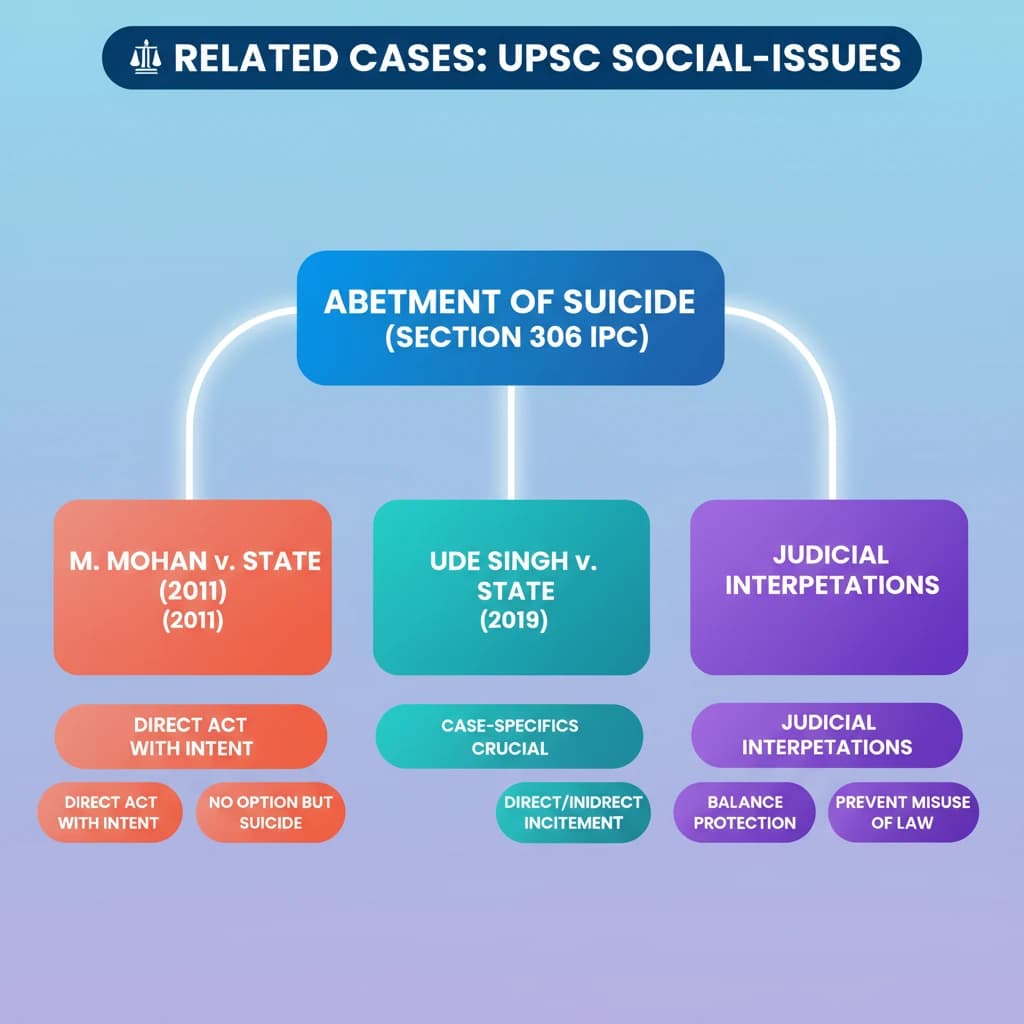
  • Abetment of suicide (Section 306 IPC) requires a direct link between the accused's actions and the victim's suicide.
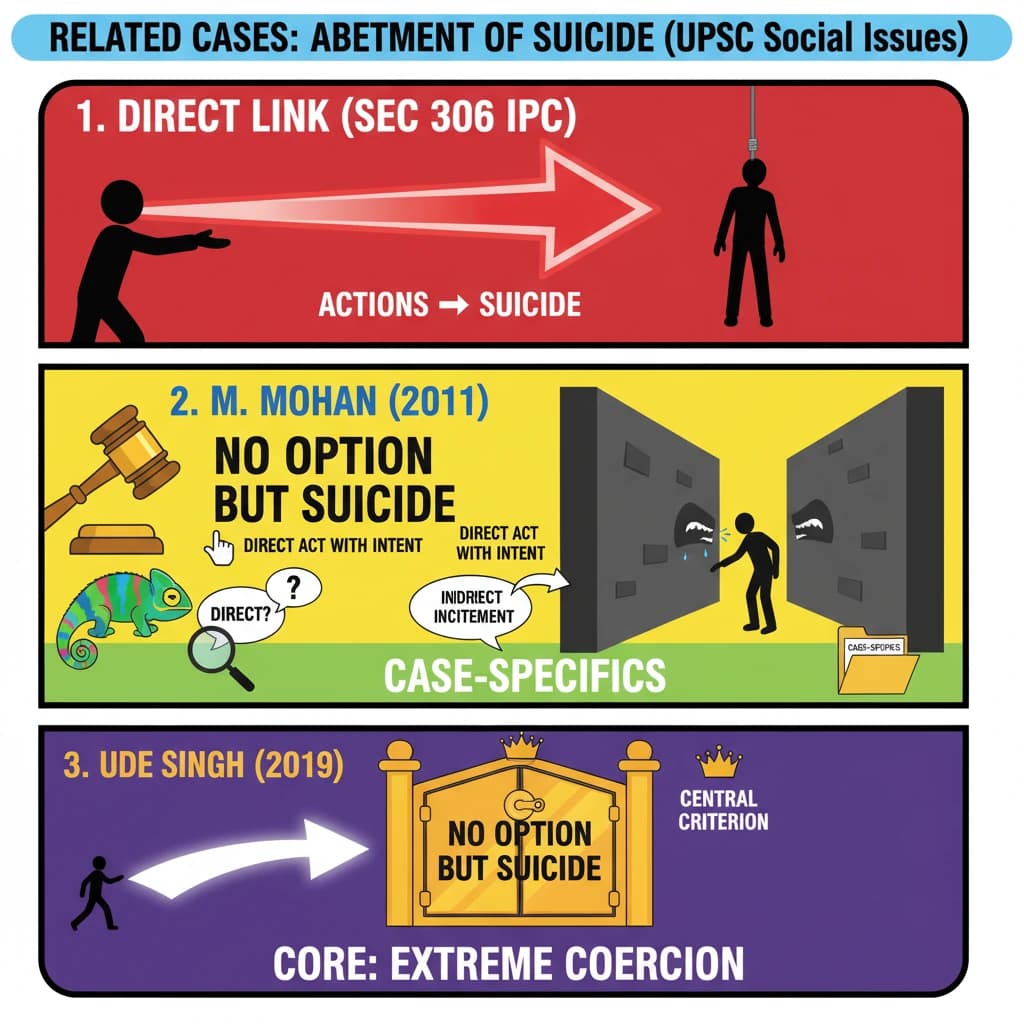
  • M. Mohan v. The State (2011) emphasized a 'direct act with intent' leaving 'no option but suicide'.
  • Ude Singh v. State of Haryana (2019) clarified that abetment depends on 'case-specifics' and 'direct or indirect incitement'.
  • The 'no option but suicide' criterion is central to proving abetment, indicating extreme coercion.
  • Judicial interpretations aim to balance protecting individuals with preventing misuse of the law.
Abetment of Suicide: Key Supreme Court Judgments

Abetment of Suicide: Key Supreme Court Judgments

Medium⏱️ 4 min read✓ 98% Verified
social issues

📖 Introduction

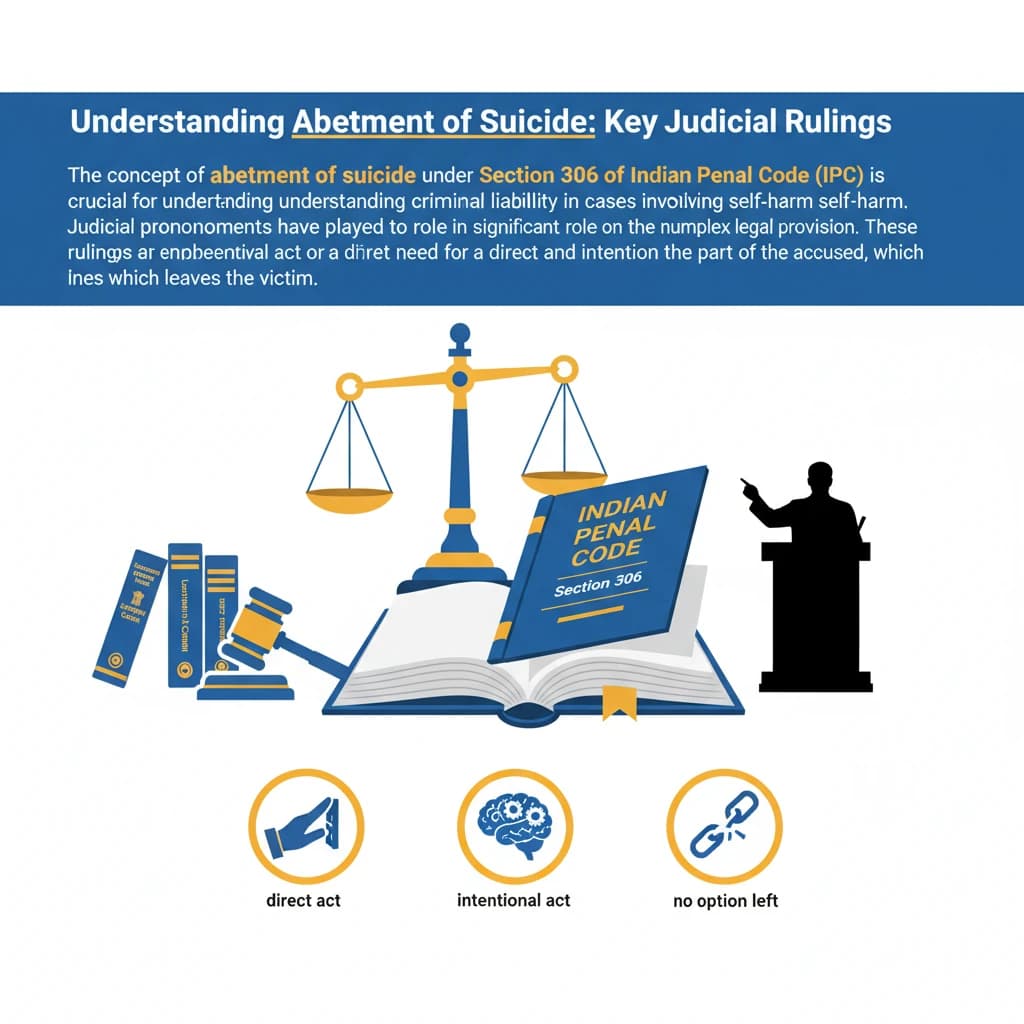
<h4>Understanding Abetment of Suicide: Key Judicial Rulings</h4><p>The concept of <strong>abetment of suicide</strong> under <strong>Section 306 of the Indian Penal Code (IPC)</strong> is crucial for understanding criminal liability in cases involving self-harm. Judicial pronouncements have played a significant role in clarifying the nuances of this complex legal provision.</p><p>These rulings emphasize the need for a direct and intentional act on the part of the accused, which leaves the victim with no viable alternative but to end their life.</p><h4>M. Mohan v. The State (2011)</h4><p>In the landmark case of <strong>M. Mohan v. The State (2011)</strong>, the <strong>Supreme Court (SC)</strong> laid down a fundamental principle regarding the proof required for abetment of suicide.</p><div class='info-box'><p>The <strong>SC</strong> ruled that proving <strong>abetment of suicide</strong> under <strong>Section 306 IPC</strong> necessitates a <strong>direct act</strong> by the accused, performed with clear <strong>intent</strong>, which leaves the victim with absolutely <strong>no option but suicide</strong>.</p></div><p>This judgment underscored the importance of a proximate and compelling link between the accused's actions and the victim's decision to commit suicide.</p><h4>Ude Singh v. State of Haryana (2019)</h4><p>Further elaborating on the complexities, the <strong>Supreme Court</strong> in <strong>Ude Singh v. State of Haryana (2019)</strong> reinforced the need for a case-specific approach to determining abetment.</p><div class='info-box'><p>The <strong>SC</strong> held that proving <strong>abetment of suicide</strong> is highly dependent on the <strong>specific facts and circumstances of each case</strong>. It requires evidence of <strong>direct or indirect incitement</strong> that effectively deprives the victim of any choice other than committing suicide.</p></div><p>This ruling highlighted that while a direct act is preferred, indirect incitement, if sufficiently potent and coercive, can also constitute abetment.</p><div class='exam-tip-box'><p><strong>UPSC Insight:</strong> These cases are vital for <strong>GS Paper II (Polity & Governance)</strong> and <strong>GS Paper IV (Ethics)</strong>. They demonstrate how judicial interpretation refines statutory provisions and addresses societal challenges. Understanding the 'direct act' and 'no option but suicide' criteria is key.</p></div>
Concept Diagram

💡 Key Takeaways

  • •Abetment of suicide (Section 306 IPC) requires a direct link between the accused's actions and the victim's suicide.
  • •M. Mohan v. The State (2011) emphasized a 'direct act with intent' leaving 'no option but suicide'.
  • •Ude Singh v. State of Haryana (2019) clarified that abetment depends on 'case-specifics' and 'direct or indirect incitement'.
  • •The 'no option but suicide' criterion is central to proving abetment, indicating extreme coercion.
  • •Judicial interpretations aim to balance protecting individuals with preventing misuse of the law.

🧠 Memory Techniques
Memory Aid
98% Verified Content

📚 Reference Sources

•Indian Penal Code, 1860 (Section 306)
•Supreme Court of India judgment: M. Mohan v. The State, (2011) 3 SCC 626
•Supreme Court of India judgment: Ude Singh v. State of Haryana, (2019) 12 SCC 301

Related Topics

Loading related topics...
Explore:Social Issues Topics·All Subjects·Daily Current Affairs·Editorial Analysis·Previous Year Questions·UPSC GPT
Abetment of Suicide: Key Supreme Court Judgments - UPSC Social Issues