📖 Introduction
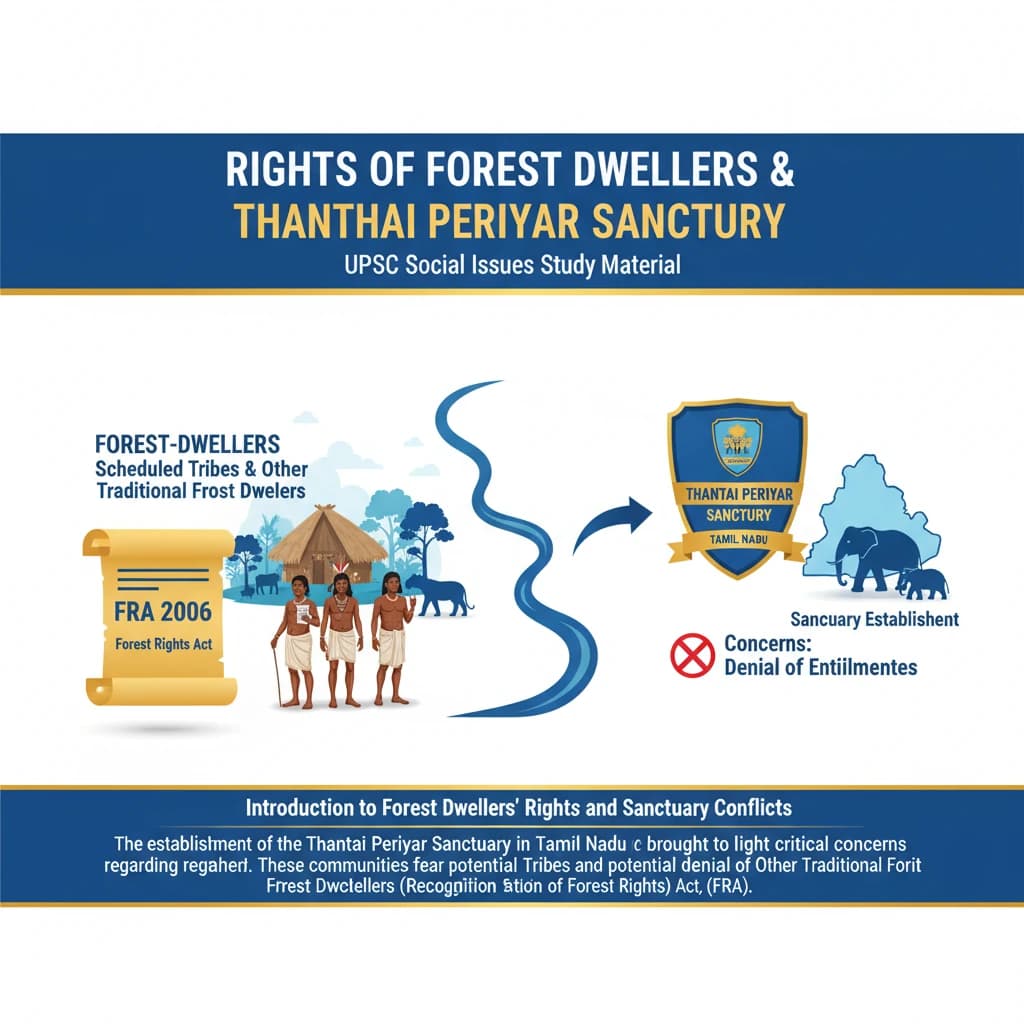
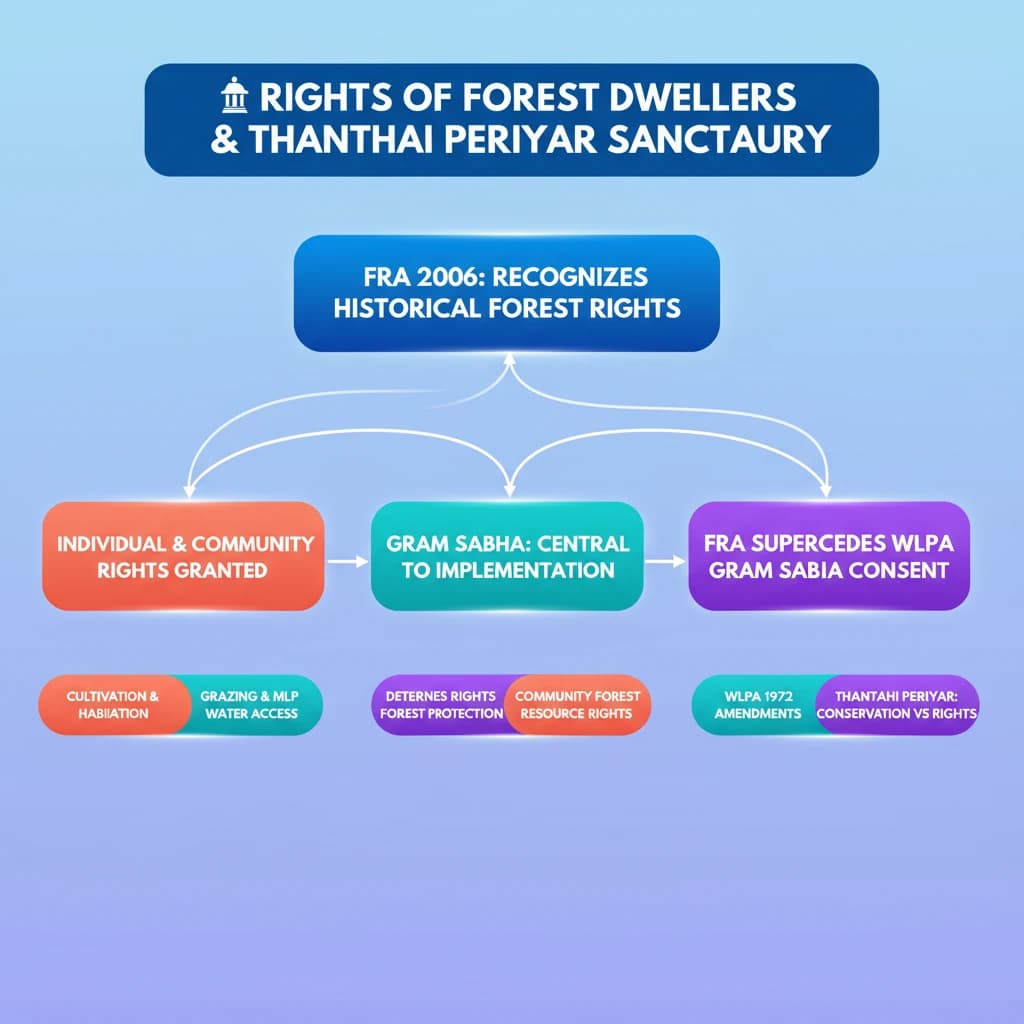
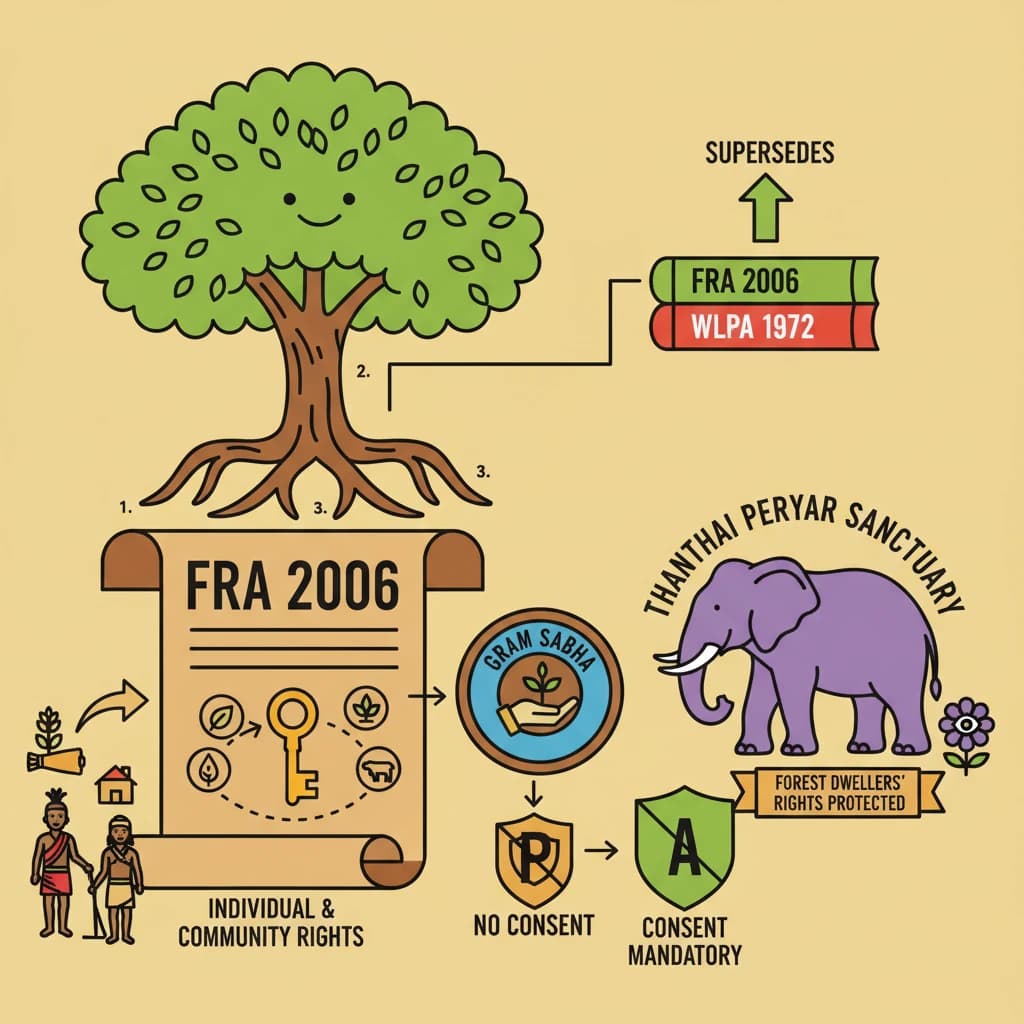
<h4>Introduction to Forest Dwellers' Rights and Sanctuary Conflicts</h4><p>The establishment of the <strong>Thanthai Periyar Sanctuary</strong> in <strong>Tamil Nadu</strong> brought to light critical concerns regarding the rights of <strong>forest-dwellers</strong>.</p><p>These communities fear potential denial of their entitlements under the crucial <strong>Scheduled Tribes and Other Traditional Forest Dwellers (Recognition of Forest Rights) Act, 2006 (FRA)</strong>.</p><div class='info-box'><p>The <strong>FRA, 2006</strong> is a landmark legislation that acknowledges the historical injustice faced by <strong>forest-dwelling tribal communities</strong> and <strong>traditional forest dwellers</strong>.</p></div><h4>The Forest Rights Act (FRA), 2006: Core Principles</h4><p>The <strong>FRA, 2006</strong>, formally known as the <strong>Scheduled Tribes and Other Traditional Forest Dwellers (Recognition of Forest Rights) Act</strong>, is pivotal for tribal welfare.</p><p>It aims to rectify the historical injustice by recognizing the symbiotic relationship between these communities and the forests they inhabit.</p><div class='key-point-box'><p>The Act secures rights over <strong>forest resources</strong> that are essential for their <strong>livelihoods, habitation, and socio-cultural needs</strong>.</p></div><h4>Rights Granted Under FRA, 2006</h4><p>The <strong>FRA</strong> provides a comprehensive set of rights, categorizing them into individual and community entitlements.</p><ul><li><strong>Individual Rights:</strong> Include rights to <strong>self-cultivation</strong> and <strong>habitation</strong>.</li><li><strong>Community Rights:</strong> Encompass <strong>grazing, fishing, access to water bodies</strong>, and <strong>traditional seasonal resource access</strong> for <strong>nomadic and pastoral communities</strong>.</li><li><strong>Special Recognitions:</strong> Rights of <strong>Particularly Vulnerable Tribal Groups (PVTGs)</strong>, <strong>intellectual property rights</strong>, and <strong>customary rights</strong> are also acknowledged.</li><li><strong>Conservation Rights:</strong> Communities gain the right to <strong>protect, regenerate, or manage community forest resources sustainably</strong>.</li><li><strong>Developmental Rights:</strong> Provision for allocation of <strong>forest land for developmental purposes</strong> to meet basic infrastructural needs.</li></ul><div class='info-box'><p>The <strong>FRA</strong> works in conjunction with the <strong>Right to Fair Compensation and Transparency in Land Acquisition, Rehabilitation and Settlement Act of 2013</strong>, preventing eviction without proper rehabilitation.</p></div><h4>Role of Gram Sabha in FRA Implementation</h4><p>The <strong>Gram Sabha (village assembly)</strong> is central to the implementation and enforcement of the <strong>FRA, 2006</strong>.</p><p>It is an highly empowered body, ensuring that the <strong>tribal population</strong> has a decisive say in local policies and schemes affecting them.</p><div class='key-point-box'><p>The <strong>Gram Sabha</strong> is authorized to <strong>determine and recognise forest rights</strong> and is responsible for <strong>protecting and preserving forests, wildlife, and biodiversity</strong> within their customary boundaries, even inside <strong>Protected Areas</strong>.</p></div><p>Violations of the <strong>FRA</strong>, especially concerning <strong>Scheduled Tribes</strong>, are considered crimes under the <strong>2016 amendment</strong> to the <strong>Scheduled Castes and the Scheduled Tribes (Prevention of Atrocities) Act of 1989</strong>.</p><p>The Act also states that converting <strong>forest villages into revenue villages</strong> is a recognized right for <strong>forest-dwelling Scheduled Tribes</strong> and other traditional forest dwellers.</p><h4>FRA and Protected Areas: A Legal Interplay</h4><p>When a <strong>Protected Area</strong> is notified under the <strong>Wild Life (Protection) Act (WLPA), 1972</strong>, the government must first assess rights under the <strong>FRA, 2006</strong>.</p><p>Crucially, <strong>consent from the Gram Sabhas</strong> is required before such notification.</p><div class='highlight-box'><p>The <strong>FRA 2006</strong>, being a later law, <strong>supersedes the WLPA, 1972</strong>. Any conflicting provisions in the <strong>WLPA</strong> are considered <strong>null and void</strong>.</p></div><h4>Madras High Court Order and Grazing Rights</h4><p>In <strong>March 2022</strong>, the <strong>Madras High Court</strong> revised an older order concerning <strong>cattle grazing</strong> in Tamil Nadu's forests.</p><p>The ban on grazing was restricted to <strong>National Parks, Sanctuaries, and Tiger Reserves</strong>, lifting the total ban across all forests.</p><div class='info-box'><p><strong>Tamil Nadu</strong> is currently the <strong>only state</strong> in India with such a specific ban on grazing in protected areas.</p></div><p>This order is notable as the <strong>FRA 2006</strong> explicitly acknowledges <strong>grazing rights</strong> and <strong>traditional resource access</strong> for <strong>nomadic or pastoralist communities</strong>.</p><p>These <strong>grazing rights</strong> are considered <strong>community rights</strong> at the habitation level and are to be regulated by their respective <strong>Gram Sabhas</strong>.</p><div class='exam-tip-box'><p>This conflict highlights the ongoing tension between <strong>conservation efforts</strong> and the <strong>rights of forest-dwelling communities</strong>, a frequent topic in <strong>UPSC Mains GS-III</strong>.</p></div><h4>Thanthai Periyar Wildlife Sanctuary: Key Features</h4><p>The <strong>Thanthai Periyar Wildlife Sanctuary</strong>, Tamil Nadu's <strong>18th wildlife sanctuary</strong>, covers <strong>80,114.80 hectares</strong> in the <strong>Bargur Hills</strong> of <strong>Erode district</strong>.</p><p>It strategically connects the <strong>Nilgiris Biosphere Reserve</strong> with the <strong>Cauvery South Wildlife Sanctuary</strong>.</p><ul><li><strong>Geographical Significance:</strong> Located at the junction of the <strong>Eastern Ghats</strong> and the <strong>Western Ghats</strong>, contributing to its rich <strong>biodiversity</strong>.</li><li><strong>Tiger Corridor:</strong> Forms a vital part of the <strong>tiger corridor</strong> linking <strong>Sathyamangalam Tiger Reserve, Male Mahadeshwara Hills Tiger Reserve</strong>, and <strong>Cauvery Wildlife Sanctuary</strong>.</li><li><strong>Conservation Importance:</strong> Recognized by the <strong>National Tiger Conservation Authority (NTCA)</strong> for supporting a viable <strong>tiger population</strong>.</li><li><strong>Elephant Reserve:</strong> A significant component of the <strong>Nilgiris Elephant Reserve</strong>, home to a healthy population of <strong>elephants</strong> and <strong>Indian Gaur</strong>.</li><li><strong>Hydrological Role:</strong> Serves as the <strong>catchment area</strong> for the <strong>Palar River</strong>, which flows into the <strong>Cauvery River</strong>, supporting agricultural activities downstream.</li></ul>