Loading page, please wait…
Vaidra Logo
Vaidra

Top 4 items + smart groups

UPSC GPT
New
Current Affairs
Daily Solutions
Daily Puzzle
Mains Evaluator

Version 2.0.0 • Built with ❤️ for UPSC aspirants

Loading...
Loading...
Loading...
Loading...
Loading...
Loading...
Loading...
Loading...
Loading...
Loading...
Loading...
Loading...
Loading...
Back
All Subjects

Topics

0 topics • 0 completed

Loading topics...
Loading...
Loading...
Loading...
Loading...
Loading...
Overall Progress0%

What are the Approaches to Tribal Development Policy? - UPSC Social Issues

What is What are the Approaches to Tribal Development Policy? in UPSC Social Issues?

What are the Approaches to Tribal Development Policy? is a key topic under Social Issues for UPSC Civil Services Examination. Key points include: Tribal development policies historically revolved around Isolation or Assimilation.. Isolation preserves culture but limits access to modern development and services.. Assimilation aims for national unity but often leads to cultural erosion and trauma.. Understanding this topic is essential for both UPSC Prelims and Mains preparation.

Why is What are the Approaches to Tribal Development Policy? important for UPSC exam?

What are the Approaches to Tribal Development Policy? is a Medium-level topic in UPSC Social Issues. It is tested in both Prelims (factual MCQs) and Mains (analytical answer writing). Previous year UPSC questions have frequently covered aspects of What are the Approaches to Tribal Development Policy?, making it essential for comprehensive IAS preparation.

How to prepare What are the Approaches to Tribal Development Policy? for UPSC?

To prepare What are the Approaches to Tribal Development Policy? for UPSC: (1) Study the comprehensive notes covering all key concepts on Vaidra. (2) Practice previous year questions on this topic. (3) Connect it with current affairs using daily updates. (4) Revise using key takeaways and mind maps available for Social Issues. (5) Write practice answers linking What are the Approaches to Tribal Development Policy? to related GS Paper topics.

Key takeaways of What are the Approaches to Tribal Development Policy? for UPSC

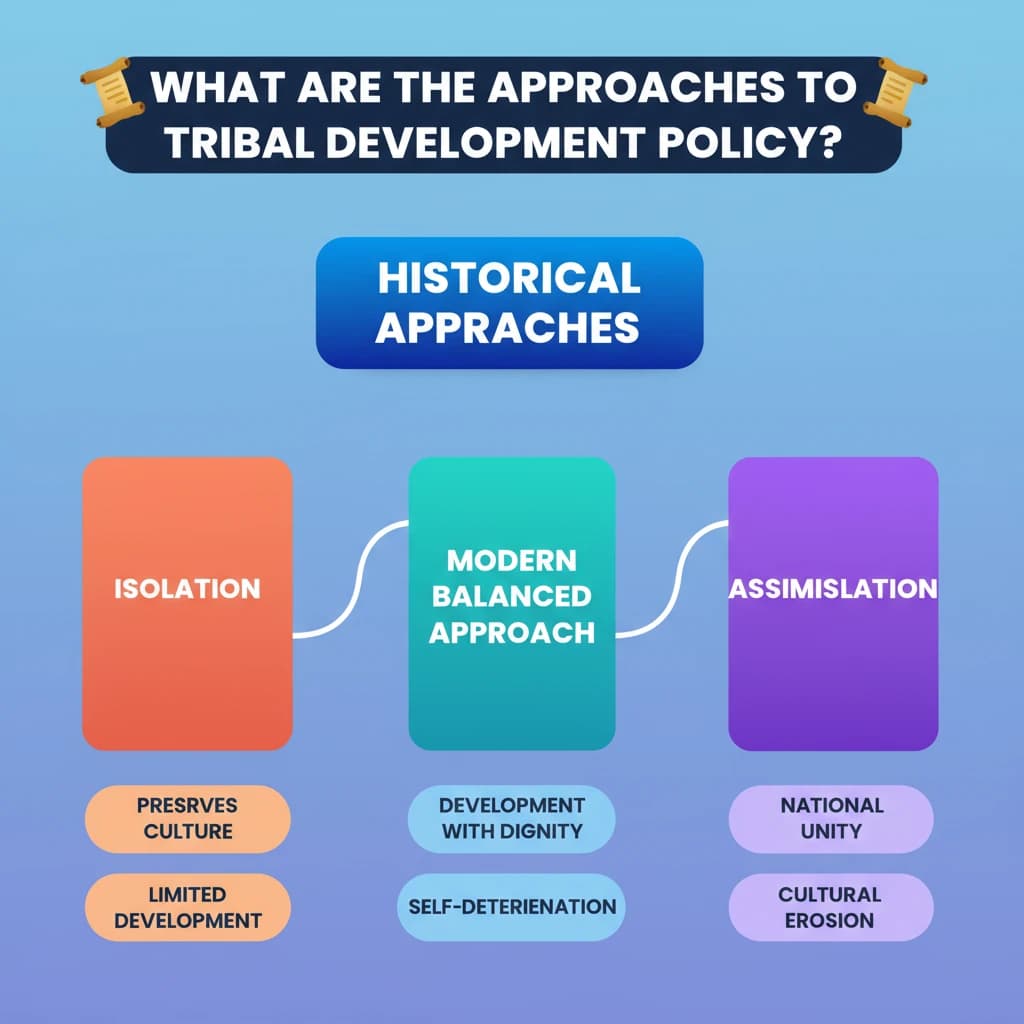
  • Tribal development policies historically revolved around Isolation or Assimilation.
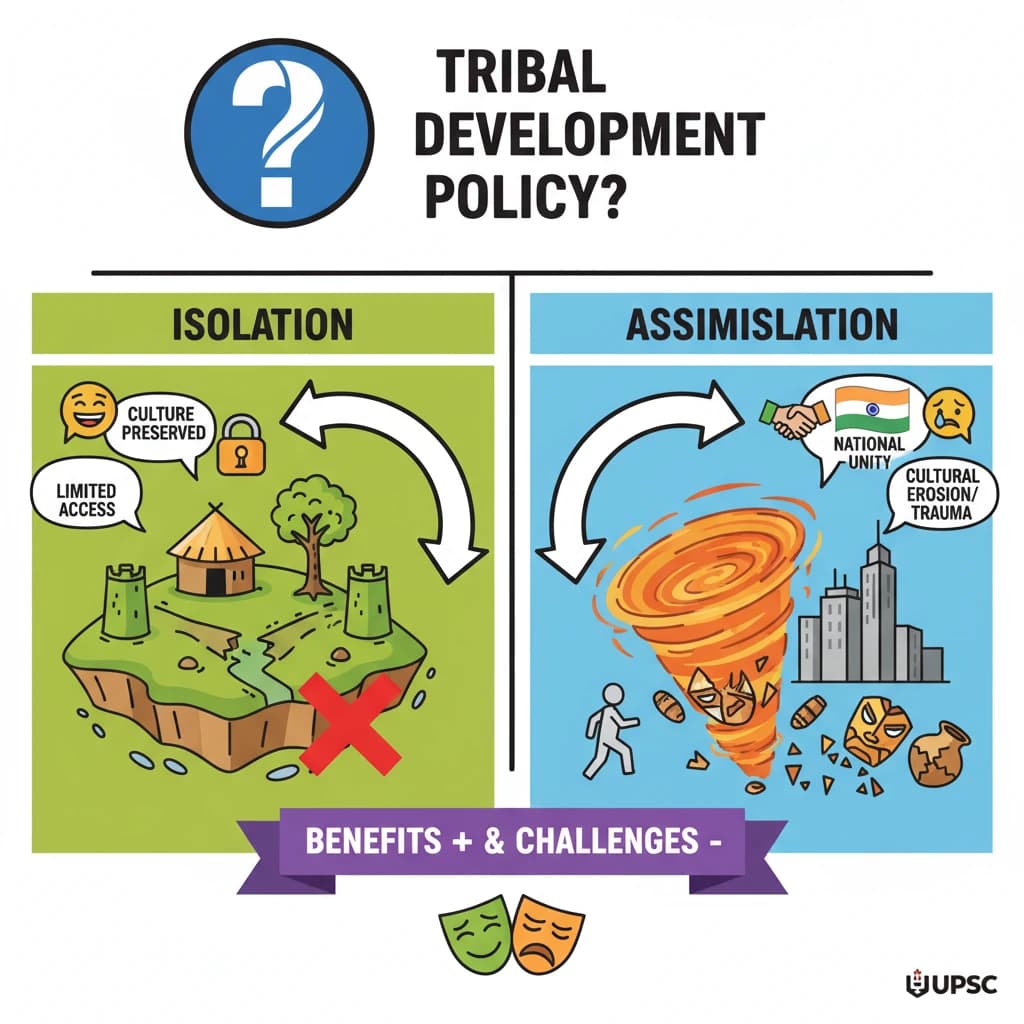
  • Isolation preserves culture but limits access to modern development and services.
  • Assimilation aims for national unity but often leads to cultural erosion and trauma.
  • Both extreme approaches have significant benefits (intended) and profound challenges (unintended consequences).
  • Modern policies seek a balanced approach, focusing on 'development with dignity' and self-determination.
  • Understanding these approaches is crucial for analyzing current government initiatives for tribal welfare.
What are the Approaches to
Tribal Development Policy?

What are the Approaches to Tribal Development Policy?

Medium⏱️ 8 min read✓ 95% Verified
social issues

📖 Introduction

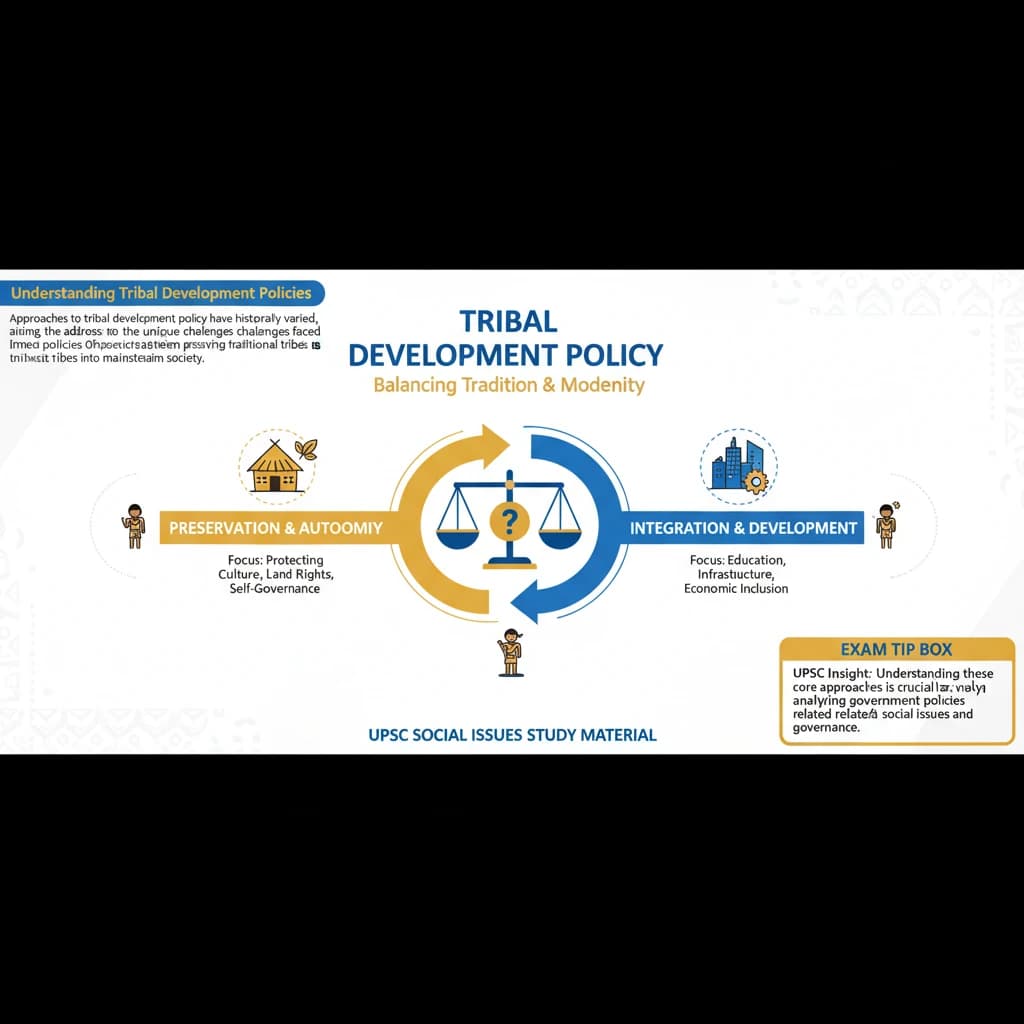
<h4>Understanding Tribal Development Policies</h4><p>Approaches to <strong>tribal development policy</strong> have historically varied, aiming to address the unique challenges faced by Indigenous communities. These policies often oscillate between preserving traditional ways of life and integrating tribes into mainstream society.</p><div class='exam-tip-box'><p><strong>UPSC Insight:</strong> Understanding these core approaches is crucial for analyzing government policies related to <strong>social justice</strong>, <strong>vulnerable sections</strong>, and <strong>cultural preservation</strong> in <strong>GS-I</strong> and <strong>GS-II</strong>.</p></div><h4>The Isolation Approach</h4><p>The <strong>Isolation Approach</strong> emphasizes protecting <strong>Indigenous communities</strong> by limiting their interaction with modern society. The primary goal is to preserve their distinct <strong>cultural and ecological systems</strong>.</p><div class='info-box'><p><strong>Definition:</strong> <strong>Isolation</strong> involves minimizing external contact to safeguard tribal identity and traditional practices.</p></div><p>This approach is often implemented through strict regulations and the creation of protected zones, ensuring minimal external influence.</p><ul><li><strong>Benefits:</strong></li><li><strong>Traditional lifestyles</strong>, <strong>languages</strong>, and <strong>knowledge systems</strong> are effectively preserved.</li><li>Communities are shielded from external influences that may lead to <strong>exploitation of resources or labour</strong>.</li><li><strong>Indigenous lands</strong>, often rich in <strong>biodiversity</strong>, are preserved through their sustainable practices.</li></ul><ul><li><strong>Challenges:</strong></li><li><strong>Isolation</strong> often results in a significant lack of essential services such as <strong>healthcare</strong>, <strong>education</strong>, and <strong>economic opportunities</strong>.</li><li>Communities may remain excluded from broader <strong>national development processes</strong> and benefits.</li><li>External changes, such as <strong>climate impacts</strong> or <strong>encroachment</strong>, can render isolation unsustainable in the long term.</li></ul><h4>The Assimilation Approach</h4><p>The <strong>Assimilation Approach</strong> aims to incorporate <strong>Indigenous communities</strong> into mainstream society. The underlying goal is to foster a <strong>unified national identity</strong>.</p><div class='info-box'><p><strong>Definition:</strong> <strong>Assimilation</strong> involves integrating tribal communities into the dominant culture, often leading to the adoption of mainstream norms and practices.</p></div><p>While seeking national unity, this approach can inadvertently undermine or suppress the unique <strong>cultural practices</strong> and distinct identities of tribal groups.</p><ul><li><strong>Challenges:</strong></li><li>Can lead to the suppression or erosion of <strong>unique cultural practices</strong>, <strong>languages</strong>, and <strong>traditional knowledge</strong>.</li><li>Often involves forced cultural changes, causing significant <strong>social and psychological trauma</strong> to individuals and communities.</li><li>May result in the loss of <strong>tribal identity</strong> and the marginalization of traditional governance structures.</li></ul><div class='key-point-box'><p>Both <strong>Isolation</strong> and <strong>Assimilation</strong> represent extreme ends of the policy spectrum, each with profound implications for tribal well-being and cultural survival.</p></div>
Concept Diagram

💡 Key Takeaways

  • •Tribal development policies historically revolved around Isolation or Assimilation.
  • •Isolation preserves culture but limits access to modern development and services.
  • •Assimilation aims for national unity but often leads to cultural erosion and trauma.
  • •Both extreme approaches have significant benefits (intended) and profound challenges (unintended consequences).
  • •Modern policies seek a balanced approach, focusing on 'development with dignity' and self-determination.
  • •Understanding these approaches is crucial for analyzing current government initiatives for tribal welfare.

🧠 Memory Techniques
Memory Aid
95% Verified Content

📚 Reference Sources

•Andaman and Nicobar Islands (Protection of Aboriginal Tribes) Act, 1956
•Historical accounts of Native American boarding schools (e.g., National Native American Boarding School Healing Coalition)
•Reports on Australia's 'Stolen Generations' (e.g., 'Bringing Them Home' Report)
•General knowledge on Indian tribal policy (PESA, FRA)

Related Topics

Loading related topics...
Explore:Social Issues Topics·All Subjects·Daily Current Affairs·Editorial Analysis·Previous Year Questions·UPSC GPT
What are the Approaches to Tribal Development Policy? - UPSC Social Issues