Loading page, please wait…
Vaidra Logo
Vaidra

Top 4 items + smart groups

UPSC GPT
New
Current Affairs
Daily Solutions
Daily Puzzle
Mains Evaluator

Version 2.0.0 • Built with ❤️ for UPSC aspirants

Loading...
Loading...
Loading...
Loading...
Loading...
Loading...
Loading...
Loading...
Loading...
Loading...
Loading...
Loading...
Loading...
Back
All Subjects

Topics

0 topics • 0 completed

Loading topics...
Loading...
Loading...
Loading...
Loading...
Loading...
Overall Progress0%

Cervical Cancer - UPSC Social Issues

What is Cervical Cancer in UPSC Social Issues?

Cervical Cancer is a key topic under Social Issues for UPSC Civil Services Examination. Key points include: Cervical cancer develops in the cervix and is the fourth most common cancer among women globally.. Nearly all cases (99%) are caused by high-risk Human Papillomaviruses (HPV), primarily types 16 and 18.. HPV is a common virus transmitted through sexual contact.. Understanding this topic is essential for both UPSC Prelims and Mains preparation.

Why is Cervical Cancer important for UPSC exam?

Cervical Cancer is a Medium-level topic in UPSC Social Issues. It is tested in both Prelims (factual MCQs) and Mains (analytical answer writing). Previous year UPSC questions have frequently covered aspects of Cervical Cancer, making it essential for comprehensive IAS preparation.

How to prepare Cervical Cancer for UPSC?

To prepare Cervical Cancer for UPSC: (1) Study the comprehensive notes covering all key concepts on Vaidra. (2) Practice previous year questions on this topic. (3) Connect it with current affairs using daily updates. (4) Revise using key takeaways and mind maps available for Social Issues. (5) Write practice answers linking Cervical Cancer to related GS Paper topics.

Key takeaways of Cervical Cancer for UPSC

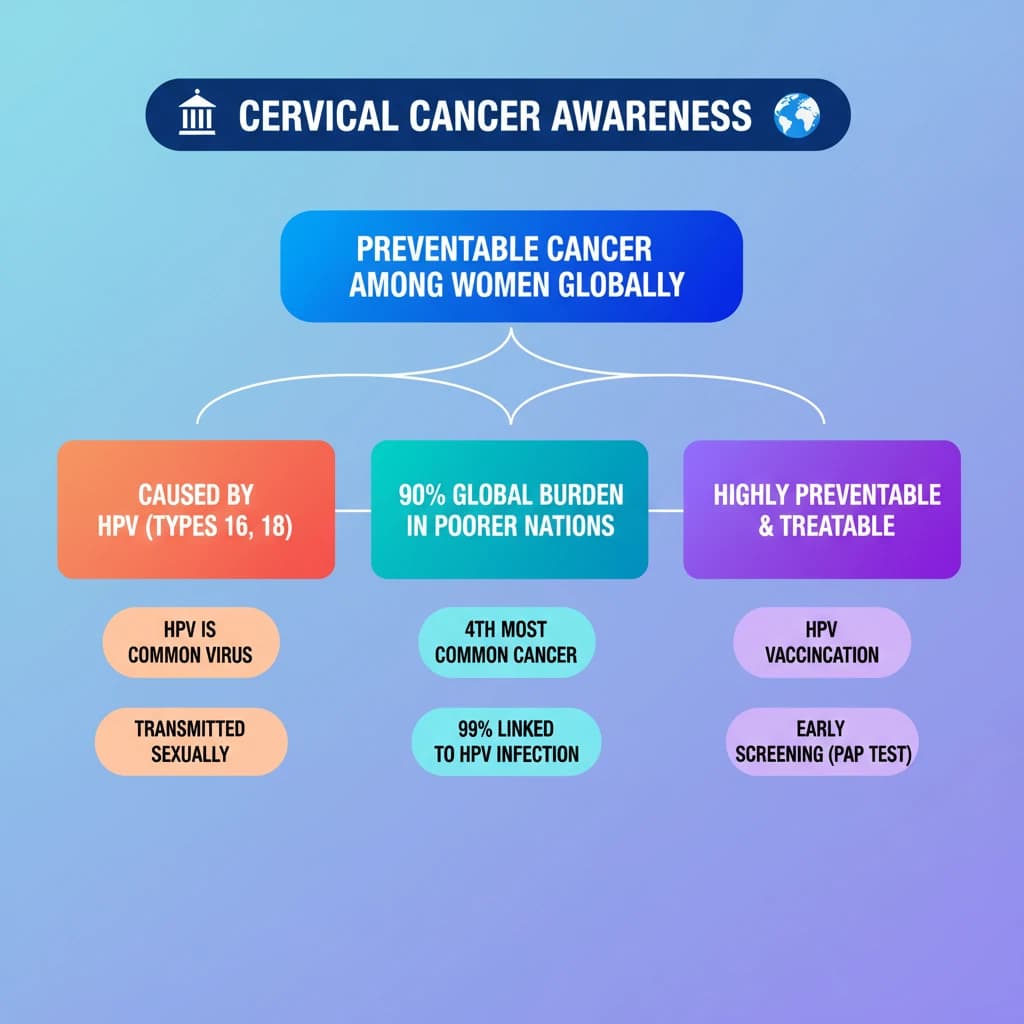
  • Cervical cancer develops in the cervix and is the fourth most common cancer among women globally.
  • Nearly all cases (99%) are caused by high-risk Human Papillomaviruses (HPV), primarily types 16 and 18.
  • HPV is a common virus transmitted through sexual contact.
  • Low- and middle-income countries bear 90% of the global burden of cervical cancer cases and deaths.
  • It is a highly preventable cancer through HPV vaccination and early detection via screening (Pap test).
Cervical Cancer

Cervical Cancer

Medium⏱️ 7 min read✓ 95% Verified
social issues

📖 Introduction

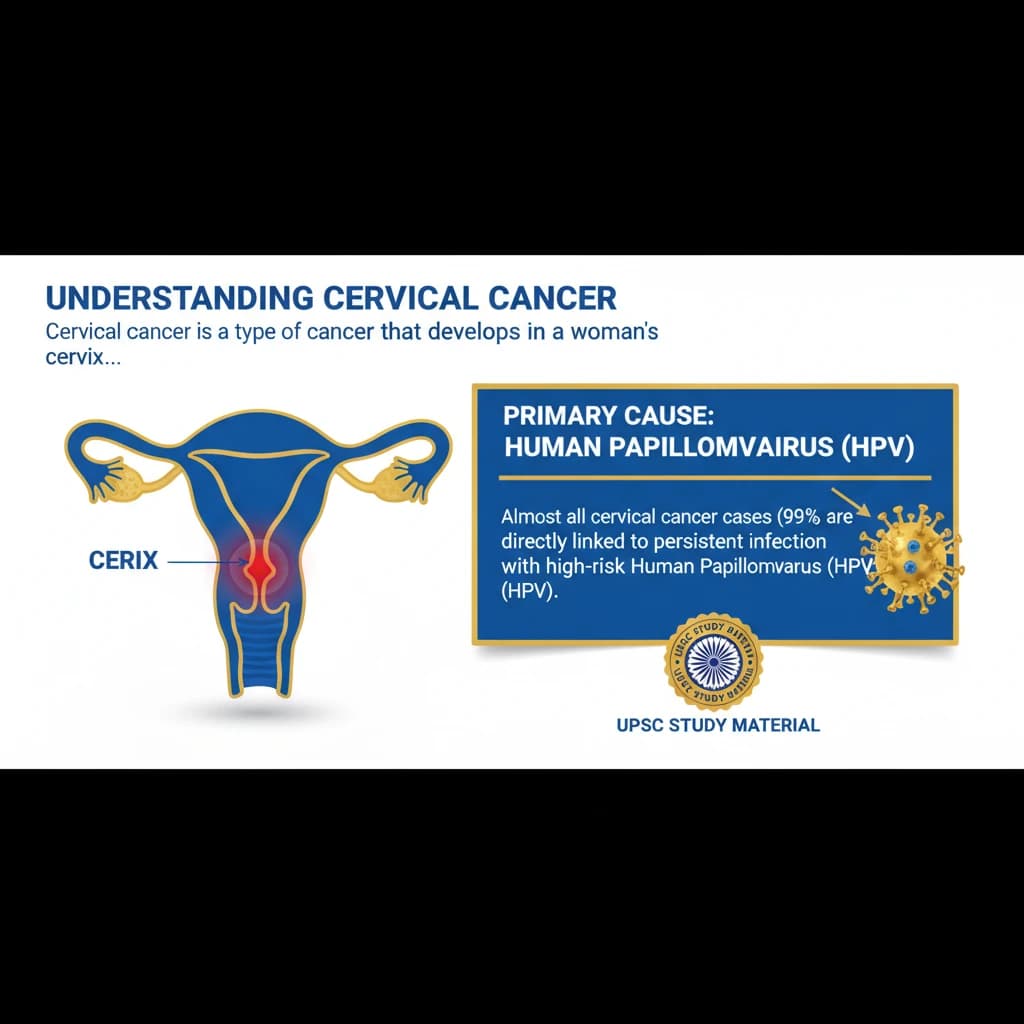
<h4>Understanding Cervical Cancer</h4><p><strong>Cervical cancer</strong> is a type of cancer that develops in a woman’s <strong>cervix</strong>, which is the lower, narrow part of the uterus that connects to the vagina.</p><p>It is a significant global health concern, primarily affecting women worldwide.</p><h4>Primary Cause: Human Papillomavirus (HPV)</h4><p>Almost all <strong>cervical cancer cases (99%)</strong> are directly linked to persistent infection with <strong>high-risk Human Papillomaviruses (HPV)</strong>.</p><p><strong>HPV</strong> is an extremely common virus that is primarily transmitted through <strong>sexual contact</strong>.</p><div class='key-point-box'><p>The strong causal link between <strong>HPV infection</strong> and <strong>cervical cancer</strong> makes it a preventable disease through vaccination and screening.</p></div><h4>Key HPV Types Responsible</h4><p>Among the many types of HPV, two specific strains, <strong>HPV types 16 and 18</strong>, are particularly virulent.</p><p>These two types alone are responsible for nearly <strong>50% of high-grade cervical pre-cancers</strong>, which can progress to invasive cancer if left untreated.</p><h4>Global Burden and Disparities</h4><p>Globally, <strong>cervical cancer</strong> ranks as the <strong>fourth most common cancer among women</strong>.</p><div class='info-box'><p>In <strong>2020</strong>, approximately <strong>90% of new cases and deaths</strong> from cervical cancer worldwide occurred in <strong>low- and middle-income countries (LMICs)</strong>. This highlights a significant health equity challenge.</p></div><div class='exam-tip-box'><p>UPSC often focuses on health disparities. Understanding why <strong>LMICs</strong> bear a disproportionate burden of diseases like <strong>cervical cancer</strong> is crucial for Mains answers, especially for <strong>GS Paper 2 (Social Justice)</strong>.</p></div>
Concept Diagram

💡 Key Takeaways

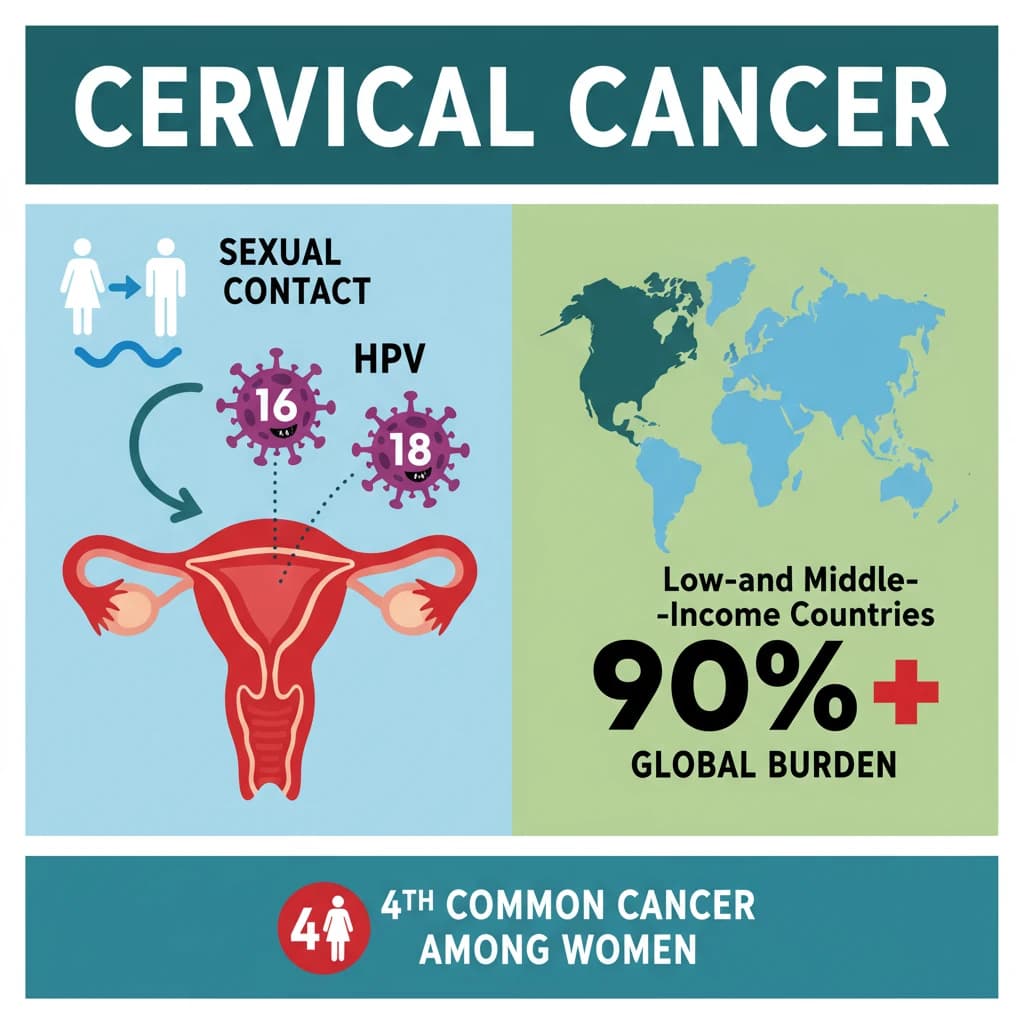
  • •Cervical cancer develops in the cervix and is the fourth most common cancer among women globally.
  • •Nearly all cases (99%) are caused by high-risk Human Papillomaviruses (HPV), primarily types 16 and 18.
  • •HPV is a common virus transmitted through sexual contact.
  • •Low- and middle-income countries bear 90% of the global burden of cervical cancer cases and deaths.
  • •It is a highly preventable cancer through HPV vaccination and early detection via screening (Pap test).

🧠 Memory Techniques
Memory Aid
95% Verified Content

📚 Reference Sources

•Drishti IAS Summary (provided source)
•Ministry of Health & Family Welfare, Government of India reports
•National Technical Advisory Group on Immunization (NTAGI) recommendations

Related Topics

Loading related topics...
Explore:Social Issues Topics·All Subjects·Daily Current Affairs·Editorial Analysis·Previous Year Questions·UPSC GPT
Cervical Cancer - UPSC Social Issues