Loading page, please wait…
Vaidra Logo
Vaidra

Top 4 items + smart groups

UPSC GPT
New
Current Affairs
Daily Solutions
Daily Puzzle
Mains Evaluator

Version 2.0.0 • Built with ❤️ for UPSC aspirants

Loading...
Loading...
Loading...
Loading...
Loading...
Loading...
Loading...
Loading...
Loading...
Loading...
Loading...
Loading...
Loading...
Back
All Subjects

Topics

0 topics • 0 completed

Loading topics...
Loading...
Loading...
Loading...
Loading...
Loading...
Overall Progress0%

Recruitment Concerns in Eklavya Model Residential Schools - UPSC Social Issues

What is Recruitment Concerns in Eklavya Model Residential Schools in UPSC Social Issues?

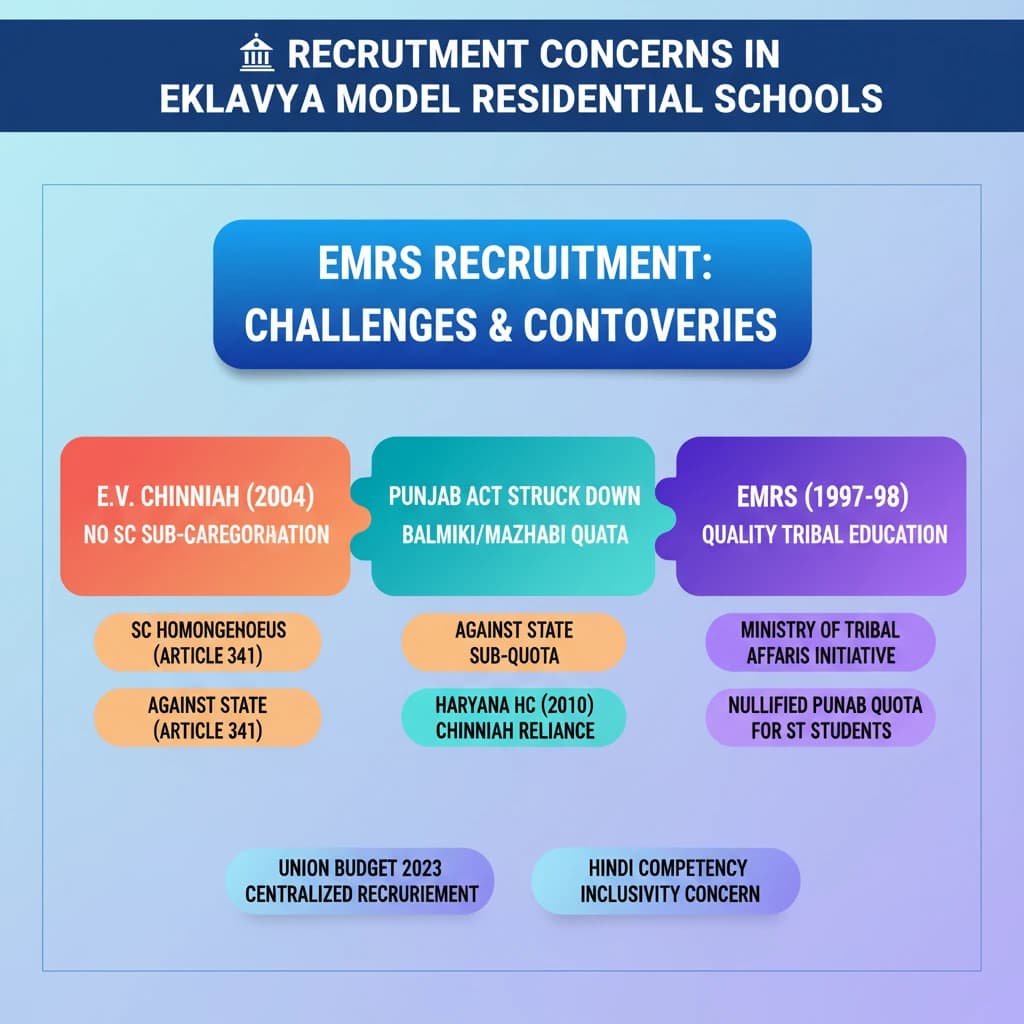
Recruitment Concerns in Eklavya Model Residential Schools is a key topic under Social Issues for UPSC Civil Services Examination. Key points include: The <strong>EV Chinniah judgment (2004)</strong> ruled against state-level sub-categorisation within <strong>Scheduled Castes (SCs)</strong>, stating they form a homogeneous group under <strong>Article 341</strong>.. The <strong>Punjab and Haryana High Court (2010)</strong> struck down a Punjab Act's provision for sub-quota for <strong>Balmikiis</strong> and <strong>Mazhabi Sikhs</strong>, citing <strong>EV Chinniah</strong>.. <strong>Eklavya Model Residential Schools (EMRS)</strong>, started in <strong>1997-98</strong> under the <strong>Ministry of Tribal Affairs</strong>, provide quality education for <strong>Scheduled Tribes (STs)</strong>.. Understanding this topic is essential for both UPSC Prelims and Mains preparation.

Why is Recruitment Concerns in Eklavya Model Residential Schools important for UPSC exam?

Recruitment Concerns in Eklavya Model Residential Schools is a Medium-level topic in UPSC Social Issues. It is tested in both Prelims (factual MCQs) and Mains (analytical answer writing). Previous year UPSC questions have frequently covered aspects of Recruitment Concerns in Eklavya Model Residential Schools, making it essential for comprehensive IAS preparation.

How to prepare Recruitment Concerns in Eklavya Model Residential Schools for UPSC?

To prepare Recruitment Concerns in Eklavya Model Residential Schools for UPSC: (1) Study the comprehensive notes covering all key concepts on Vaidra. (2) Practice previous year questions on this topic. (3) Connect it with current affairs using daily updates. (4) Revise using key takeaways and mind maps available for Social Issues. (5) Write practice answers linking Recruitment Concerns in Eklavya Model Residential Schools to related GS Paper topics.

Key takeaways of Recruitment Concerns in Eklavya Model Residential Schools for UPSC

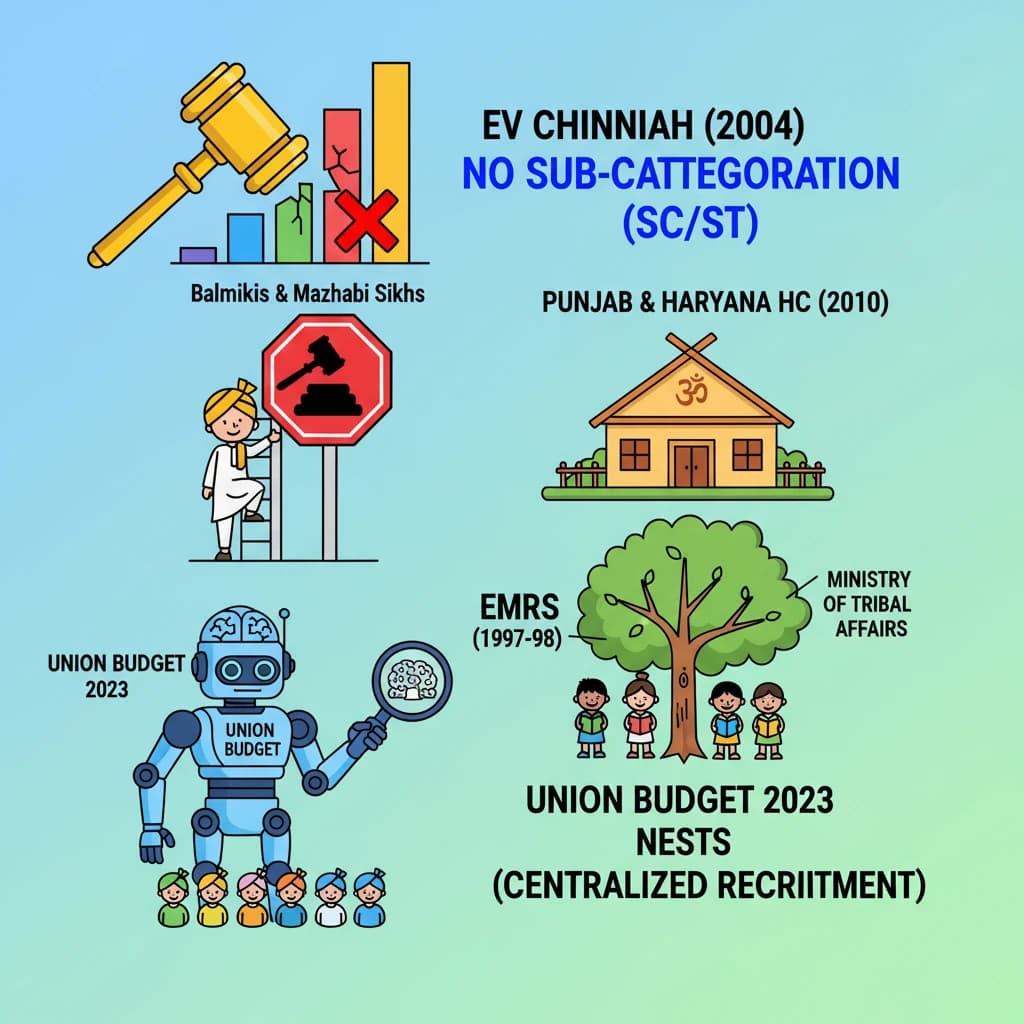
  • The <strong>EV Chinniah judgment (2004)</strong> ruled against state-level sub-categorisation within <strong>Scheduled Castes (SCs)</strong>, stating they form a homogeneous group under <strong>Article 341</strong>.
  • The <strong>Punjab and Haryana High Court (2010)</strong> struck down a Punjab Act's provision for sub-quota for <strong>Balmikiis</strong> and <strong>Mazhabi Sikhs</strong>, citing <strong>EV Chinniah</strong>.
  • <strong>Eklavya Model Residential Schools (EMRS)</strong>, started in <strong>1997-98</strong> under the <strong>Ministry of Tribal Affairs</strong>, provide quality education for <strong>Scheduled Tribes (STs)</strong>.
  • The <strong>Union Budget 2023</strong> announced centralisation of <strong>EMRS recruitment</strong> through <strong>NESTS</strong> to address teacher shortages and standardise rules.
  • Mandatory <strong>Hindi competency</strong> in centralised <strong>EMRS</strong> recruitment raises concerns about inclusivity for non-Hindi speaking tribal regions.
Recruitment Concerns in Eklavya Model Residential Schools

Recruitment Concerns in Eklavya Model Residential Schools

Medium⏱️ 8 min read✓ 98% Verified
social issues

📖 Introduction

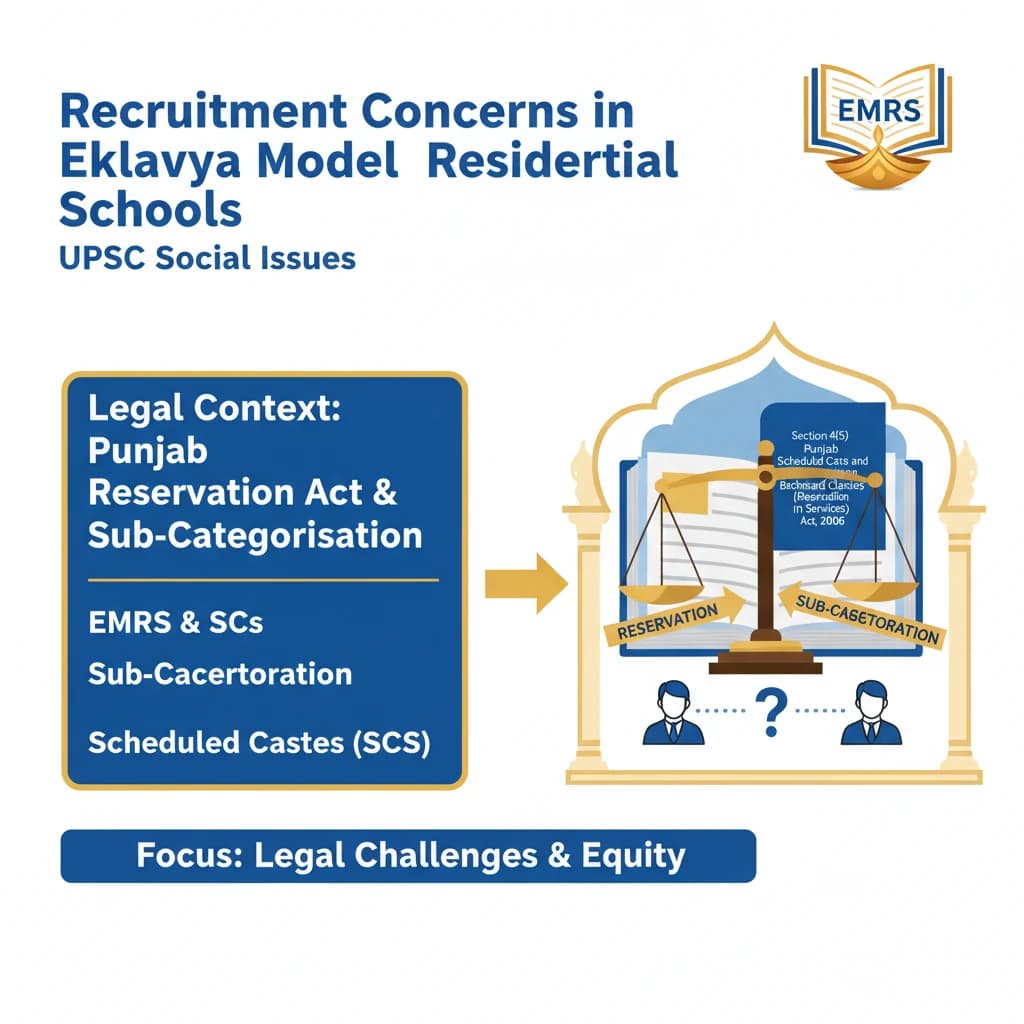
<h4>Legal Context: Punjab Reservation Act & Sub-Categorisation</h4><p>The discussion around recruitment concerns in <strong>Eklavya Model Residential Schools (EMRS)</strong> is closely linked to broader legal debates on reservation, specifically the concept of <strong>sub-categorisation</strong> within <strong>Scheduled Castes (SCs)</strong>.</p><p>A significant legal challenge involved <strong>Section 4(5)</strong> of the <strong>Punjab Scheduled Caste and Backward Classes (Reservation in Services) Act, 2006</strong>.</p><div class='info-box'><p><strong>Section 4(5) Mandate:</strong> This provision stipulated that <strong>50%</strong> of vacancies reserved for <strong>SCs</strong> in recruitment must be offered to <strong>Balmikiis</strong> and <strong>Mazhabi Sikhs</strong>, subject to their availability.</p></div><p>The <strong>Punjab and Haryana High Court</strong>, in <strong>2010</strong>, struck down this provision. The court's decision was based on the principles established in the earlier <strong>EV Chinniah judgment</strong>.</p><div class='key-point-box'><p><strong>EV Chinniah Judgment (2004):</strong> This landmark judgment established that all castes listed under <strong>Article 341(1)</strong> of the Constitution form a <strong>single homogeneous group</strong> and cannot be further subdivided by states for preferential treatment within the SC quota.</p><p><strong>Article 341:</strong> Empowers the <strong>President</strong> to identify and notify <strong>Scheduled Castes</strong> in consultation with the <strong>Governor</strong> and through public notification. This article is the constitutional basis for SC reservations.</p></div><h4>Eklavya Model Residential Schools (EMRS): An Overview</h4><p><strong>Eklavya Model Residential Schools (EMRS)</strong> are a crucial initiative for the education of <strong>Indian tribals (Scheduled Tribes - STs)</strong> across India.</p><div class='info-box'><p><strong>EMRS Key Facts:</strong><ul><li><strong>Started:</strong> <strong>1997-98</strong></li><li><strong>Nodal Ministry:</strong> <strong>Ministry of Tribal Affairs</strong></li><li><strong>Objective:</strong> To provide quality education and overall development for <strong>tribal students</strong>.</li><li><strong>Curriculum:</strong> Generally follows the <strong>CBSE curriculum</strong>.</li></ul></p></div><p>These schools aim to offer facilities comparable to <strong>Jawahar Navodaya Vidyalayas</strong> and <strong>Kendriya Vidyalayas</strong>. They focus on preserving <strong>local art and culture</strong>, alongside providing training in <strong>sports</strong> and <strong>skill development</strong>.</p><p>The <strong>EMRS scheme</strong> underwent a significant revamp in <strong>FY 2018-19</strong> to enhance its effectiveness and reach.</p><h4>Centralisation of EMRS Recruitment & Associated Concerns</h4><p>A major development affecting <strong>EMRS</strong> was announced during the <strong>Union Budget 2023</strong> session. The responsibility for recruiting staff for these schools was transferred to the <strong>National Education Society for Tribal Students (NESTS)</strong>.</p><div class='info-box'><p><strong>National Education Society for Tribal Students (NESTS):</strong> This is an <strong>autonomous organization</strong> established under the <strong>Ministry of Tribal Affairs (MoTA)</strong>. Its primary objective is to conduct training and capacity-building programs for <strong>EMRS teachers</strong> and students.</p><p><strong>Recruitment Mandate:</strong> <strong>NESTS</strong> is now tasked with staffing approximately <strong>38,000 positions</strong> across more than <strong>400 Eklavya schools</strong> nationwide.</p></div><p>The <strong>centralisation of recruitment</strong> aimed to address the severe <strong>teacher shortage</strong> prevalent in the <strong>EMRS system</strong>. It also sought to <strong>standardise recruitment rules</strong> across different states, ensuring uniformity and efficiency.</p><p>However, this centralisation has introduced a new concern: the mandatory requirement of <strong>Hindi competency</strong> for all applicants. This raises questions about linguistic diversity and inclusivity, particularly in non-Hindi speaking tribal regions.</p><div class='exam-tip-box'><p><strong>UPSC Insight:</strong> The <strong>EMRS</strong> scheme and its recruitment challenges are highly relevant for <strong>GS Paper II (Social Justice, Government Policies)</strong>. Understand the constitutional basis of reservation and the implications of centralisation on tribal education.</p></div>
Concept Diagram

💡 Key Takeaways

  • •The <strong>EV Chinniah judgment (2004)</strong> ruled against state-level sub-categorisation within <strong>Scheduled Castes (SCs)</strong>, stating they form a homogeneous group under <strong>Article 341</strong>.
  • •The <strong>Punjab and Haryana High Court (2010)</strong> struck down a Punjab Act's provision for sub-quota for <strong>Balmikiis</strong> and <strong>Mazhabi Sikhs</strong>, citing <strong>EV Chinniah</strong>.
  • •<strong>Eklavya Model Residential Schools (EMRS)</strong>, started in <strong>1997-98</strong> under the <strong>Ministry of Tribal Affairs</strong>, provide quality education for <strong>Scheduled Tribes (STs)</strong>.
  • •The <strong>Union Budget 2023</strong> announced centralisation of <strong>EMRS recruitment</strong> through <strong>NESTS</strong> to address teacher shortages and standardise rules.
  • •Mandatory <strong>Hindi competency</strong> in centralised <strong>EMRS</strong> recruitment raises concerns about inclusivity for non-Hindi speaking tribal regions.

🧠 Memory Techniques
Memory Aid
98% Verified Content

📚 Reference Sources

•The Constitution of India (Article 341, 342)
•Supreme Court of India judgments (E.V. Chinniah v. State of A.P., 2004)
•Punjab Scheduled Caste and Backward Classes (Reservation in Services) Act, 2006
•Union Budget 2023-24 announcements regarding EMRS

Related Topics

Loading related topics...
Explore:Social Issues Topics·All Subjects·Daily Current Affairs·Editorial Analysis·Previous Year Questions·UPSC GPT
Recruitment Concerns in Eklavya Model Residential Schools - UPSC Social Issues