Loading page, please wait…
Vaidra Logo
Vaidra

Top 4 items + smart groups

UPSC GPT
New
Current Affairs
Daily Solutions
Daily Puzzle
Mains Evaluator

Version 2.0.0 • Built with ❤️ for UPSC aspirants

Loading...
Loading...
Loading...
Loading...
Loading...
Loading...
Loading...
Loading...
Loading...
Loading...
Loading...
Loading...
Loading...
NAMASTE Scheme: Caste & Manual Scavenging Data - UPSC Social Issues
Back
All Subjects

Topics

0 topics • 0 completed

Loading topics...
Loading...
Loading...
Loading...
Loading...
Loading...
Overall Progress0%

NAMASTE Scheme: Caste & Manual Scavenging Data - UPSC Social Issues

What is NAMASTE Scheme: Caste & Manual Scavenging Data in UPSC Social Issues?

NAMASTE Scheme: Caste & Manual Scavenging Data is a key topic under Social Issues for UPSC Civil Services Examination. Key points include: NAMASTE Scheme data reveals 92% of hazardous sanitation workers belong to SC/ST/OBC communities.. This highlights persistent caste-based occupational segregation in urban India's sanitation sector.. Approximately 58,000 workers in over 3,000 ULBs are involved in dangerous sewer and septic tank cleaning.. Understanding this topic is essential for both UPSC Prelims and Mains preparation.

Why is NAMASTE Scheme: Caste & Manual Scavenging Data important for UPSC exam?

NAMASTE Scheme: Caste & Manual Scavenging Data is a Medium-level topic in UPSC Social Issues. It is tested in both Prelims (factual MCQs) and Mains (analytical answer writing). Previous year UPSC questions have frequently covered aspects of NAMASTE Scheme: Caste & Manual Scavenging Data, making it essential for comprehensive IAS preparation.

How to prepare NAMASTE Scheme: Caste & Manual Scavenging Data for UPSC?

To prepare NAMASTE Scheme: Caste & Manual Scavenging Data for UPSC: (1) Study the comprehensive notes covering all key concepts on Vaidra. (2) Practice previous year questions on this topic. (3) Connect it with current affairs using daily updates. (4) Revise using key takeaways and mind maps available for Social Issues. (5) Write practice answers linking NAMASTE Scheme: Caste & Manual Scavenging Data to related GS Paper topics.

Key takeaways of NAMASTE Scheme: Caste & Manual Scavenging Data for UPSC

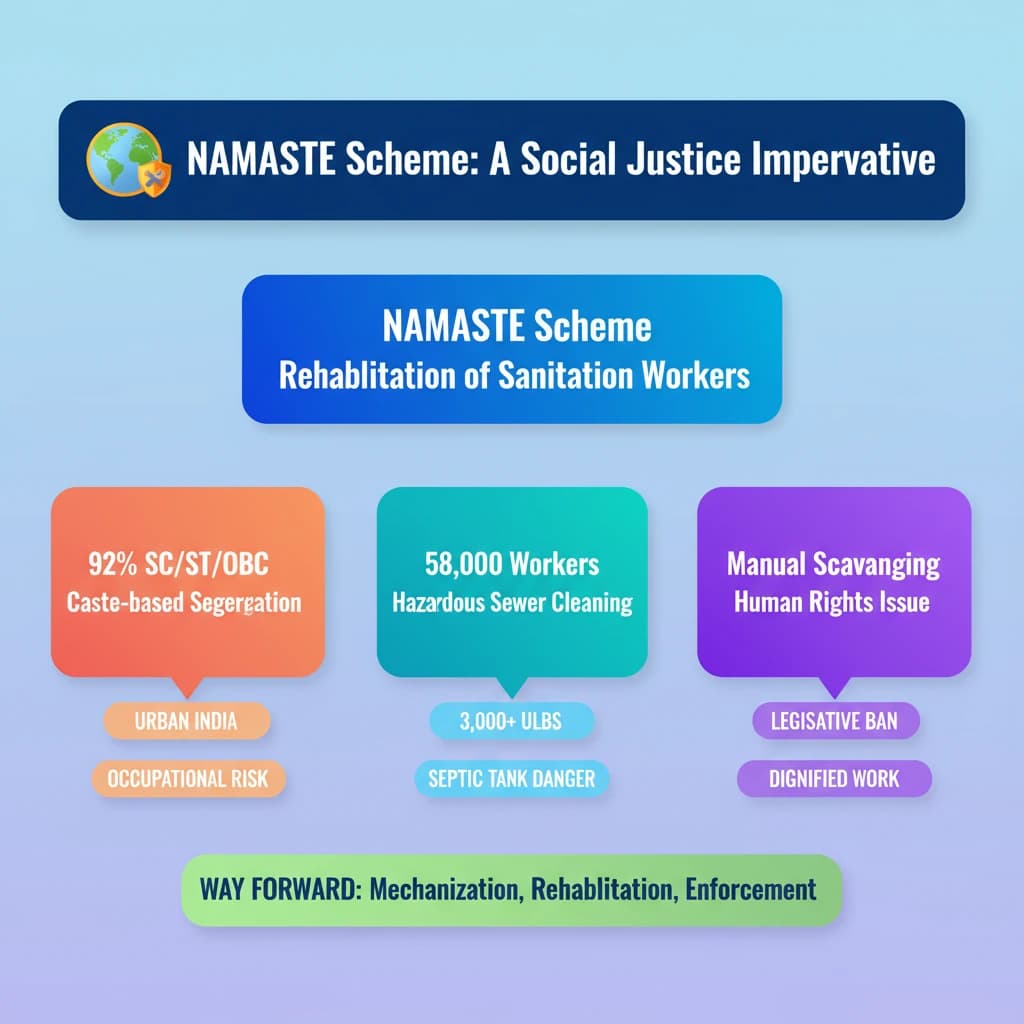
  • NAMASTE Scheme data reveals 92% of hazardous sanitation workers belong to SC/ST/OBC communities.
  • This highlights persistent caste-based occupational segregation in urban India's sanitation sector.
  • Approximately 58,000 workers in over 3,000 ULBs are involved in dangerous sewer and septic tank cleaning.
  • Manual scavenging remains a critical social justice and human rights issue despite legislative bans.
  • Urgent need for comprehensive mechanization, robust rehabilitation programs, and strict enforcement of existing laws to ensure dignified work.
NAMASTE Scheme: Caste & Manual Scavenging Data

NAMASTE Scheme: Caste & Manual Scavenging Data

Medium⏱️ 7 min read✓ 95% Verified
social issues

📖 Introduction

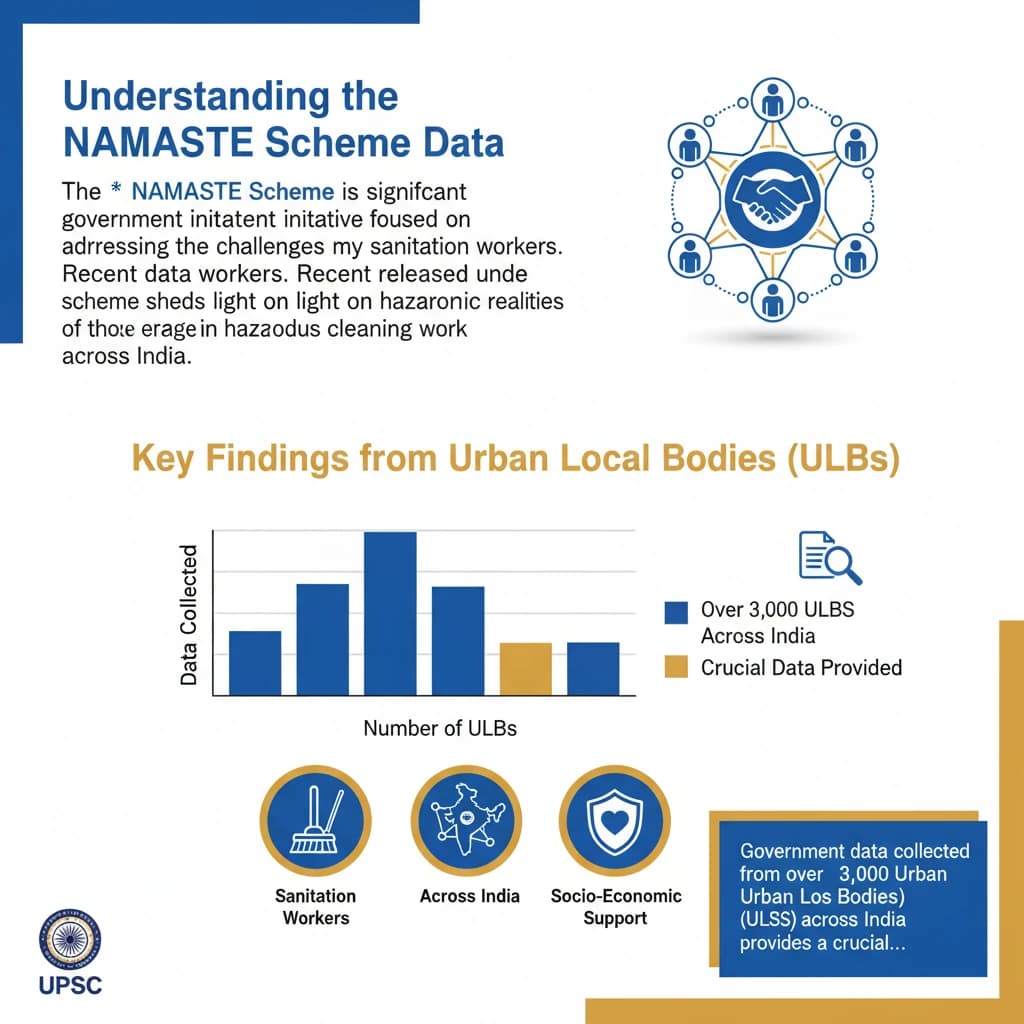
<h4>Understanding the NAMASTE Scheme Data</h4><p>The <strong>NAMASTE Scheme</strong> is a significant government initiative focused on addressing the challenges faced by sanitation workers. Recent data released under this scheme sheds light on the socio-economic realities of those engaged in hazardous cleaning work across India.</p><h4>Key Findings from Urban Local Bodies (ULBs)</h4><p>Government data collected from over <strong>3,000 Urban Local Bodies (ULBs)</strong> across India provides a critical insight into the demographic composition of sanitation workers. This extensive data collection effort underscores the scale and prevalence of manual scavenging.</p><div class='info-box'><p>The data covers approximately <strong>58,000 manual scavengers and workers</strong>. These individuals are primarily involved in the hazardous tasks of <strong>sewer and septic tank cleaning</strong> in various cities nationwide.</p></div><h4>Caste-Based Occupational Segregation</h4><p>A striking revelation from the <strong>NAMASTE Scheme</strong> data is the predominant representation of specific social groups. A significant majority of these workers belong to historically marginalized communities, highlighting deep-seated inequalities.</p><div class='key-point-box'><p>Specifically, <strong>92%</strong> of the identified <strong>manual scavengers and hazardous sanitation workers</strong> are from <strong>Scheduled Caste (SC)</strong>, <strong>Scheduled Tribe (ST)</strong>, or <strong>Other Backward Class (OBC)</strong> communities.</p></div><p>This statistic unequivocally highlights the deep-rooted issue of <strong>caste-based occupational segregation</strong> prevalent in India's urban sanitation sector. It points to a systemic problem where certain communities are disproportionately engaged in undignified and dangerous work.</p><h4>Dangers Faced by Sanitation Workers</h4><p>Beyond the social segregation, the data also implicitly underscores the severe <strong>dangers and health risks</strong> associated with <strong>manual scavenging</strong> and <strong>hazardous sewer and septic tank cleaning</strong>. These workers often operate without adequate safety gear or proper training, leading to high mortality rates.</p><div class='exam-tip-box'><p>This information is crucial for understanding social justice issues in <strong>GS-I (Society)</strong> and governance challenges in <strong>GS-II (Social Justice)</strong>. It provides concrete data points to substantiate arguments on inequality and human rights violations.</p></div>
Concept Diagram

💡 Key Takeaways

  • •NAMASTE Scheme data reveals 92% of hazardous sanitation workers belong to SC/ST/OBC communities.
  • •This highlights persistent caste-based occupational segregation in urban India's sanitation sector.
  • •Approximately 58,000 workers in over 3,000 ULBs are involved in dangerous sewer and septic tank cleaning.
  • •Manual scavenging remains a critical social justice and human rights issue despite legislative bans.
  • •Urgent need for comprehensive mechanization, robust rehabilitation programs, and strict enforcement of existing laws to ensure dignified work.

🧠 Memory Techniques

Memory Aid
95% Verified Content

📚 Reference Sources

•Government of India official reports (implied by 'government data' as cited by Drishti IAS)

Related Topics

Loading related topics...
Explore:Social Issues Topics·All Subjects·Daily Current Affairs·Editorial Analysis·Previous Year Questions·UPSC GPT