Loading page, please wait…
Vaidra Logo
Vaidra

Top 4 items + smart groups

UPSC GPT
New
Current Affairs
Daily Solutions
Daily Puzzle
Mains Evaluator

Version 2.0.0 • Built with ❤️ for UPSC aspirants

Loading...
Loading...
Loading...
Loading...
Loading...
Loading...
Loading...
Loading...
Loading...
Loading...
Loading...
Loading...
Loading...
Back
All Subjects

Topics

0 topics • 0 completed

Loading topics...
Loading...
Loading...
Loading...
Loading...
Loading...
Overall Progress0%

What are the Key Facts About the Porja, Bagata, and Konda Dora tribes? - UPSC Social Issues

What is What are the Key Facts About the Porja, Bagata, and Konda Dora tribes? in UPSC Social Issues?

What are the Key Facts About the Porja, Bagata, and Konda Dora tribes? is a key topic under Social Issues for UPSC Civil Services Examination. Key points include: Porja tribe (Bondo, Khond, Parangi Porja) primarily resides in Visakhapatnam, Andhra Pradesh.. Porjas migrated from Odisha ~300 years ago, historically serving Jeypore rulers as palanquin bearers.. They practice shifting cultivation (Podu) and follow a patriarchal, patrilineal system with specific marriage customs (cross-cousin, bride price).. Understanding this topic is essential for both UPSC Prelims and Mains preparation.

Why is What are the Key Facts About the Porja, Bagata, and Konda Dora tribes? important for UPSC exam?

What are the Key Facts About the Porja, Bagata, and Konda Dora tribes? is a Medium-level topic in UPSC Social Issues. It is tested in both Prelims (factual MCQs) and Mains (analytical answer writing). Previous year UPSC questions have frequently covered aspects of What are the Key Facts About the Porja, Bagata, and Konda Dora tribes?, making it essential for comprehensive IAS preparation.

How to prepare What are the Key Facts About the Porja, Bagata, and Konda Dora tribes? for UPSC?

To prepare What are the Key Facts About the Porja, Bagata, and Konda Dora tribes? for UPSC: (1) Study the comprehensive notes covering all key concepts on Vaidra. (2) Practice previous year questions on this topic. (3) Connect it with current affairs using daily updates. (4) Revise using key takeaways and mind maps available for Social Issues. (5) Write practice answers linking What are the Key Facts About the Porja, Bagata, and Konda Dora tribes? to related GS Paper topics.

Key takeaways of What are the Key Facts About the Porja, Bagata, and Konda Dora tribes? for UPSC

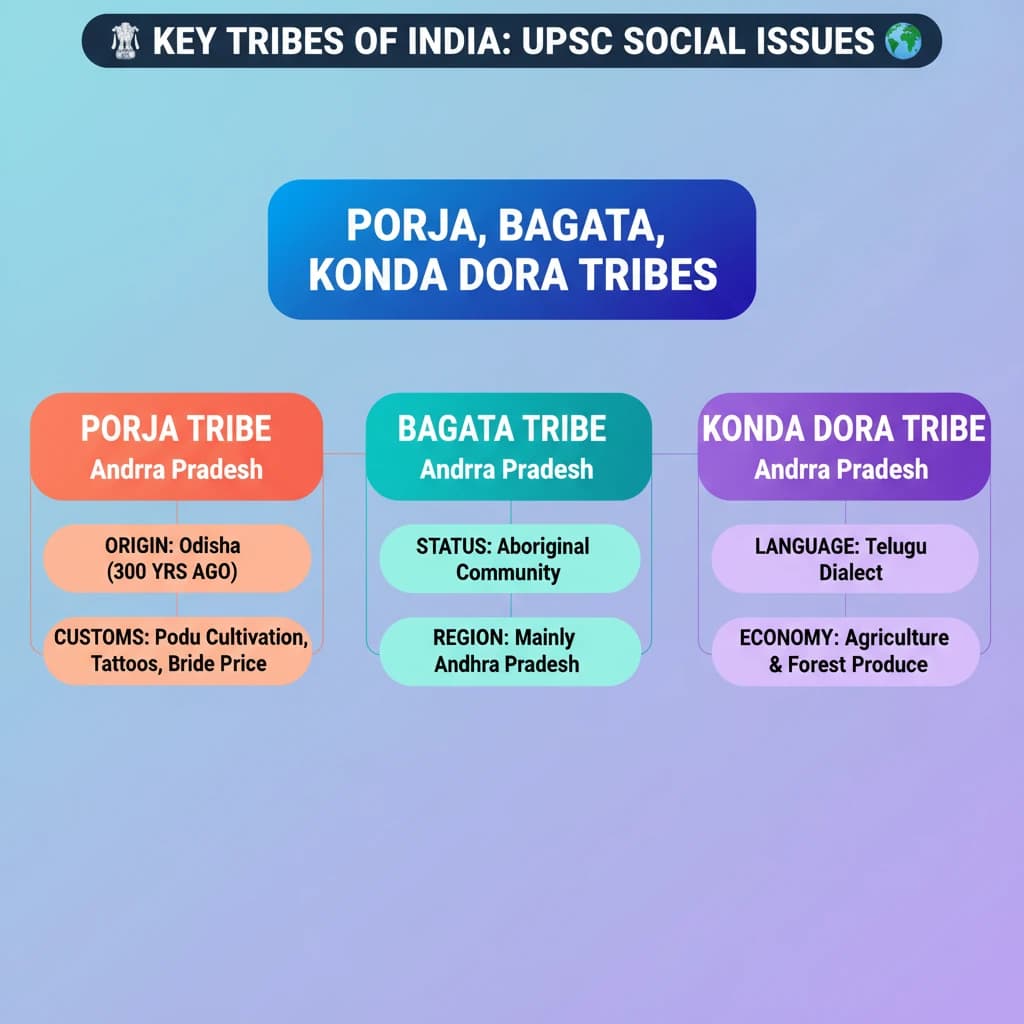
  • Porja tribe (Bondo, Khond, Parangi Porja) primarily resides in Visakhapatnam, Andhra Pradesh.
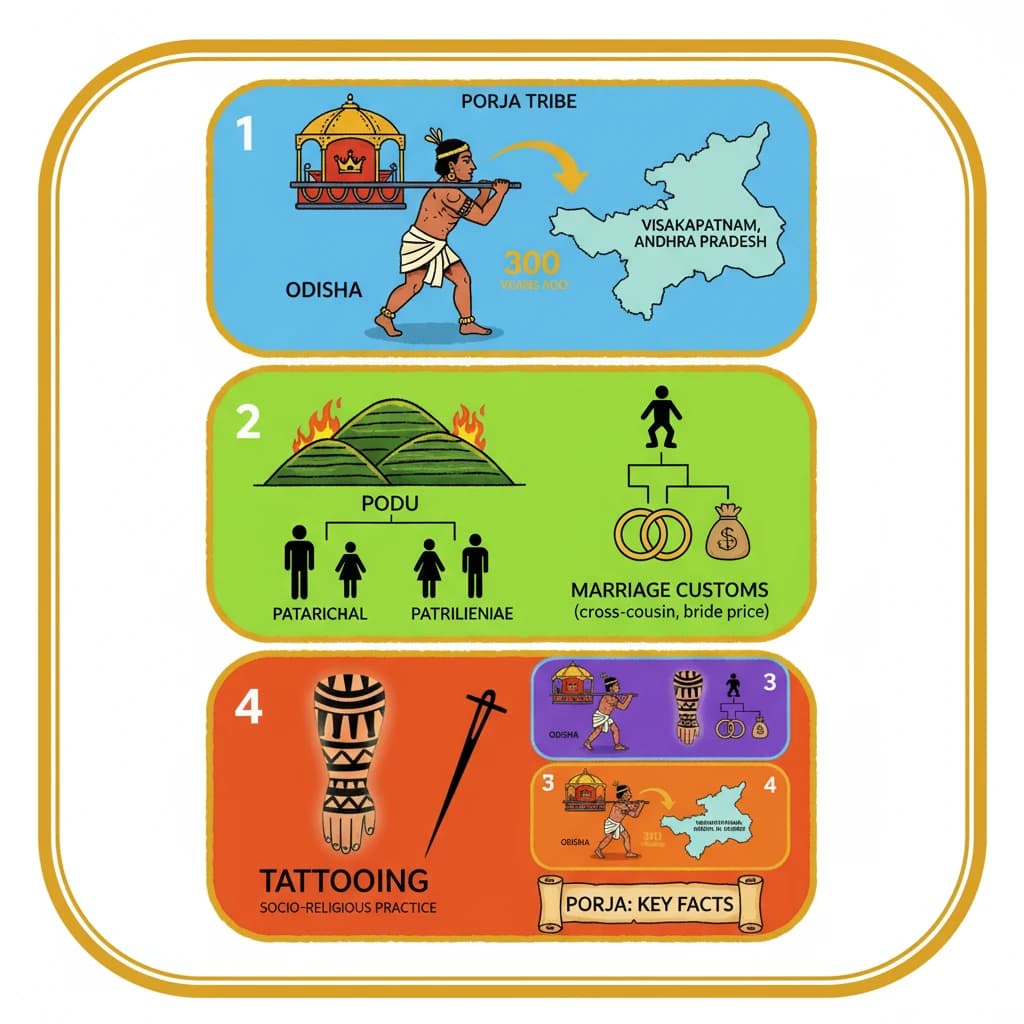
  • Porjas migrated from Odisha ~300 years ago, historically serving Jeypore rulers as palanquin bearers.
  • They practice shifting cultivation (Podu) and follow a patriarchal, patrilineal system with specific marriage customs (cross-cousin, bride price).
  • Tattooing is a significant socio-religious practice for the Porja tribe.
  • Bagata tribe is an aboriginal community mainly found in Andhra Pradesh.
  • Understanding tribal characteristics is crucial for UPSC topics on society, social justice, and environment.
What are the Key Facts About the Porja, Bagata, and Konda Dora tribes?

What are the Key Facts About the Porja, Bagata, and Konda Dora tribes?

Medium⏱️ 6 min read✓ 90% Verified
social issues

📖 Introduction

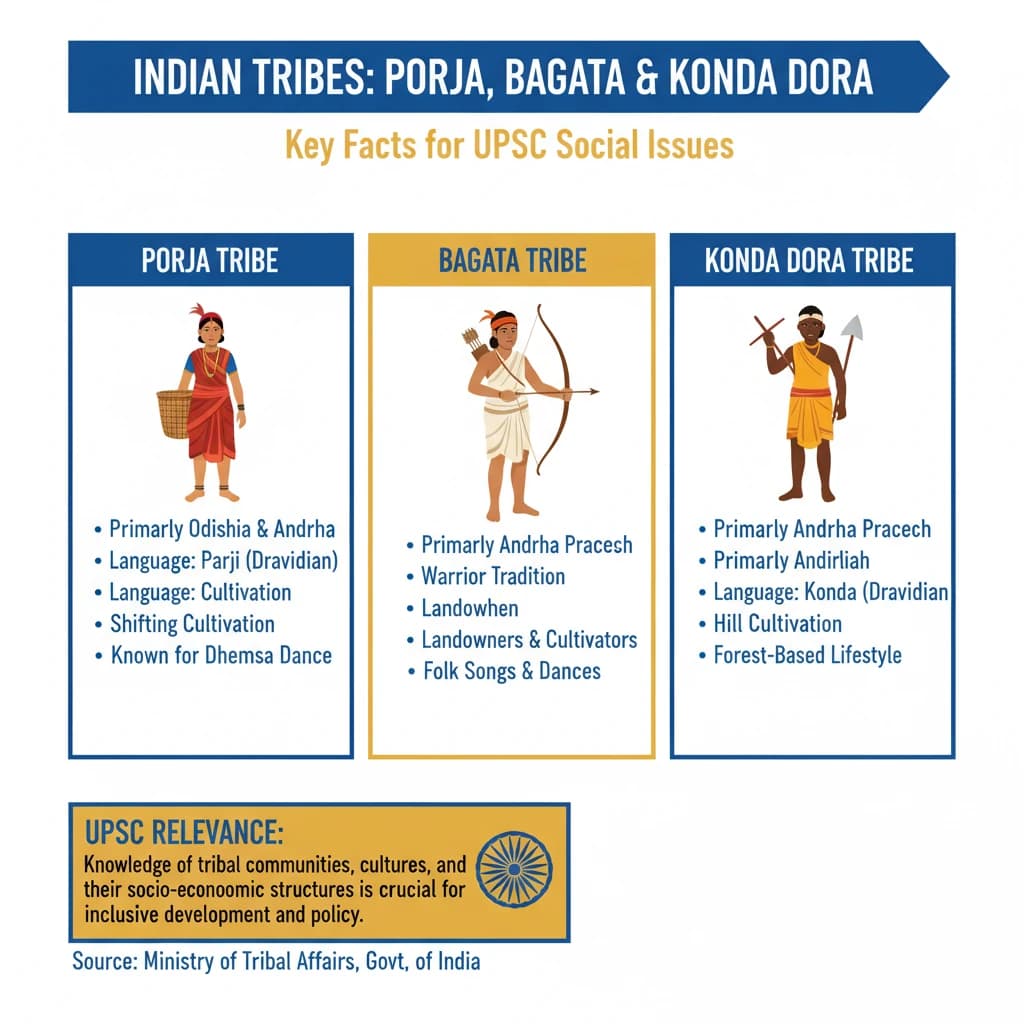
<h4>Introduction to Indian Tribes</h4><p>India is home to a diverse array of tribal communities, each with unique cultures, traditions, and socio-economic structures. Understanding these communities is crucial for inclusive development and cultural preservation. This section focuses on key facts about the <strong>Porja</strong> and <strong>Bagata</strong> tribes, primarily residing in <strong>Andhra Pradesh</strong>.</p><div class='exam-tip-box'><p><strong>UPSC Relevance:</strong> Knowledge of specific tribal communities is vital for <strong>GS Paper 1 (Indian Society)</strong>, <strong>GS Paper 2 (Social Justice, Government Policies)</strong>, and <strong>Prelims (Culture, Geography)</strong>.</p></div><h4>The Porja Tribe</h4><p>The <strong>Porja tribe</strong> is a significant community with various sub-groups, including <strong>Bondo Porja</strong>, <strong>Khond Porja</strong>, and <strong>Parangi Porja</strong>. They primarily inhabit the <strong>Visakhapatnam area</strong> of <strong>Andhra Pradesh</strong>.</p><div class='info-box'><p><strong>Population Data:</strong> According to the <strong>1991 Census</strong>, the Porja tribe had an approximate population of <strong>16,479</strong>.</p></div><p>Historically, the Porjas migrated from <strong>Odisha</strong> around <strong>300 years ago</strong>, driven by the search for cultivable land. They were traditionally employed as <strong>palanquin bearers</strong> and for other menial tasks.</p><div class='info-box'><p><strong>Etymology of ‘Porja’:</strong> The term <strong>‘Porja’</strong> is derived from Oriya words meaning <strong>“son of a king,”</strong> reflecting their historical association and employment by the <strong>Jeypore rulers</strong>.</p></div><p>The Porjas primarily inhabit <strong>hilly terrains</strong> and practice <strong>shifting cultivation</strong>, which is locally known as <strong>Podu</strong>. This agricultural method is integral to their livelihood and traditional practices.</p><h4>Social Structure and Practices of Porja Tribe</h4><p>The <strong>Porja tribe</strong> follows a strong <strong>patriarchal system</strong> with <strong>patrilineal descent</strong>. This system dictates property inheritance and succession to hereditary offices, ensuring lineage through the male line.</p><ul><li><strong>Inheritance:</strong> The <strong>eldest son</strong> typically receives an extra share of inherited property.</li><li><strong>Marriage Customs:</strong> They practice <strong>cross-cousin marriages</strong>, which are common among many tribal communities.</li><li><strong>Bride Price:</strong> A formal <strong>bride price system</strong> is an established part of their marital customs.</li><li><strong>Social Acceptance:</strong> The community accepts both <strong>pre-marital and post-marital relations</strong> within their social norms.</li><li><strong>Tattooing:</strong> <strong>Tattooing</strong> is considered an integral part of their <strong>socio-religious culture</strong>, carrying significant symbolic meaning.</li></ul><p>The Porjas are characterized by <strong>endogamous sub-groups</strong>, meaning individuals marry within their specific sub-group. Each sub-group maintains unique customs, languages, and food habits.</p><div class='key-point-box'><p><strong>Key Sub-group:</strong> Most Porjas residing in <strong>Visakhapatnam</strong> belong to the <strong>Parangi Porja</strong> group, highlighting regional variations within the tribe.</p></div><h4>The Bagata Tribe</h4><p>The <strong>Bagata</strong> are recognized as an <strong>aboriginal tribe of India</strong>. Their primary habitation is in the states of <strong>Andhra Pradesh</strong>.</p><div class='exam-tip-box'><p><strong>Note:</strong> The provided source content for the <strong>Konda Dora tribe</strong> is not available beyond its mention in the topic title. Further research would be required for detailed information on this specific community.</p></div>
Concept Diagram

💡 Key Takeaways

  • •Porja tribe (Bondo, Khond, Parangi Porja) primarily resides in Visakhapatnam, Andhra Pradesh.
  • •Porjas migrated from Odisha ~300 years ago, historically serving Jeypore rulers as palanquin bearers.
  • •They practice shifting cultivation (Podu) and follow a patriarchal, patrilineal system with specific marriage customs (cross-cousin, bride price).
  • •Tattooing is a significant socio-religious practice for the Porja tribe.
  • •Bagata tribe is an aboriginal community mainly found in Andhra Pradesh.
  • •Understanding tribal characteristics is crucial for UPSC topics on society, social justice, and environment.

🧠 Memory Techniques
Memory Aid
90% Verified Content

Related Topics

Loading related topics...
Explore:Social Issues Topics·All Subjects·Daily Current Affairs·Editorial Analysis·Previous Year Questions·UPSC GPT
What are the Key Facts About the Porja, Bagata, and Konda Dora tribes? - UPSC Social Issues