Loading page, please wait…
Vaidra Logo
Vaidra

Top 4 items + smart groups

UPSC GPT
New
Current Affairs
Daily Solutions
Daily Puzzle
Mains Evaluator

Version 2.0.0 • Built with ❤️ for UPSC aspirants

Loading...
Loading...
Loading...
Loading...
Loading...
Loading...
Loading...
Loading...
Loading...
Loading...
Loading...
Loading...
Loading...
Manual Scavenging: Constitutional Safeguards & Efforts to Reduce - UPSC Social Issues
Back
All Subjects

Topics

0 topics • 0 completed

Loading topics...
Loading...
Loading...
Loading...
Loading...
Loading...
Overall Progress0%

Manual Scavenging: Constitutional Safeguards & Efforts to Reduce - UPSC Social Issues

What is Manual Scavenging: Constitutional Safeguards & Efforts to Reduce in UPSC Social Issues?

Manual Scavenging: Constitutional Safeguards & Efforts to Reduce is a key topic under Social Issues for UPSC Civil Services Examination. Key points include: Constitutional safeguards (Articles 14, 16, 17, 21, 23) are foundational to eradicating manual scavenging.. Article 14 ensures equal protection of law, preventing discrimination based on occupation or caste.. Article 16 guarantees equal employment, crucial for economic upliftment and alternative livelihoods.. Understanding this topic is essential for both UPSC Prelims and Mains preparation.

Why is Manual Scavenging: Constitutional Safeguards & Efforts to Reduce important for UPSC exam?

Manual Scavenging: Constitutional Safeguards & Efforts to Reduce is a Medium-level topic in UPSC Social Issues. It is tested in both Prelims (factual MCQs) and Mains (analytical answer writing). Previous year UPSC questions have frequently covered aspects of Manual Scavenging: Constitutional Safeguards & Efforts to Reduce, making it essential for comprehensive IAS preparation.

How to prepare Manual Scavenging: Constitutional Safeguards & Efforts to Reduce for UPSC?

To prepare Manual Scavenging: Constitutional Safeguards & Efforts to Reduce for UPSC: (1) Study the comprehensive notes covering all key concepts on Vaidra. (2) Practice previous year questions on this topic. (3) Connect it with current affairs using daily updates. (4) Revise using key takeaways and mind maps available for Social Issues. (5) Write practice answers linking Manual Scavenging: Constitutional Safeguards & Efforts to Reduce to related GS Paper topics.

Key takeaways of Manual Scavenging: Constitutional Safeguards & Efforts to Reduce for UPSC

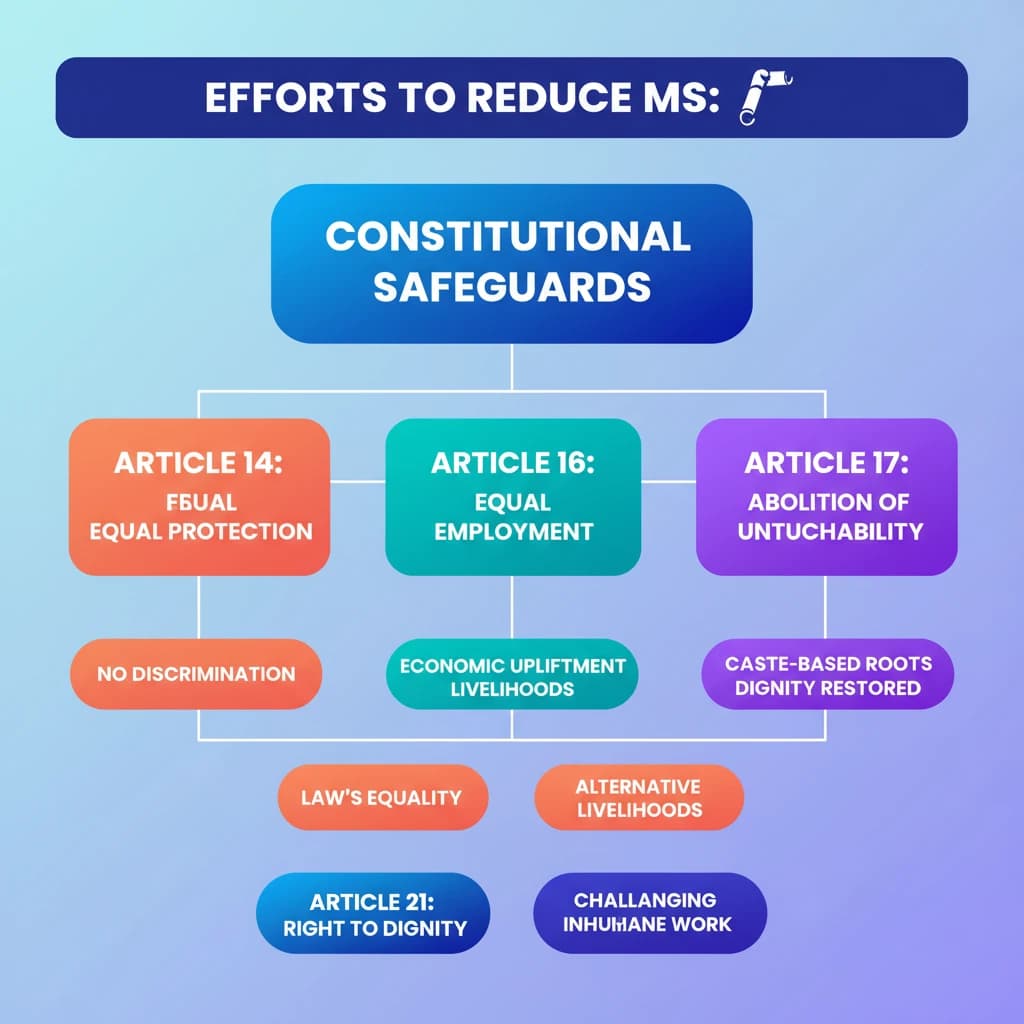
  • Constitutional safeguards (Articles 14, 16, 17, 21, 23) are foundational to eradicating manual scavenging.
  • Article 14 ensures equal protection of law, preventing discrimination based on occupation or caste.
  • Article 16 guarantees equal employment, crucial for economic upliftment and alternative livelihoods.
  • Article 17 abolishes untouchability, directly addressing the caste-based roots of manual scavenging.
  • Article 21 protects the right to live with dignity, challenging dehumanizing work conditions.
  • Article 23 prohibits forced labor, safeguarding against coercion into hazardous work.
Manual Scavenging: Constitutional Safeguards & Efforts to Reduce

Manual Scavenging: Constitutional Safeguards & Efforts to Reduce

Medium⏱️ 7 min read✓ 98% Verified
social issues

📖 Introduction

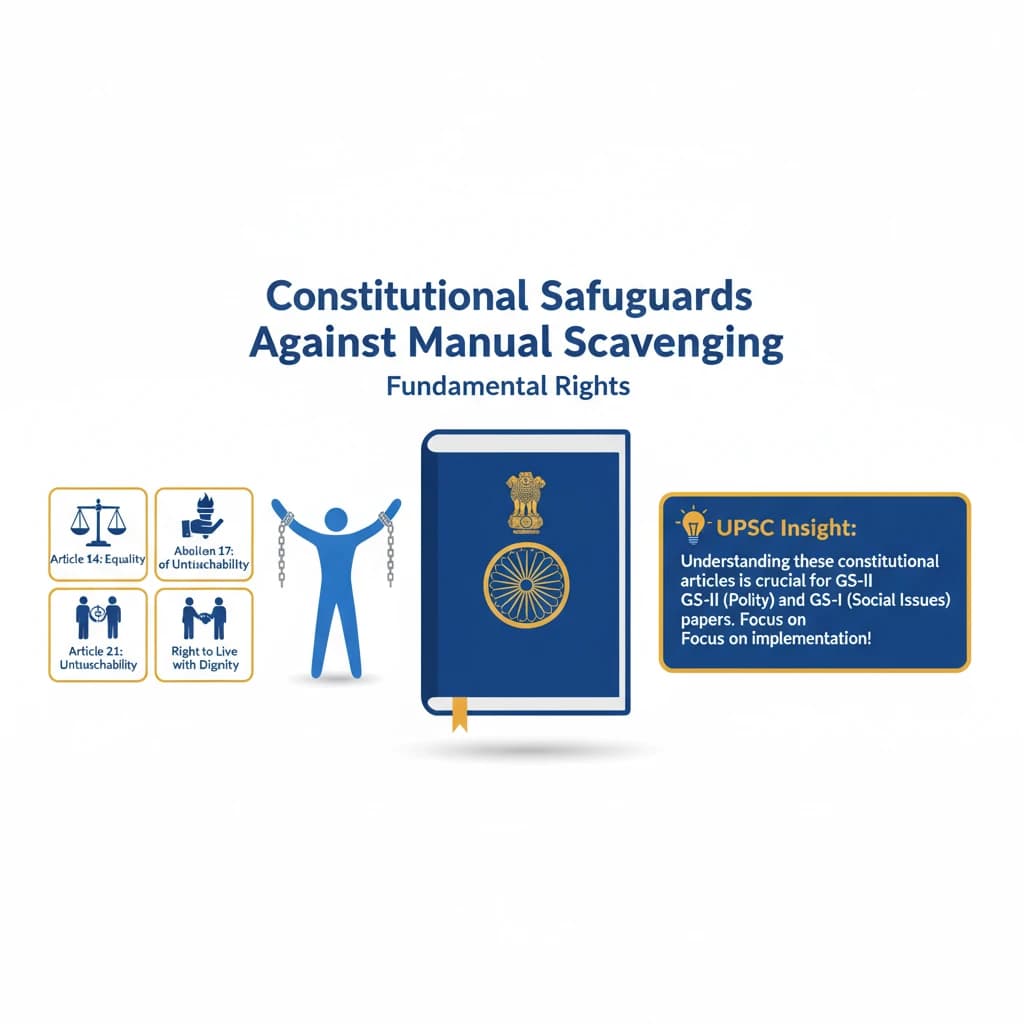
<h4>Constitutional Safeguards Against Manual Scavenging</h4><p>The <strong>Indian Constitution</strong> provides a robust framework of <strong>Fundamental Rights</strong> designed to protect all citizens, including those engaged in or vulnerable to <strong>manual scavenging</strong>. These provisions aim to ensure dignity, equality, and freedom from exploitation.</p><div class='exam-tip-box'><p><strong>UPSC Insight:</strong> Understanding these constitutional articles is crucial for GS-II (Polity & Governance) and GS-I (Social Issues). Questions often link social evils with constitutional remedies.</p></div><h4>Article 14: Equality Before Law</h4><p><strong>Article 14</strong> of the Constitution guarantees <strong>equal protection of the law</strong> for all persons within the territory of India. This means that no individual, regardless of their caste or occupation, can be subjected to discriminatory practices.</p><div class='info-box'><p><strong>Key Principle:</strong> It ensures that <strong>manual scavengers</strong> are not treated differently or unfairly under the law, providing a legal basis to challenge any form of state-sanctioned or tolerated discrimination based on their work or social standing.</p></div><h4>Article 16: Equal Employment Opportunities</h4><p><strong>Article 16</strong> ensures <strong>equal employment opportunities</strong> for all citizens in matters relating to public employment. It explicitly prohibits discrimination on grounds of religion, race, caste, sex, descent, place of birth, residence, or any of them.</p><div class='key-point-box'><p>This article is vital for promoting the <strong>economic upliftment</strong> and social mobility of individuals from communities traditionally associated with manual scavenging. It aims to prevent <strong>caste-based discrimination</strong> in government jobs, thereby offering alternative, dignified livelihoods.</p></div><h4>Article 17: Abolition of Untouchability</h4><p><strong>Article 17</strong> unequivocally <strong>abolishes untouchability</strong> and forbids its practice in any form. The enforcement of any disability arising out of 'untouchability' shall be an offence punishable in accordance with law.</p><div class='info-box'><p>This provision directly protects <strong>manual scavengers</strong> from <strong>caste-based exclusion</strong> and discrimination, as manual scavenging is deeply rooted in the historical practice of untouchability. It criminalizes any act that perpetuates such discrimination.</p></div><h4>Article 21: Right to Life and Personal Liberty</h4><p><strong>Article 21</strong> states that no person shall be deprived of their <strong>life or personal liberty</strong> except according to procedure established by law. The Supreme Court has interpreted 'right to life' to include the <strong>right to live with dignity</strong>.</p><div class='key-point-box'><p>For <strong>manual scavengers</strong>, this article offers strong legal grounds to demand protection from <strong>dehumanising work</strong> and hazardous conditions. It asserts their right to a life free from indignity and health risks inherent in manual scavenging.</p></div><h4>Article 23: Prohibition of Forced Labour</h4><p><strong>Article 23</strong> prohibits <strong>traffic in human beings</strong> and <strong>forced labour</strong> (begar) and other similar forms of forced labour. Any contravention of this provision shall be an offence punishable in accordance with law.</p><div class='info-box'><p>This article ensures that <strong>manual scavengers</strong> cannot be <strong>coerced into working</strong> under harsh conditions without proper wages or safety standards. It safeguards them against any form of involuntary servitude, which is often a component of manual scavenging.</p></div>
Concept Diagram

💡 Key Takeaways

  • •Constitutional safeguards (Articles 14, 16, 17, 21, 23) are foundational to eradicating manual scavenging.
  • •Article 14 ensures equal protection of law, preventing discrimination based on occupation or caste.
  • •Article 16 guarantees equal employment, crucial for economic upliftment and alternative livelihoods.
  • •Article 17 abolishes untouchability, directly addressing the caste-based roots of manual scavenging.
  • •Article 21 protects the right to live with dignity, challenging dehumanizing work conditions.
  • •Article 23 prohibits forced labor, safeguarding against coercion into hazardous work.

🧠 Memory Techniques

Memory Aid
98% Verified Content

📚 Reference Sources

•The Constitution of India (Articles 14, 16, 17, 21, 23)
•The Prohibition of Employment as Manual Scavengers and their Rehabilitation Act, 2013
•Safai Karamchari Andolan v. Union of India (2014) Supreme Court Judgment

Related Topics

Loading related topics...
Explore:Social Issues Topics·All Subjects·Daily Current Affairs·Editorial Analysis·Previous Year Questions·UPSC GPT