Loading page, please wait…
Vaidra Logo
Vaidra

Top 4 items + smart groups

UPSC GPT
New
Current Affairs
Daily Solutions
Daily Puzzle
Mains Evaluator

Version 2.0.0 • Built with ❤️ for UPSC aspirants

Loading...
Loading...
Loading...
Loading...
Loading...
Loading...
Loading...
Loading...
Loading...
Loading...
Loading...
Loading...
Loading...
High Court Struck Down Bihar 65% Quota Rule - UPSC Social Issues
Back
All Subjects

Topics

0 topics • 0 completed

Loading topics...
Loading...
Loading...
Loading...
Loading...
Loading...
Overall Progress0%

High Court Struck Down Bihar 65% Quota Rule - UPSC Social Issues

What is High Court Struck Down Bihar 65% Quota Rule in UPSC Social Issues?

High Court Struck Down Bihar 65% Quota Rule is a key topic under Social Issues for UPSC Civil Services Examination. Key points include: Patna High Court struck down Bihar's 65% reservation quota for BC, EBC, SC, ST.. The ruling reaffirms the 50% reservation ceiling established by the Supreme Court.. Indra Sawhney vs. Union of India (1992) is the landmark case setting the 50% limit.. Understanding this topic is essential for both UPSC Prelims and Mains preparation.

Why is High Court Struck Down Bihar 65% Quota Rule important for UPSC exam?

High Court Struck Down Bihar 65% Quota Rule is a Medium-level topic in UPSC Social Issues. It is tested in both Prelims (factual MCQs) and Mains (analytical answer writing). Previous year UPSC questions have frequently covered aspects of High Court Struck Down Bihar 65% Quota Rule, making it essential for comprehensive IAS preparation.

How to prepare High Court Struck Down Bihar 65% Quota Rule for UPSC?

To prepare High Court Struck Down Bihar 65% Quota Rule for UPSC: (1) Study the comprehensive notes covering all key concepts on Vaidra. (2) Practice previous year questions on this topic. (3) Connect it with current affairs using daily updates. (4) Revise using key takeaways and mind maps available for Social Issues. (5) Write practice answers linking High Court Struck Down Bihar 65% Quota Rule to related GS Paper topics.

Key takeaways of High Court Struck Down Bihar 65% Quota Rule for UPSC

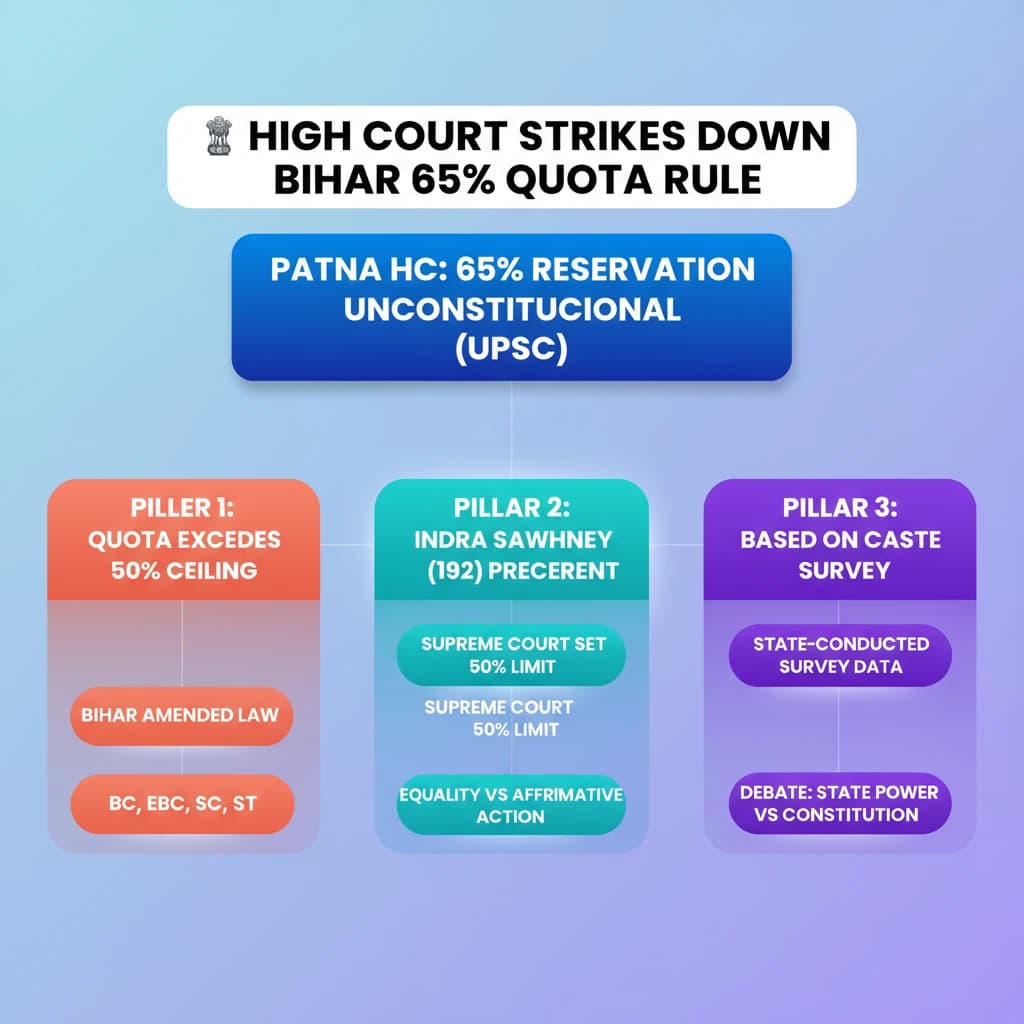
  • Patna High Court struck down Bihar's 65% reservation quota for BC, EBC, SC, ST.
  • The ruling reaffirms the 50% reservation ceiling established by the Supreme Court.
  • Indra Sawhney vs. Union of India (1992) is the landmark case setting the 50% limit.
  • Bihar's increase was based on a state-conducted caste-based survey.
  • The judgment highlights the ongoing debate between state policy and constitutional limits on reservation.
  • Reservation aims to ensure social justice and adequate representation for disadvantaged communities.
High Court Struck Down Bihar 65% Quota Rule

High Court Struck Down Bihar 65% Quota Rule

Medium⏱️ 7 min read✓ 98% Verified
social issues

📖 Introduction

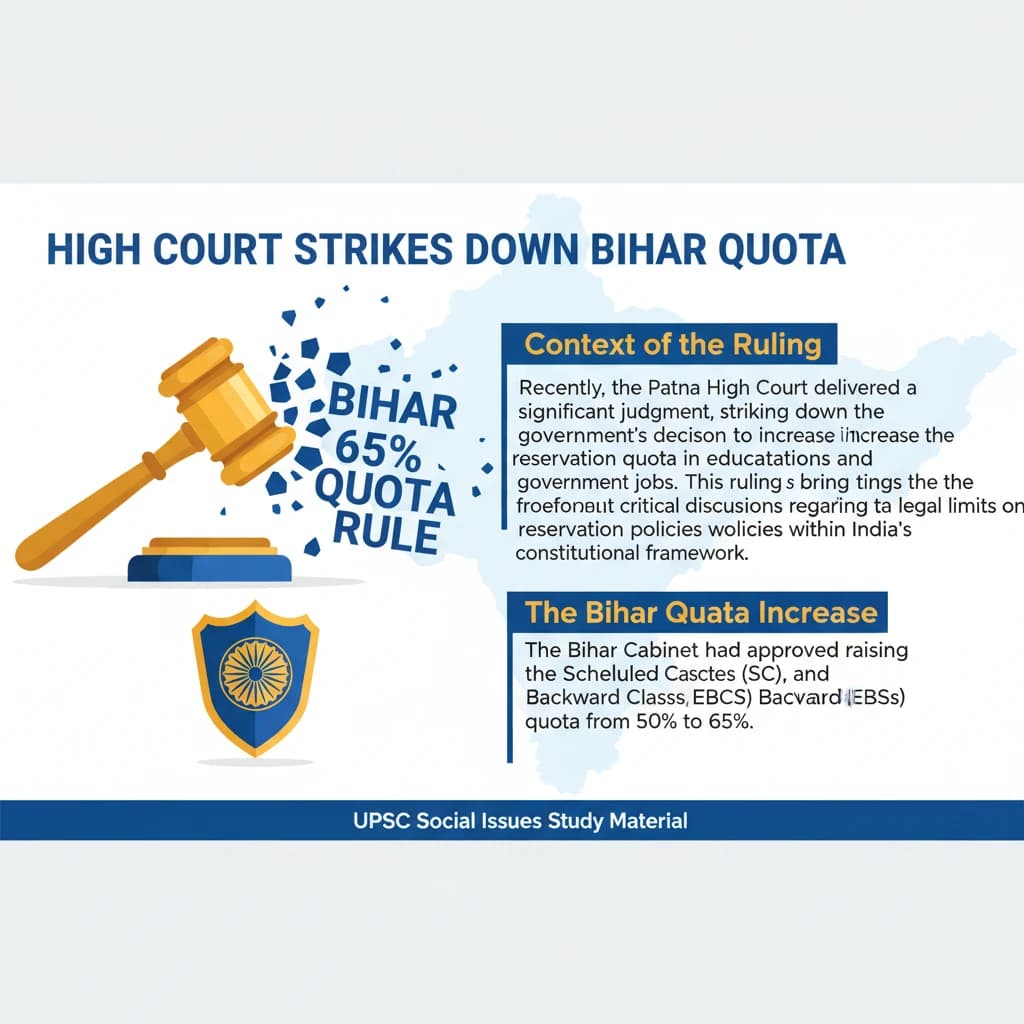
<h4>Context of the Ruling</h4><p>Recently, the <strong>Patna High Court</strong> delivered a significant judgment, striking down the <strong>Bihar government’s</strong> decision to increase the <strong>reservation quota</strong> in educational institutions and government jobs.</p><p>This ruling brings to the forefront critical discussions regarding the <strong>legal limits</strong> on <strong>reservation policies</strong> within India's constitutional framework.</p><h4>The Bihar Quota Increase</h4><p>The <strong>Bihar government</strong> had decided to raise the total reservation quota from the existing <strong>50%</strong> to <strong>65%</strong>. This increase was intended for various categories of beneficiaries.</p><div class='info-box'><p>The beneficiaries of the proposed <strong>65% quota</strong> included:</p><ul><li><strong>Backward Classes (BC)</strong></li><li><strong>Extremely Backward Classes (EBC)</strong></li><li><strong>Scheduled Castes (SC)</strong></li><li><strong>Scheduled Tribes (ST)</strong></li></ul></div><h4>Patna High Court's Decision</h4><p>The <strong>Patna High Court</strong> meticulously examined the legality of this increased quota. Its judgment concluded that the hike was unconstitutional, thereby striking down the government's notification.</p><div class='key-point-box'><p>The core issue revolved around whether states can exceed the <strong>50% ceiling on reservation</strong>, a principle established by the Supreme Court in landmark judgments.</p></div><h4>Implications and Legal Questions</h4><p>The High Court's decision underscores the judiciary's role in maintaining the constitutional balance regarding affirmative action policies. It reaffirms the existing legal precedents on reservation limits.</p><div class='exam-tip-box'><p>This ruling is crucial for understanding the interplay between <strong>social justice initiatives</strong> by states and the <strong>constitutional limitations</strong> set by the judiciary. It's a key topic for <strong>GS Paper II: Polity and Governance</strong>.</p></div>
Concept Diagram

💡 Key Takeaways

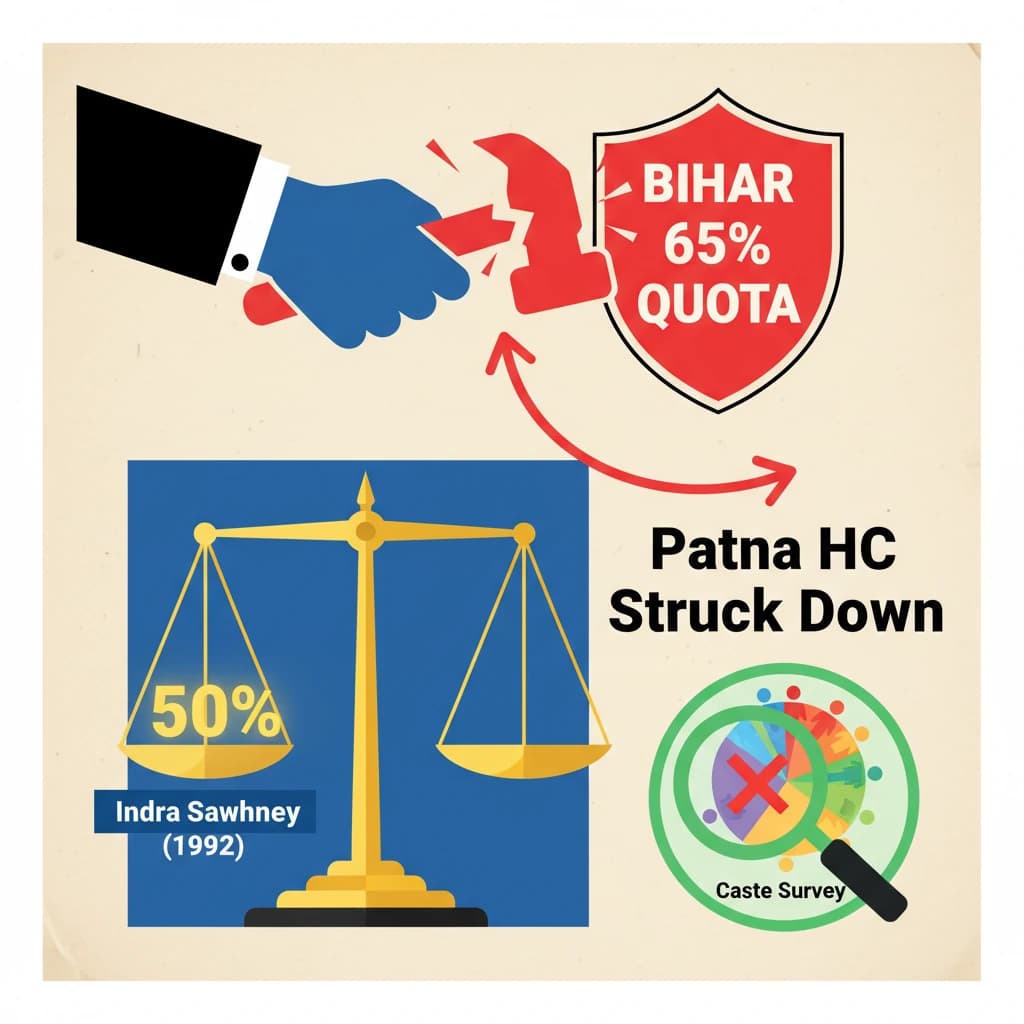
  • •Patna High Court struck down Bihar's 65% reservation quota for BC, EBC, SC, ST.
  • •The ruling reaffirms the 50% reservation ceiling established by the Supreme Court.
  • •Indra Sawhney vs. Union of India (1992) is the landmark case setting the 50% limit.
  • •Bihar's increase was based on a state-conducted caste-based survey.
  • •The judgment highlights the ongoing debate between state policy and constitutional limits on reservation.
  • •Reservation aims to ensure social justice and adequate representation for disadvantaged communities.

🧠 Memory Techniques
Memory Aid
98% Verified Content

📚 Reference Sources

•The Constitution of India (Articles 15, 16)
•Supreme Court judgment: Indra Sawhney vs. Union of India (1992)
•News reports on Patna High Court's ruling on Bihar's reservation quota (e.g., The Hindu, Indian Express)
•103rd Constitutional Amendment Act (EWS Reservation)

Related Topics

Loading related topics...
Explore:Social Issues Topics·All Subjects·Daily Current Affairs·Editorial Analysis·Previous Year Questions·UPSC GPT