Loading page, please wait…
Vaidra Logo
Vaidra

Top 4 items + smart groups

UPSC GPT
New
Current Affairs
Daily Solutions
Daily Puzzle
Mains Evaluator

Version 2.0.0 • Built with ❤️ for UPSC aspirants

Loading...
Loading...
Loading...
Loading...
Loading...
Loading...
Loading...
Loading...
Loading...
Loading...
Loading...
Loading...
Loading...
Back
All Subjects

Topics

0 topics • 0 completed

Loading topics...
Loading...
Loading...
Loading...
Loading...
Loading...
Overall Progress0%

What is the Hindu Succession Act, 1956? - UPSC Social Issues

What is What is the Hindu Succession Act, 1956? in UPSC Social Issues?

What is the Hindu Succession Act, 1956? is a key topic under Social Issues for UPSC Civil Services Examination. Key points include: Hindu Succession Act, 1956, governs intestate property distribution for Hindus, Buddhists, Jains, Sikhs.. It provides a legal framework for when an individual dies without a will.. The 2005 Amendment granted daughters equal coparcenary rights in ancestral property as sons.. Understanding this topic is essential for both UPSC Prelims and Mains preparation.

Why is What is the Hindu Succession Act, 1956? important for UPSC exam?

What is the Hindu Succession Act, 1956? is a Medium-level topic in UPSC Social Issues. It is tested in both Prelims (factual MCQs) and Mains (analytical answer writing). Previous year UPSC questions have frequently covered aspects of What is the Hindu Succession Act, 1956?, making it essential for comprehensive IAS preparation.

How to prepare What is the Hindu Succession Act, 1956? for UPSC?

To prepare What is the Hindu Succession Act, 1956? for UPSC: (1) Study the comprehensive notes covering all key concepts on Vaidra. (2) Practice previous year questions on this topic. (3) Connect it with current affairs using daily updates. (4) Revise using key takeaways and mind maps available for Social Issues. (5) Write practice answers linking What is the Hindu Succession Act, 1956? to related GS Paper topics.

Key takeaways of What is the Hindu Succession Act, 1956? for UPSC

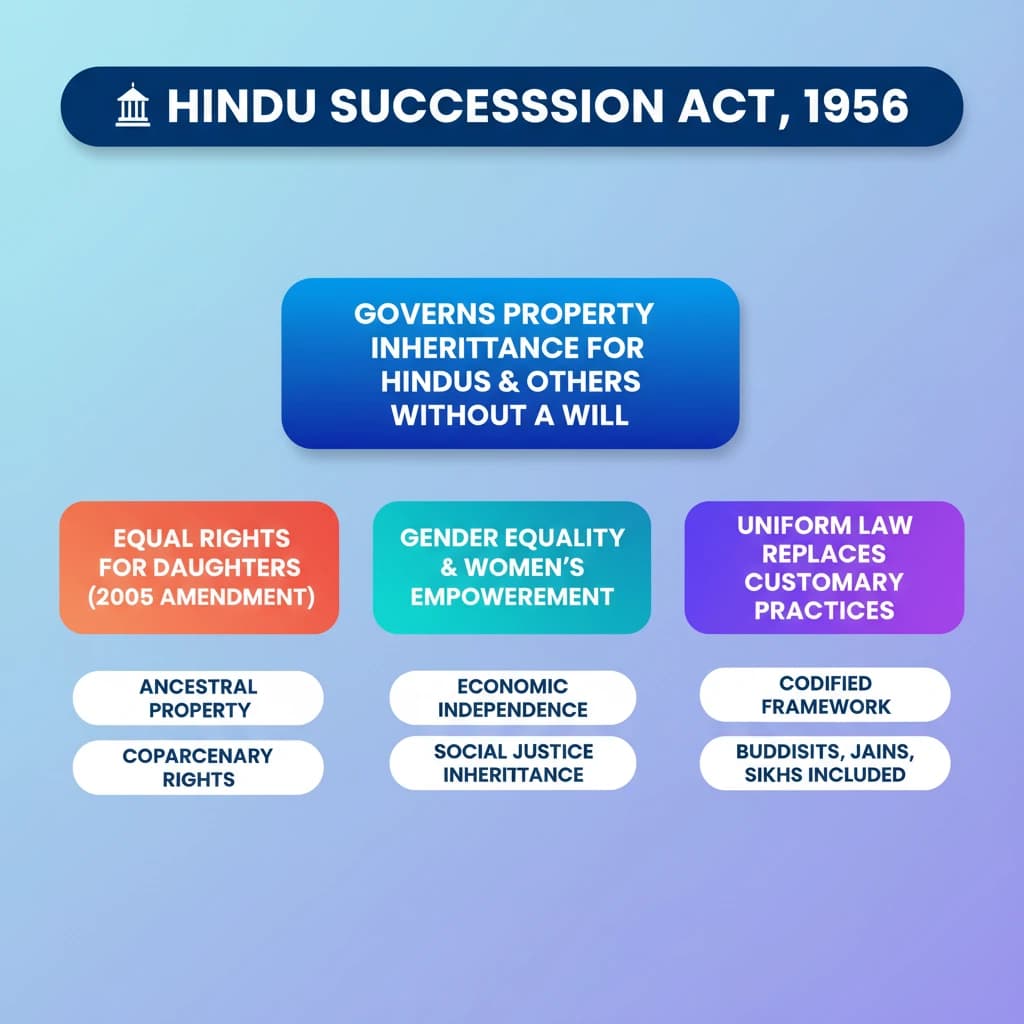
  • Hindu Succession Act, 1956, governs intestate property distribution for Hindus, Buddhists, Jains, Sikhs.
  • It provides a legal framework for when an individual dies without a will.
  • The 2005 Amendment granted daughters equal coparcenary rights in ancestral property as sons.
  • The Act significantly contributes to gender equality and women's economic empowerment.
  • It replaced diverse customary laws with a uniform, codified system of inheritance.
What is the Hindu Succession Act, 1956?

What is the Hindu Succession Act, 1956?

Medium⏱️ 8 min read✓ 98% Verified
social issues

📖 Introduction

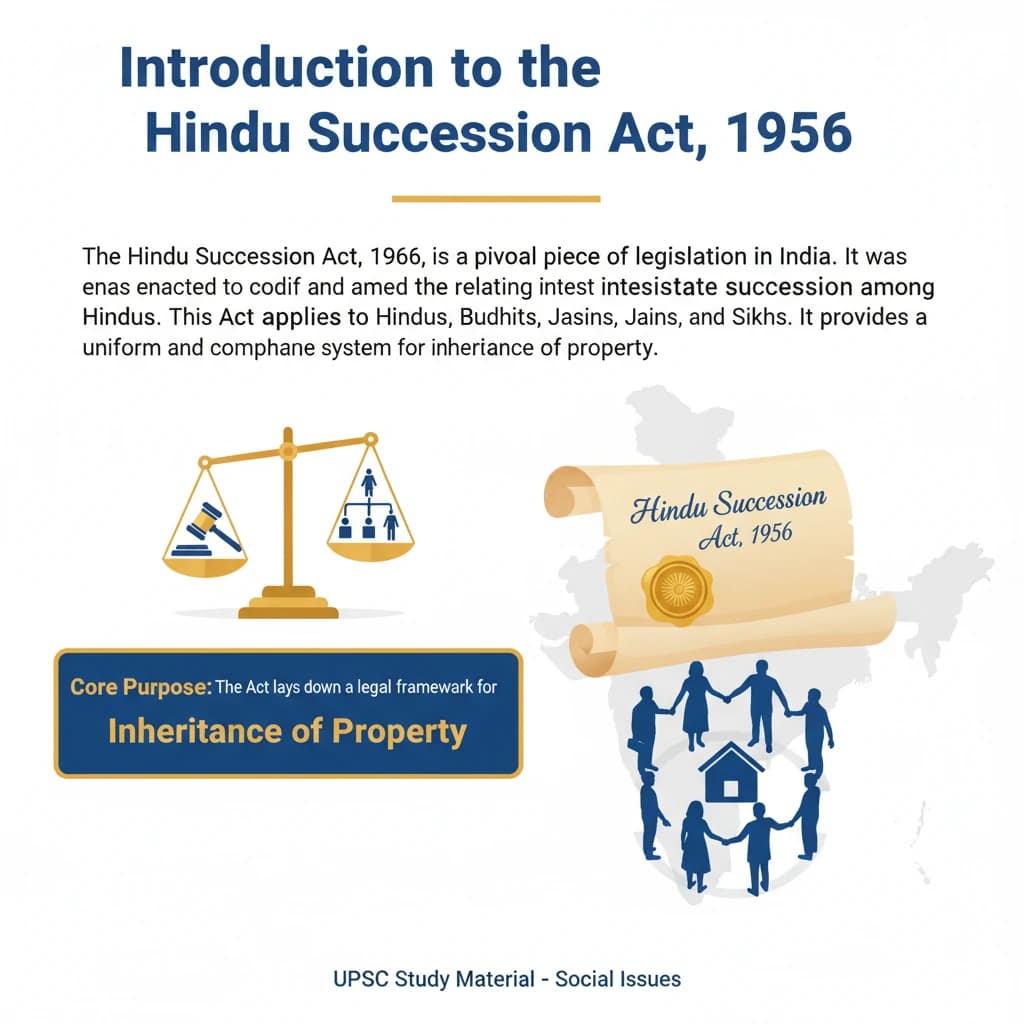
<h4>Introduction to the Hindu Succession Act, 1956</h4><p>The <strong>Hindu Succession Act, 1956</strong>, is a pivotal piece of legislation in India. It was enacted to codify and amend the law relating to intestate succession among Hindus.</p><p>This Act applies to Hindus, Buddhists, Jains, and Sikhs. It provides a uniform and comprehensive system for the inheritance of property.</p><div class='info-box'><p><strong>Core Purpose:</strong> The Act lays down a <strong>legal framework</strong> for the <strong>distribution of property</strong> when a <strong>Hindu individual dies intestate</strong>. Intestate means dying without a valid will.</p></div><h4>Key Provisions and Scope</h4><p>The Act primarily deals with the devolution of property of a deceased person who has not made a will. It defines various classes of heirs and their respective shares in the property.</p><div class='key-point-box'><p><strong>Classes of Heirs:</strong> The Act categorizes heirs into <strong>Class I</strong>, <strong>Class II</strong>, <strong>Agnates</strong>, and <strong>Cognates</strong>. <strong>Class I heirs</strong> inherit simultaneously and exclude all other heirs.</p></div><p>It also addresses the property rights of both male and female Hindus, establishing principles of succession that were a significant departure from traditional Hindu law prevalent before its enactment.</p><h4>Gender Equality and the 2005 Amendment</h4><p>While the 1956 Act was a step towards reform, it initially did not grant daughters equal rights as coparceners in ancestral property. This disparity was addressed by a crucial amendment.</p><div class='exam-tip-box'><p><strong>UPSC Insight:</strong> The <strong>Hindu Succession (Amendment) Act, 2005</strong>, is extremely important. It granted <strong>daughters equal coparcenary rights</strong> in ancestral property as sons, effective from <strong>September 9, 2005</strong>. This amendment is often discussed in questions related to <strong>gender justice</strong> and <strong>property rights</strong>.</p></div><p>This amendment significantly enhanced the property rights of Hindu women, bringing them on par with men in terms of inheriting ancestral property.</p>
Concept Diagram

💡 Key Takeaways

  • •Hindu Succession Act, 1956, governs intestate property distribution for Hindus, Buddhists, Jains, Sikhs.
  • •It provides a legal framework for when an individual dies without a will.
  • •The 2005 Amendment granted daughters equal coparcenary rights in ancestral property as sons.
  • •The Act significantly contributes to gender equality and women's economic empowerment.
  • •It replaced diverse customary laws with a uniform, codified system of inheritance.

🧠 Memory Techniques

Memory Aid
98% Verified Content

📚 Reference Sources

•The Hindu Succession Act, 1956 (as amended by 2005 Act)
•Legal commentaries and academic articles on Indian succession law

Related Topics

Loading related topics...
Explore:Social Issues Topics·All Subjects·Daily Current Affairs·Editorial Analysis·Previous Year Questions·UPSC GPT
What is the Hindu Succession Act, 1956? - UPSC Social Issues