Loading page, please wait…
Vaidra Logo
Vaidra

Top 4 items + smart groups

UPSC GPT
New
Current Affairs
Daily Solutions
Daily Puzzle
Mains Evaluator

Version 2.0.0 • Built with ❤️ for UPSC aspirants

Loading...
Loading...
Loading...
Loading...
Loading...
Loading...
Loading...
Loading...
Loading...
Loading...
Loading...
Loading...
Loading...
Back
All Subjects

Topics

0 topics • 0 completed

Loading topics...
Loading...
Loading...
Loading...
Loading...
Loading...
Overall Progress0%

What are the Key Findings of the Study - UPSC Social Issues

What is What are the Key Findings of the Study in UPSC Social Issues?

What are the Key Findings of the Study is a key topic under Social Issues for UPSC Civil Services Examination. Key points include: Global Nutrition Targets (GNTs) progress is slow and insufficient across 204 countries (2012-2021).. None of the countries are projected to meet targets for low birth weight, anaemia, and childhood overweight by 2030.. Anaemia in India has been static for two decades, with iron deficiency accounting for only one-third of cases; one-third are due to unknown causes.. Understanding this topic is essential for both UPSC Prelims and Mains preparation.

Why is What are the Key Findings of the Study important for UPSC exam?

What are the Key Findings of the Study is a Medium-level topic in UPSC Social Issues. It is tested in both Prelims (factual MCQs) and Mains (analytical answer writing). Previous year UPSC questions have frequently covered aspects of What are the Key Findings of the Study, making it essential for comprehensive IAS preparation.

How to prepare What are the Key Findings of the Study for UPSC?

To prepare What are the Key Findings of the Study for UPSC: (1) Study the comprehensive notes covering all key concepts on Vaidra. (2) Practice previous year questions on this topic. (3) Connect it with current affairs using daily updates. (4) Revise using key takeaways and mind maps available for Social Issues. (5) Write practice answers linking What are the Key Findings of the Study to related GS Paper topics.

Key takeaways of What are the Key Findings of the Study for UPSC

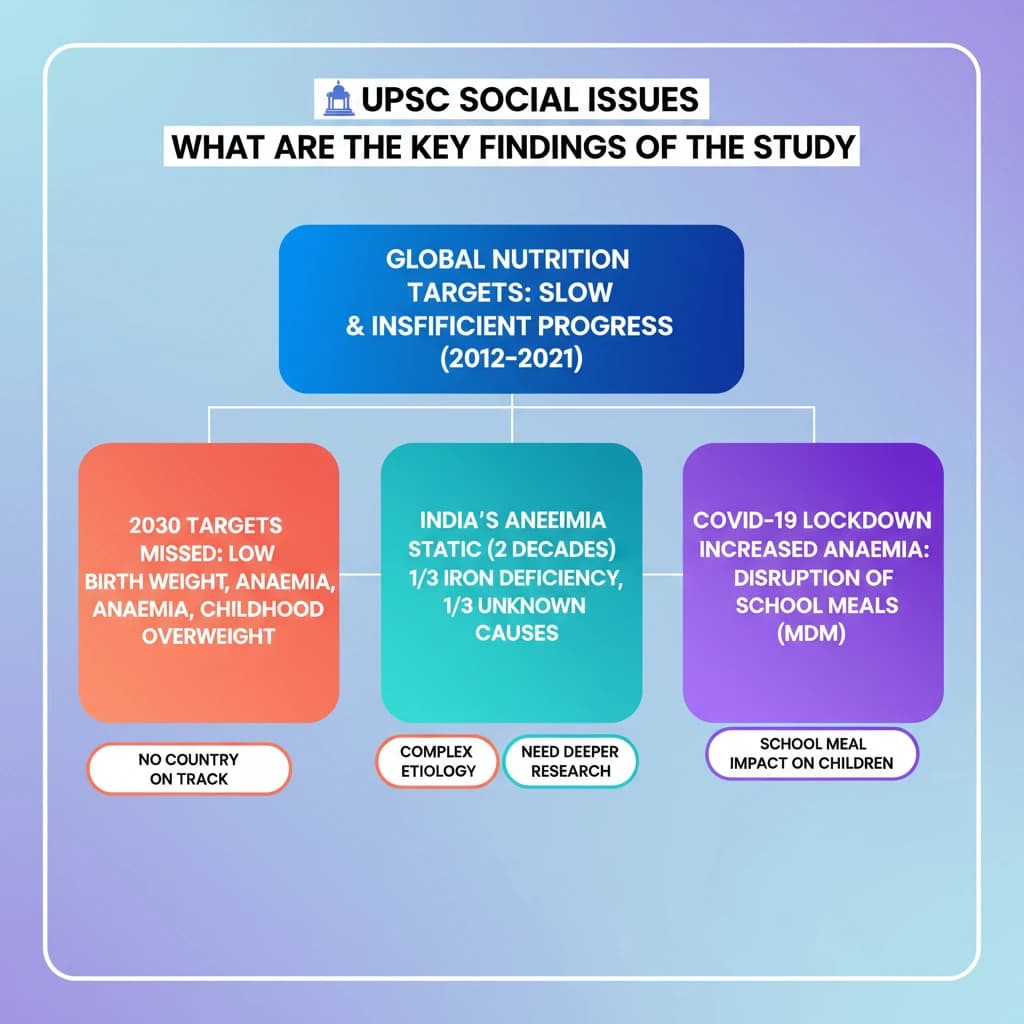
  • Global Nutrition Targets (GNTs) progress is slow and insufficient across 204 countries (2012-2021).
  • None of the countries are projected to meet targets for low birth weight, anaemia, and childhood overweight by 2030.
  • Anaemia in India has been static for two decades, with iron deficiency accounting for only one-third of cases; one-third are due to unknown causes.
  • Covid-19 lockdown increased anaemia prevalence due to disruption of school meal programs (Midday Meal Scheme).
  • There's a critical need for re-evaluation of nutritional interventions and deeper research into anaemia's complex etiology.
What are the Key Findings of the Study

What are the Key Findings of the Study

Medium⏱️ 8 min read✓ 95% Verified
social issues

📖 Introduction

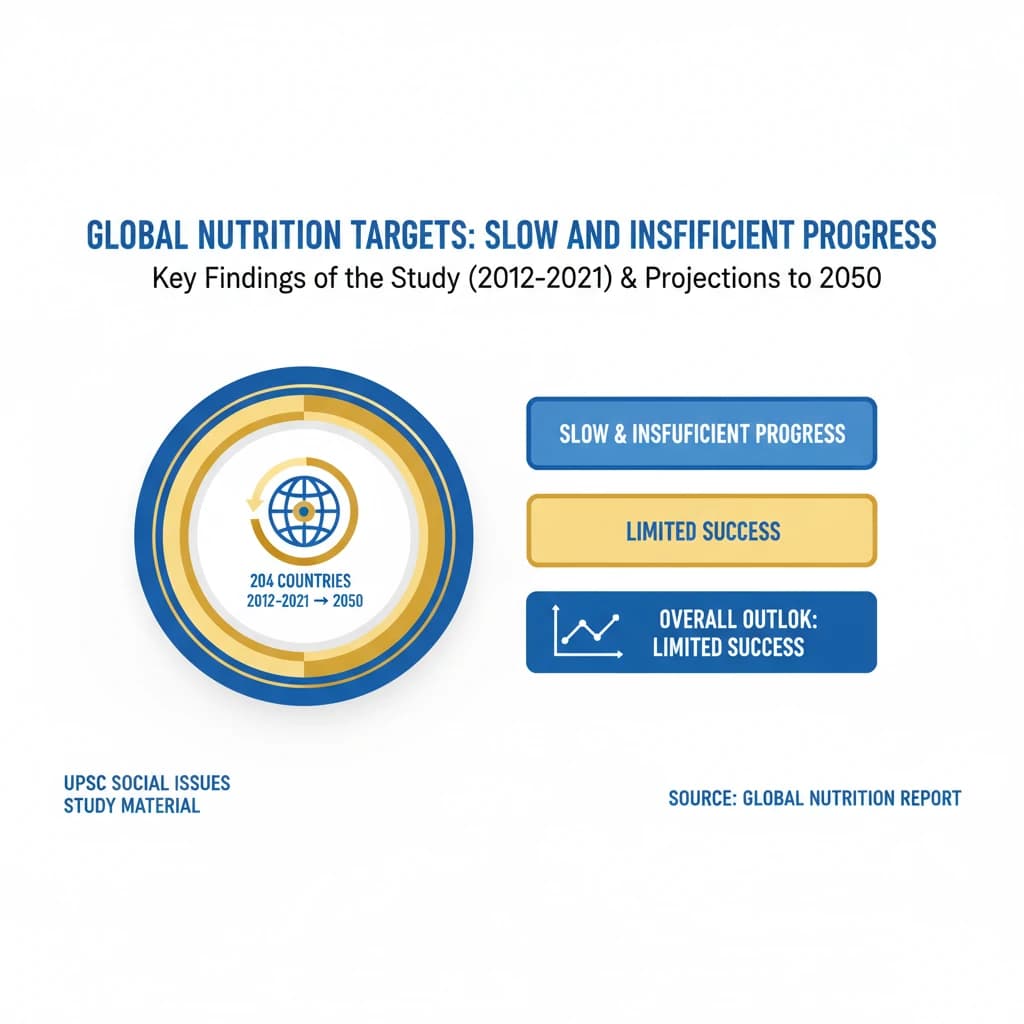
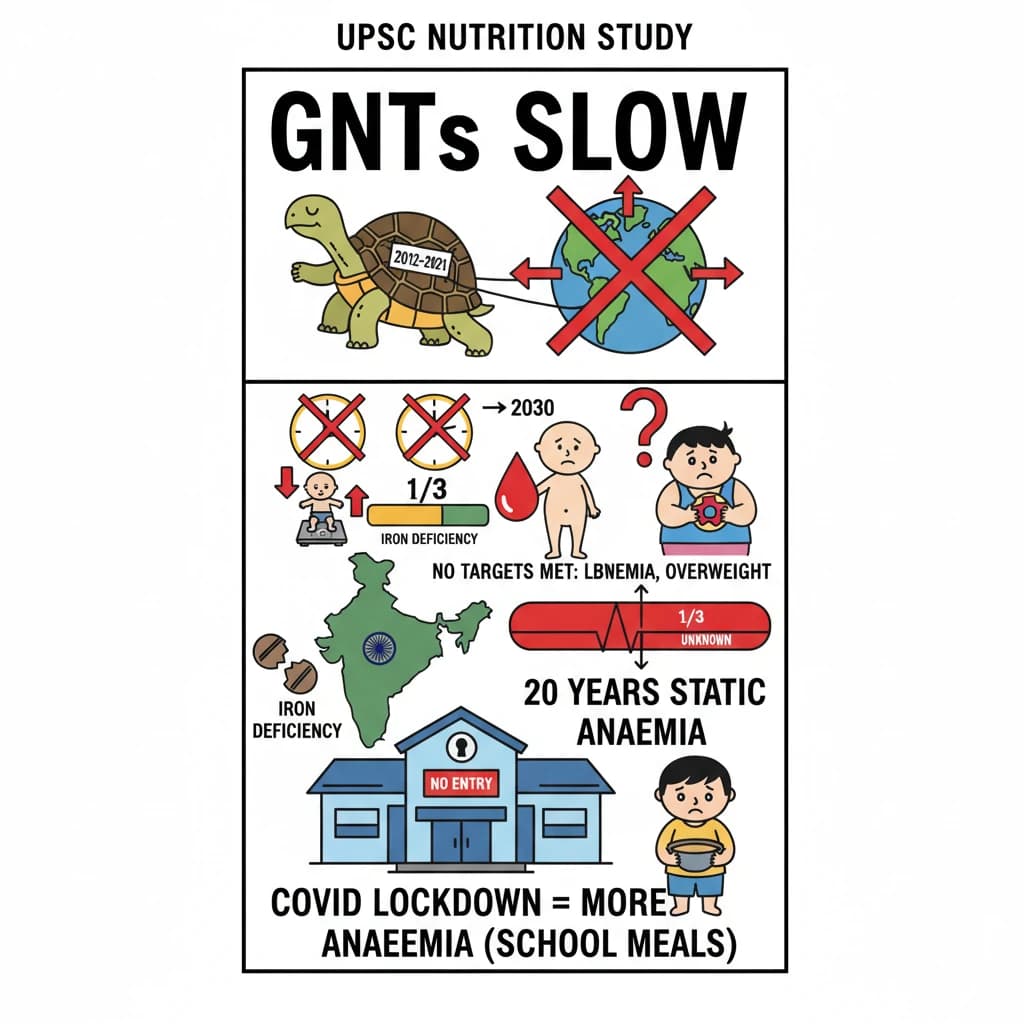
<h4>Global Nutrition Targets: Slow and Insufficient Progress</h4><p>A recent study highlights the concerning trend of <strong>slow</strong> and <strong>insufficient progress</strong> in achieving the <strong>Global Nutrition Targets (GNTs)</strong>. This assessment covers <strong>204 countries</strong> over the period from <strong>2012 to 2021</strong>, with projections extending to <strong>2050</strong>.</p><div class='key-point-box'><p>The overall outlook suggests limited success, indicating a significant global challenge in addressing malnutrition in its various forms.</p></div><h4>Specific Target Failures</h4><p>The study reveals critical areas where countries are falling short. Only a few nations are anticipated to meet the targets for reducing <strong>stunting</strong> in children under <strong>5 years of age</strong>.</p><p>Even more concerning is the projection that <strong>none</strong> of the surveyed countries are expected to achieve the targets for <strong>low birth weight</strong>, <strong>anaemia</strong>, and <strong>childhood overweight</strong> by the crucial deadline of <strong>2030</strong>.</p><div class='info-box'><p><strong>GNTs Not Met by 2030:</strong><ul><li><strong>Low birth weight</strong></li><li><strong>Anaemia</strong></li><li><strong>Childhood overweight</strong></li></ul></p></div><h4>Anaemia in India: A Persistent Challenge</h4><p>The study specifically points out that the prevalence of <strong>anaemia in India</strong> has remained largely <strong>static</strong> for the past <strong>two decades</strong>. This indicates a deep-rooted and complex public health issue that requires renewed focus.</p><p>Historically, <strong>iron deficiency</strong> has been widely assumed to be the primary cause of anaemia. However, the study's findings challenge this assumption, stating that iron deficiency accounts for only approximately <strong>one-third</strong> of all anaemia cases.</p><p>A significant proportion, another <strong>one-third</strong>, is attributed to <strong>unknown causes</strong>. This highlights the need for more comprehensive research into the multifactorial etiology of anaemia beyond just iron deficiency.</p><div class='exam-tip-box'><p><strong>UPSC Insight:</strong> Understanding the complex causes of anaemia (beyond just iron) is crucial for Mains answers on public health and nutrition, especially when discussing policy interventions.</p></div><h4>Impact of Covid-19 Lockdown on Nutrition</h4><p>The study also observed an increase in <strong>anaemia prevalence</strong> during the <strong>Covid-19 lockdown</strong> period. This surge is partly linked to the disruption of essential services, particularly the suspension of <strong>school meals</strong>.</p><p>The <strong>Midday Meal Scheme</strong> (now PM POSHAN) plays a vital role in providing nutritional support to millions of children. Its interruption had direct consequences on their dietary intake and overall health, contributing to rising anaemia rates.</p><div class='info-box'><p><strong>Key Observation:</strong> Increased <strong>anaemia</strong> during <strong>Covid-19 lockdown</strong> due to disruption of <strong>school meals</strong> (e.g., <strong>Midday Meal Scheme</strong>).</p></div>
Concept Diagram

💡 Key Takeaways

  • •Global Nutrition Targets (GNTs) progress is slow and insufficient across 204 countries (2012-2021).
  • •None of the countries are projected to meet targets for low birth weight, anaemia, and childhood overweight by 2030.
  • •Anaemia in India has been static for two decades, with iron deficiency accounting for only one-third of cases; one-third are due to unknown causes.
  • •Covid-19 lockdown increased anaemia prevalence due to disruption of school meal programs (Midday Meal Scheme).
  • •There's a critical need for re-evaluation of nutritional interventions and deeper research into anaemia's complex etiology.

🧠 Memory Techniques
Memory Aid
95% Verified Content

📚 Reference Sources

•World Health Organization (WHO) documents on Global Nutrition Targets (GNTs)
•National Family Health Survey (NFHS) reports (general knowledge of static anaemia trends)

Related Topics

Loading related topics...
Explore:Social Issues Topics·All Subjects·Daily Current Affairs·Editorial Analysis·Previous Year Questions·UPSC GPT
What are the Key Findings of the Study - UPSC Social Issues