Loading page, please wait…
Vaidra Logo
Vaidra

Top 4 items + smart groups

UPSC GPT
New
Current Affairs
Daily Solutions
Daily Puzzle
Mains Evaluator

Version 2.0.0 • Built with ❤️ for UPSC aspirants

Loading...
Loading...
Loading...
Loading...
Loading...
Loading...
Loading...
Loading...
Loading...
Loading...
Loading...
Loading...
Loading...
Back
All Subjects

Topics

0 topics • 0 completed

Loading topics...
Loading...
Loading...
Loading...
Loading...
Loading...
Overall Progress0%

Particularly Vulnerable Tribal Groups (PVTGs) - UPSC Social Issues

What is Particularly Vulnerable Tribal Groups (PVTGs) in UPSC Social Issues?

Particularly Vulnerable Tribal Groups (PVTGs) is a key topic under Social Issues for UPSC Civil Services Examination. Key points include: PVTGs are the most vulnerable tribal groups, identified by specific characteristics.. The concept evolved from Primitive Tribal Groups (PTGs) in 1973 (Dhebar Commission) to PVTGs in 2006.. There are 75 identified PVTGs out of 705 Scheduled Tribes in India.. Understanding this topic is essential for both UPSC Prelims and Mains preparation.

Why is Particularly Vulnerable Tribal Groups (PVTGs) important for UPSC exam?

Particularly Vulnerable Tribal Groups (PVTGs) is a Medium-level topic in UPSC Social Issues. It is tested in both Prelims (factual MCQs) and Mains (analytical answer writing). Previous year UPSC questions have frequently covered aspects of Particularly Vulnerable Tribal Groups (PVTGs), making it essential for comprehensive IAS preparation.

How to prepare Particularly Vulnerable Tribal Groups (PVTGs) for UPSC?

To prepare Particularly Vulnerable Tribal Groups (PVTGs) for UPSC: (1) Study the comprehensive notes covering all key concepts on Vaidra. (2) Practice previous year questions on this topic. (3) Connect it with current affairs using daily updates. (4) Revise using key takeaways and mind maps available for Social Issues. (5) Write practice answers linking Particularly Vulnerable Tribal Groups (PVTGs) to related GS Paper topics.

Key takeaways of Particularly Vulnerable Tribal Groups (PVTGs) for UPSC

  • PVTGs are the most vulnerable tribal groups, identified by specific characteristics.
  • The concept evolved from Primitive Tribal Groups (PTGs) in 1973 (Dhebar Commission) to PVTGs in 2006.
  • There are 75 identified PVTGs out of 705 Scheduled Tribes in India.
  • Key characteristics include homogeneity, small population, physical isolation, simple technology, and slow change.
  • Odisha has the highest number of PVTGs.
  • Government schemes focus on their holistic development and cultural preservation.
Particularly Vulnerable Tribal Groups (PVTGs)

Particularly Vulnerable Tribal Groups (PVTGs)

Medium⏱️ 8 min read✓ 98% Verified
social issues

📖 Introduction

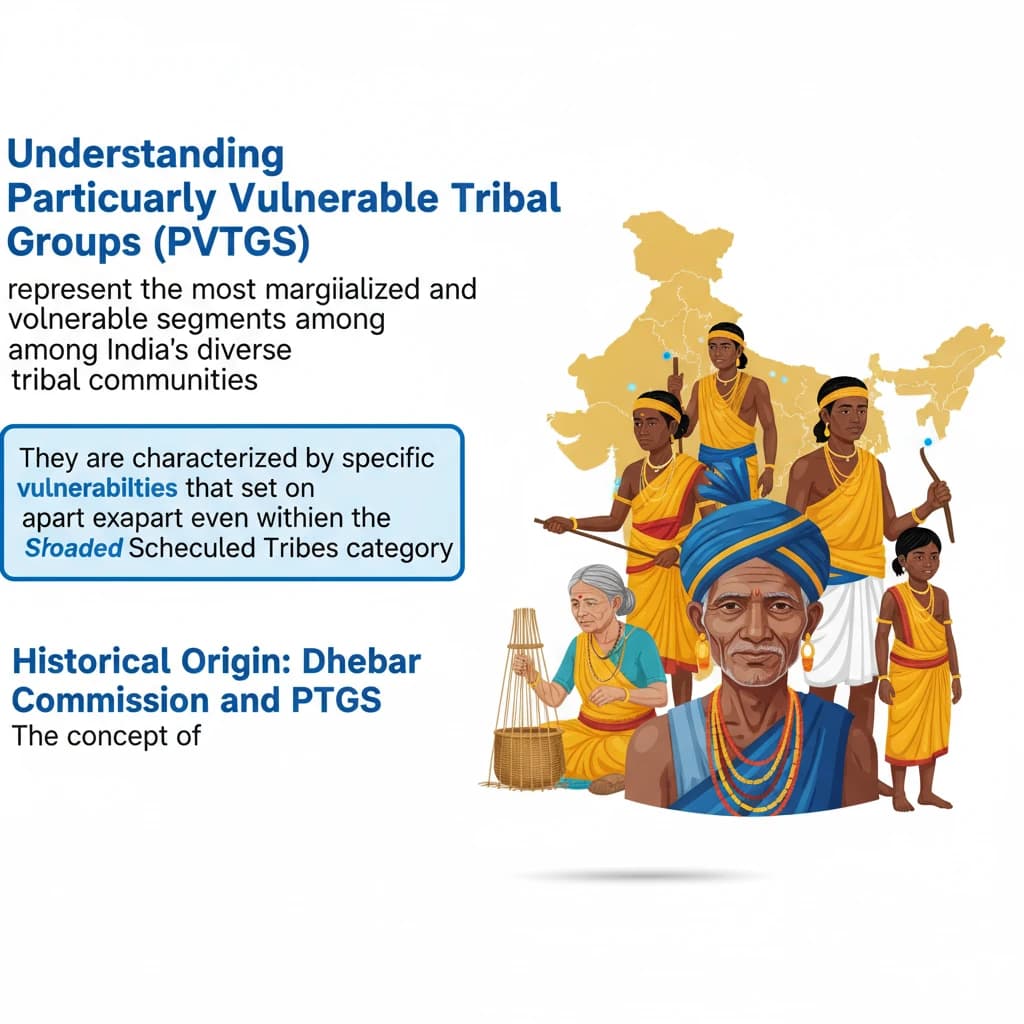
<h4>Understanding Particularly Vulnerable Tribal Groups (PVTGs)</h4><p><strong>Particularly Vulnerable Tribal Groups (PVTGs)</strong> represent the most marginalized and vulnerable segments among India's diverse <strong>tribal communities</strong>.</p><div class='key-point-box'><p>They are characterized by specific vulnerabilities that set them apart even within the broader <strong>Scheduled Tribes</strong> category.</p></div><h4>Historical Origin: Dhebar Commission and PTGs</h4><p>The concept of a more vulnerable tribal group originated in <strong>1973</strong> with the recommendations of the <strong>Dhebar Commission</strong>.</p><p>This commission identified a separate category known as <strong>Primitive Tribal Groups (PTGs)</strong>, recognizing them as less developed compared to other tribal groups.</p><div class='info-box'><p>The <strong>Dhebar Commission (1973)</strong> was instrumental in highlighting the unique challenges faced by these groups.</p></div><h4>Renaming and Official Identification</h4><p>In <strong>2006</strong>, the <strong>Government of India</strong> officially renamed the <strong>Primitive Tribal Groups (PTGs)</strong> as <strong>Particularly Vulnerable Tribal Groups (PVTGs)</strong>.</p><p>This renaming aimed to better reflect their specific status and the focused interventions required for their upliftment.</p><h4>Identification Process and Numbers</h4><p>The process of identifying these most vulnerable groups began in <strong>1975</strong> when the <strong>Government of India</strong> initiated efforts to categorize them separately.</p><p>Initially, <strong>52 such groups</strong> were declared as <strong>PVTGs</strong>. Later, in <strong>1993</strong>, an additional <strong>23 groups</strong> were added to this category.</p><div class='info-box'><p>Currently, there are a total of <strong>75 PVTGs</strong> identified across India, out of the <strong>705 recognized Scheduled Tribes</strong>.</p></div><h4>Defining Characteristics of PVTGs</h4><p><strong>PVTGs</strong> share several distinct characteristics that underscore their vulnerability and unique developmental needs. These traits often contribute to their isolation and slower pace of change.</p><ul><li>They are largely <strong>homogenous</strong> in their social structure and cultural practices.</li><li>Typically have a <strong>small population size</strong>, making them susceptible to demographic decline.</li><li>Often experience relative <strong>physical isolation</strong>, living in remote and inaccessible areas.</li><li>Many lack a <strong>written language</strong>, relying on oral traditions for cultural transmission.</li><li>Utilize relatively <strong>simple technology</strong>, often at a pre-agricultural or subsistence level.</li><li>Exhibit a <strong>slower rate of change</strong> and integration with mainstream society.</li></ul><h4>Geographical Distribution</h4><p>Among the <strong>75 listed PVTGs</strong>, the highest concentration is found in the state of <strong>Odisha</strong>.</p><div class='exam-tip-box'><p>Knowing the state with the highest number of <strong>PVTGs</strong> (<strong>Odisha</strong>) is a common factual question in <strong>UPSC Prelims</strong>.</p></div>
Concept Diagram

💡 Key Takeaways

  • •PVTGs are the most vulnerable tribal groups, identified by specific characteristics.
  • •The concept evolved from Primitive Tribal Groups (PTGs) in 1973 (Dhebar Commission) to PVTGs in 2006.
  • •There are 75 identified PVTGs out of 705 Scheduled Tribes in India.
  • •Key characteristics include homogeneity, small population, physical isolation, simple technology, and slow change.
  • •Odisha has the highest number of PVTGs.
  • •Government schemes focus on their holistic development and cultural preservation.

🧠 Memory Techniques

Memory Aid
98% Verified Content

Related Topics

Loading related topics...
Explore:Social Issues Topics·All Subjects·Daily Current Affairs·Editorial Analysis·Previous Year Questions·UPSC GPT
Particularly Vulnerable Tribal Groups (PVTGs) - UPSC Social Issues