📖 Introduction
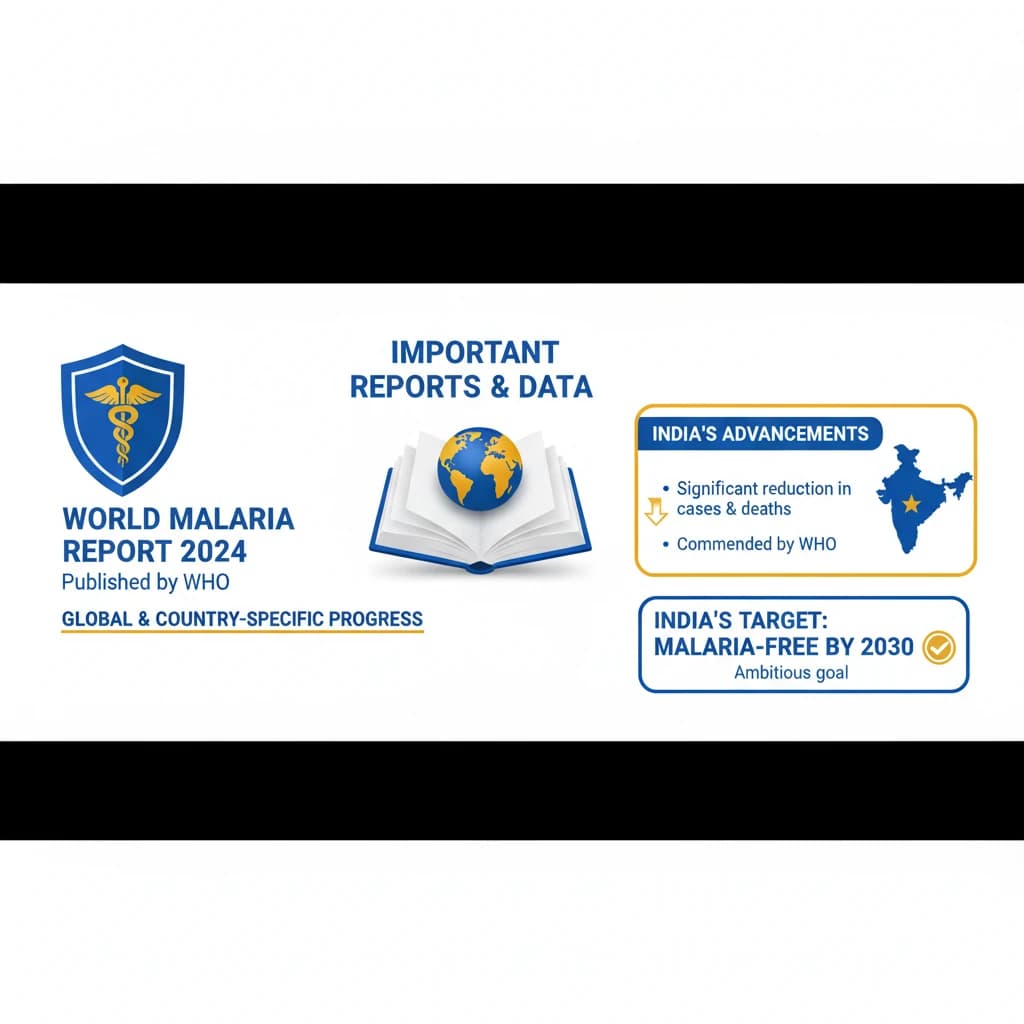
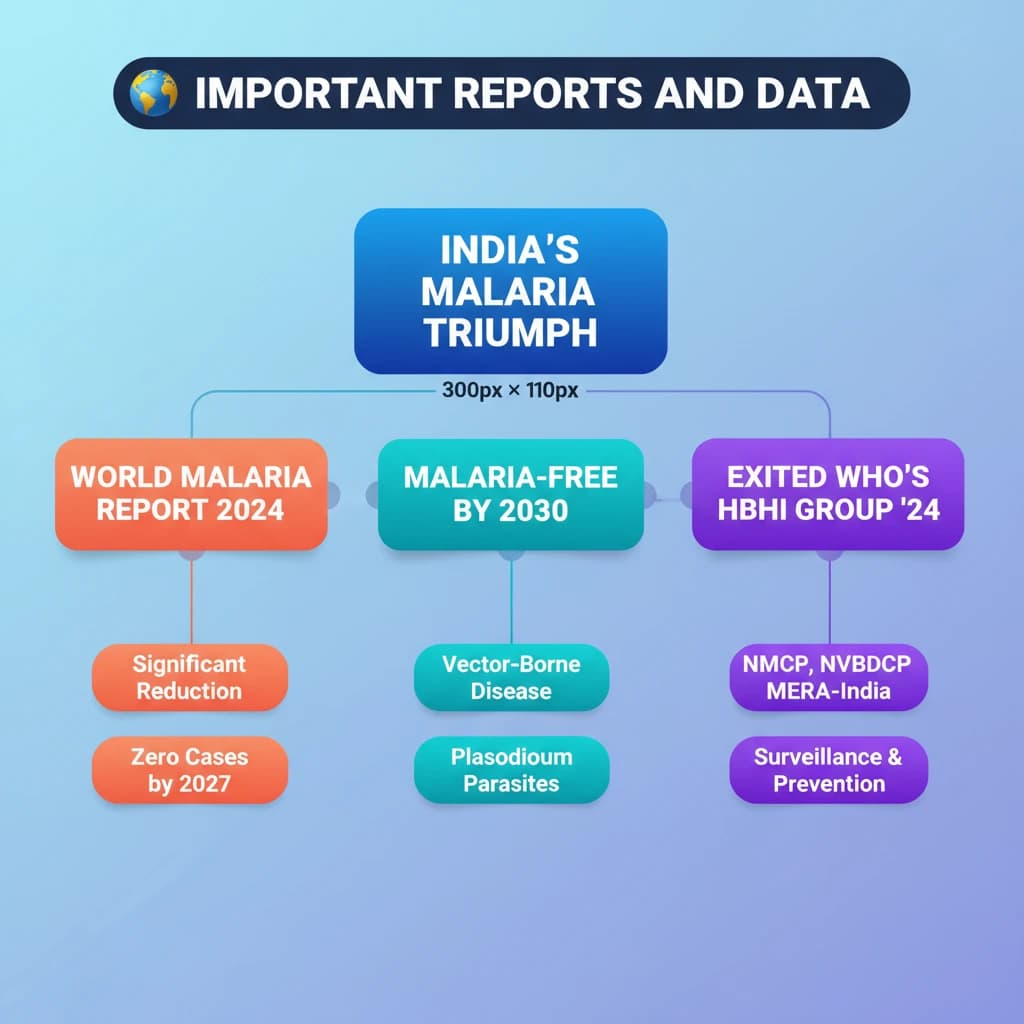
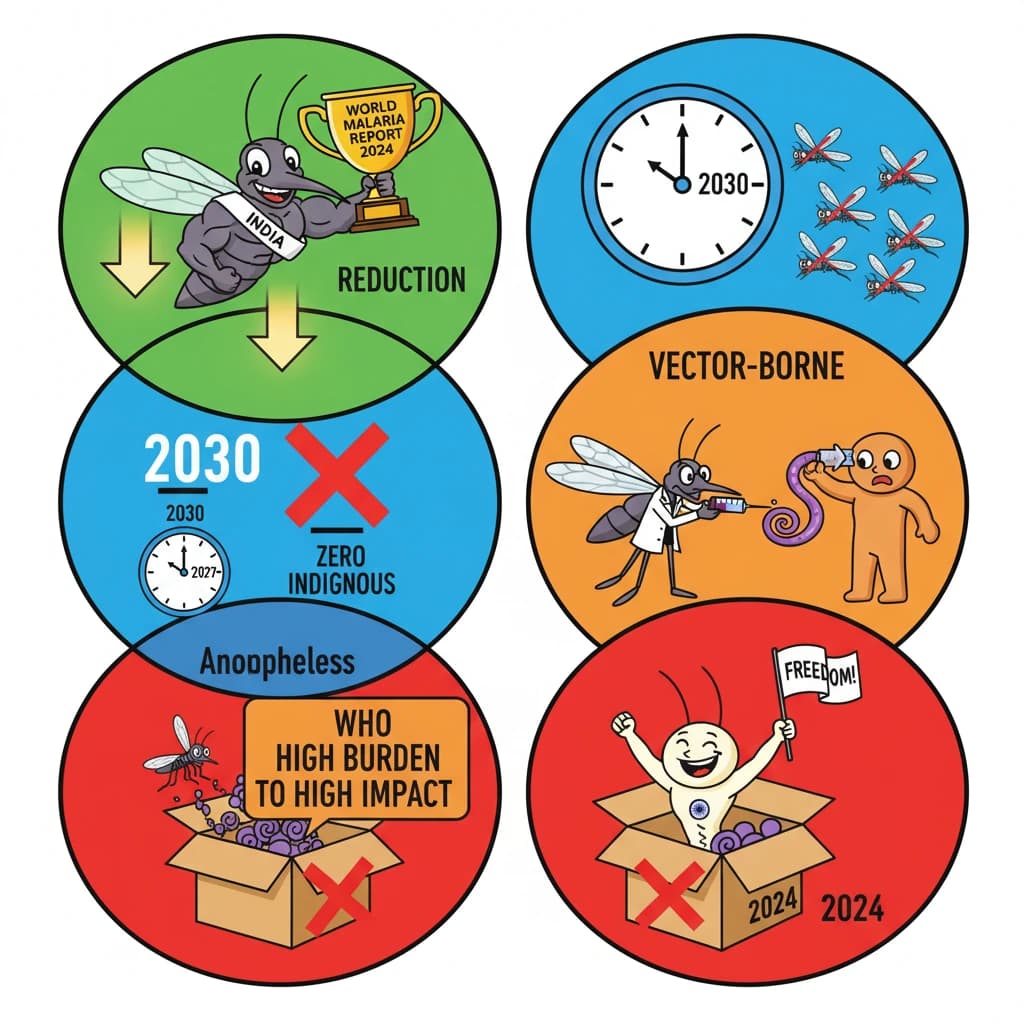
<h4>Introduction to World Malaria Report 2024</h4><p>The <strong>World Malaria Report 2024</strong>, published by the <strong>World Health Organization (WHO)</strong>, highlights significant global and country-specific progress in the fight against malaria.</p><p>Notably, the report commended <strong>India's remarkable advancements</strong> in reducing both malaria cases and related deaths over recent years.</p><div class='key-point-box'><p><strong>India's ambitious target</strong> is to achieve <strong>malaria-free status by 2030</strong>, with a crucial interim goal of <strong>zero indigenous cases by 2027</strong>.</p></div><h4>Understanding Malaria: The Disease</h4><p><strong>Malaria</strong> is a severe, <strong>life-threatening vector-borne disease</strong> that poses a significant public health challenge globally.</p><div class='info-box'><p><strong>Cause and Transmission:</strong> It is caused by <strong>Plasmodium parasites</strong> and transmitted to humans through the bites of infected female <strong>Anopheles mosquitoes</strong>.</p></div><p>There are <strong>five Plasmodium parasite species</strong> that infect humans. Among these, <strong>P. falciparum</strong> and <strong>P. vivax</strong> are the two species that present the greatest threat.</p><p>The disease is primarily prevalent in <strong>tropical and subtropical regions</strong> across <strong>Africa, South America, and Asia</strong>.</p><p>The transmission cycle begins when a mosquito bites an infected person, acquiring the parasites. These parasites then enter the bloodstream of the next person the mosquito bites, travel to the liver, mature, and subsequently infect red blood cells.</p><p>Common symptoms include <strong>fever, flu-like illness, shaking chills, headache, muscle aches, and tiredness</strong>. Importantly, malaria is both <strong>preventable and curable</strong>.</p><h4>Key Global Findings of the World Malaria Report 2024</h4><p>The report provided an updated overview of the global malaria burden, indicating both challenges and areas of progress.</p><div class='info-box'><ul><li><strong>Global Cases (2023):</strong> An estimated <strong>263 million malaria cases</strong> were reported worldwide.</li><li><strong>Increase from 2022:</strong> This figure represents an increase of <strong>11 million cases</strong> compared to the previous year.</li><li><strong>Global Mortality (2023):</strong> Malaria mortality stood at <strong>597,000 deaths</strong> globally.</li><li><strong>Mortality Trend:</strong> This shows a welcome decline compared to the <strong>622,000 deaths recorded in 2020</strong>.</li></ul></div><h4>India's Remarkable Progress and Achievements</h4><p>India's journey in combating malaria represents a significant public health success story, transforming a critical challenge into a pathway for elimination.</p><div class='info-box'><p><strong>Historical Context:</strong> At the time of <strong>independence</strong>, India faced an alarming <strong>7.5 crore malaria cases annually</strong>, resulting in approximately <strong>800,000 deaths</strong>.</p></div><p>Through sustained and concerted efforts, India has achieved a dramatic reduction in disease burden. Cases have been cut by <strong>over 97%</strong>, bringing the annual count down to approximately <strong>2 million</strong>.</p><p>Malaria-related deaths have also plummeted significantly, reaching just <strong>83 by 2023</strong>.</p><div class='key-point-box'><p><strong>Latest Achievements (2015-2022):</strong> Malaria cases decreased from <strong>11,69,261 to 2,27,564</strong>, while deaths reduced from <strong>384 to 83</strong>, signifying an <strong>80% reduction</strong>.</p></div><p>The <strong>Annual Blood Examination Rate (ABER)</strong>, a crucial indicator for detection, increased from <strong>9.58 in 2015 to 11.62 in 2023</strong>, ensuring early diagnosis and intervention.</p><div class='highlight-box'><p><strong>Major Milestone 2024:</strong> India officially exited the <strong>WHO's High Burden to High Impact (HBHI) group</strong>, a testament to its successful malaria control strategies.</p></div><div class='info-box'><p>The <strong>HBHI initiative</strong> is a <strong>country-led approach</strong> designed to accelerate progress in countries with a high burden of malaria.</p></div><h4>Government Initiatives for Malaria Control and Elimination</h4><p>India has implemented a robust framework of programs and initiatives to systematically tackle malaria and move towards its elimination goals.</p><ul><li><strong>National Framework for Malaria Elimination 2016-2030:</strong> This comprehensive framework outlines the strategy and roadmap for achieving malaria elimination in India.</li><li><strong>National Vector-Borne Disease Control Programme (NVBDCP):</strong> This broader program addresses various vector-borne diseases, including <strong>malaria</strong>, through a range of prevention and control measures.</li><li><strong>National Malaria Control Programme (NMCP):</strong> Launched in <strong>1953</strong>, the <strong>NMCP</strong> was a foundational initiative to combat the severe impact of malaria.</li></ul><div class='info-box'><p><strong>NMCP Core Activities:</strong> It focuses on <strong>insecticidal residual spraying (IRS)</strong>, rigorous <strong>case monitoring and surveillance</strong>, and effective <strong>patient treatment</strong>.</p></div><ul><li><strong>High Burden to High Impact (HBHI) Initiative:</strong> Initiated in <strong>2019</strong>, this program was rolled out in four key states: <strong>West Bengal, Jharkhand, Chhattisgarh, and Madhya Pradesh</strong>.</li></ul><div class='info-box'><p><strong>HBHI Focus:</strong> Its primary strategy for malaria reduction involves the widespread distribution of <strong>insecticidal nets</strong> in high-burden areas.</p></div><ul><li><strong>Malaria Elimination Research Alliance-India (MERA-India):</strong> Established by the <strong>Indian Council of Medical Research (ICMR)</strong>, <strong>MERA-India</strong> fosters collaboration with various partners to conduct crucial research for malaria control and elimination.</li></ul><div class='exam-tip-box'><p><strong>UPSC Relevance:</strong> Understanding these initiatives is crucial for questions on <strong>public health policy</strong>, <strong>disease elimination strategies</strong>, and <strong>India's international commitments</strong> (e.g., SDGs).</p></div>