Loading page, please wait…
Vaidra Logo
Vaidra

Top 4 items + smart groups

UPSC GPT
New
Current Affairs
Daily Solutions
Daily Puzzle
Mains Evaluator

Version 2.0.0 • Built with ❤️ for UPSC aspirants

Loading...
Loading...
Loading...
Loading...
Loading...
Loading...
Loading...
Loading...
Loading...
Loading...
Loading...
Loading...
Loading...
Back
All Subjects

Topics

0 topics • 0 completed

Loading topics...
Loading...
Loading...
Loading...
Loading...
Loading...
Overall Progress0%

World Food Day 2024 - UPSC Social Issues

What is World Food Day 2024 in UPSC Social Issues?

World Food Day 2024 is a key topic under Social Issues for UPSC Civil Services Examination. Key points include: World Food Day (Oct 16) highlights global hunger and resilient food systems; 2024 theme: Right to Food.. Commemorates FAO's establishment (1945); Right to Food recognized by UDHR 1948.. India's food consumption is G20's most sustainable; strong commitment via NFSA, PMGKAY, PM POSHAN, etc.. Understanding this topic is essential for both UPSC Prelims and Mains preparation.

Why is World Food Day 2024 important for UPSC exam?

World Food Day 2024 is a Medium-level topic in UPSC Social Issues. It is tested in both Prelims (factual MCQs) and Mains (analytical answer writing). Previous year UPSC questions have frequently covered aspects of World Food Day 2024, making it essential for comprehensive IAS preparation.

How to prepare World Food Day 2024 for UPSC?

To prepare World Food Day 2024 for UPSC: (1) Study the comprehensive notes covering all key concepts on Vaidra. (2) Practice previous year questions on this topic. (3) Connect it with current affairs using daily updates. (4) Revise using key takeaways and mind maps available for Social Issues. (5) Write practice answers linking World Food Day 2024 to related GS Paper topics.

Key takeaways of World Food Day 2024 for UPSC

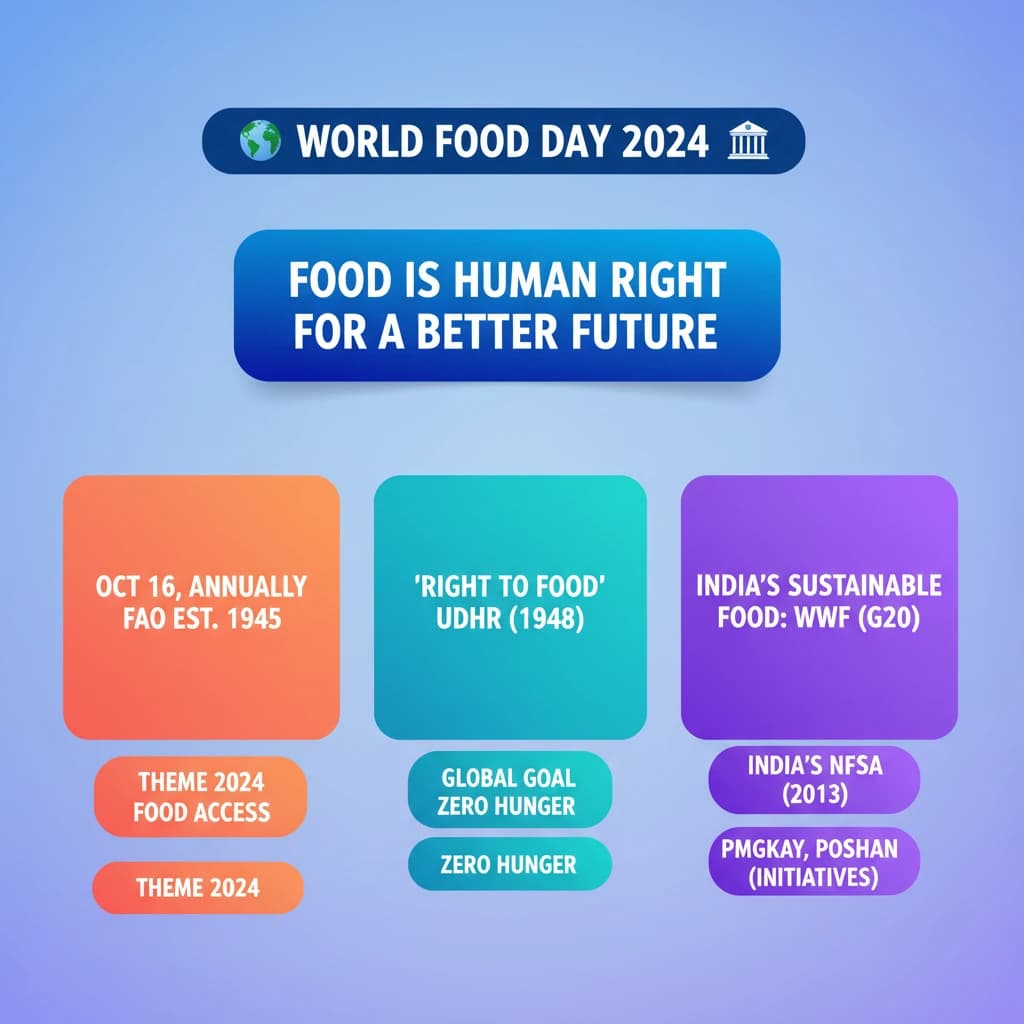
  • World Food Day (Oct 16) highlights global hunger and resilient food systems; 2024 theme: Right to Food.
  • Commemorates FAO's establishment (1945); Right to Food recognized by UDHR 1948.
  • India's food consumption is G20's most sustainable; strong commitment via NFSA, PMGKAY, PM POSHAN, etc.
  • National Education Day (Nov 11) honors Maulana Abul Kalam Azad's birth anniversary.
  • Azad, India's first Education Minister, founded UGC, AICTE, CSIR, IIT Kharagpur, and various cultural academies.
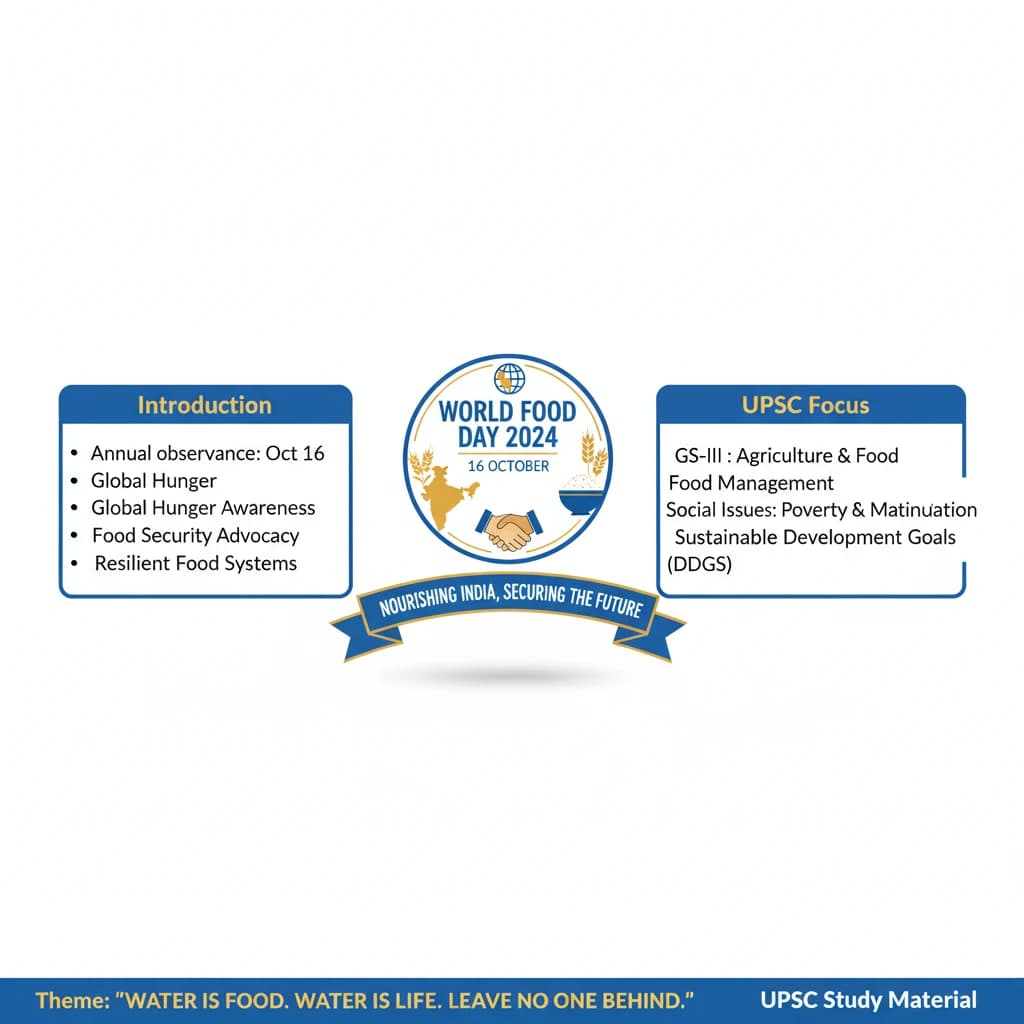
World Food Day 2024

World Food Day 2024

Medium⏱️ 7 min read✓ 95% Verified
social issues

📖 Introduction

<h4>World Food Day 2024: Eradicating Hunger</h4><p><strong>World Food Day</strong> is an annual observance held on <strong>October 16th</strong>. Its primary focus is on the urgent need to <strong>eradicate hunger</strong> globally and to foster the development of <strong>resilient global food systems</strong>.</p><div class="info-box"><p>The <strong>Theme for 2024</strong> was: <strong>"Right to Food for a Better Life and a Better Future"</strong>. This theme underscores the fundamental human right to adequate food.</p></div><h4>Historical Significance of World Food Day</h4><p>The date, <strong>October 16th</strong>, commemorates the establishment of the <strong>Food and Agriculture Organization (FAO)</strong> of the United Nations. The FAO was founded on <strong>October 16th, 1945</strong>, marking a pivotal moment in international efforts towards food security.</p><p>The observance of World Food Day itself was initiated in <strong>1979</strong> during the <strong>FAO’s 20th General Conference</strong>. It gained further international recognition when the <strong>UN General Assembly endorsed it in <strong>1984</strong>.</p><div class="key-point-box"><p>The <strong>Right to Food</strong> is a universally recognized human right. It is enshrined in the <strong>Universal Declaration of Human Rights 1948</strong>, highlighting its foundational importance.</p></div><h4>India's Sustainable Food Consumption and Commitment</h4><p>India has received international acclaim for its sustainable food practices. The <strong>WWF’s Living Planet Report</strong> specifically praised <strong>India’s food consumption pattern</strong> as the <strong>most sustainable among G20 countries</strong>.</p><div class="info-box"><p>The report highlighted that if the global population were to adopt <strong>India’s consumption patterns</strong>, only <strong>0.84 Earths</strong> would be required by <strong>2050</strong> to sustain global food production. This showcases India's efficient resource utilization.</p></div><p>India demonstrates a strong commitment to <strong>food security</strong> through various government initiatives and policies. These schemes aim to ensure access to adequate and nutritious food for all citizens.</p><p>Key initiatives include:</p><ul><li><strong>National Food Security Act (NFSA), 2013</strong>: A landmark legislation guaranteeing food and nutritional security.</li><li><strong>Pradhan Mantri Garib Kalyan Anna Yojana (PMGKAY)</strong>: Providing free food grains to vulnerable sections.</li><li><strong>PM POSHAN Scheme</strong>: Focused on improving nutritional outcomes for school children.</li><li><strong>Antyodaya Anna Yojana (AAY)</strong>: Providing highly subsidized food grains to the poorest of the poor.</li><li><strong>Rice Fortification</strong>: Enhancing the nutritional content of rice to combat micronutrient deficiencies.</li><li><strong>Price Stabilization Fund (PSF)</strong>: Designed to manage stock volatility and control prices of essential commodities.</li></ul><div class="exam-tip-box"><p>For UPSC Mains, understanding the interplay between <strong>Food Security & National Security</strong> is crucial. Be prepared to discuss how these schemes contribute to both.</p></div><h4>National Education Day 2024: Honoring Maulana Abul Kalam Azad</h4><p><strong>National Education Day (NED)</strong> is observed annually on <strong>November 11th</strong>. This day is dedicated to honouring the birth anniversary of <strong>Maulana Abul Kalam Azad</strong>, India’s first Education Minister.</p><p>The day celebrates his profound contributions to India's educational landscape and his vision for an educated nation. His birthday is <strong>November 11th, 1888</strong>.</p><div class="info-box"><p>The <strong>Government of India</strong> officially declared <strong>National Education Day</strong> in <strong>2008</strong> to commemorate Azad's legacy and emphasize the importance of education.</p></div><h4>Maulana Azad's Vision and Impact on Education</h4><p>As India’s first Education Minister, <strong>Maulana Abul Kalam Azad</strong> played a pivotal role in shaping the country's post-independence educational framework. He championed <strong>accessible and inclusive education</strong> for all.</p><p>NED serves to reinforce several key principles:</p><ul><li>Emphasizing <strong>education as a fundamental right</strong> for every citizen.</li><li>Inspiring reflection on <strong>Azad’s principles</strong> of universal education and intellectual freedom.</li><li>Promoting <strong>creativity and lifelong learning</strong> among students and educators.</li><li>Sparking discussions and initiatives for <strong>educational reforms</strong> across India.</li></ul><h4>Key Contributions of Maulana Abul Kalam Azad</h4><p>Maulana Azad's legacy is marked by the establishment of several foundational institutions that continue to shape India's academic and cultural spheres.</p><p>His significant contributions include:</p><ul><li>Pivotal role in establishing the <strong>University Grants Commission (UGC)</strong> and the <strong>All India Council for Technical Education (AICTE)</strong>, which regulate higher and technical education.</li><li>Founding of key research and cultural bodies such as the <strong>Council of Scientific and Industrial Research (CSIR)</strong>, <strong>Sahitya Academy</strong>, <strong>Lalit Kala Academy</strong>, <strong>Sangeet Natak Academy</strong>, and the <strong>Indian Council for Cultural Relations (ICCR)</strong>.</li><li>Launching <strong>IIT Kharagpur</strong>, which laid the foundation for India’s premier technical education institutions, fostering scientific and technological advancement.</li></ul><div class="exam-tip-box"><p>For UPSC Prelims and Mains, knowing <strong>Maulana Azad's</strong> contributions to institution building and his vision for education is vital. Connect his work to current educational policies.</p></div>
Concept Diagram

💡 Key Takeaways

  • •World Food Day (Oct 16) highlights global hunger and resilient food systems; 2024 theme: Right to Food.
  • •Commemorates FAO's establishment (1945); Right to Food recognized by UDHR 1948.
  • •India's food consumption is G20's most sustainable; strong commitment via NFSA, PMGKAY, PM POSHAN, etc.
  • •National Education Day (Nov 11) honors Maulana Abul Kalam Azad's birth anniversary.
  • •Azad, India's first Education Minister, founded UGC, AICTE, CSIR, IIT Kharagpur, and various cultural academies.

🧠 Memory Techniques
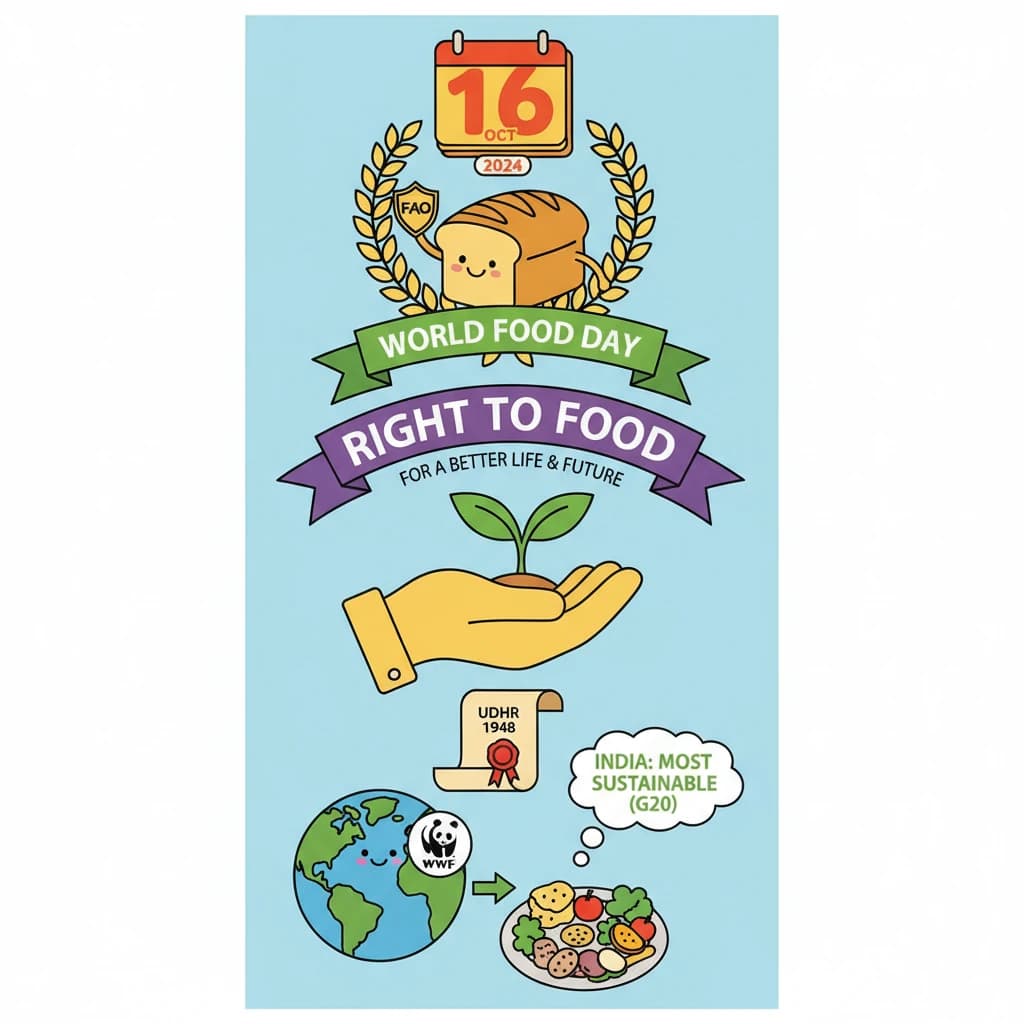
Memory Aid
95% Verified Content

Related Topics

Loading related topics...
Explore:Social Issues Topics·All Subjects·Daily Current Affairs·Editorial Analysis·Previous Year Questions·UPSC GPT
World Food Day 2024 - UPSC Social Issues