Loading page, please wait…
Vaidra Logo
Vaidra

Top 4 items + smart groups

UPSC GPT
New
Current Affairs
Daily Solutions
Daily Puzzle
Mains Evaluator

Version 2.0.0 • Built with ❤️ for UPSC aspirants

Loading...
Loading...
Loading...
Loading...
Loading...
Loading...
Loading...
Loading...
Loading...
Loading...
Loading...
Loading...
Loading...
Back
All Subjects

Topics

0 topics • 0 completed

Loading topics...
Loading...
Loading...
Loading...
Loading...
Loading...
Overall Progress0%

What is Manual Scavenging? - UPSC Social Issues

What is What is Manual Scavenging? in UPSC Social Issues?

What is Manual Scavenging? is a key topic under Social Issues for UPSC Civil Services Examination. Key points include: Manual Scavenging is the manual removal of human excreta from unsanitary locations like sewers and septic tanks.. It is legally banned in India by the Prohibition of Employment as Manual Scavengers and their Rehabilitation (PEMSR) Act, 2013.. The PEMSR Act, 2013, significantly broadens the definition of manual scavenging to include various hazardous sanitation tasks.. Understanding this topic is essential for both UPSC Prelims and Mains preparation.

Why is What is Manual Scavenging? important for UPSC exam?

What is Manual Scavenging? is a Medium-level topic in UPSC Social Issues. It is tested in both Prelims (factual MCQs) and Mains (analytical answer writing). Previous year UPSC questions have frequently covered aspects of What is Manual Scavenging?, making it essential for comprehensive IAS preparation.

How to prepare What is Manual Scavenging? for UPSC?

To prepare What is Manual Scavenging? for UPSC: (1) Study the comprehensive notes covering all key concepts on Vaidra. (2) Practice previous year questions on this topic. (3) Connect it with current affairs using daily updates. (4) Revise using key takeaways and mind maps available for Social Issues. (5) Write practice answers linking What is Manual Scavenging? to related GS Paper topics.

Key takeaways of What is Manual Scavenging? for UPSC

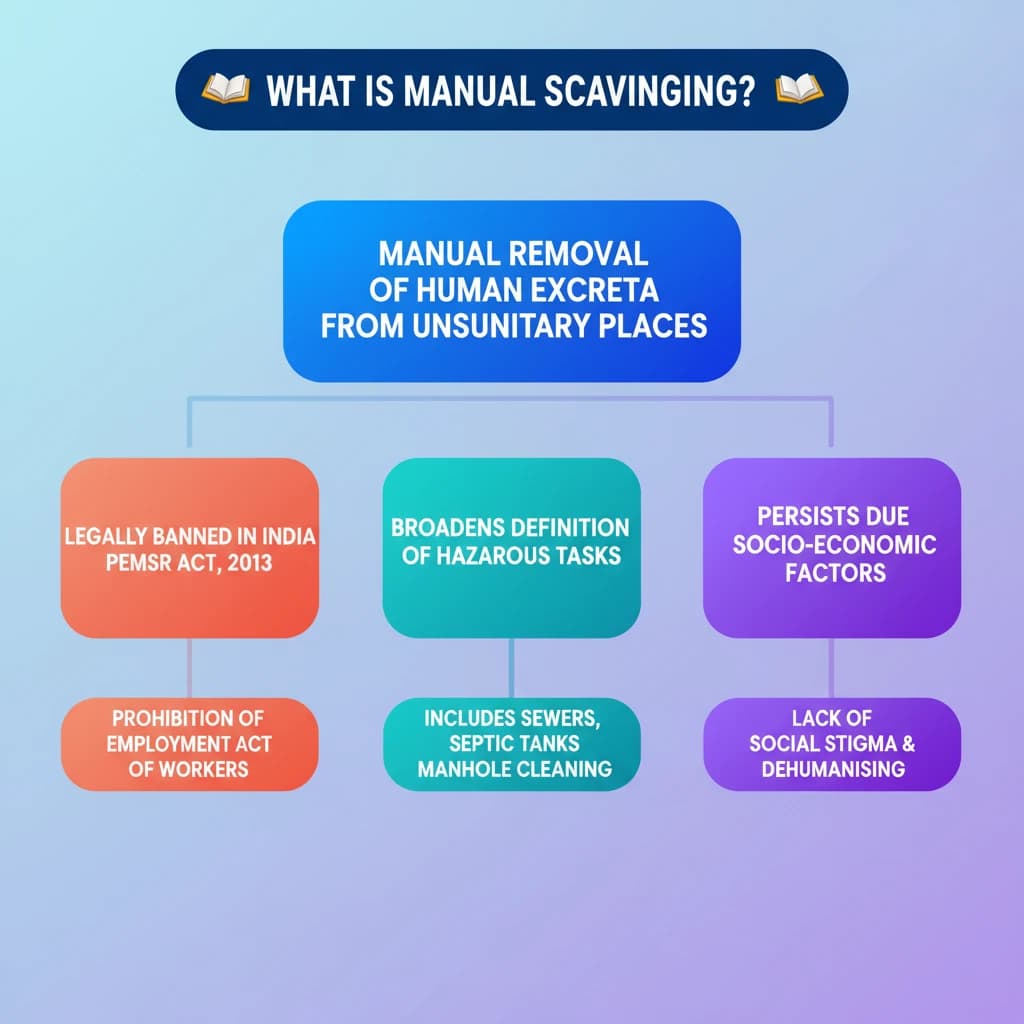
  • Manual Scavenging is the manual removal of human excreta from unsanitary locations like sewers and septic tanks.
  • It is legally banned in India by the Prohibition of Employment as Manual Scavengers and their Rehabilitation (PEMSR) Act, 2013.
  • The PEMSR Act, 2013, significantly broadens the definition of manual scavenging to include various hazardous sanitation tasks.
  • Despite the ban, the practice tragically persists due to socio-economic factors, lack of enforcement, and social stigma.
  • The practice is recognized as 'dehumanising' and is a direct consequence of historical injustices faced by marginalized communities.
What is Manual Scavenging?

What is Manual Scavenging?

Medium⏱️ 7 min read✓ 95% Verified
social issues

📖 Introduction

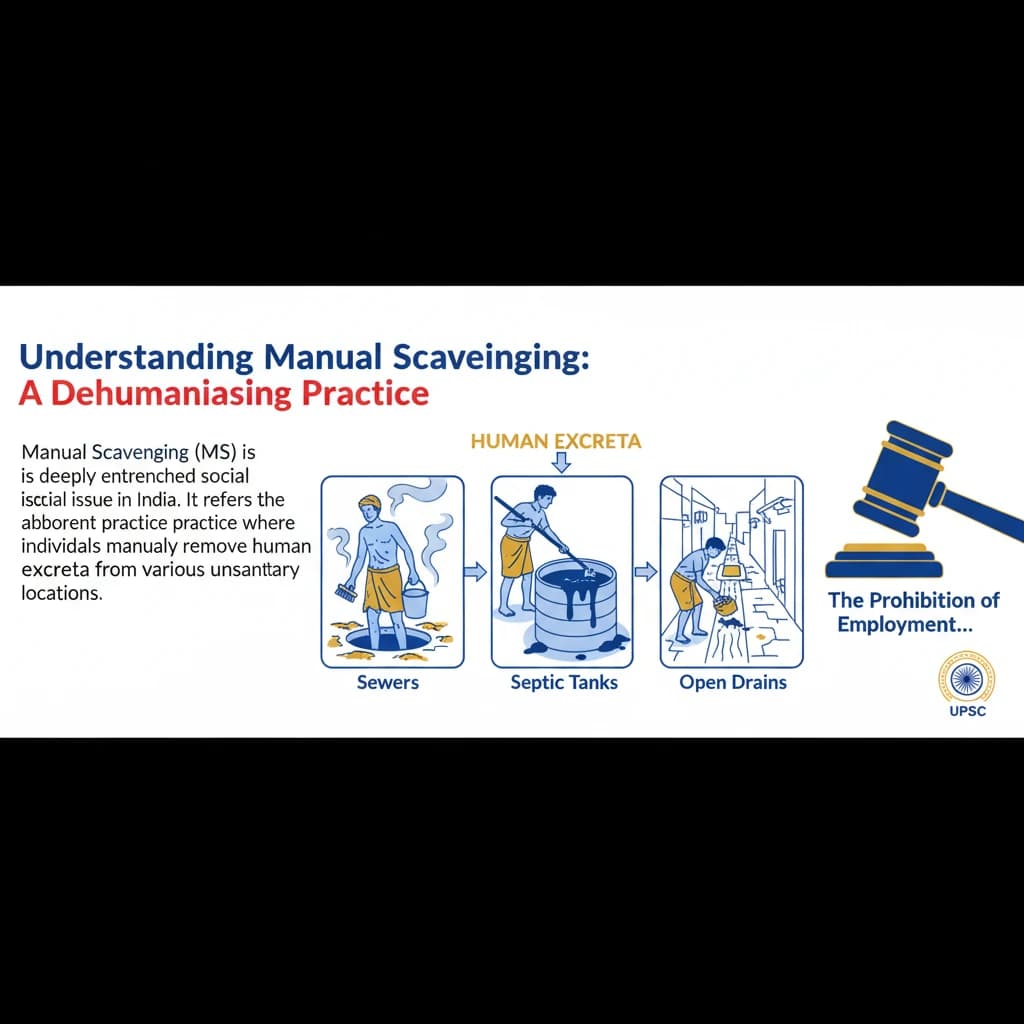
<h4>Understanding Manual Scavenging: A Dehumanising Practice</h4><p><strong>Manual Scavenging (MS)</strong> is a deeply entrenched social issue in India. It refers to the abhorrent practice where individuals manually remove <strong>human excreta</strong> from various unsanitary locations.</p><p>This includes cleaning out <strong>sewers</strong>, <strong>septic tanks</strong>, open drains, and other waste receptacles, often without proper protective gear or tools.</p><h4>The Prohibition of Employment as Manual Scavengers and their Rehabilitation (PEMSR) Act, 2013</h4><p>Despite its widespread prevalence, <strong>Manual Scavenging</strong> was officially banned in India with the enactment of the <strong>Prohibition of Employment as Manual Scavengers and their Rehabilitation (PEMSR) Act, 2013</strong>.</p><div class="info-box"><p>The <strong>PEMSR Act, 2013</strong> aims to eliminate the practice and rehabilitate those engaged in it, recognizing the inherent dignity of labor and addressing historical injustices.</p></div><h4>Expanded Definition and Prohibitions under the Act</h4><p>The <strong>PEMSR Act, 2013</strong> significantly expanded the definition of manual scavenging beyond traditional dry latrines. It explicitly <strong>prohibits</strong> the employment of any person for:</p><ul><li>Cleaning or handling <strong>human excreta</strong> in any manner.</li><li>Cleaning <strong>septic tanks</strong>.</li><li>Clearing <strong>ditches</strong> containing human waste.</li><li>Maintenance of <strong>railway tracks</strong> where human excreta is present.</li></ul><div class="key-point-box"><p>This broader definition ensures that all forms of hazardous sanitation work involving direct contact with human waste are legally covered and prohibited.</p></div><h4>Rationale Behind the Legislative Ban</h4><p>The legislation unequivocally recognizes <strong>manual scavenging</strong> as a profoundly <strong>“dehumanising”</strong> practice. It strips individuals of their dignity, impacts their health, and perpetuates severe social discrimination.</p><p>A primary objective of the <strong>PEMSR Act, 2013</strong> is to address the long-standing <strong>historical injustices</strong> faced by communities traditionally forced into this occupation, primarily due to the caste system.</p><div class="exam-tip-box"><p>For <strong>UPSC Mains GS Paper 1 (Social Issues)</strong> and <strong>GS Paper 2 (Governance & Social Justice)</strong>, understanding the definition, the Act, its expanded scope, and its rationale is crucial for answering questions on social reforms and vulnerable sections.</p></div>
Concept Diagram

💡 Key Takeaways

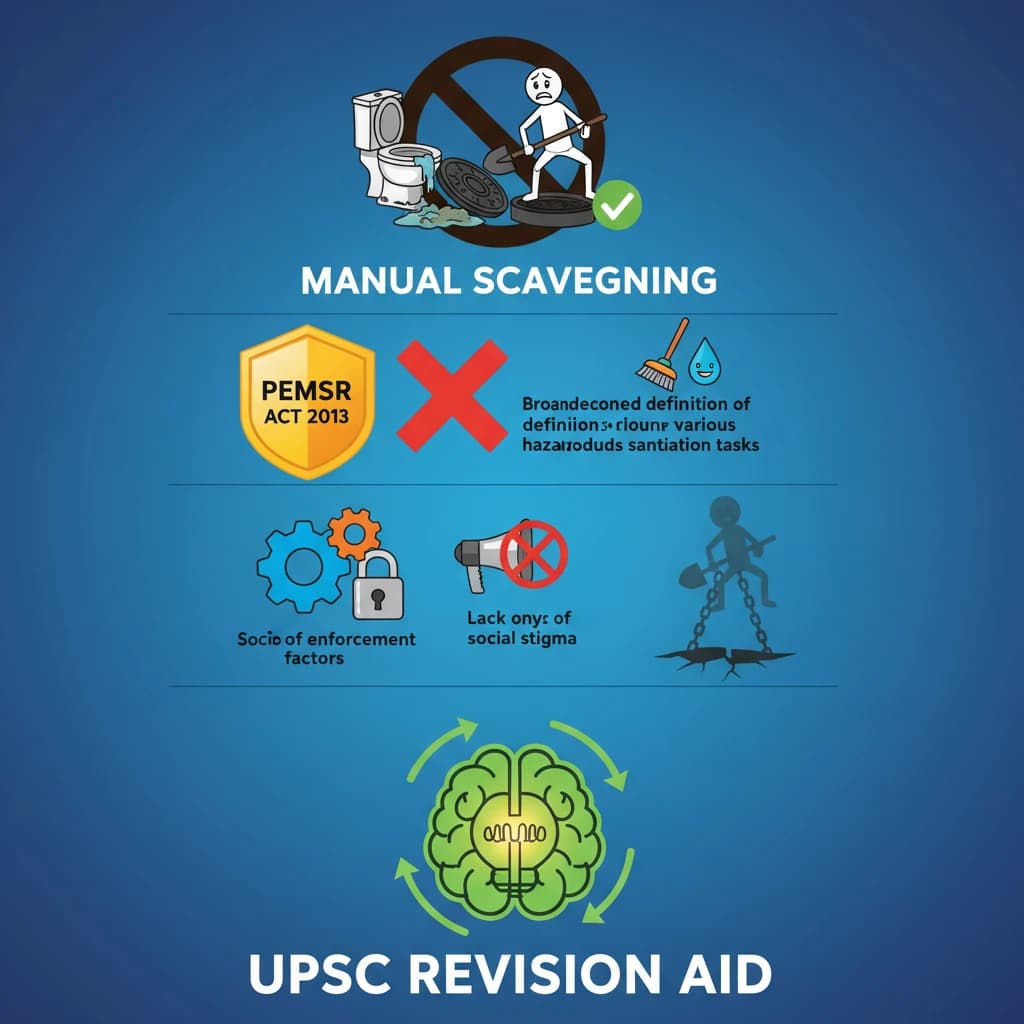
  • •Manual Scavenging is the manual removal of human excreta from unsanitary locations like sewers and septic tanks.
  • •It is legally banned in India by the Prohibition of Employment as Manual Scavengers and their Rehabilitation (PEMSR) Act, 2013.
  • •The PEMSR Act, 2013, significantly broadens the definition of manual scavenging to include various hazardous sanitation tasks.
  • •Despite the ban, the practice tragically persists due to socio-economic factors, lack of enforcement, and social stigma.
  • •The practice is recognized as 'dehumanising' and is a direct consequence of historical injustices faced by marginalized communities.

🧠 Memory Techniques
Memory Aid
95% Verified Content

📚 Reference Sources

•The Prohibition of Employment as Manual Scavengers and their Rehabilitation Act, 2013
•Ministry of Social Justice and Empowerment, Government of India reports and data
•National Commission for Safai Karamcharis (NCSK) reports

Related Topics

Loading related topics...
Explore:Social Issues Topics·All Subjects·Daily Current Affairs·Editorial Analysis·Previous Year Questions·UPSC GPT
What is Manual Scavenging? - UPSC Social Issues