Loading page, please wait…
Vaidra Logo
Vaidra

Top 4 items + smart groups

UPSC GPT
New
Current Affairs
Daily Solutions
Daily Puzzle
Mains Evaluator

Version 2.0.0 • Built with ❤️ for UPSC aspirants

Loading...
Loading...
Loading...
Loading...
Loading...
Loading...
Loading...
Loading...
Loading...
Loading...
Loading...
Loading...
Loading...
Back
All Subjects

Topics

0 topics • 0 completed

Loading topics...
Loading...
Loading...
Loading...
Loading...
Loading...
Overall Progress0%

Government Initiatives for Manual Scavengers & Sanitation Workers - UPSC Social Issues

What is Government Initiatives for Manual Scavengers & Sanitation Workers in UPSC Social Issues?

Government Initiatives for Manual Scavengers & Sanitation Workers is a key topic under Social Issues for UPSC Civil Services Examination. Key points include: Government is committed to eradicating manual scavenging through a multi-pronged approach.. Schemes like SESRM and NSKFDC focus on rehabilitation and financial empowerment of sanitation workers.. Rashtriya Garima Abhiyaan is a national campaign for eradication and rehabilitation.. Understanding this topic is essential for both UPSC Prelims and Mains preparation.

Why is Government Initiatives for Manual Scavengers & Sanitation Workers important for UPSC exam?

Government Initiatives for Manual Scavengers & Sanitation Workers is a Medium-level topic in UPSC Social Issues. It is tested in both Prelims (factual MCQs) and Mains (analytical answer writing). Previous year UPSC questions have frequently covered aspects of Government Initiatives for Manual Scavengers & Sanitation Workers, making it essential for comprehensive IAS preparation.

How to prepare Government Initiatives for Manual Scavengers & Sanitation Workers for UPSC?

To prepare Government Initiatives for Manual Scavengers & Sanitation Workers for UPSC: (1) Study the comprehensive notes covering all key concepts on Vaidra. (2) Practice previous year questions on this topic. (3) Connect it with current affairs using daily updates. (4) Revise using key takeaways and mind maps available for Social Issues. (5) Write practice answers linking Government Initiatives for Manual Scavengers & Sanitation Workers to related GS Paper topics.

Key takeaways of Government Initiatives for Manual Scavengers & Sanitation Workers for UPSC

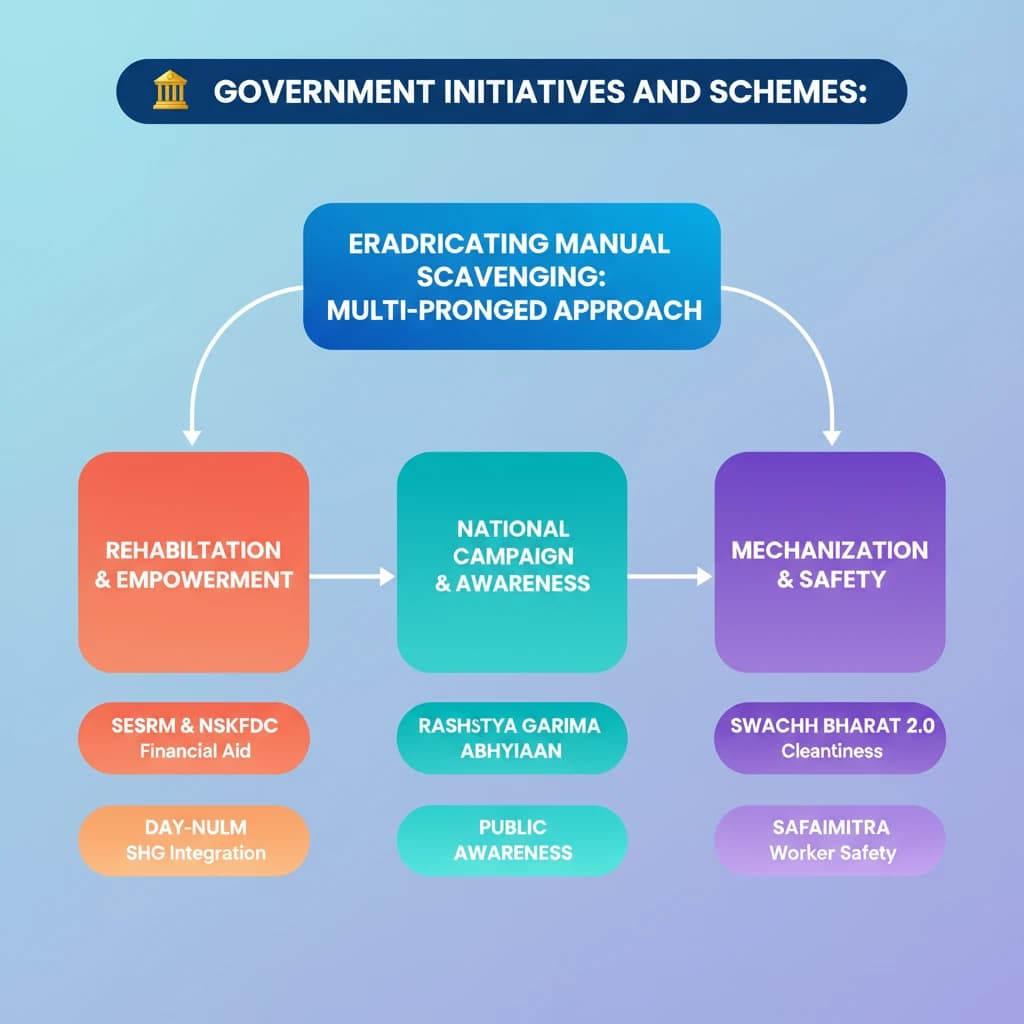
  • Government is committed to eradicating manual scavenging through a multi-pronged approach.
  • Schemes like SESRM and NSKFDC focus on rehabilitation and financial empowerment of sanitation workers.
  • Rashtriya Garima Abhiyaan is a national campaign for eradication and rehabilitation.
  • Swachh Bharat Mission 2.0 and Safaimitra Suraksha Challenge emphasize mechanization and worker safety.
  • DAY-NULM integrates vulnerable workers into Self-Help Groups for economic independence.
  • Despite legislative prohibitions, sustained efforts are needed due to socio-economic challenges.
Government Initiatives for Manual Scavengers & Sanitation Workers

Government Initiatives for Manual Scavengers & Sanitation Workers

Medium⏱️ 8 min read✓ 95% Verified
social issues

📖 Introduction

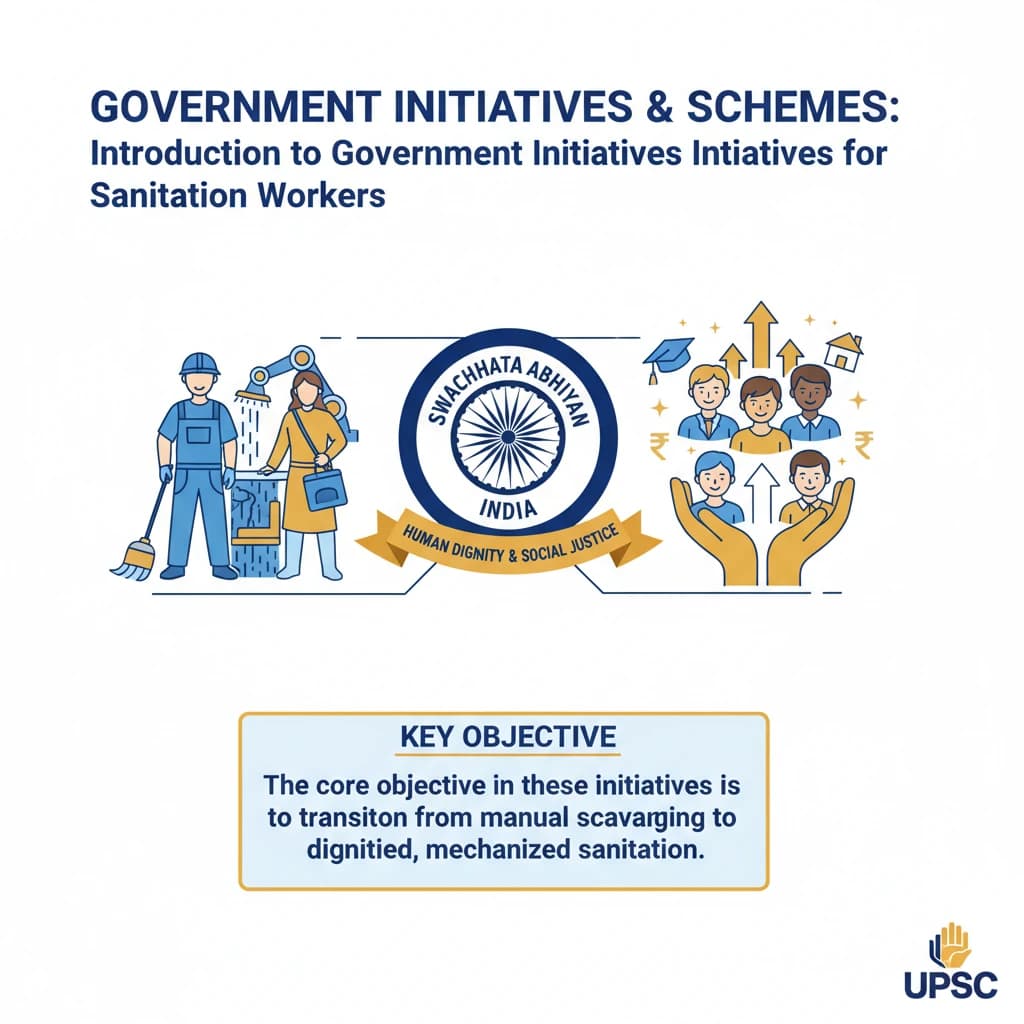
<h4>Introduction to Government Initiatives for Sanitation Workers</h4><p>The Indian government has launched several significant initiatives and schemes aimed at eradicating the practice of <strong>manual scavenging</strong> and ensuring the socio-economic upliftment and rehabilitation of <strong>Safai Karamcharis</strong> (sanitation workers). These programs reflect a commitment to human dignity and social justice.</p><div class='key-point-box'><p>The core objective of these initiatives is to transition individuals from hazardous manual scavenging work to dignified self-employment and to promote safer, mechanized sanitation practices.</p></div><h4>Self Employment Scheme for Rehabilitation of Manual Scavengers (SESRM)</h4><p>The <strong>Self Employment Scheme for Rehabilitation of Manual Scavengers (SESRM)</strong> is a crucial initiative designed to provide direct assistance. Its primary goal is to help identified manual scavengers move away from their traditional, hazardous occupation.</p><div class='info-box'><p><strong>SESRM</strong> provides financial and other support to manual scavengers, enabling them to pursue alternative livelihoods and engage in <strong>self-employment</strong> ventures.</p></div><h4>National Safai Karamcharis Finance and Development Corporation (NSKFDC)</h4><p>The <strong>National Safai Karamcharis Finance and Development Corporation (NSKFDC)</strong> plays a vital role in the financial empowerment of sanitation workers. It acts as an apex body for their socio-economic development.</p><div class='info-box'><p><strong>NSKFDC</strong> offers <strong>concessional loans</strong> and various forms of financial support. These are specifically targeted at <strong>Safai Karamcharis</strong> and their families to facilitate their upliftment and integration into mainstream economic activities.</p></div><h4>Rashtriya Garima Abhiyaan</h4><p>The <strong>Rashtriya Garima Abhiyaan</strong> is a national-level campaign with a strong focus on advocacy and direct action. It represents a concerted effort to address the issue of manual scavenging comprehensively.</p><div class='info-box'><p>This campaign aims for the complete eradication of the practice of <strong>manual scavenging</strong>. It also focuses on the dignified <strong>rehabilitation</strong> of those who have been engaged in this work, ensuring their societal acceptance and economic stability.</p></div><h4>Swachh Bharat Mission 2.0 and Safaimitra Suraksha Challenge</h4><p>The second phase of the <strong>Swachh Bharat Mission (SBM 2.0)</strong> has broadened its scope to include the safety and dignity of sanitation workers. It emphasizes a shift towards modern and safe sanitation practices.</p><div class='info-box'><p><strong>SBM 2.0</strong> actively encourages <strong>Urban Local Bodies (ULBs)</strong> to prioritize the safety of sanitation workers. This includes promoting <strong>mechanisation</strong> of cleaning processes and ensuring the provision of adequate <strong>protective measures</strong>.</p></div><p>As a key component of the <strong>Swachh Bharat Mission</strong>, the <strong>Safaimitra Suraksha Challenge (SSC)</strong> specifically addresses the dangers associated with manual sewer cleaning.</p><div class='info-box'><p>The <strong>SSC</strong> incentivizes cities to adopt <strong>mechanised sewer cleaning</strong> technologies. Its main objective is to prevent fatalities and injuries by significantly reducing or eliminating <strong>manual intervention</strong> in hazardous sanitation tasks.</p></div><h4>Deendayal Antyodaya Yojana-National Urban Livelihoods Mission (DAY-NULM)</h4><p>The <strong>Deendayal Antyodaya Yojana-National Urban Livelihoods Mission (DAY-NULM)</strong> is a broader livelihood scheme that includes specific provisions for vulnerable occupational groups, such as sanitation workers.</p><div class='info-box'><p><strong>DAY-NULM</strong> guidelines stipulate that at least <strong>10%</strong> of the <strong>Self-Help Groups (SHGs)</strong> formed under the mission should comprise individuals engaged in vulnerable occupations, including <strong>sanitation workers</strong>. These SHGs are then empowered to establish and manage their own enterprises, fostering economic independence.</p></div><div class='exam-tip-box'><p>Understanding these schemes is crucial for <strong>UPSC Civil Services Exam</strong>, particularly for <strong>GS Paper I (Social Issues)</strong> and <strong>GS Paper II (Government Policies & Welfare Schemes)</strong>. Focus on their objectives, target beneficiaries, and implementation mechanisms.</p></div>
Concept Diagram

💡 Key Takeaways

  • •Government is committed to eradicating manual scavenging through a multi-pronged approach.
  • •Schemes like SESRM and NSKFDC focus on rehabilitation and financial empowerment of sanitation workers.
  • •Rashtriya Garima Abhiyaan is a national campaign for eradication and rehabilitation.
  • •Swachh Bharat Mission 2.0 and Safaimitra Suraksha Challenge emphasize mechanization and worker safety.
  • •DAY-NULM integrates vulnerable workers into Self-Help Groups for economic independence.
  • •Despite legislative prohibitions, sustained efforts are needed due to socio-economic challenges.

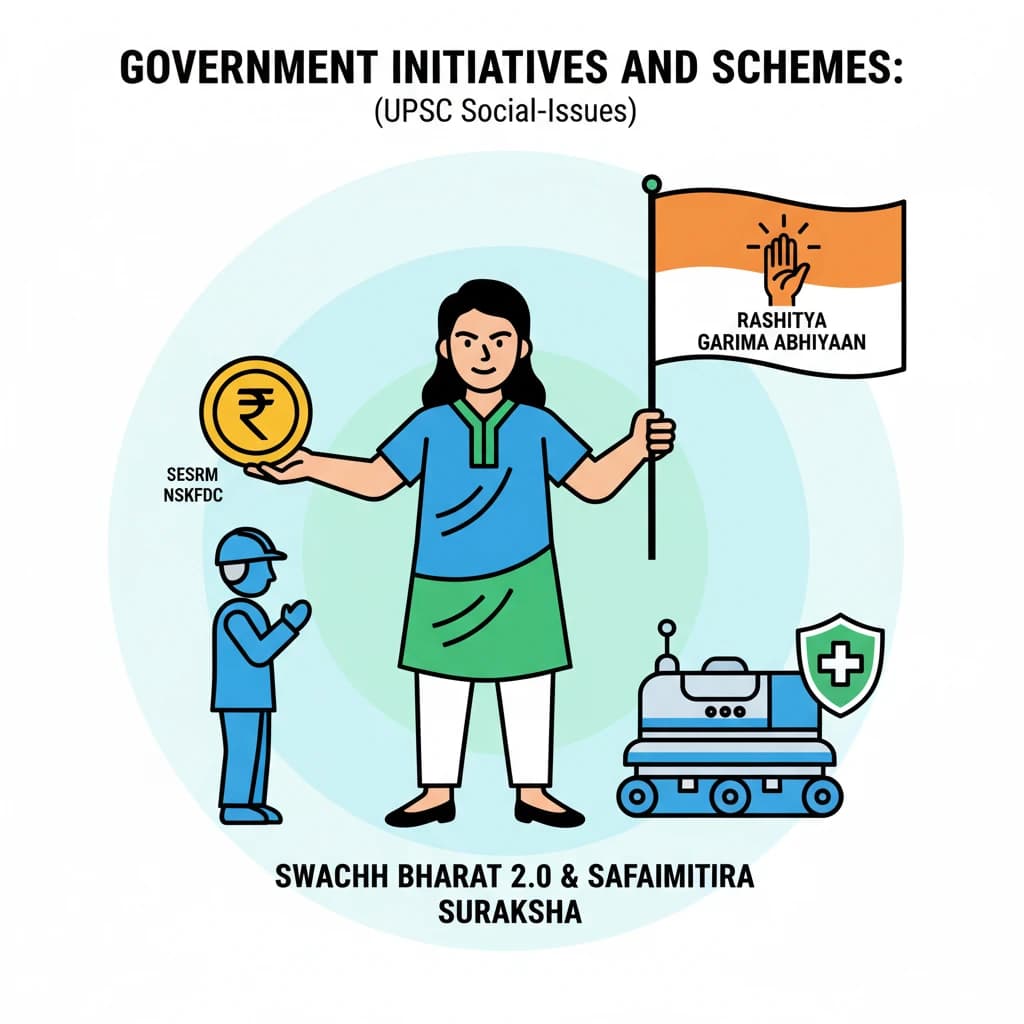
🧠 Memory Techniques
Memory Aid
95% Verified Content

Related Topics

Loading related topics...
Explore:Social Issues Topics·All Subjects·Daily Current Affairs·Editorial Analysis·Previous Year Questions·UPSC GPT
Government Initiatives for Manual Scavengers & Sanitation Workers - UPSC Social Issues