Loading page, please wait…
Vaidra Logo
Vaidra

Top 4 items + smart groups

UPSC GPT
New
Current Affairs
Daily Solutions
Daily Puzzle
Mains Evaluator

Version 2.0.0 • Built with ❤️ for UPSC aspirants

Loading...
Loading...
Loading...
Loading...
Loading...
Loading...
Loading...
Loading...
Loading...
Loading...
Loading...
Loading...
Loading...
Back
All Subjects

Topics

0 topics • 0 completed

Loading topics...
Loading...
Loading...
Loading...
Loading...
Loading...
Overall Progress0%

Nicobarese Tribe - UPSC Social Issues

What is Nicobarese Tribe in UPSC Social Issues?

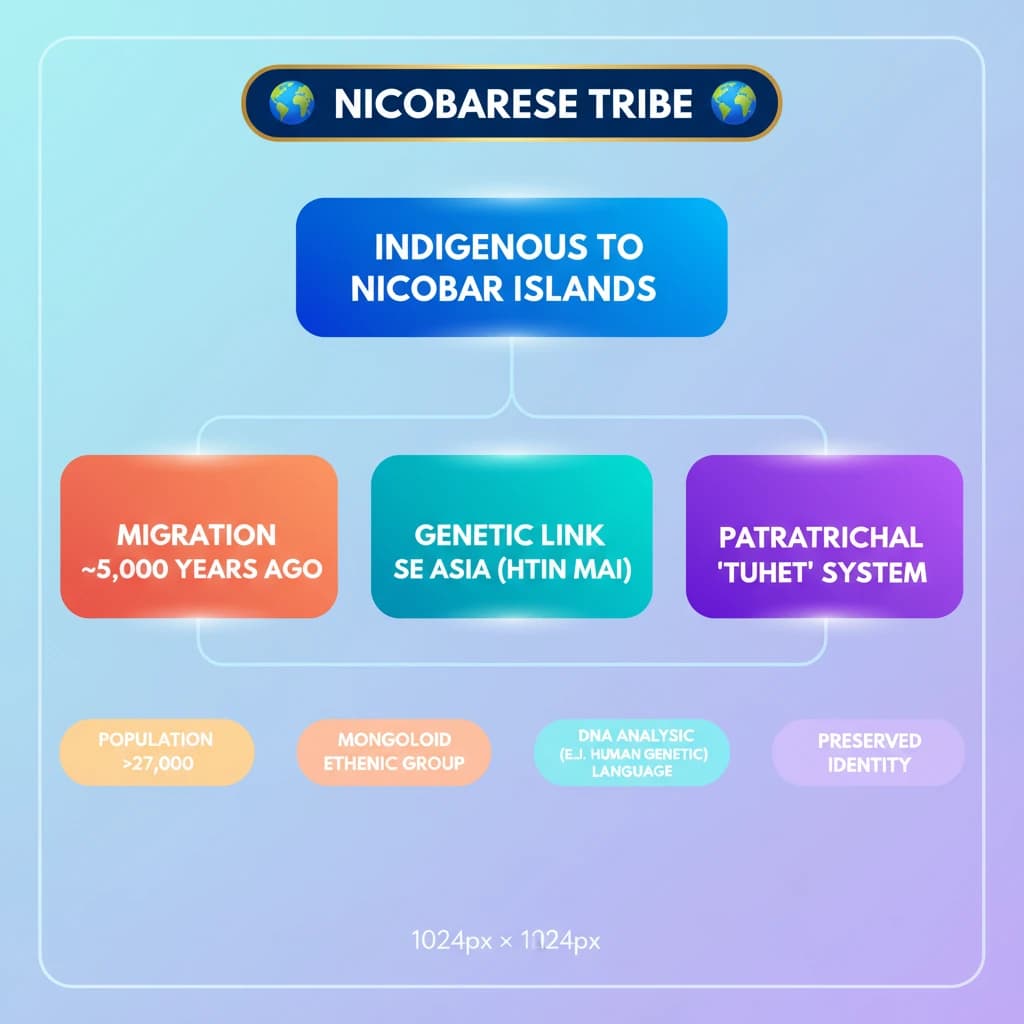
Nicobarese Tribe is a key topic under Social Issues for UPSC Civil Services Examination. Key points include: Nicobarese Tribe: Indigenous to Nicobar Islands, part of Mongoloid ethnic group, population over 27,000.. Recent study (European Journal of Human Genetics) revised their migration timeline from >11,000 years ago to ~5,000 years ago.. Genetic analysis (DNA) linked Nicobarese to Htin Mai community (Laos-Thailand), confirming Southeast Asian origin.. Understanding this topic is essential for both UPSC Prelims and Mains preparation.

Why is Nicobarese Tribe important for UPSC exam?

Nicobarese Tribe is a Medium-level topic in UPSC Social Issues. It is tested in both Prelims (factual MCQs) and Mains (analytical answer writing). Previous year UPSC questions have frequently covered aspects of Nicobarese Tribe, making it essential for comprehensive IAS preparation.

How to prepare Nicobarese Tribe for UPSC?

To prepare Nicobarese Tribe for UPSC: (1) Study the comprehensive notes covering all key concepts on Vaidra. (2) Practice previous year questions on this topic. (3) Connect it with current affairs using daily updates. (4) Revise using key takeaways and mind maps available for Social Issues. (5) Write practice answers linking Nicobarese Tribe to related GS Paper topics.

Key takeaways of Nicobarese Tribe for UPSC

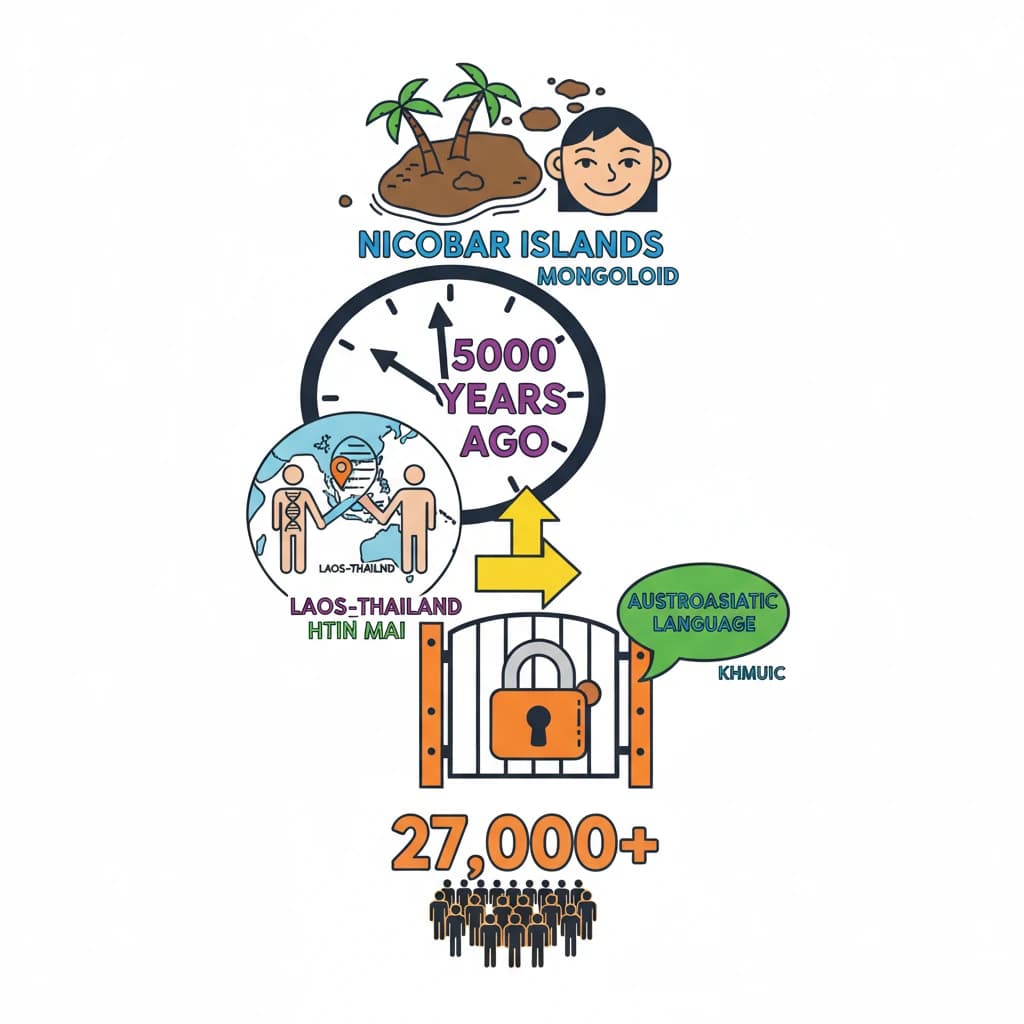
  • Nicobarese Tribe: Indigenous to Nicobar Islands, part of Mongoloid ethnic group, population over 27,000.
  • Recent study (European Journal of Human Genetics) revised their migration timeline from >11,000 years ago to ~5,000 years ago.
  • Genetic analysis (DNA) linked Nicobarese to Htin Mai community (Laos-Thailand), confirming Southeast Asian origin.
  • Geographical isolation helped preserve their distinct genetic and Austroasiatic linguistic identity (Khmuic branch).
  • Social structure is a patriarchal joint family system known as 'Tuhet'.
  • They are classified into six territorial groups across major islands like Car Nicobar, Great Nicobar (home to Shompen).
Nicobarese Tribe

Nicobarese Tribe

Medium⏱️ 6 min read✓ 95% Verified
social issues

📖 Introduction

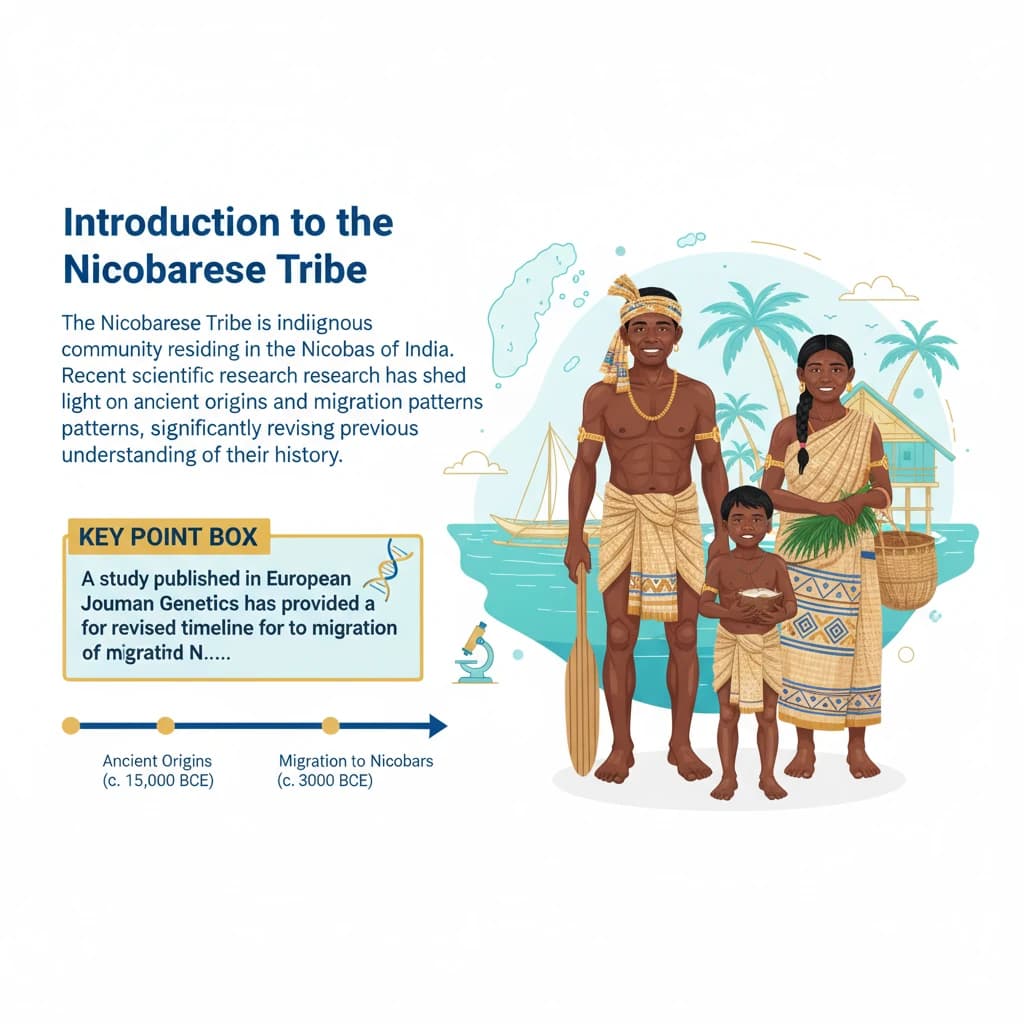
<h4>Introduction to the Nicobarese Tribe</h4><p>The <strong>Nicobarese Tribe</strong> is an indigenous community residing in the <strong>Nicobar Islands</strong> of India. Recent scientific research has shed new light on their ancient origins and migration patterns, significantly revising previous understandings of their history.</p><div class='key-point-box'><p>A study published in the <strong>European Journal of Human Genetics</strong> has provided a revised timeline for the migration of the Nicobarese to the islands, offering deeper insights into their genetic and linguistic heritage.</p></div><h4>Revised Migration Timeline</h4><p>Previous studies had estimated that the <strong>Austroasiatic</strong> ancestors of the Nicobarese arrived in the Nicobar Islands over <strong>11,000 years ago</strong>. This long-held belief has now been updated.</p><p>The new study, employing advanced <strong>deoxyribonucleic acid (DNA) analysis</strong>, has corrected this estimate. The revised timeline suggests their arrival was approximately <strong>5,000 years ago</strong>, a significant adjustment to their historical narrative.</p><h4>Genetic Link and Ancestral Ties</h4><p>The research established a clear <strong>genetic link</strong> for the Nicobarese. They share ancestral ties with the <strong>Htin Mai community</strong>, an ethnic group native to the <strong>Laos-Thailand region</strong>.</p><div class='info-box'><p>This finding strongly supports the hypothesis that the ancestors of the Nicobarese migrated from <strong>Southeast Asia</strong>, rather than the traditionally considered <strong>South Asia</strong>.</p></div><h4>Preservation of Genetic Identity</h4><p>Due to their significant <strong>geographical isolation</strong>, the Nicobarese have remarkably maintained their unique <strong>genetic identity</strong>. They have experienced minimal external influence over millennia.</p><p>This preservation has been crucial for researchers, enabling them to trace their ancestry with a high degree of precision and clarity.</p><h4>Linguistic Continuity</h4><p>Despite their deep genetic ties to Southeast Asia, the Nicobarese have also retained their original <strong>Austroasiatic language roots</strong>. Specifically, their language belongs to the <strong>Khmuic branch</strong>.</p><p>This linguistic continuity further reinforces their connection to other populations in <strong>Southeast Asia</strong>, highlighting a strong cultural and historical lineage.</p><h4>Geography of the Nicobarese Homeland</h4><p>The Nicobarese primarily inhabit the <strong>Nicobar Islands</strong>, which are situated in the <strong>Bay of Bengal</strong>. These islands form a crucial part of India’s <strong>Andaman and Nicobar Islands Union Territory</strong>.</p><div class='info-box'><p>The Nicobar Islands comprise <strong>19 islands</strong>. The major islands where the Nicobarese reside include <strong>Car Nicobar</strong>, <strong>Kamorta</strong>, <strong>Nancowrie</strong>, and <strong>Great Nicobar</strong>. These islands feature diverse terrains, encompassing both hilly and flat areas.</p></div><p><strong>Great Nicobar</strong> stands out as the southernmost and largest among the Nicobar Islands, playing a significant role in the tribe's habitat.</p><h4>Ethnic Classification and Population</h4><p>The Nicobarese belong to the <strong>Mongoloid ethnic group</strong>. Their population is substantial, numbering over <strong>27,000 individuals</strong>.</p><p>While they are not formally divided into distinct tribes, the Nicobarese are categorized into <strong>six territorial groups</strong> based on their island habitation:</p><ul><li><strong>Car Nicobar</strong></li><li><strong>Chowra</strong></li><li><strong>Teressa with Bompoka</strong></li><li><strong>Central Group</strong></li><li><strong>Southern Group</strong></li><li>The <strong>Shompen</strong> (an inland tribe primarily found on Great Nicobar)</li></ul><h4>Social Structure</h4><p>The social organization of the Nicobarese is characterized by a <strong>patriarchal joint family system</strong>. This traditional structure is known as <strong>Tuhet</strong>.</p>
Concept Diagram

💡 Key Takeaways

  • •Nicobarese Tribe: Indigenous to Nicobar Islands, part of Mongoloid ethnic group, population over 27,000.
  • •Recent study (European Journal of Human Genetics) revised their migration timeline from >11,000 years ago to ~5,000 years ago.
  • •Genetic analysis (DNA) linked Nicobarese to Htin Mai community (Laos-Thailand), confirming Southeast Asian origin.
  • •Geographical isolation helped preserve their distinct genetic and Austroasiatic linguistic identity (Khmuic branch).
  • •Social structure is a patriarchal joint family system known as 'Tuhet'.
  • •They are classified into six territorial groups across major islands like Car Nicobar, Great Nicobar (home to Shompen).

🧠 Memory Techniques
Memory Aid
95% Verified Content

📚 Reference Sources

•European Journal of Human Genetics (as cited in the summary)

Related Topics

Loading related topics...
Explore:Social Issues Topics·All Subjects·Daily Current Affairs·Editorial Analysis·Previous Year Questions·UPSC GPT
Nicobarese Tribe - UPSC Social Issues